armd wrote:
We have yet to see how the R1/R5II perform though as a general rule, the R5/R3 are very capable cameras with excellent AF capabilities.
True that trusted FM members have not yet been able to use the new cameras and provide reliable feedback. I've been following Jeff Cable's Olympics blog posts and so far he is very enthusiastic about the cameras. He has posted good photos (gymnastics) with the R1. So at the least, the cameras are functional and appear to be 'prime time' ready.
My feeling is that once the dust settles the differences between this round of Canon, Nikon and Sony AF capabilities will not be huge. As you suggested, some cameras may have slight advantages in specific areas but that it will really be the operator that will make the biggest difference, as it always has been.
rscheffler wrote:
True that trusted FM members have not yet been able to use the new cameras and provide reliable feedback. I've been following Jeff Cable's Olympics blog posts and so far he is very enthusiastic about the cameras. He has posted good photos (gymnastics) with the R1. So at the least, the cameras are functional and appear to be 'prime time' ready.
My feeling is that once the dust settles the differences between this round of Canon, Nikon and Sony AF capabilities will not be huge. As you suggested, some cameras may have slight advantages in specific areas but that it will really be the operator that will make the biggest difference, as it always has been....Show more →
Is this the same fellow who only got 45% keeper rate with his previous Canon camera?
armd wrote:
We have yet to see how the R1/R5II perform though as a general rule, the R5/R3 are very capable cameras with excellent AF capabilities.
rscheffler wrote:
True that trusted FM members have not yet been able to use the new cameras and provide reliable feedback. I've been following Jeff Cable's Olympics blog posts and so far he is very enthusiastic about the cameras. He has posted good photos (gymnastics) with the R1. So at the least, the cameras are functional and appear to be 'prime time' ready.
My feeling is that once the dust settles the differences between this round of Canon, Nikon and Sony AF capabilities will not be huge. As you suggested, some cameras may have slight advantages in specific areas but that it will really be the operator that will make the biggest difference, as it always has been. ...Show more → mogul wrote:
Is this the same fellow who only got 45% keeper rate with his previous Canon camera?
You're free to interpret it however you like and maintain a skeptical position, but he did not specify which previous camera or which previous Olympics. Gymnastics can be very challenging for AF systems - low light combined with sudden movement/velocity changes... if you've ever tried, you'll know how challenging it can be.
Roughly 1 out of every 2 photos is still decent odds when at a high frame rate, so it's not like 45% yields no usable options. I guess it depends on if you're a glass half full or half empty type of person.
mogul wrote:
Why are you defending 2 cameras with beta releases that aren't even available for sale or review?
The R1 may be the better camera, and I'm not interested in letting Sony fanboys come in and tear it apart over some spec. I'm not interested in hear8ng about the a9III, especially since we've heard DR, DR, DR for years, that camera doesn't have it, and the R1 is likely to be WAY WAY better, on DR just like the R3 and R5.
I can absolutely defend Canon cameras on the Canon board, why are you attacking cameras that are in beta, then telling me I can't defend them? Makes no sense, like many of the critiques of the R1
People get all mad over the 24mp but the a9III, Zf, Z6III are all 24mp, so I guess either those aren't any good, or you're full of it. You see the Northrup video , Canon's all bad because it's only 24mp, it's ridiculous.
ilkka_nissila wrote:
One important and very useful feature in the Z9/Z8/Zf/Z6 III is the custom wide-area AF area mode which allows one to customize the width and height of the AF box. Together with subject detection this allows one to select which part of the frame the subject's eyes are likely to be and this very useful as it gives just the needed amount of compositional freedom while the camera finds the intended subject's eyes and focuses on them.
The R3 has exactly this feature. You can alter the width and height of each of the 3 available region AF areas, and the camera remembers the size and shape. These 3 areas are available via the same selection mechanism that lets you choose between spot AF, expanded spot, entire frame etc.
The photographer just needs to learn the system to make the best use of it.
It took me months to become fluent in operating the R3’s AF. Part of that was how dreadful the manual is. For me, even if the lenses are more expensive, the time sunk into this is a big incentive to stay with Canon.
melcat wrote:
The R3 has exactly this feature. You can alter the width and height of each of the 3 available region AF areas, and the camera remembers the size and shape. These 3 areas are available via the same selection mechanism that lets you choose between spot AF, expanded spot, entire frame etc.
It took me months to become fluent in operating the R3’s AF. Part of that was how dreadful the manual is. For me, even if the lenses are more expensive, the time sunk into this is a big incentive to stay with Canon.
I own the R7 and R8 MK II and they also have resizable AF areas (probably other R series do as well).
AmbientMike wrote:
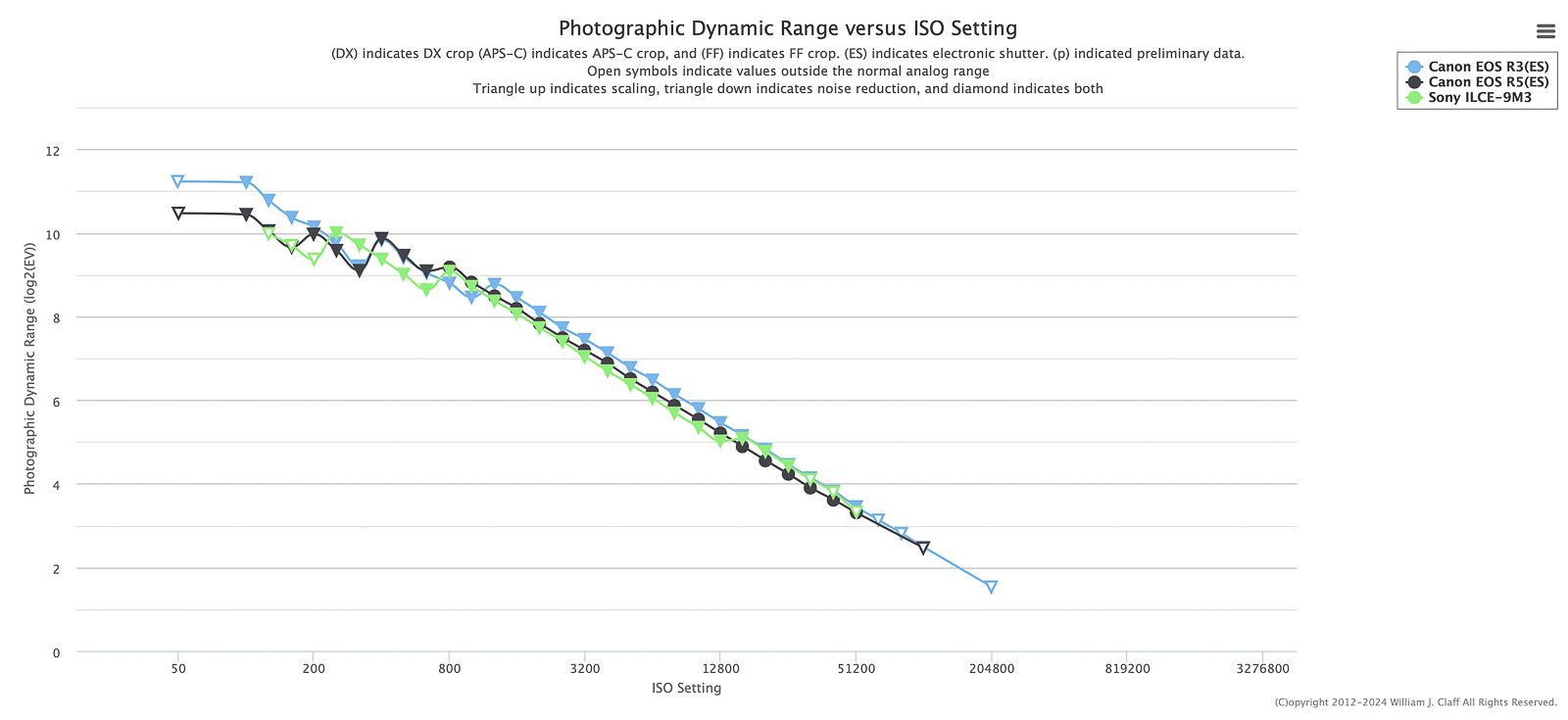
The Canon R3 and R5 actually beats the A9III by close to 2 stops. The Z6III is a little better but still gets trounced
Even the D750 is better than the Z6III by 1 stop. Did nikon "cheat" on the D750?
Sony has cameras that get closer but not better than R5 & R3 on DR
Will you ever give this up? How many times do I have to post the graphs from the same site you keep quoting from that totally disproves your ridiculous claim?
Where on earth are you seeing this close to 2 stop DR advantage for the R3/R5 over the A9III?
The biggest gaps I see are about 2/3 stop and that is just because they do their dual-gain jumps at different ISO values.
Cherry pick the data at ISO 320 and you could say the A9III bests the R5/R3 by 2/3 stop. Cherry pick the data at ISO 400-640 (before the A9III jumps but after the R5/R3 have jumped) and you can say the Canon's best the A9III by 1/2-2/3 stop.
But actually look at the data where most people will use these types of cameras (sports, wildlife, journalism) at ISO 800 and above and they are right on top of each other. The R3 does hold a small advantage throughout and if that 1/3-1/2 stop of DR is key to your shooting then pick the R3. The R5 is virtually identical to the A9III.
Personally, DR that varies under a stop from camera to camera means nothing to me. I rarely even look at these types of graphs anymore.
But please stop spreading total BS numbers claiming 2-stop advantages when it is far from the truth.
melcat wrote:
The R3 has exactly this feature. You can alter the width and height of each of the 3 available region AF areas, and the camera remembers the size and shape. These 3 areas are available via the same selection mechanism that lets you choose between spot AF, expanded spot, entire frame etc.
It took me months to become fluent in operating the R3’s AF. Part of that was how dreadful the manual is. For me, even if the lenses are more expensive, the time sunk into this is a big incentive to stay with Canon.
ooh, ooh, ooh, me too, me too....guess what guys, the A9III has this same feature also....so lets all go back to the drawing board and find some other useless specification we can try to one up the competition with. FFS.
arbitrage wrote:
Will you ever give this up? How many times do I have to post the graphs from the same site you keep quoting from that totally disproves your ridiculous claim?
Where on earth are you seeing this close to 2 stop DR advantage for the R3/R5 over the A9III?
The biggest gaps I see are about 2/3 stop and that is just because they do their dual-gain jumps at different ISO values.
Cherry pick the data at ISO 320 and you could say the A9III bests the R5/R3 by 2/3 stop. Cherry pick the data at ISO 400-640 (before the A9III jumps but after the R5/R3 have jumped) and you can say the Canon's best the A9III by 1/2-2/3 stop.
But actually look at the data where most people will use these types of cameras (sports, wildlife, journalism) at ISO 800 and above and they are right on top of each other. The R3 does hold a small advantage throughout and if that 1/3-1/2 stop of DR is key to your shooting then pick the R3. The R5 is virtually identical to the A9III.
Personally, DR that varies under a stop from camera to camera means nothing to me. I rarely even look at these types of graphs anymore.
But please stop spreading total BS numbers claiming 2-stop advantages when it is far from the truth....Show more →
Where do you get this crap from?
If you knew how to read I told you days ago that I got it off the Maximum DR in the table. If you'd like to make it hard you could look find the highest DR point on the graph. The DR in MS is, actually, close to 2 stops better, in ES, still well over a stop as the graph you posted points out (thanks for posting,) completely dusting the a9III
Duh, the 800+ is the same but that's true of DSLR'S DR and they got slammed for years over poor DR. THAT IS BASICALLY THE SAME DR VS A9III. Like I already pointed out, 5DsR DR virtually identical to the A9III
arbitrage wrote:
Will you ever give this up? How many times do I have to post the graphs from the same site you keep quoting from that totally disproves your ridiculous claim?
Where on earth are you seeing this close to 2 stop DR advantage for the R3/R5 over the A9III?
The biggest gaps I see are about 2/3 stop and that is just because they do their dual-gain jumps at different ISO values.
Cherry pick the data at ISO 320 and you could say the A9III bests the R5/R3 by 2/3 stop. Cherry pick the data at ISO 400-640 (before the A9III jumps but after the R5/R3 have jumped) and you can say the Canon's best the A9III by 1/2-2/3 stop.
But actually look at the data where most people will use these types of cameras (sports, wildlife, journalism) at ISO 800 and above and they are right on top of each other. The R3 does hold a small advantage throughout and if that 1/3-1/2 stop of DR is key to your shooting then pick the R3. The R5 is virtually identical to the A9III.
Personally, DR that varies under a stop from camera to camera means nothing to me. I rarely even look at these types of graphs anymore.
But please stop spreading total BS numbers claiming 2-stop advantages when it is far from the truth....Show more →
That's a quite interesting chart. It looks like both the A9III and R3 produce cooked raw (what a funny name!!). It's always cooked and never raw, just like USDA tells us.
The R5 is cooking raw up to ISO 800 and then it's fresh from the garden
I am a long time Canon user and bird photographer. Now shooting with R3 and RF600/f4. I’ve had two (and a half) occasions with big smile on my face. First one was changing from poor 50-500/f6.3 zoom to EF500/f4 Mk I and see how cropping is actually possible. Second big moment was first time seeing how the AF point in mirrorless R3 keeps in birds eye no matter how poorly I can follow it. Third minor smile was seeing how much faster RF600/f4 is compared to EF600/f4 Mk 2 with R3 when trying to find BIF in focus against pure sky. That’s like old days, with 1DX Mk 3 DSLR.
For me two things are most important: Low light and AF performance cause I like shooting BIFs, usually early mornings (waterfowl) or late evenings (owls e.g.) and during low light winter time here in Scandinavia. High mexapixels are not that important cause I am willing to use time, camouflage or such to get the bird big enough in the frame. So I am pretty excited to see how R1 will suit me (that has been preordered).
What Canon is missing for sure are teles like 600/f6.3 which would be fast enought for low light action and still quite affordable. For Dorian my only advice is that you only know what is important to you so familiarize yourself with all the brands and make desicion based on your needs.