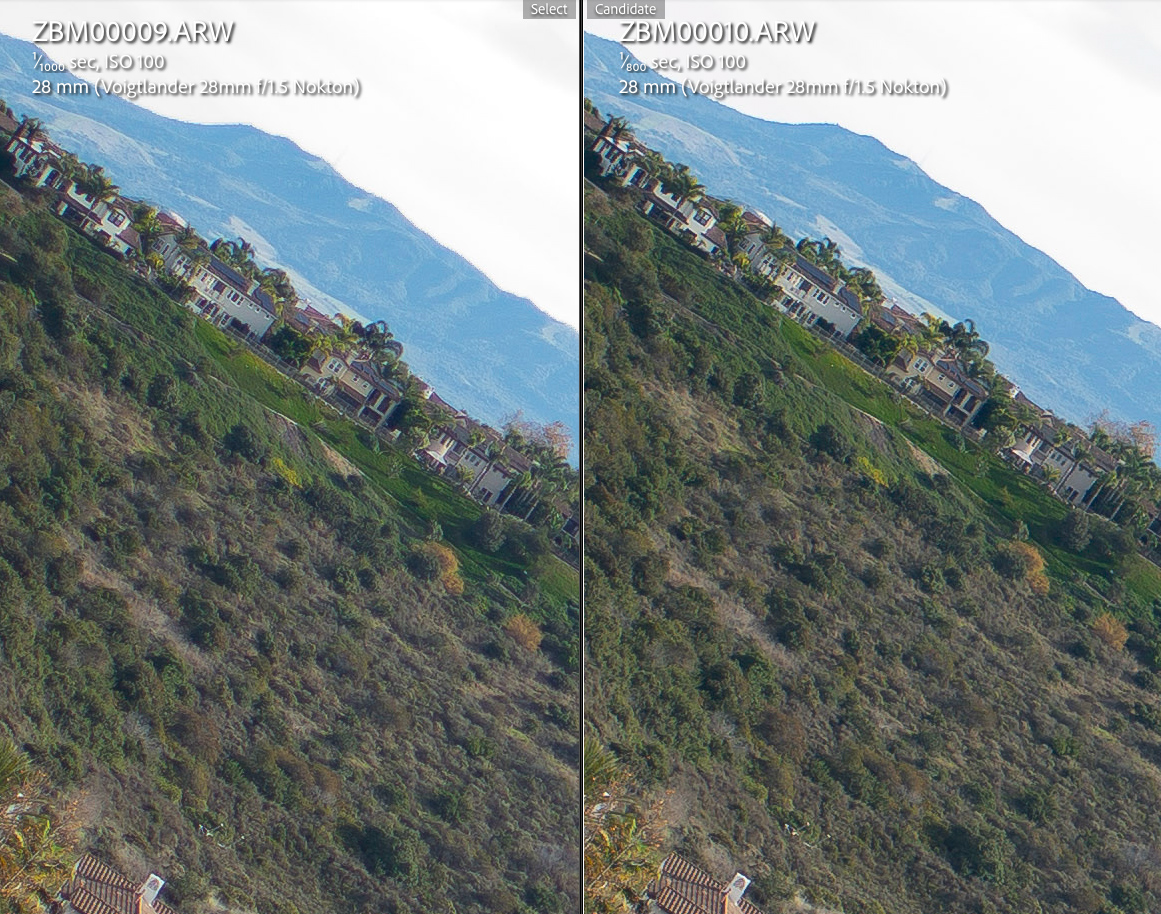
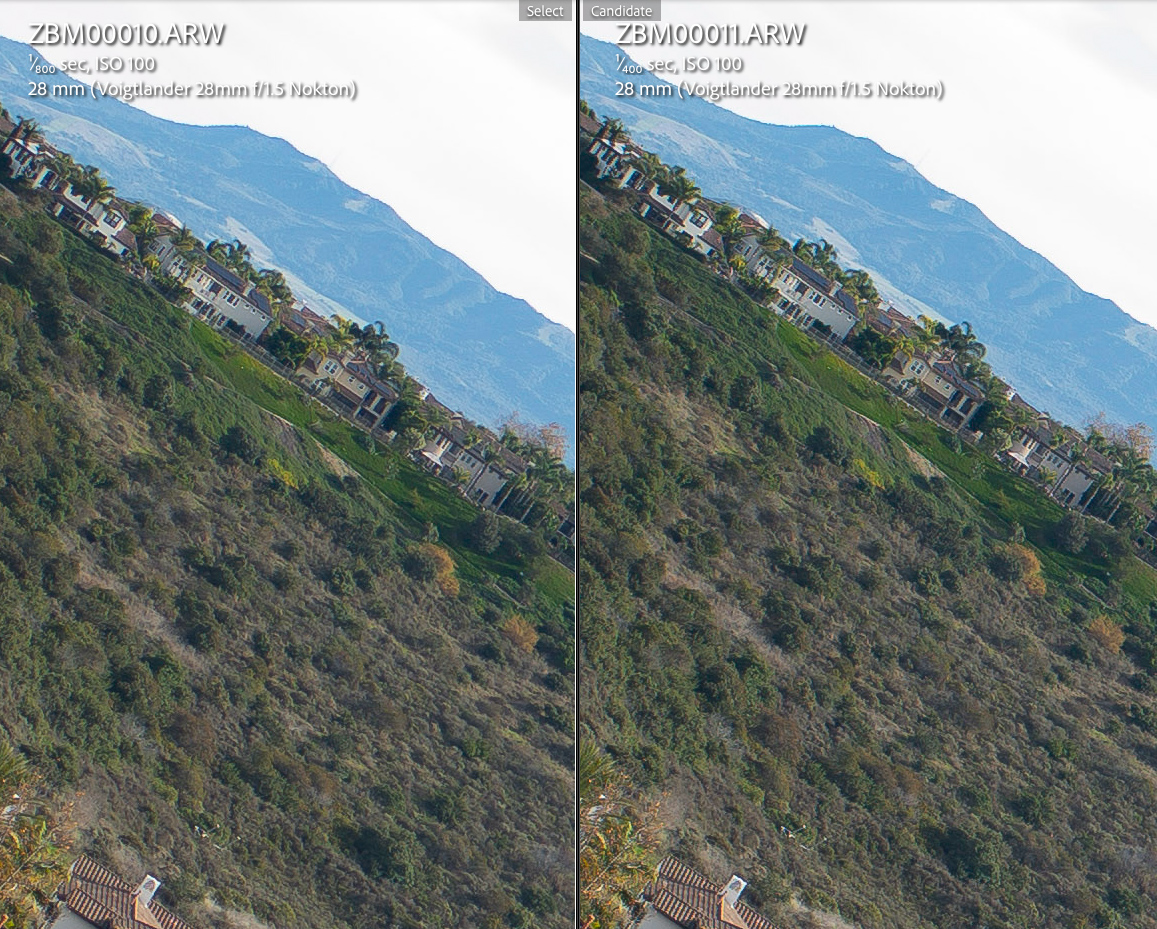
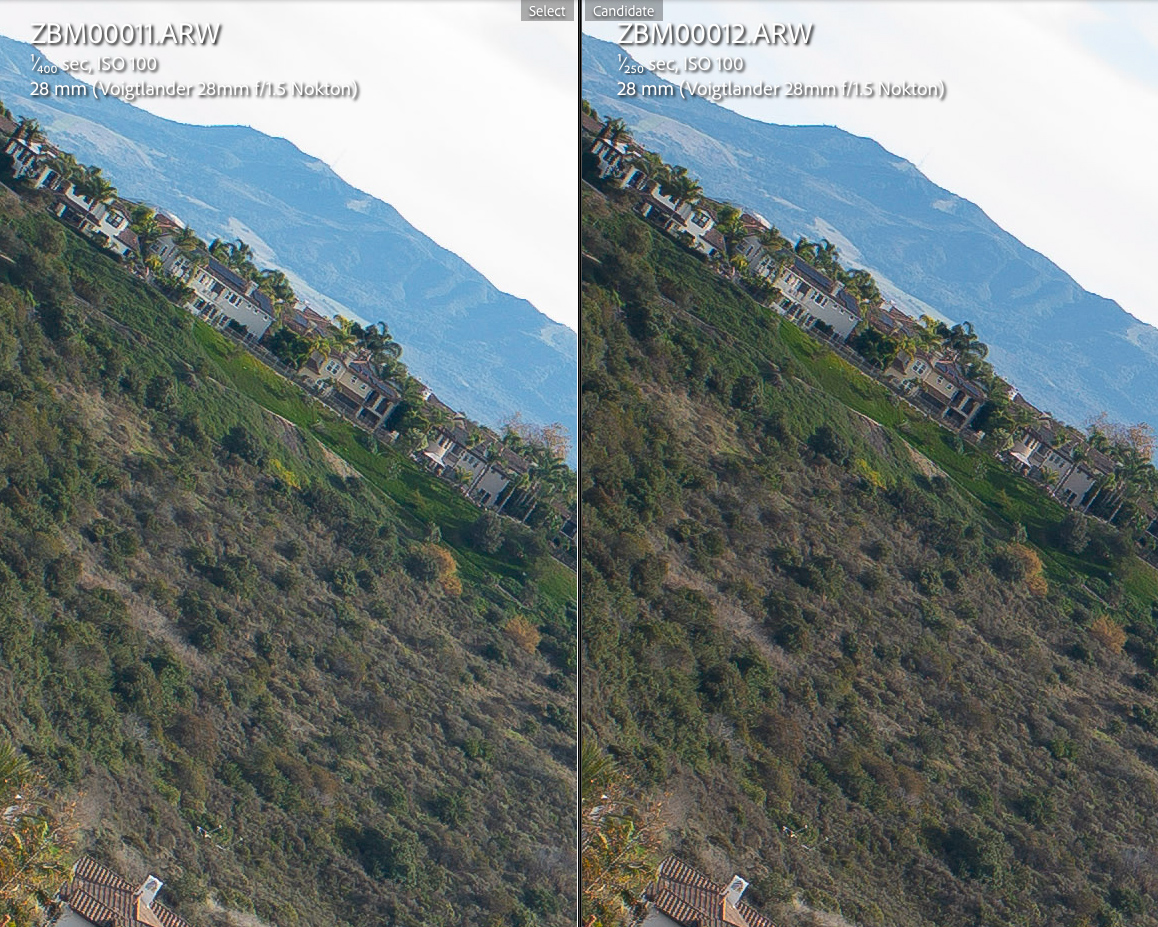
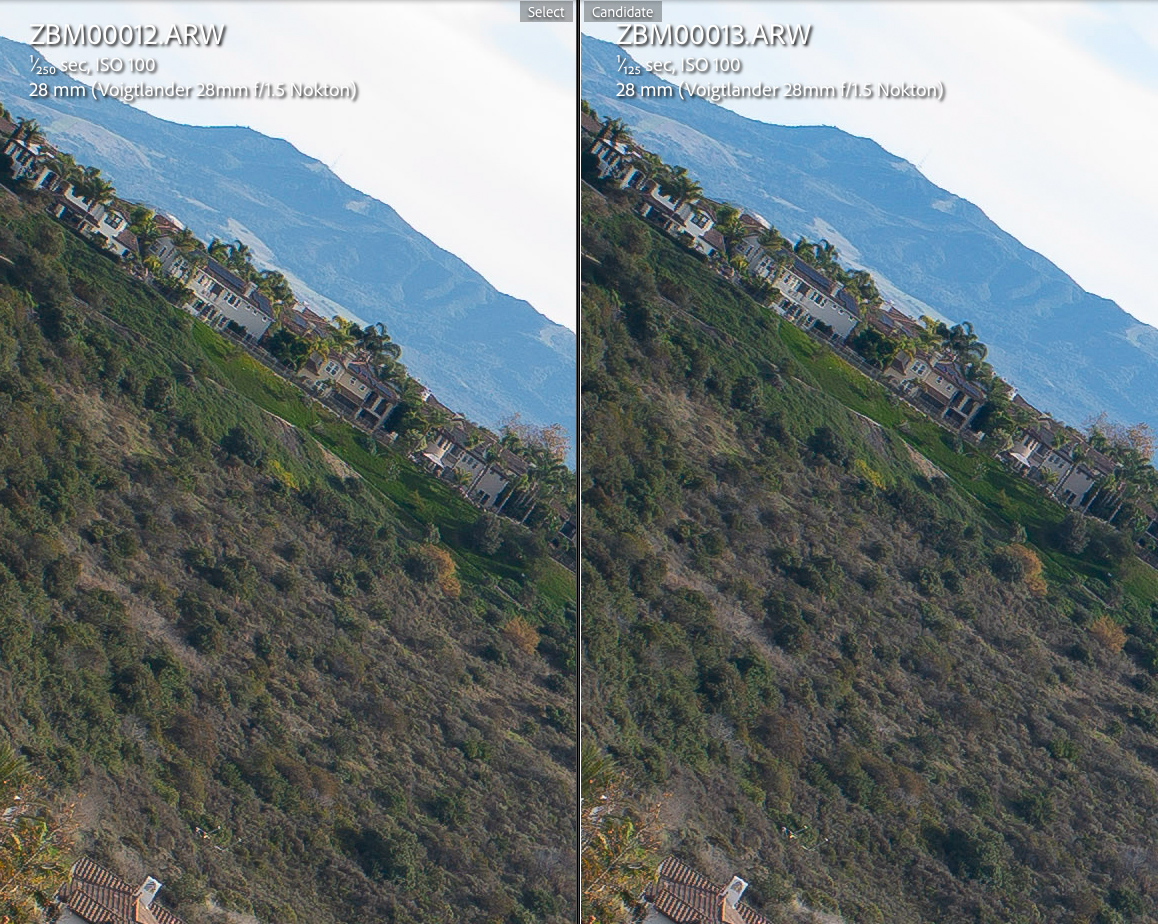
The Leica does well here, it must be said. It's often very close to near indistinguishable in many crops. Due to its within-bokeh depth cues and very fine colour handling, the CV is my choice. Leica's colour grading is often flat (p.2 #18), but it's very easy to see why this Summilux is popular.
The CV has excellent micro contrast and macro contrast matching (p.2 #8 for example) leading to better depth (sometimes you see the Zeiss legacy). Overall, you may get the impression CV designed this one with the Leica lens at hand. Interesting CA and colour shift in one of these two lenses in the flag crop at p.2 #14, and number plate crop at p.2. #16 - both at image height of ~5mm.
The curvature map, what a graphic! Oh, more please, you just don't see this yet it is so important. It helps shed light on bokeh effects. I wonder how the Leica lens's FC looks? (Leica may win the skin contest, should you have time for a modeling comparo.)
Fred Miranda wrote:
In my view, the Type II black paint looks equally glossy compared to my M10-R BP and MP bodies. It seems like Cosina made sure the lens matches these cameras. Haha!
That's really great. I'm still up in the air about type II silver or black paint.
thrice wrote:
Great review, it astounds me how similar they are with such different optical designs (and price points). That Voigtlander managed to do it for so much cheaper, without a floating element design and in a smaller housing is so very impressive.
I love my 35/1.5 Nokton but I fear this will have to replace it. I don't like running more than 3 lenses on my M kit.
+1 for Fred's ... ALWAYS GREAT review(s).
The one thing (and another) that comes to mind is that Leica brought the Lux to market nearly a decade sooner. Also, that gave Voigtlander, a model and target to chase after. Even, if they didn't follow the same approach, it gave them something to study ... and then, put their spin toward how to go about it.
But, that said ... it looks pretty good. The one thing I'm waiting to see, is how it compares to the Summilux 1.7 on the Q2 / Q3. I've been thinking about moving the Q2 > 28 Cron or 24 Elmarit, but the Nokton is certainly in the mix as a serious contender.
It kinda strikes me that the Ultron renders more like a Cron, and the Nokton more like a Lux. Hmmm, what a coincidence.
But, in both cases ... it took quite a while for Voigtlander to "catch up" to what Leica had done, much sooner.
Fast, good and cheap ... pick two. Good and cheap, but, we had to wait quite a while. Wouldn't surprise me if this one "sells out".
wow, what a review, and a confirmation of what I was sensing. For all intents and purposes, this lens would produce real world images indistinguishable from the 28 lux, which was my absolute favorite on the M system. Now with the 35 and 50 apo lanthars, this 28 nokton, and the amazing 28 ultron, plus arguably the 50 mm f/1.0 Nokton, we have lenses that perform at or insanely near to their Leica counterparts at 1/4-1/8 of the price, plus so many more options to dive into (f/1.2 Noktons) that offer remarkable character in a unique aperture space.
I could go on and on, but Fred, I wanted to commend you on what is likely to be the definitive review on one of Voigtlander's definitive lenses in its lineup.
highdesertmesa wrote:
Great review and comparisons, Fred. Can you do a worst-case scenario purple fringing comparison? I know they'll both have it, but I wonder if the CV will be a little better.
I would also like to see this as the Lux can have very strong wide aperture purple fringing in certain situations, like someone/something photographed against a bright/white background.
I would also like to see a viewfinder blockage comparison. I think we all know the Lux will block more, but it would still be informative to see how the VM compares.
In respect to rendering, it is surprising how similar they are. But there are some instances where the Lux has less bokeh ball outlining, though not dramatically less. As Steve suggested, the somewhat lower flare resistance of the VM is a bit more concerning but unless you already have the Lux, IMO it would be very difficult to justify it over the VM just for this reason.
I'm seeing a little more pop and saturation on the lux particularly on closer range samples, not sure if it's due to the slightly more veiling flare on certain samples from the voigtlander. I believe in real world usage one cannot tell the difference. Looks like we have a winner!
I see slightly better bokeh on the Summilux vs incredibly better size and price for the CV for a very similar performance. Even admiring and using different Leica lenses, it is impossible not to ask yourself if the price difference is really worth it and, above all, what you could do with the money you save.
jeffersoncasey wrote:
I'm seeing a little more pop and saturation on the lux particularly on closer range samples, not sure if it's due to the slightly more veiling flare on certain samples from the voigtlander. I believe in real world usage one cannot tell the difference. Looks like we have a winner!
I agree with this- The Lux 100% looks more saturated and has more contrast on wide open shots - It’s really the only place I see the Lux having a leg up on the Voigt. Everything else really looks neck and neck.
Jan 26, 2024 at 08:00 AM
Steve Spencer Offline • • • • • • • Upload & Sell: On
RustyRus wrote:
I agree with this- The Lux 100% looks more saturated and has more contrast on wide open shots - It’s really the only place I see the Lux having a leg up on the Voigt. Everything else really looks neck and neck.
I think we are seeing the effect of the floating element in the Lux at close range with just a bit more contrast as it probably has less spherical aberrations at these close distances (that's what the FLE is supposed to do). The Lux does seem to be more resistant to veiling flare and seems to have less lateral chromatic aberrations (but these can probably be fixed in post).
In contrast to my eye the Nokton has slightly better infinity resolution especially in the mid-zone and corners. It might have just a bit less (although this is close) axial CA and its field curvature pattern is for my uses close to ideal. Oh, it is smaller and costs way less.
That said thinking about costs it should be noted that total cost of ownership of Leica M lenses is tricky. If you buy Leica lenses used and are patient and don't over pay, you often can use them for years and sell them for very close to what you paid for them. Buying Voigtlander lenses new and selling them used in contrast will cost you a couple hundred dollars. I just recently sold my 28 Ultron Asph II that I bought for $800 new and the cost of a couple of years ownership was almost $250. That isn't bad, but I am not at all sure it would have been higher if I would have bought a Leica 28 Summicron Asph and resold it. Certainly buying Leica lenses new is going to cost you a lot, but buying them used I am less sure is such a bad deal.
Steve Spencer wrote:
I think we are seeing the effect of the floating element in the Lux at close range with just a bit more contrast as it probably has less spherical aberrations at these close distances (that's what the FLE is supposed to do). The Lux does seem to be more resistant to veiling flare and seems to have less lateral chromatic aberrations (but these can probably be fixed in post).
In contrast to my eye the Nokton has slightly better infinity resolution especially in the mid-zone and corners. It might have just a bit less (although this is close) axial CA and its field curvature pattern is for my uses close to ideal. Oh, it is smaller and costs way less.
That said thinking about costs it should be noted that total cost of ownership of Leica M lenses is tricky. If you buy Leica lenses used and are patient and don't over pay, you often can use them for years and sell them for very close to what you paid for them. Buying Voigtlander lenses new and selling them used in contrast will cost you a couple hundred dollars. I just recently sold my 28 Ultron Asph II that I bought for $800 new and the cost of a couple of years ownership was almost $250. That isn't bad, but I am not at all sure it would have been higher if I would have bought a Leica 28 Summicron Asph and resold it. Certainly buying Leica lenses new is going to cost you a lot, but buying them used I am less sure is such a bad deal....Show more →
In Spain that sequence is not possible. If you buy Leica, you have to assume that the second hand market will give you way less money than if, for instance, you live in USA or Germany. Therefore, buying Leica means a long term commitment, which is true in any case. Relative to Voigtlander, the economic impact is minor: you buy relatively cheap and sell at around 50% of the original price.
RustyRus wrote:
I agree with this- The Lux 100% looks more saturated and has more contrast on wide open shots - It’s really the only place I see the Lux having a leg up on the Voigt. Everything else really looks neck and neck.
Ah, but therein lies the rub. $1K vs $5.5K (used), but only one has what I consider the magic for which I use M lenses in the first place. It’s impressive that CV’s 1.5 lens line can come as close as it does to both the 28 and 35 Lux (and in some ways surpass them), but CV really needs to make FLE 28 1.4 and 35 1.4 lenses that have the rendering of their 21 1.4, provided they can do that without the lenses being overly large.
Still, I think I really like what I’m seeing from this 28 1.5. But I like it as a way to ditch a 35 lens and just shoot 28. Something about this lens makes me think of a 35 lens with a 28 FOV. I don’t know that this makes any sense but…
Any of those very slight differences that some people are seeing in saturation and contrast? That can be ‘fixed’ in post in about 2 seconds.
Try to forget the $6500 price difference for a moment…. The fact that the CV lens matches up like this AND is significantly smaller is remarkable. I will always prefer a smaller lens over a larger lens on an M.
Based on Fred’s rendering tests I have a black paint version arriving today. Will quickly compare to my Leica 28 1.4 & 28 2.8. If it’s as close to the lux as his results show, looks like it’ll be a winner.
lifeandmylens wrote:
Based on Fred’s rendering tests I have a black paint version arriving today. Will quickly compare to my Leica 28 1.4 & 28 2.8. If it’s as close to the lux as his results show, looks like it’ll be a winner.
Let us know how the BP feels on camera! Too heavy? Perfectly balanced? etc. I need to knows before I buys!
Desmolicious wrote:
Let us know how the BP feels on camera! Too heavy? Perfectly balanced? etc. I need to knows before I buys!
I believe that balance is determined by how the weight of the camera and lens is distributed. At 325 grams (measured), The Voigtlander 28mm f/1.5 Nokton Type II definitely not too heavy. To check for balance, I hold the camera by its strap and examine the lens angle. If the lens is parallel to the floor, it's well-balanced.
For instance, on my M10-R BP (brass top), the lens remains parallel to the floor, showing excellent balance. In contrast, on the lighter Type I, the front of the lens tilts up at an angle, indicating that it's not as balanced as the Type II on this body. Maybe the Type I will achieve better balance on a lighter Leica M.
Desmolicious wrote:
Any of those very slight differences that some people are seeing in saturation and contrast? That can be ‘fixed’ in post in about 2 seconds.
Try to forget the $6500 price difference for a moment…. The fact that the CV lens matches up like this AND is significantly smaller is remarkable. I will always prefer a smaller lens over a larger lens on an M.
For distance shots and stopped down shooting, I think the CV is actually the better lens here. For close up wide open shooting, it’s not so easy to just dial in the look of the Lux. And it’s those close up wide open shots that I buy a wide aperture 28 for in the first place (mostly). Perhaps this is one of those situations where one wouldn’t sell the Lux to buy the CV, but it might make more sense for someone with neither to choose the CV over the Lux.
Infinity Resolution and Contrast on Sony A7R II (42MP)
The Voigtlander 28mm f/1.5 Nokton is designed for the slim Leica M sensor, making its performance less optimal on sensors of other mirrorless bodies. However, many photographers successfully adapt M lenses to their mirrorless cameras. In this test, I adapted the CV 28/1.5 to the Sony A7R II, a camera known for its thicker sensor stack compared to Leica. Surprisingly, the results are better than with other Nokton lenses. The mid-field significantly improves from f/2.8 onwards, but the corners require at least f/5.6 for the depth of field to overcome the induced field curvature. Here are the results.
For this test, no corrections for vignetting or chromatic aberration were applied, allowing us to analyze its performance without post-processing.
Distance: Infinity
Focus: Center - Best of three @ 12.4x magnification