tschopp
Offline
• • •
Upload & Sell: On
|
 p.3 #8 · Tripod primary leg angle - Is 23 deg. the new trend? p.3 #8 · Tripod primary leg angle - Is 23 deg. the new trend? | |
Bobarino wrote:
You raise many points,,, valid points,, ,,, and that's a good thing. Trying to address all those points is frustrating for me, because there are so many directions of thought to be addressed, and finding the time to respond is not always easy. I could probably write a book with all the thoughts that are going through my head as I read this post.
As you've experienced with that "heavy Manfrotto",,, there's not always a "magic bullet" available. Details,,,details,,,details. Problems have to be specifically identified before they can be effectively addressed,, and hopefully, resolved. That heavy tripod may simply have issues with the feet "skating" on a dusty floor ,,, or one or more of the leg bushings at the top of a leg may be worn,, and loose. Maybe the leg shims are defective or worn ,,, or maybe one or more of the feet are sinking in the sand or mud,, perhaps a slipping leg-lock,,, or maybe it's just the wrong tripod for the job..With the proliferation these days, of so many high-resolution cameras,and lenses,,, careful consideration has to be given in order to extract maximum performance from our gear, and yet, the vast majority of us will gravitate to that single-solution magic bullet,, the perfect do-it-all support system, and like a unicorn,,, it may simply not exist. I have roughly nine tripods, and most excel at one or two points,,, but they also have trade-offs to deal with.
I'll leave it at that for the moment since it's wayyyyy past my bed-time and I'm rambling,, but I'll try to share a few more thoughts fomorrow.
...Show more →
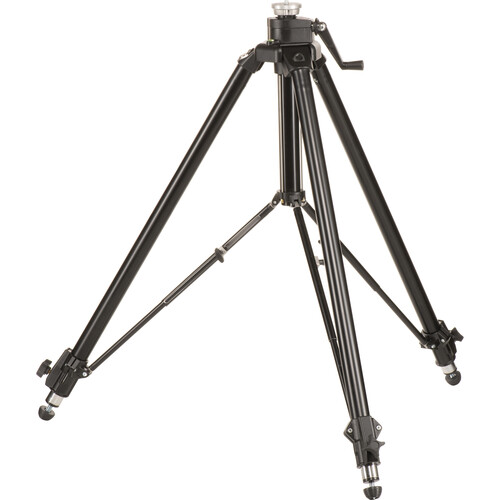
One of the takeaways I got from reading the material in the center column was to use a holistic systems engineering approach to tripod evaluation. I'd say the legs on the Manfroto were solid but things fell apart above that. I mostly used it on rough concrete. Spikes worked better than the rubber feet, but both were good. When you locked the clamps on the diagonals that ran from the legs to the center column it was just solid. I think the aluminum was prone to vibration at times that carbon fiber would resist better, but that was the only minor complaint for the legs. It had a geared center column, when locked down it was reasonable, but I think some rigidity was lost here. The head screws on the tripod and I think some rigidity is lost here as well. My Leofoto has a head that screws on, but it also has three set screws that lock it in. These transfer the force from the center screw to the three screws that provide a significant lever angle advantage (better than 1" lever vs 1/4"). I know the whole head mounting surface will provide some transfer of force, but much will be at the actual mechanical connection. We used a geared head on the manfroto and it never locks down as tight as I think it should. The biggest problem was the quick release plate, this always has some slop. Then the quick release plate mount to the camera is again mainly a single screw into the body. I picket up an L bracket for use with my camera and it engages the camera not just at the screw, but a ridge along the front of the body provides the needed lever arm support. The Arca mounts are really solid and a huge step up from what the manfroto has. For tele lenses it was critical to mount on the lens instead of the camera to reduce the moment of inertia, but even when mounted on the center of mass the tele lens system still has a large moment of inertial. I haven't tried this, but seen pictures, in this case another mount that extends also to the camera seems helpful, again it would provide a much needed improvement to the lever arm distance.
I suspect my Leofoto will outperform the manfroto in heavy wind, I haven't tried it yet. But I want to fix up the leg angle before I try that.
I have seen videos of tripods being used in decent wind providing better results than I would expect. I think the key is not having any weak links in the chain from the ground to the lens. Or at least trying to make all the tradeoffs similar so they are not dominated by one weak point.
|




 ...
... We had no internet to gain advice and no phone service. Kodachrome 64 and Fujichrome 100 were popular. Dead participants were stored in the deep freeze until the end of the trip. Weather was mentioned on the ship, but it was very basic. Fur seals like on SG were not out of control yet.
 at this thread.