This topic is in the 2022 archive. You can read it and like its posts here. It is read only.
Archive 2022Learning Leica "M", a 30 day project
p.4 #1Learning Leica "M", a 30 day project
naturephoto1 wrote:
Hi Steve,
I think that you meant CV 28mm f2 Ultron, not Nokton.
You are making some real strides. But, I never used an M Leica myself, only R cameras for a long time. My experience was with the Mamiya 7II as my RF cameras.
Rich
Thanks for the supportive words Rich. Leaning the Range Finder is a challenge. So encouragement helps. You should try one some time. You will find it interesting and enjoyable I think.
Steve
Feb 21, 2022 at 11:24 PM
p.4 #2Learning Leica "M", a 30 day project
ShadowDoc wrote:
1bwana1 wrote
ShadowDoc wrote
That's a nice portrait, though it is hard to tell (often is w/ the compression on here) whether or not the focus is truly nailed. At a glance it looks slightly out of focus, but I'll take your word for it that the eyes are sharp in full res.At any rate, exactly the sort of photo the M system inspires one to take IME.
Do you see a place where focus is sharpest? If I missed in a certain direction I would like to learn so I can improve.
I stopped down to f/2 because at f1.5 the lens is a bit too soft for me. But from what I have see this lens doesn't reach top sharpness untill about f4. But I don't mind that so much for portraits. Especially for women.
Thanks,
Steve
I don't have a Flickr account, but I will take a look on my big monitor in the morning and get back to you on this.
Steve
Feb 21, 2022 at 11:29 PM
p.4 #3Learning Leica "M", a 30 day project
rscheffler wrote:
If you see image EXIF here on the forum showing a non-Leica lens on a Leica M camera, the photographer manually edited/corrected the EXIF. I don't recall the program that is used, but I believe Fred posted about it recently.
There are many programs, but I think the easiest is a plug in via Lightroom called Lens Tagger: https://www.lenstagger.com
Steve - great information here, and great progress!
Feb 22, 2022 at 05:43 AM
p.4 #4Learning Leica "M", a 30 day project
Day 5 Image:
Kind of wore out today. Tonight is my evening lecture for my Gemology students. Just finished and a whole day of other work as well. The thermostat on my car failed today, so I was stuck, and had to get to the mechanic to be fixed. I lost a lot of time, but somehow managed to get it all done. Luckily, tonight's post is short, and is about learning the camera, and some of the idiosyncrasies of the Range Finder system.
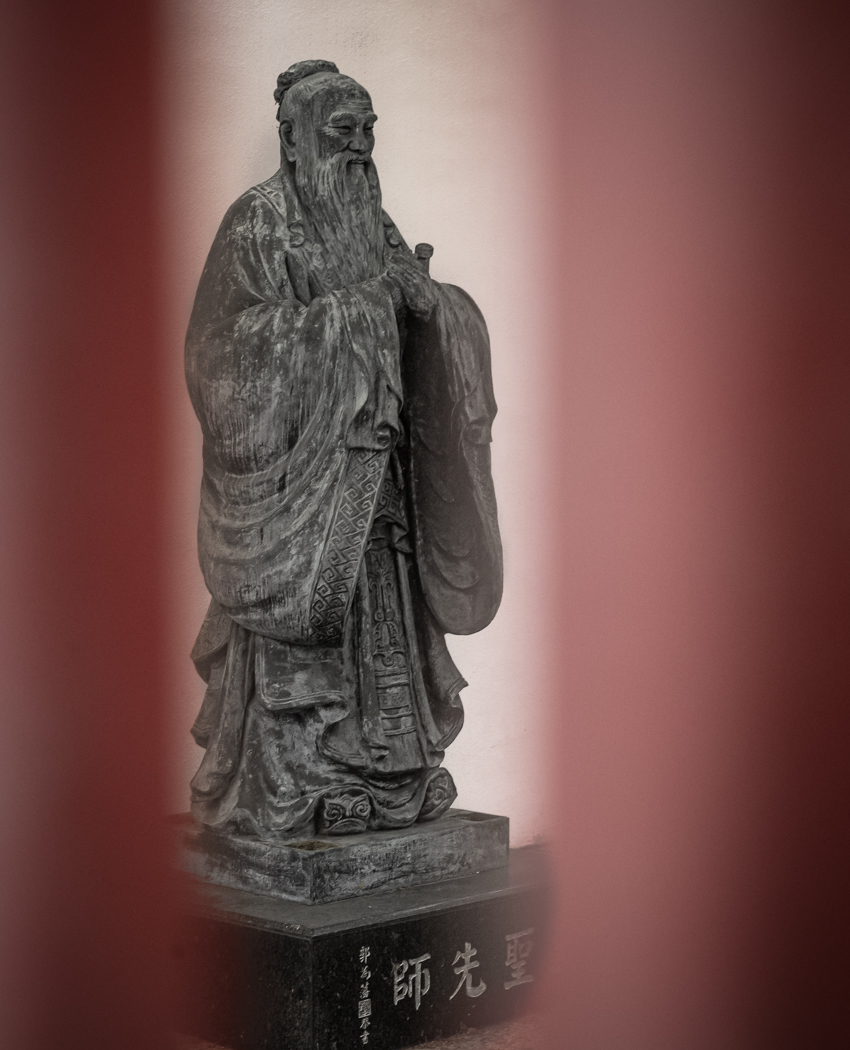
Today's image is about learning something the hard way. There is a small Chinese Museum downtown San Diego. I have never seen it open. On one side you can see a beautiful Chinese garden patio through a coral colored iron gate. The is an amazing statue of what I think may be Confucius in this garden. I decided to use the M10-P to make an image of the statue through the gate. I used the 50mm CV lens, and the Range Finder through the gaps between the bars to shoot through. No problem getting focus. But after the shot all I had was a coral pink image when I reviewed on the rear screen. I did this no less than 5 times. Then it hit me. I am not looking through the lens. The Range Finder is off set from the lens. So while I had a clear view, the lens itself was blocked by the metal bars in the gate. I tried to focus and recompose by estimating the offset. But the image was always not framed right. I was getting frustrated. Then it occurred to to not fight the camera. Leica has given us the tools needed for such a situation. I could shoot this image using "Live View" on the rear screen. Easy to compose and focus this way. A couple of shots, and I had my image.
Once again, Leica has provided a simple, easy, and elegant way to solve my problem. I just need to pay attention.
Here is the finished image. Nothing special but it does show a situation where the offset and parallax of a Range Finder system comes into play. Note that this statue is actually bigger than live size. My guess is about 8 feet tall. It is also about 20 feet away from the gate up against a white wall. The image kind of has a miniature feeling to me.
Enjoy!
Steve
Kind of wore out today. Tonight is my evening lecture for my Gemology students. Just finished and a whole day of other work as well. The thermostat on my car failed today, so I was stuck, and had to get to the mechanic to be fixed. I lost a lot of time, but somehow managed to get it all done. Luckily, tonight's post is short, and is about learning the camera, and some of the idiosyncrasies of the Range Finder system.
Today's image is about learning something the hard way. There is a small Chinese Museum downtown San Diego. I have never seen it open. On one side you can see a beautiful Chinese garden patio through a coral colored iron gate. The is an amazing statue of what I think may be Confucius in this garden. I decided to use the M10-P to make an image of the statue through the gate. I used the 50mm CV lens, and the Range Finder through the gaps between the bars to shoot through. No problem getting focus. But after the shot all I had was a coral pink image when I reviewed on the rear screen. I did this no less than 5 times. Then it hit me. I am not looking through the lens. The Range Finder is off set from the lens. So while I had a clear view, the lens itself was blocked by the metal bars in the gate. I tried to focus and recompose by estimating the offset. But the image was always not framed right. I was getting frustrated. Then it occurred to to not fight the camera. Leica has given us the tools needed for such a situation. I could shoot this image using "Live View" on the rear screen. Easy to compose and focus this way. A couple of shots, and I had my image.
Once again, Leica has provided a simple, easy, and elegant way to solve my problem. I just need to pay attention.
Here is the finished image. Nothing special but it does show a situation where the offset and parallax of a Range Finder system comes into play. Note that this statue is actually bigger than live size. My guess is about 8 feet tall. It is also about 20 feet away from the gate up against a white wall. The image kind of has a miniature feeling to me.
Enjoy!
Steve
Feb 22, 2022 at 11:18 PM
p.4 #5Learning Leica "M", a 30 day project
airfrogusmc wrote:
Interesting to compare shooting a weapon with taking photographs with a Leica. Bresson made a comparison decades ago. I agree that the techniques that go into firing a weapon can also help with steading a camera. Things like when Kent compared the shutter with the trigger. Also the way you hold the camera. I would also say breathing and controlling that can also help. We learned to breathe and squeeze. Breath out, relax and at the bottom of that breath squeeze the trigger. Never jerk it.
Guess who wrote this?
The funniest thing about the LEICA M7 is how oddly familiar it feels.
It took a while for it to dawn on me, and then I realized it's because holding a LEICA M7 feels just like holding a gun.
By comparison, current cameras (Nikon, Canon, Sony, etc.) feel just like cell phones or video games.
The LEICA feels as simple, mechanical, solid, precise and directly to-the-point as a handgun. It even has the same black-metal finish, not paint, enamel or epoxy like other cameras.
Just like SIG-Sauer, the LEICA is made in Germany. A LEICA M7 is about as dense as a gun
Same applies to digital Ms
Feb 23, 2022 at 01:18 AM

p.4 #6Learning Leica "M", a 30 day project
Sounds like something Henri Cartier- Bresson would say.
Feb 23, 2022 at 07:26 AM
p.4 #7Learning Leica "M", a 30 day project
airfrogusmc wrote:
Sounds like something Henri Cartier- Bresson would say.
Ken Rockwell...

(Ducks for cover).
I agree with Sir Ken... When you pick up and use an M they just have that feeling of purpose and build.
It takes a while to get used to it, and frankly feels shockingly basic compared to the latest 20fps AF everything.
And yet, and yet it's the system that I enjoy the most and because of that, use the most.
Film Ms actually take this to the nth degree. Flicking the on/off switch on the M7. Snapping the film advance lever like working the bolt action on a rifle...
I had the Zeiss Ikon ZM, and it is nothing like an M. Much cheaper lighter build. Delicate feeling film advance. Film transport mechanism failed on mine (cheap plastic gears shared with the $90 Bessa L - which mine broke in the same way). RF patch that does not move with the frame lines as it parallax corrects. Shutter speed leds that get washed out in daylight. I could go on..
Ms, film and digital, have that feeling of purpose. Definitely not the best camera for a lot of things, but in it's niche there is nothing like them.
Sounds like something Henri Cartier- Bresson would say.
Ken Rockwell...
(Ducks for cover).
I agree with Sir Ken... When you pick up and use an M they just have that feeling of purpose and build.
It takes a while to get used to it, and frankly feels shockingly basic compared to the latest 20fps AF everything.
And yet, and yet it's the system that I enjoy the most and because of that, use the most.
Film Ms actually take this to the nth degree. Flicking the on/off switch on the M7. Snapping the film advance lever like working the bolt action on a rifle...
I had the Zeiss Ikon ZM, and it is nothing like an M. Much cheaper lighter build. Delicate feeling film advance. Film transport mechanism failed on mine (cheap plastic gears shared with the $90 Bessa L - which mine broke in the same way). RF patch that does not move with the frame lines as it parallax corrects. Shutter speed leds that get washed out in daylight. I could go on..
Ms, film and digital, have that feeling of purpose. Definitely not the best camera for a lot of things, but in it's niche there is nothing like them.
Feb 23, 2022 at 10:43 AM
p.4 #8Learning Leica "M", a 30 day project
OUCH!!!! Bresson talked in similar terms a long time ago.
The only thing I really couldn't do well with my Leicas is shoot anything that needs a longer lens that say 90mm. I really don't shoot those kinds of things both personally (usually only a 35 and sometimes a 24) or professionally where I usually do formal portraits with a 90. Most of what I shoot both pro and personally I use a 35.
My m 10 Mono is the finest digital 135 format camera I have shot with period. And I have shot with my fair share over the years.
Edited on Feb 23, 2022 at 08:48 PM · View previous versions
Feb 23, 2022 at 10:54 AM
p.4 #9Learning Leica "M", a 30 day project
Well played Huss. You crack me up! 
Feb 23, 2022 at 11:04 AM
p.4 #10Learning Leica "M", a 30 day project
What Bresson said
"Shooting with a LEICA is like a long tender kiss, like firing an automatic pistol, like an hour on the analyist's couch."
Henri Cartier-Bresson
One more. Sorry not exactly to topic
"As I photograph with my little Leica, I have the feeling that there is something so right about it: with one eye that is closed one looks within. With the other eye that is open one looks without."
Henri Cartier-Bresson
Feb 23, 2022 at 11:27 AM
p.4 #11Learning Leica "M", a 30 day project
1bwana1 wrote:
Day 4 Image:
It was a cold and cloudy day here today. Rain expected starting tonight. Because of the dark low clouds light levels were low and flat.
I was driving by the Santa FE Rail Terminal today and there was an open parking place right out front. So, I thought I would go inside and try to make an image. I chose the CV 28mm f/2 Nokton. They are keeping the lights of so it was really dark inside. The outside lights created a big contrast challenge through the window. The activity inside the station wasn't that interesting.
Since this...Show more →
+1 for testing to learn limits when it doesn't count, so you know when it does matter.
Which, at SS 1/500 and a 28mm lens at that subject distance ... you had a ton of latitude (4 stops) to get down to a 1:1 shutter vs. focal length. Even with three stops (1/60), you still would have been 2X focal length ... easily handheld, too. And that would have been retaining f/11. Even more latitude for f/8 or 5.6 still available.
Of course, that point was to force the issue into an ISO test shot.
Feb 23, 2022 at 06:35 PM
p.4 #12Learning Leica "M", a 30 day project
RustyBug wrote:
Which, at SS 1/500 and a 28mm lens at that subject distance ... you had a ton of latitude (4 stops) to get down to a 1:1 shutter vs. focal length.
Unfortunately due to nerve damage cause tremors in my hands I need to be at 1/250 sec SS when hand holding to ensure sharp images. Luckily the M10-P handles higher ISO values well.
Feb 23, 2022 at 09:11 PM
p.4 #13Learning Leica "M", a 30 day project
Day 6 Image(s)
Having the camera with me 24/7 as I go about my life is an interesting experience. I am constantly seeing new photographic opportunities. The Leica M10-P is a perfect camera to do this with. Great form factor that doesn't get in your way, or draw too much attention.
As I am trying to learn, I am of course watching a number of YouTube videos. You can't search YouTube for Leica without getting a good number of "street photography videos". I do enjoy those. Along that vein I saw this great mural on the wall of a Micro Brewery in downtown San Diego this afternoon. There was a convenient parking spot on the street, so I pulled in and parked to see what kind of opportunity presented itself. I basically positioned myself like I would near a watering hole, or game trail in Africa. I then set my camera up as follows.
CV 28mm f/2 Ultron lens.
Auto ISO
Auto SS
F/8
preset focus to so that Infinity was over the f/8 mark on the DOF scale to ensure the proper focus area.
I set Drive mode to the High Frame Rate setting. I knew I wanted to get someone walking by and interacting with the Girl in the mural. I figured I had a better chance of getting an interesting position and gesture this way.
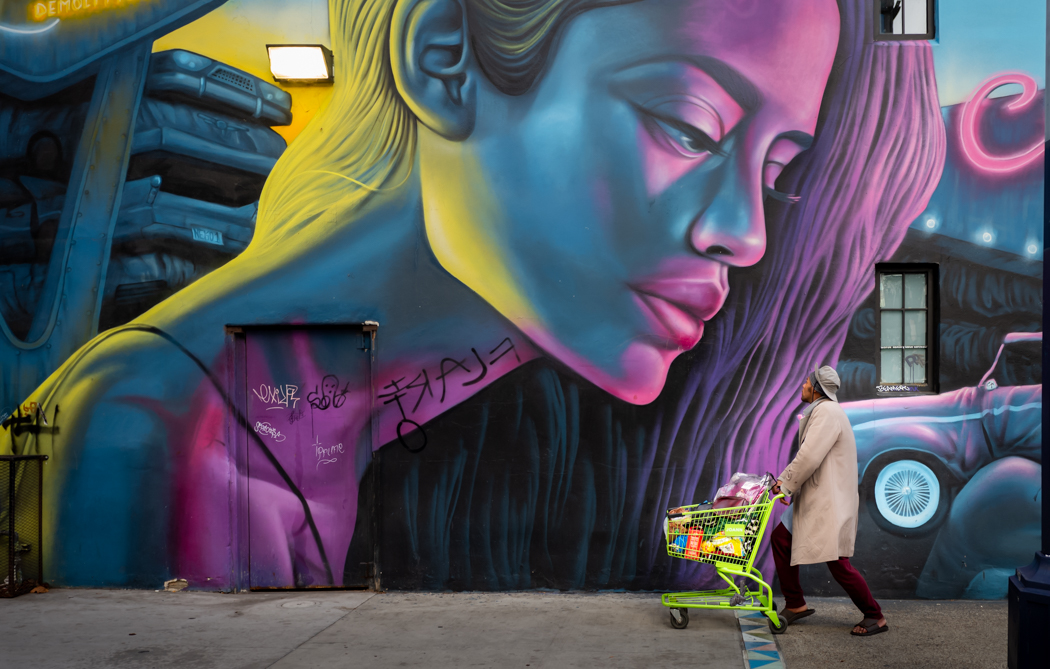
Then I waited. I got a number of shots with different people. Some with interesting dress, dogs, couples. Any number of them made for nice images. Then the guy with the food basket came around the corner. Unbelievably the yellow color of his basket matched the yellow in the mural perfectly. He also had maroon pants and items in his basket. I am not so comfortable shooting strangers like this. The 28mm means I am close enough to be noticed, and I am not familiar enough with the camera to be stealth when shooting. Sure enough, this guy noticed and came over to talk to me. He said I owed him a beer for taking his picture. He was very nice about it, and it was put as a suggestion more than a demand. I gave him a few bucks. I am not sure about the ethics involved in this.
I am happy with both the focus and exposure in this image. Almost no work was required in post processing this image. The yellows really are that bright. I have added zero vibrancy, or saturation.
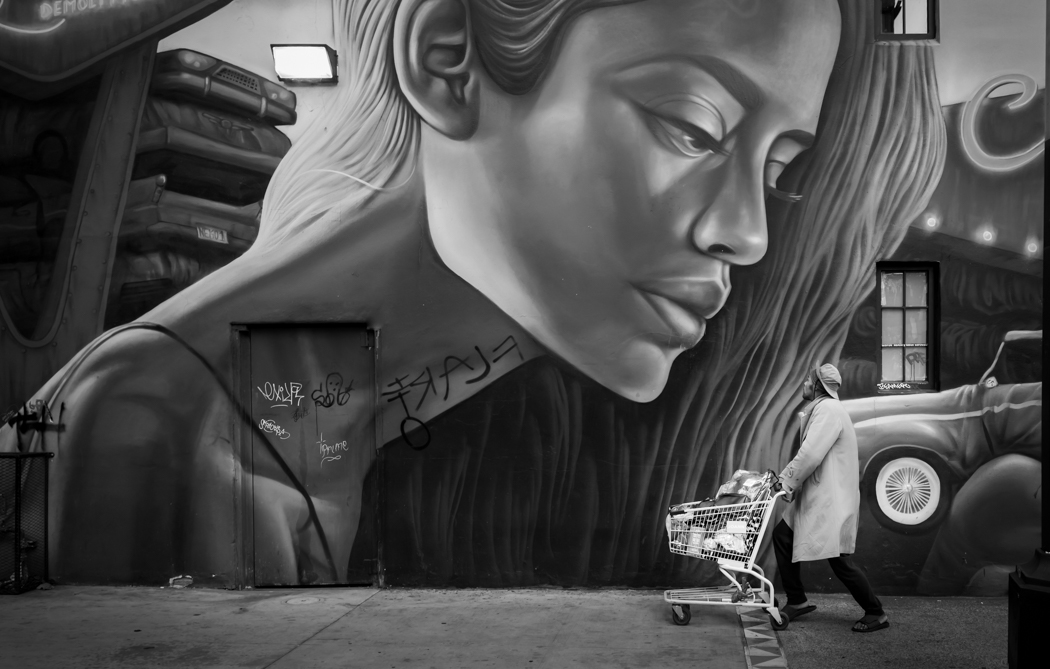
Honestly, I cannot decide whether I prefer the color or monochrome version of this image. I am more and more being drawn in the graphical nature and the rich shadows and blacks this camera produces.
I have decided to post both versions today. I am looking forward to everyone's comments on which one they prefer and why. Also suggestions on post processing the monochrome as I am new to this. I did bump contrast in the B&W version.
I can't express how much I am enjoying this experiment and the learning it provides. Once again, I appreciate the input you are all generously contributing.
Enjoy the images,
Steve
Having the camera with me 24/7 as I go about my life is an interesting experience. I am constantly seeing new photographic opportunities. The Leica M10-P is a perfect camera to do this with. Great form factor that doesn't get in your way, or draw too much attention.
As I am trying to learn, I am of course watching a number of YouTube videos. You can't search YouTube for Leica without getting a good number of "street photography videos". I do enjoy those. Along that vein I saw this great mural on the wall of a Micro Brewery in downtown San Diego this afternoon. There was a convenient parking spot on the street, so I pulled in and parked to see what kind of opportunity presented itself. I basically positioned myself like I would near a watering hole, or game trail in Africa. I then set my camera up as follows.
CV 28mm f/2 Ultron lens.
Auto ISO
Auto SS
F/8
preset focus to so that Infinity was over the f/8 mark on the DOF scale to ensure the proper focus area.
I set Drive mode to the High Frame Rate setting. I knew I wanted to get someone walking by and interacting with the Girl in the mural. I figured I had a better chance of getting an interesting position and gesture this way.
Then I waited. I got a number of shots with different people. Some with interesting dress, dogs, couples. Any number of them made for nice images. Then the guy with the food basket came around the corner. Unbelievably the yellow color of his basket matched the yellow in the mural perfectly. He also had maroon pants and items in his basket. I am not so comfortable shooting strangers like this. The 28mm means I am close enough to be noticed, and I am not familiar enough with the camera to be stealth when shooting. Sure enough, this guy noticed and came over to talk to me. He said I owed him a beer for taking his picture. He was very nice about it, and it was put as a suggestion more than a demand. I gave him a few bucks. I am not sure about the ethics involved in this.
I am happy with both the focus and exposure in this image. Almost no work was required in post processing this image. The yellows really are that bright. I have added zero vibrancy, or saturation.
Honestly, I cannot decide whether I prefer the color or monochrome version of this image. I am more and more being drawn in the graphical nature and the rich shadows and blacks this camera produces.
I have decided to post both versions today. I am looking forward to everyone's comments on which one they prefer and why. Also suggestions on post processing the monochrome as I am new to this. I did bump contrast in the B&W version.
I can't express how much I am enjoying this experiment and the learning it provides. Once again, I appreciate the input you are all generously contributing.
Enjoy the images,
Steve
Feb 23, 2022 at 09:36 PM
p.4 #14Learning Leica "M", a 30 day project
1bwana1 wrote:
Then it occurred to to not fight the camera. Leica has given us the tools needed for such a situation. I could shoot this image using "Live View" on the rear screen. Easy to compose and focus this way. A couple of shots, and I had my image.
Once again, Leica has provided a simple, easy, and elegant way to solve my problem. I just need to pay attention.
Exactly. Live view is just one more tool at your disposal, to use at your discretion, to get the shot. IMO it takes nothing away from the rangefinder, rather, it complements it.
If you couldn't fall back on live view, you could frame the shot with the viewfinder, keep the camera in place, move your face back away from it so you can see the lens and how it lines up with the obstruction caused by the fence, then shift the camera, without tilting it, so that the lens is between the bars in the fence.
Feb 23, 2022 at 09:45 PM
p.4 #15Learning Leica "M", a 30 day project
Color would be my choice becasue of the way it is tied together by the yellow. Wonderful image. ..
Feb 23, 2022 at 10:08 PM
p.4 #16Learning Leica "M", a 30 day project
1bwana1 wrote:
Unfortunately due to nerve damage cause tremors in my hands I need to be at 1/250 sec SS when hand holding to ensure sharp images. Luckily the M10-P handles higher ISO values well.
Okay, gotcha ... I was only thinking about nerve damage pain (earlier post about crooked position), not about steadiness. Good to have the ISO in your hip pocket.
+1 on the day's events. The capture works well in either color or mono ... the nice ones just seem to have a way of doing that.
Like Allen said, the color coordination is a key aspect to what makes the color such as it is.
OTOH, the mono renders the mural girl in a way that is striking also. I find it interesting that in the color, the man seems to appear a bit larger in relationship to the girl. Whereas, in the mono, the girl seems to be a bit (perceptually) larger (tonal values, I reckon) in relationship to the man. Interesting how the eye perceives things (I dig on the physiological response a bit, too).
Always a tough call when you gotta choose between the cute blonde or the sultry brunette.
The nice thing about it is ... you don't have to choose one vs. the other. Time will tell ya which one you like best ... no matter what anyone else thinks or feels. It could be that 99% of folks dig on the color ... but, if the mono is the one you dig, what does it matter about the 99%. Or, you can just like both.
Again ... nice one. It works both ways (for different reasons).
A bit more thought on the image. Typically, photography is used as either a recording medium tool (just the facts ma'am), or as a creative tool (anything goes). One of the wonderful aspects of our beloved craft. In the history of image making (drawing, painting, photography, etc.), there have been plights to render the image with such a dexterity that it fools the eye (trompe l'oeil) into perceiving an image as real.
Here, I find that this one has its own flavor of trompe l'oeil to it. In that, that while the capture is an excellent interaction between the man himself and the mural girl (and you with the world) ... it looks also as though he was actually part of the mural itself as though the entire scene is a mural. Hence, an almost "reverse" trompe l'oeil (making the real appear created vs. making the created appear real) if you will.
Anyway, suffice to say ... I like it on a variety of levels.


RustyBug wrote
Which, at SS 1/500 and a 28mm lens at that subject distance ... you had a ton of latitude (4 stops) to get down to a 1:1 shutter vs. focal length.Okay, gotcha ... I was only thinking about nerve damage pain (earlier post about crooked position), not about steadiness. Good to have the ISO in your hip pocket.
+1 on the day's events. The capture works well in either color or mono ... the nice ones just seem to have a way of doing that.
Like Allen said, the color coordination is a key aspect to what makes the color such as it is.
OTOH, the mono renders the mural girl in a way that is striking also. I find it interesting that in the color, the man seems to appear a bit larger in relationship to the girl. Whereas, in the mono, the girl seems to be a bit (perceptually) larger (tonal values, I reckon) in relationship to the man. Interesting how the eye perceives things (I dig on the physiological response a bit, too).
Always a tough call when you gotta choose between the cute blonde or the sultry brunette.
The nice thing about it is ... you don't have to choose one vs. the other. Time will tell ya which one you like best ... no matter what anyone else thinks or feels. It could be that 99% of folks dig on the color ... but, if the mono is the one you dig, what does it matter about the 99%. Or, you can just like both.
Again ... nice one. It works both ways (for different reasons).
A bit more thought on the image. Typically, photography is used as either a recording medium tool (just the facts ma'am), or as a creative tool (anything goes). One of the wonderful aspects of our beloved craft. In the history of image making (drawing, painting, photography, etc.), there have been plights to render the image with such a dexterity that it fools the eye (trompe l'oeil) into perceiving an image as real.
Here, I find that this one has its own flavor of trompe l'oeil to it. In that, that while the capture is an excellent interaction between the man himself and the mural girl (and you with the world) ... it looks also as though he was actually part of the mural itself as though the entire scene is a mural. Hence, an almost "reverse" trompe l'oeil (making the real appear created vs. making the created appear real) if you will.
Anyway, suffice to say ... I like it on a variety of levels.
Feb 23, 2022 at 10:12 PM
p.4 #17Learning Leica "M", a 30 day project
Steve,
Then comes the big questions. How did you see it? How does it fit in with your other work?
Then comes the big questions. How did you see it? How does it fit in with your other work?
Feb 24, 2022 at 07:21 AM
p.4 #18Learning Leica "M", a 30 day project
airfrogusmc wrote:
Steve,
Then comes the big questions. How did you see it? How does it fit in with your other work?
Interesting questions. Realize that my time with the Leica has been very short. It will take more time for my understanding of it, and how that influences my images to establish itself. With that as a basis, I can say that my approach using the M10-P is a bit different from my other images. They have mostly been landscape, wildlife, portraits, things like that. Very subject centric. My landscapes have tended to be grand scene orientated. My subject images tend to be set up to focus on a subject. Very often using shallow depth of field for subject isolation. During this experiment I am drawn to take a subject that I find beautiful or interesting and capture it in a context that tells a story. My Sony a1 is a technical marvel. I approach and use in that way. I relate to it like I do scientific instruments. It is a tool, a very powerful one. I am carrying the Leica with me full time. So, I am open to seeing images all the time rather than just when I am out to enjoy photography. In that sense I have a different relationship with this camera. Nothing is automatic, I have to work with the camera to get something I want. It is till very much in the developmental phase. It is sort of like a new romance in a way.
I see the image potential in things because since I am wearing a camera, I am open to them.
Great questions, thanks for asking.,
Steve
Feb 24, 2022 at 09:04 AM
p.4 #19Learning Leica "M", a 30 day project
Yes with a lot in focus you are forced to see differently and need to learn to use all the elements in the frame to help support your visual statement instead of just cropping tight or bluring the background out. It is a much different approach. .
Feb 24, 2022 at 09:23 AM
p.4 #20Learning Leica "M", a 30 day project
Excellent article (IMHO) on how to enter the Leica M rangefinder world:
https://www.macfilos.com/2022/02/24/gateways-to-heaven-or-at-least-to-a-new-rangefinder-world/
https://www.macfilos.com/2022/02/24/gateways-to-heaven-or-at-least-to-a-new-rangefinder-world/
Feb 24, 2022 at 11:10 AM