This topic is in the 2022 archive. You can read it and like its posts here. It is read only.
Archive 2022Learning Leica "M", a 30 day project

p.11 #1Learning Leica "M", a 30 day project
I donno exposure is very important to me and I would never let the camera make that decision for me. No way does the camera know more about the way I need my exposures to get the final image I need than I do. I would never let the camera make thsoe kind of choices for me.
if I were shooting in snow with my M 10 M and wanted to hold detail in the snow I would meter the snow where it is brightest and open two stops from that reading that would keep those highlights at zone VII.
if I were shooting in snow with my M 10 M and wanted to hold detail in the snow I would meter the snow where it is brightest and open two stops from that reading that would keep those highlights at zone VII.
Mar 04, 2022 at 10:32 AM
p.11 #2Learning Leica "M", a 30 day project
Reflective metering is easily fooled because it doesn't know if that bright area is the key light or accent / kicker light.
That, and it is predicated on an assumed reflectance value of the subject, rather than it being a light source, itself.
Matrix metering and engineering programming try to formulate a variety of pattern recognition scenarios. But, once you realize that YOU can make those assessments for yourself fairly easily ... those matrix metering from reflective light pales in the ability to consistently get your exposure the way you really want it from doing it yourself. The trickier the scenario ... The better to do it yourself many times.
Knowledge of incident lighting ... key, fill or accent ... gives YOU the control over your exposure.
Mar 04, 2022 at 10:49 AM
p.11 #3Learning Leica "M", a 30 day project
You are not wrong, but when you are traveling on a glacier, everyone is roped together, and you can't just stop every time you want to take a picture. Some pictures will be taken while I would be walking, and my other hand will be holding gear, so I won't know for sure if the camera was exactly pointed at the snow or the sky or a rock.
Edit: And yes, I am learning those things as I am still shooting film with an external meter. But again, time on the glacier will be limited, and I will be busy with a thousand other things, so some average scene metering without blowing highlights would be highly preferable.
Edit: And yes, I am learning those things as I am still shooting film with an external meter. But again, time on the glacier will be limited, and I will be busy with a thousand other things, so some average scene metering without blowing highlights would be highly preferable.
Mar 04, 2022 at 10:51 AM
p.11 #4Learning Leica "M", a 30 day project
If you're on a glacier just point it at any bright snow or if it is a clear blue sky that is usually about zone V. Meter that, shoot a quick shot that has bright areas in it, quickly see where things are falling, adjust and leave it there. Easy and fast.
And if you are really worried about highlights then just stop down even more. with the M 10 M you have a lot of info in those shadows that you don't have with other cameras.
And if you are really worried about highlights then just stop down even more. with the M 10 M you have a lot of info in those shadows that you don't have with other cameras.
Mar 04, 2022 at 10:59 AM
p.11 #5Learning Leica "M", a 30 day project
Yeah, I'll give it a proper try. Sorry for the derail, and thank you for the discussion.
Mar 04, 2022 at 11:16 AM
p.11 #7Learning Leica "M", a 30 day project
coralnut wrote:
> Man on crutches in hallway
Two weeks in and I'm still really enjoying this thread. I had previously mentioned that one of the things that I enjoy most about it are Steve's narrations about his thought processes in composition, which assist me in how I look at composition of his scenes. Something else that I am really enjoying is the diversity of Steve's choices for subject matter. It's very easy to get stuck in a rut, taking pictures of the kinds of things that one is good at. I like Steve's willingness to compose such a wide variety of subjects....Show more →
Bob, thanks for the kind comments. I am pleased when I hear people are enjoying the thread. I also appreciate the time spent to write such a detailed comment.
I am making an effort to try out a broad range of subjects and shooting situations. I want to learn this camera as well as I can. It is my hope that others will benefit as well.
Below are answers to your questions.
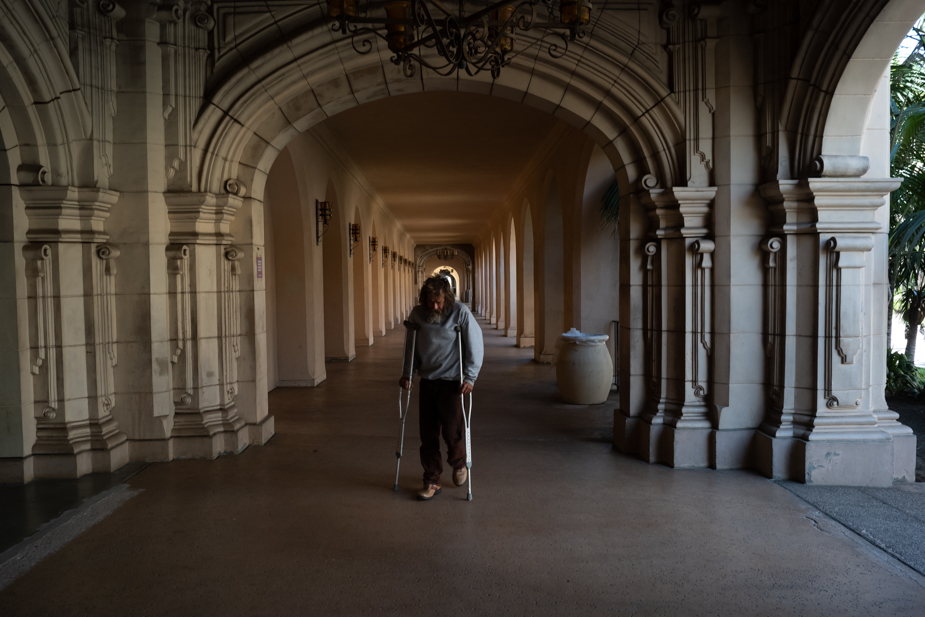
The perspective was derived by the path I chose to walk. I was just hoping that something interesting would appear inside the amazing arches. So, I guess I did choose the environment, but the images presented itself.
I shot the image in color as always. I have not yet set my camera to monochrome. Since I am shooting just RAW files the files will be saved in full color anyway. I then look at the image in LR and decide which way to process it. In this case I decided on B&W because of the amazing way the Leica handles tonality. I just love it. Still it does look good in color. The palette at this location is subtle and moody to begin with.
As far as exposure I am still relying primarily of manual aperture and auto for shutter speed (with a minimum SS to manage my hand tremors), and ISO (with a 12500 max). I have found that the camera's meter will let the whites blow out in high contrast scenes. So, when I see this situation I automatically click in an estimated amount of compensation as I bring the camera up to shoot. It takes just a fraction of a second to do. I generally like to have 1/3 stop below the meter in any case as a safety, because the sensor allows such great shadow recovery. Still, in this exposure a small area outside the arches in direct sunlight did blow out slightly.
For focus I am relying on zone focusing with the generous DOF provided by f/8 on the 28mm lens. I always start with the focus tab up against the stop for closest focus. I have memorized the position (and a couple of others) where the infinity mark is right over the f/8 marker on the DOF scale. In the case of this lens that a little past 1/2 way rotation of the focus ring. I can get it there with acceptable accuracy as I see the the shot develop, and before I bring it up to my eye. In this position the DOF indicator says I should have acceptable focus from about 5 feet to infinity. It worked well in this case.
I did shoot a total of 5 fames as the man approached. He moved across the center line as he got closer. I held my position on the center line as this was core to my view of the composition. I the frame I chose he is still a bit short of ideal. He was very well centered in the next and final frame. But his head position, and gesture was not as good. So, I chose the netter story over the better composition as my favorite.
As far as post processing all that was done is a small crop, with standard LR sliders to my taste, very little doge/burn in a couple of areas, and a vignette. I am sure someone with better B&W skills could do much better. I am just starting with monochrome since I got the M10-P.
I think posting a straight out of camera (jpeg from RAW) sample of the frame after the one I processed might answer questions better than I can in text. Maybe people will find it useful to see exactly what I was dealing with, and what I ended up with. I think you will see what I mean about the gesture. This was the final frame of the 5 I shot. So, I will post one below.
Remember that the EXIF data is totally wrong. I do wish Leica would have electric communication between the lens and the camera.
-Steve-
Edited on Mar 04, 2022 at 01:00 PM · View previous versions
> Man on crutches in hallway
Two weeks in and I'm still really enjoying this thread. I had previously mentioned that one of the things that I enjoy most about it are Steve's narrations about his thought processes in composition, which assist me in how I look at composition of his scenes. Something else that I am really enjoying is the diversity of Steve's choices for subject matter. It's very easy to get stuck in a rut, taking pictures of the kinds of things that one is good at. I like Steve's willingness to compose such a wide variety of subjects....Show more →
Bob, thanks for the kind comments. I am pleased when I hear people are enjoying the thread. I also appreciate the time spent to write such a detailed comment.
I am making an effort to try out a broad range of subjects and shooting situations. I want to learn this camera as well as I can. It is my hope that others will benefit as well.
Below are answers to your questions.
The perspective was derived by the path I chose to walk. I was just hoping that something interesting would appear inside the amazing arches. So, I guess I did choose the environment, but the images presented itself.
I shot the image in color as always. I have not yet set my camera to monochrome. Since I am shooting just RAW files the files will be saved in full color anyway. I then look at the image in LR and decide which way to process it. In this case I decided on B&W because of the amazing way the Leica handles tonality. I just love it. Still it does look good in color. The palette at this location is subtle and moody to begin with.
As far as exposure I am still relying primarily of manual aperture and auto for shutter speed (with a minimum SS to manage my hand tremors), and ISO (with a 12500 max). I have found that the camera's meter will let the whites blow out in high contrast scenes. So, when I see this situation I automatically click in an estimated amount of compensation as I bring the camera up to shoot. It takes just a fraction of a second to do. I generally like to have 1/3 stop below the meter in any case as a safety, because the sensor allows such great shadow recovery. Still, in this exposure a small area outside the arches in direct sunlight did blow out slightly.
For focus I am relying on zone focusing with the generous DOF provided by f/8 on the 28mm lens. I always start with the focus tab up against the stop for closest focus. I have memorized the position (and a couple of others) where the infinity mark is right over the f/8 marker on the DOF scale. In the case of this lens that a little past 1/2 way rotation of the focus ring. I can get it there with acceptable accuracy as I see the the shot develop, and before I bring it up to my eye. In this position the DOF indicator says I should have acceptable focus from about 5 feet to infinity. It worked well in this case.
I did shoot a total of 5 fames as the man approached. He moved across the center line as he got closer. I held my position on the center line as this was core to my view of the composition. I the frame I chose he is still a bit short of ideal. He was very well centered in the next and final frame. But his head position, and gesture was not as good. So, I chose the netter story over the better composition as my favorite.
As far as post processing all that was done is a small crop, with standard LR sliders to my taste, very little doge/burn in a couple of areas, and a vignette. I am sure someone with better B&W skills could do much better. I am just starting with monochrome since I got the M10-P.
I think posting a straight out of camera (jpeg from RAW) sample of the frame after the one I processed might answer questions better than I can in text. Maybe people will find it useful to see exactly what I was dealing with, and what I ended up with. I think you will see what I mean about the gesture. This was the final frame of the 5 I shot. So, I will post one below.
Remember that the EXIF data is totally wrong. I do wish Leica would have electric communication between the lens and the camera.
-Steve-
Edited on Mar 04, 2022 at 01:00 PM · View previous versions
Mar 04, 2022 at 12:58 PM
p.11 #8Learning Leica "M", a 30 day project
What a great conversation on managing exposure guys. Thanks for all the tips on this!
Mar 04, 2022 at 01:00 PM
p.11 #9Learning Leica "M", a 30 day project
There is generally a three EV difference between key and fill. Set your EC to -1 or -1.5 and split the difference for convenience, if you're worried about your meter getting fooled.
Post can easily handle that, if you're off on either direction.
theHUN wrote:
You are not wrong, but when you are traveling on a glacier, everyone is roped together, and you can't just stop every time you want to take a picture. Some pictures will be taken while I would be walking, and my other hand will be holding gear, so I won't know for sure if the camera was exactly pointed at the snow or the sky or a rock.
Edit: And yes, I am learning those things as I am still shooting film with an external meter. But again, time on the glacier will be limited, and I will be busy with...Show more →
Mar 04, 2022 at 02:27 PM
p.11 #10Learning Leica "M", a 30 day project
Regarding in-camera metering accuracy/consistency: has anyone tested the M10 generation's 'classic' off the shutter blades metering method against the 'advanced' metering option that uses the imaging sensor for quasi-matrix metering?
On my M240 I never use advanced metering because of the additional lag/delay it introduces (because the camera is essentially in live view mode, but with the rear LCD off). And I generally don't trust the classic metering system much, so try as much as possible to shoot manually and optimize image brightness in post.
But based on some comments I've seen about the M11, some seem to think its sensor-based metering is very good.
This has me wondering if the pre-M11 advanced metering option is comparable?
That said, at least for the environments in which I typically work, I prefer the manual exposure approach for consistency.
Mar 04, 2022 at 06:19 PM
p.11 #11Learning Leica "M", a 30 day project
I like today’s image Steve. I know exactly where that lifeguard box is. Brings back memories, beautiful area. If I remember right it was a little stinky around there from the sea lions.
Mar 04, 2022 at 06:34 PM
p.11 #12Learning Leica "M", a 30 day project
Day 14 Image:
Hard to believe that I have been shooting the Leica, and posting this thread for two full weeks now. I have learned a great deal with the help of all of you. The camera and it's process has definitely had a profound affect of how I shoot, and how I see. That is what I had hoped for, so I am pleased.
For today's image I have gone indoors for the first time. The La Valencia Hotel is a La Jolla icon. It has old World charm, ambiance, and the perfect location in the center of the Village with fantastic Pacific Ocean views from the rooms and public areas. If you are ever coming to visit us here in la Jolla, it is a great place to stay. It is in the center of many great restaurant, bistros, shops, art galleries, and World famous beaches. Your significant other will reward you for the choice I am sure. There are tons of photographic opportunities in walking distance.
https://www.lavalencia.com/
I went to the bar, sitting area overlooking the ocean and sat at a table. I ordered a Cranberry juice with soda, set the camera on the table and began looking for compositions of interest. I expected it would have something to do with the combination of the Ocean view and the elegant room. However, I was drawn to this woman sitting over in a corner next to a set of stairs that go who knows where. She was working on her computer, had ordered a drink of some sort, and some food that had not yet come. The corner itself was dark and featured the Spanish Revival architecture and nice leather chairs. The big two story Ocean view window was the primary source of light. The woman had turned her laptop away from the light of the window I assumed to avoid glare on her screen. This had her facing directly into the light. It produced an amazing light on her that in this setting reminded me of the old World master painters that painted by natural window light. I decided that this would by my image for the day.
I put the Voigtlander f/1.5 II MC Nokton on the camera so I could fill the frame with the composition from across the room. I needed to open it up a bit to get my required shutter speed in the low light. Because of this I didn't have the confidence to use zone focus and depend on depth of field. So, I used the Range Finder to focus on her. I set the shutter speed for 1250 sec which is about my minimum with the 50mm FL. The Auto ISO with -.30 exposure compensation to protect the highlights resolved to ISO 1250. No noise issues at the ISO in my opinion so I was happy with that.
I brought the camera up to my eye and pretended to point it all around the room. In that she was a young woman alone, I didn't want to cause her to feel uncomfortable by obviously focusing on her. It seemed to work as she paid me absolutely no mind.
I tried both color and monochrome in post. I liked both of them, but decided to keep it in the subdued, vintage colors that it naturally was. Once again, minimal processing was required, both saturation and vibrancy set to zero. As I am consistently finding I like the rendering and fall of in the shadows from this camera in this image. I wonder who the stuffed animal on her lap was for. No one joined her in the time I was there.
Enjoy the image,
-Steve-
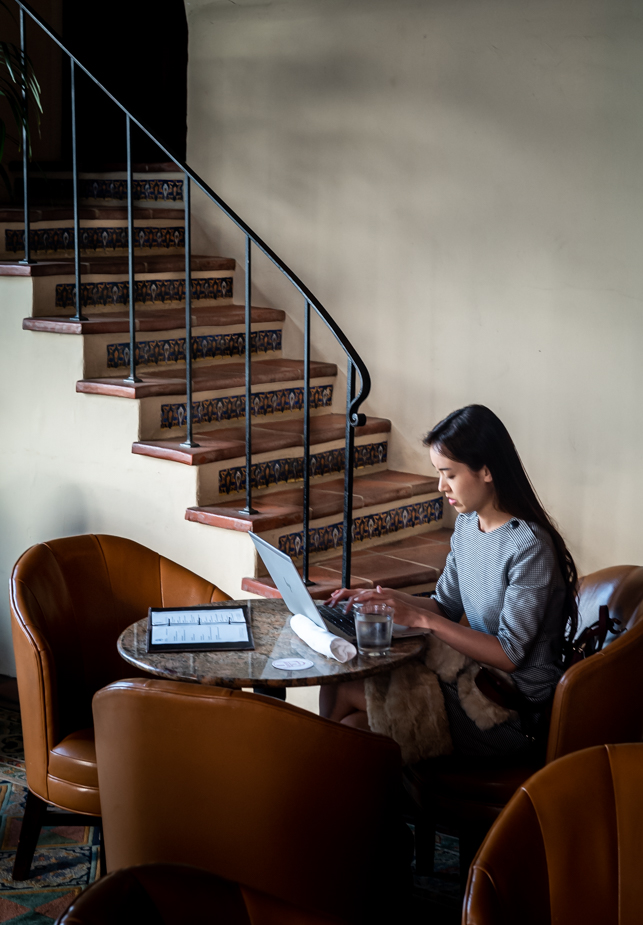
Leica M10-P, Voigtlander 50mm f/1.5 Nokton II MC, f.2.8, 125/sec, ISO 1250, AWB
Hard to believe that I have been shooting the Leica, and posting this thread for two full weeks now. I have learned a great deal with the help of all of you. The camera and it's process has definitely had a profound affect of how I shoot, and how I see. That is what I had hoped for, so I am pleased.
For today's image I have gone indoors for the first time. The La Valencia Hotel is a La Jolla icon. It has old World charm, ambiance, and the perfect location in the center of the Village with fantastic Pacific Ocean views from the rooms and public areas. If you are ever coming to visit us here in la Jolla, it is a great place to stay. It is in the center of many great restaurant, bistros, shops, art galleries, and World famous beaches. Your significant other will reward you for the choice I am sure. There are tons of photographic opportunities in walking distance.
https://www.lavalencia.com/
I went to the bar, sitting area overlooking the ocean and sat at a table. I ordered a Cranberry juice with soda, set the camera on the table and began looking for compositions of interest. I expected it would have something to do with the combination of the Ocean view and the elegant room. However, I was drawn to this woman sitting over in a corner next to a set of stairs that go who knows where. She was working on her computer, had ordered a drink of some sort, and some food that had not yet come. The corner itself was dark and featured the Spanish Revival architecture and nice leather chairs. The big two story Ocean view window was the primary source of light. The woman had turned her laptop away from the light of the window I assumed to avoid glare on her screen. This had her facing directly into the light. It produced an amazing light on her that in this setting reminded me of the old World master painters that painted by natural window light. I decided that this would by my image for the day.
I put the Voigtlander f/1.5 II MC Nokton on the camera so I could fill the frame with the composition from across the room. I needed to open it up a bit to get my required shutter speed in the low light. Because of this I didn't have the confidence to use zone focus and depend on depth of field. So, I used the Range Finder to focus on her. I set the shutter speed for 1250 sec which is about my minimum with the 50mm FL. The Auto ISO with -.30 exposure compensation to protect the highlights resolved to ISO 1250. No noise issues at the ISO in my opinion so I was happy with that.
I brought the camera up to my eye and pretended to point it all around the room. In that she was a young woman alone, I didn't want to cause her to feel uncomfortable by obviously focusing on her. It seemed to work as she paid me absolutely no mind.
I tried both color and monochrome in post. I liked both of them, but decided to keep it in the subdued, vintage colors that it naturally was. Once again, minimal processing was required, both saturation and vibrancy set to zero. As I am consistently finding I like the rendering and fall of in the shadows from this camera in this image. I wonder who the stuffed animal on her lap was for. No one joined her in the time I was there.
Enjoy the image,
-Steve-
Leica M10-P, Voigtlander 50mm f/1.5 Nokton II MC, f.2.8, 125/sec, ISO 1250, AWB
Mar 04, 2022 at 11:45 PM
p.11 #13Learning Leica "M", a 30 day project
Day 15 Image:
I grew up on the island of Coronado that forms seaward side San Diego Bay. I was over there today visiting family that still lives there. While there I stopped in to the historic Hotel Del Coronado. As a child my family was members of the Beach and Tennis Club there. It is there I learned to swim, play tennis, and many other things. I haven't been there for more than a decade. It retains the elegance I remembered, but has expanded and been upscaled a great deal. There was unlimited photographic opportunity. I got a number of nice images. I chose one for this thread, and I will post some of the others in the general M image thread.
I decided I wanted to shoot my Voigtlander 50mm 1.5 Nokton II MC. Being a longer FL than the 28mm I find it a bit more difficult to shoot. Low light makes it even more important. Since 125/sec is about as slow as I can hand hold without camera shake becoming an issue, I had to open the aperture to f/2.8 to keep the ISO down to a reasonable level.
The elegant reception counter had very interesting lighting so attracted my attention. I found the story portrayed as each member of the staff did there job. I spent a few minutes waiting for a composition, and the right people to be in the frame. Because of the wide aperture my depth of field was narrow. So, rather than rely on Zone Focus as I so often do with the 28mm, I used the Range Finder to establish focus. I did do a couple of test shots for exposure. Keeping detail in the brightly lit display cases behind the counter presented the biggest problem exposure wise. This is actually what controlled the exposure. I felt comfortable knowing I could bring up the shadows in post. After I was satisfied with focus and exposure, I let the camera rest on my side. Once I saw a scene that I though expressed what I was looking for, I raised the camera up , composed and took the shot. The visualization, and setup worked very well for the situation.
I think the old traditional room key board is now just for ambiance. I never saw them use it, the hotel is busy, and 100% of the slots had keys in them. I guess they use modern day key cards now.
I hope you enjoy the image.
-Steve-
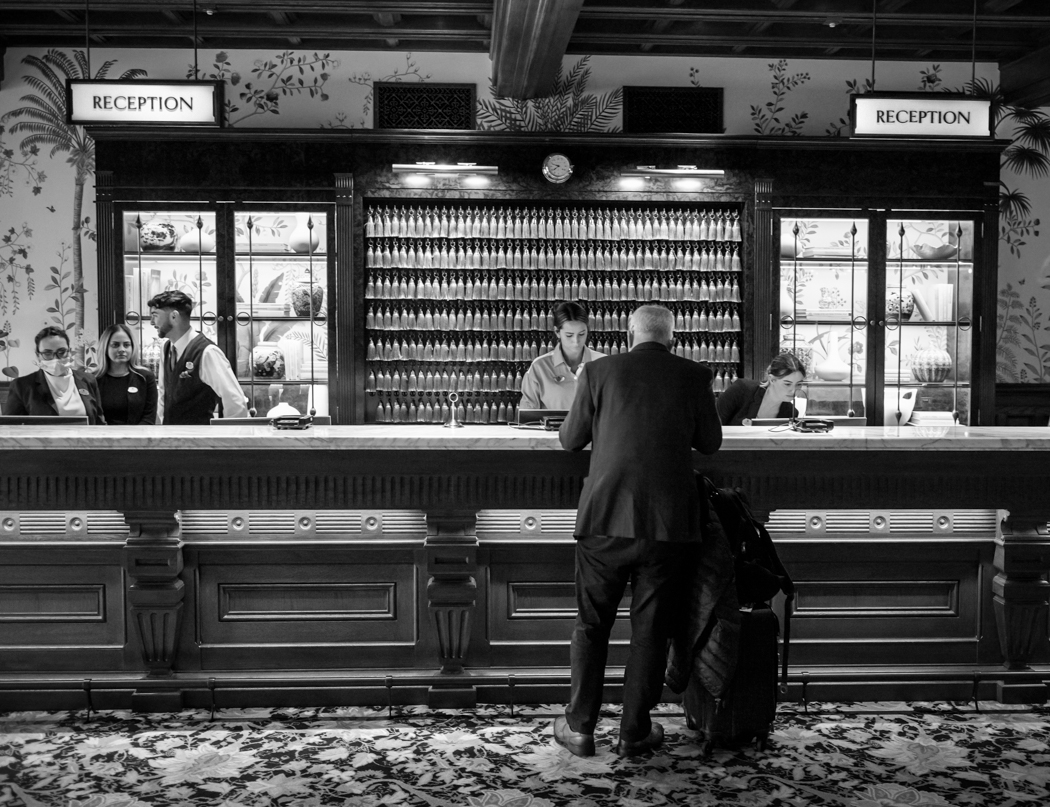
Leica M10-P, CV 50mm f/1.5 Nokton, f/2.8, 125/sec, ISO 4000, AW, hand held
I grew up on the island of Coronado that forms seaward side San Diego Bay. I was over there today visiting family that still lives there. While there I stopped in to the historic Hotel Del Coronado. As a child my family was members of the Beach and Tennis Club there. It is there I learned to swim, play tennis, and many other things. I haven't been there for more than a decade. It retains the elegance I remembered, but has expanded and been upscaled a great deal. There was unlimited photographic opportunity. I got a number of nice images. I chose one for this thread, and I will post some of the others in the general M image thread.
I decided I wanted to shoot my Voigtlander 50mm 1.5 Nokton II MC. Being a longer FL than the 28mm I find it a bit more difficult to shoot. Low light makes it even more important. Since 125/sec is about as slow as I can hand hold without camera shake becoming an issue, I had to open the aperture to f/2.8 to keep the ISO down to a reasonable level.
The elegant reception counter had very interesting lighting so attracted my attention. I found the story portrayed as each member of the staff did there job. I spent a few minutes waiting for a composition, and the right people to be in the frame. Because of the wide aperture my depth of field was narrow. So, rather than rely on Zone Focus as I so often do with the 28mm, I used the Range Finder to establish focus. I did do a couple of test shots for exposure. Keeping detail in the brightly lit display cases behind the counter presented the biggest problem exposure wise. This is actually what controlled the exposure. I felt comfortable knowing I could bring up the shadows in post. After I was satisfied with focus and exposure, I let the camera rest on my side. Once I saw a scene that I though expressed what I was looking for, I raised the camera up , composed and took the shot. The visualization, and setup worked very well for the situation.
I think the old traditional room key board is now just for ambiance. I never saw them use it, the hotel is busy, and 100% of the slots had keys in them. I guess they use modern day key cards now.
I hope you enjoy the image.
-Steve-
Leica M10-P, CV 50mm f/1.5 Nokton, f/2.8, 125/sec, ISO 4000, AW, hand held
Mar 05, 2022 at 11:12 PM
p.11 #14Learning Leica "M", a 30 day project
Happy to see you still doing a daily update. I enjoy your posts...your progress and explanations just as much as the images.
Mar 06, 2022 at 10:56 AM
p.11 #15Learning Leica "M", a 30 day project
Day 16 Image:
This one is also from my visit the the Hotel Del Coronado this weekend. Once again I used the Voigtlander 28mm f/2 Ultron. These are the stairs into the hotel from the back parking lot. It is the way I walked into the hotel as I park on the street for free rather than pay the $75.00 parking fee.
I was instantly struck by the graphic nature of the horizontal lines from the stairs, along with the vertical and curved lines of the canvas covering. I shot a number of frames as various people came down the steps. One family with small children came down. The gesture of the kids made a nice image. But right after that this gentleman came down. He stayed smack in the middle of the stairs. The day was a bit cold and blustery so he was wearing an uncharacteristic heavy black coat. In the Navy family I grew up in this was called a "P" coat. I think he is part of the Valet team for this entrance. I knew I had my shot. So moved on.
This time I once again relied on estimating the distance and DOF required to make the image and setting a stooped down aperture and estimating focus by tab position. I am getting fairly fast and accurate with this. Prior to this I would have set a wide DOF also but relied on the Sony a1 Eye AF for focus. I have never zoomed in to look at whether the focus in this image is exactly on the pupil of the eye. That is entirely irrelevant to to value of this image.
This color one is nice. I really like the shot in the B&W version I did as well. I have begun to make a virtual copy of images I like in Light Room. I process one in color and one in monochrome. I have been posting mostly B&W lately. Maybe this is because I am new to B&W processing so they seem more impactful to me at this time. Once again, this Leica experiment is doing what it was intended to do and broadening my view of images.
Enjoy #16. Let me know what you think.
-Steve-
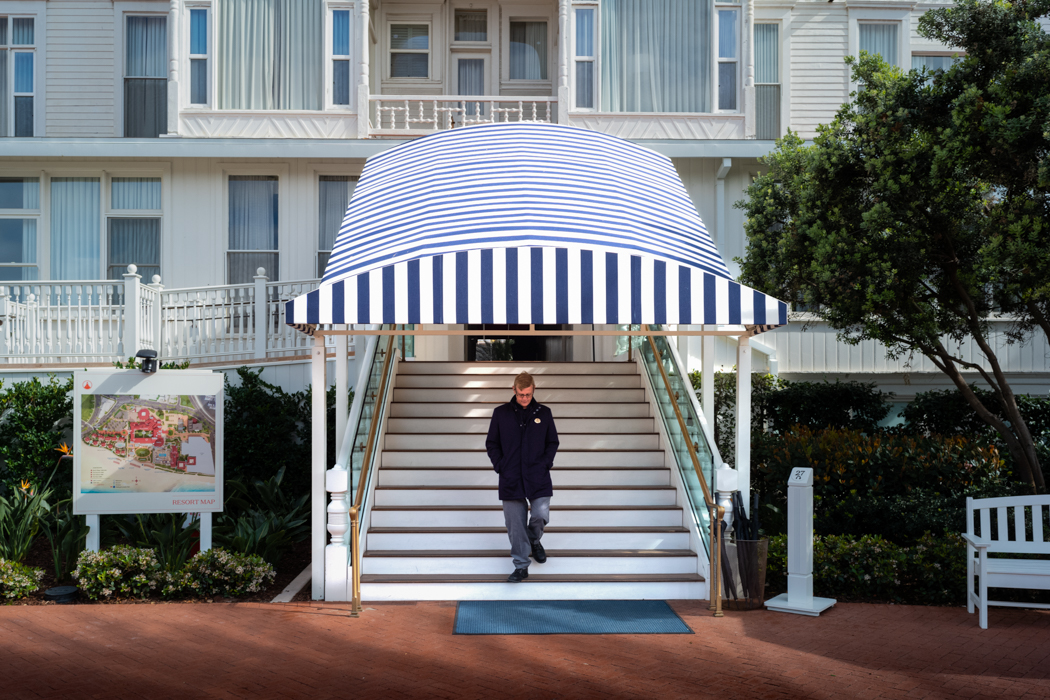
Leica M10-P, Voigtlander 28mm f/2.0 Ultron. F/8, 1/500 sec, ISO 640, AW, Hand Held.
Edited on Mar 06, 2022 at 08:19 PM · View previous versions
This one is also from my visit the the Hotel Del Coronado this weekend. Once again I used the Voigtlander 28mm f/2 Ultron. These are the stairs into the hotel from the back parking lot. It is the way I walked into the hotel as I park on the street for free rather than pay the $75.00 parking fee.
I was instantly struck by the graphic nature of the horizontal lines from the stairs, along with the vertical and curved lines of the canvas covering. I shot a number of frames as various people came down the steps. One family with small children came down. The gesture of the kids made a nice image. But right after that this gentleman came down. He stayed smack in the middle of the stairs. The day was a bit cold and blustery so he was wearing an uncharacteristic heavy black coat. In the Navy family I grew up in this was called a "P" coat. I think he is part of the Valet team for this entrance. I knew I had my shot. So moved on.
This time I once again relied on estimating the distance and DOF required to make the image and setting a stooped down aperture and estimating focus by tab position. I am getting fairly fast and accurate with this. Prior to this I would have set a wide DOF also but relied on the Sony a1 Eye AF for focus. I have never zoomed in to look at whether the focus in this image is exactly on the pupil of the eye. That is entirely irrelevant to to value of this image.
This color one is nice. I really like the shot in the B&W version I did as well. I have begun to make a virtual copy of images I like in Light Room. I process one in color and one in monochrome. I have been posting mostly B&W lately. Maybe this is because I am new to B&W processing so they seem more impactful to me at this time. Once again, this Leica experiment is doing what it was intended to do and broadening my view of images.
Enjoy #16. Let me know what you think.
-Steve-
Leica M10-P, Voigtlander 28mm f/2.0 Ultron. F/8, 1/500 sec, ISO 640, AW, Hand Held.
Edited on Mar 06, 2022 at 08:19 PM · View previous versions
Mar 06, 2022 at 08:10 PM
p.11 #16Learning Leica "M", a 30 day project
lifeandmylens wrote:
Happy to see you still doing a daily update. I enjoy your posts...your progress and explanations just as much as the images.
Thanks, I am committed to completing the 30 day learning project I set out to do. The support of the FM community has been a big help in keeping me motivated.
-Steve-
Happy to see you still doing a daily update. I enjoy your posts...your progress and explanations just as much as the images.
Thanks, I am committed to completing the 30 day learning project I set out to do. The support of the FM community has been a big help in keeping me motivated.
-Steve-
Mar 06, 2022 at 08:14 PM
p.11 #17Learning Leica "M", a 30 day project
1bwana1 wrote:
Day 16 Image:
This one is also from my visit the the Hotel Del Coronado this weekend. Once again I used the Voigtlander 28mm f/2 Ultron. These are the stairs into the hotel from the back parking lot. It is the way I walked into the hotel as I park on the street for free rather than pay the $75.00 parking fee.
I was instantly struck by the graphic nature of the horizontal lines from the stairs, along with the vertical and curved lines of the canvas covering. I shot a number of frames as various people came down the steps. One...Show more →
Mar 06, 2022 at 10:17 PM
p.11 #18Learning Leica "M", a 30 day project
Two weeks in and it is becoming very clear to me that my current most frequently used lens is the Voigtlander 28mm f/2 Ultron. Interesting that this lens has arguably the lowest image quality in my 3 lens M collection. It is the version 1 of this lens from Cosina. There is a much improved version 2 currently available. I received this lens prior to receiving my M10-P, so I initially tested it on my Sony a1. I have to say the I was disappointed in its performance on the Sony. Especially so in the corners. This seems to be in large part due to the thicker sensor stack on the Sony. The lens design seems optimized for the M sensor. I have not been disappointed in my results on the Leica. They are significantly better. I did buy in for only $325 so was Ok with it as possible a short term ownership. I can sell it for less of a loss that even a short term rental.
My current M lens collection is as follows.
CV 28mm f/2 Ultron
CV 50mm f/1.5 Nokton vII MC
CV 75mm f/1.5 Nokton.
I am very happy with the focal length gaping of this set of lenses. Image quality wise the 50 and the 75 are best, and both recent release models.
Since it already clear to me that I will be keeping a Leica M kit in my inventory I am wondering which way I should optimize it. I also want to have the full Leica M experience so want to try a Leica lens to see if it justifies the substantial cost differential over the CV lenses.
Options I am considering.
1.) Selling the CV 28mm and replacing with the Leica 28mm Summicron latest version.
2.) Selling the CV 28mm and upgrading to the new CV version.
3.) If I choose #2, which Leica should I buy. Possibly a 35mm Summicron latest version.
My instincts are telling me that switching out the CV 28mm with a Leica equivalent is the best choice. I will be upgrading this lens in any case even if I sat Voitlander. Since I know the CV lens well, switching out to the Leica will give me a direct comparison, and a meaningful answer on whether the price difference is worth it.
I am open to all you opinions and suggestions on the best way to optimize my kit for long term ownership satisfaction.
Knowing myself, I am guessing there is also a Leica M-11 of some sort in my future in the next couple of years.
Thanks in advance for all your contributions.
-Steve-
Mar 06, 2022 at 10:40 PM
p.11 #19Learning Leica "M", a 30 day project
1bwana1 wrote:
my current most frequently used lens is the Voigtlander 28mm f/2 Ultron. Interesting that this lens has arguably the lowest image quality in my 3 lens M collection.
You do not need the best lenses to create good pictures and this lens would have made a lot of photographers of the past more than happy.
But we are obsessed by this, tend to suffer from GAS.
So why would you care as your pictures are already interesting?
P.S: no judgment here. I have the Summicron last version and the Voigt v2
Mar 07, 2022 at 01:53 AM
p.11 #20Learning Leica "M", a 30 day project
1bwana1 wrote:
Two weeks in and it is becoming very clear to me that my current most frequently used lens is the Voigtlander 28mm f/2 Ultron. Interesting that this lens has arguably the lowest image quality in my 3 lens M collection. It is the version 1 of this lens from Cosina. There is a much improved version 2 currently available. I received this lens prior to receiving my M10-P, so I initially tested it on my Sony a1. I have to say the I was disappointed in its performance on the Sony. Especially so in the corners. This seems to be...Show more →
Hi Steve,
I've been enjoying your images. Thanks for the interesting thread.
Get the Voigtlander 28/2 II. You won't be disappointed. It does everything better than v1 including rendering. I don't think the Leica is better in any way.
Although I really like the Voigtlander 50/1.5 II, the Leica 50/1.4 Lux is a must have. Alternatively, the Voigtlander 50/1.2 Nokton offers similar rendering to the Leica if you can get a calibrated copy. You are good with the CV 75/1.5!
Warning: Be careful moving from Voigtlander to Leica...It's a one way road..
Mar 07, 2022 at 02:14 AM