This topic is in the 2022 archive. You can read it and like its posts here. It is read only.
Archive 2022Learning Leica "M", a 30 day project
p.2 #1Learning Leica "M", a 30 day project
Valorin wrote:
I'm kind of in a similar situation. I was shooting with a Sony A7R2, but the shooting experience left a lot to be desired for me. I had my most enjoyable and successful photography experiences when I was shooting a Nikon D700 with some Zeiss manual focus lenses. After moving to Sony, while the images might have been technically better, I lost a lot of inspiration and desire to shoot. Autofocus just isn't fun for me, and since this is just a hobby the fun is even more important than the end result.
I recently picked up a well used Leica...Show more →
Thanks for posting such an interesting set of comments to the thread. They add meaningfully to the discussion.
For me, my motivation has nothing to do with anything about my Sony a1 experience. I am still loving that system as much as I ever have. I see the Leica M system as an "and" not an "or". Hopefully it will provide me a different experience that will influence how I think about imaging. I fully intend to keep and use both systems.
-Steve-
Feb 19, 2022 at 10:33 PM
p.2 #2Learning Leica "M", a 30 day project
What a great thread on your experiences. I am in a similar boat, just recently purchased a 35 Distagon ZM, CV 50 1.2 and CV 75 1.5 but on an SL2-S. I already find it more fun to manually focus. I rented an M10-r coming Tuesday to play around with, so will be following your thread and watching out for your tips.
Feb 20, 2022 at 05:48 AM
p.2 #3Learning Leica "M", a 30 day project
Also enjoying your experiences. I have used a Sony A7RIV and A7RII the past few years and always enjoyed using manual lenses on them, so had the “itch” to try a Leica M for an extended period.
I picked up an M10 and have been mostly using my ZM CSonnar. I enjoyed the rendering on the Sony and love it on the Leica. I will probably pick up a more well rounded 50 as well. I am thinking I will try to stick to 50 as I learn the system as ~90% of my images were 50 on Sony.
Like you, I plan on keeping both systems. The Sony is great when AF is needed or for a landscape focused work. However for day to day I really enjoy the Leica so far.
Feb 20, 2022 at 07:20 AM

p.2 #4Learning Leica "M", a 30 day project
My first digital Leica was the original M Mono and that was 2012. I went Canon when I went digital in 2005. I had several bodies and 24L, 35L 85L and a 200 2L. I never really bonded with the DSLRs. To much stuff on them. But when I started shooting with my Leica Mono it was like I was home. The last time I bonded with a camera like I was bonding with my Mono was when I picked up my Hasselblads(500 C/Ms) in the 1980s.
I liked the shooting experience so much that I sold all my Canon gear. The one piece of gear I thought that I would really miss was the 200 2L. And it is the only piece of Canon gear I got any realy money for. I don't miss any of it. I have no regrets with the move to all Leica digital M. I do my pro work and my personal work with Leica.Most of my pro work is color thus the 2 M 10 bodies. When I first made the jump to Leica M I had the M Mono,
I picked up an M 262(stripped down M 240) and an M-E(stripped down M9). I added an M 10 when they came on the market. Love the M 10 so much I picked up another a year or so later. Sold my M 262, M-E and original MM to fund the M 10 Mono. So now I have 3 bodies that have the same batteries.
Sometimes I get B&W assignments so I use the M 10 Mono for those. Otherwise when I travel or any persoanl work I do is with the M 10 Mono and the 35 Lux FLE. It really fits the way I see and work.
Feb 20, 2022 at 08:18 AM
p.2 #5Learning Leica "M", a 30 day project
Valorin wrote:
I really miss being able to shoot with slower shutter speeds with IBIS
Prior to getting my first Leica (CL), I was concerned about the lack of IBIS. But, I reminded myself that back in the day, I could routinely shoot two stops below 1:1 SS:FL with the old Nikon FE.
Early on, it was a bit of an issue. Found that I needed to be more considerate of either raising the ISO a couple stops, or just underexpose a bit. I found that the noise pattern was more pleasing to me than with other cameras, if I did raise the ISO significantly. That's not to say it has less noise than some other cameras, but less intrusive noise (imo). That said, mostly to convey that I'm aware of the leaning on IBIS, too.
I sold my CL on the premise (rumor) that the CL2 was going to release last year and would have IBIS. Well, that never happened.
Since then, I've acquired my M-P (240) and found that my technique has improved. Along with this, my desire for IBIS is no longer commandeering my thoughts, regarding slower shutter speeds. Rather, I have come to realize that in those instances where I'm concerned about my technique ... I simply raise the ISO to what I find comfort with for the SS. Usually, that means a two stop bump. Big diff between 1/8 and 1/30. Not to suggest IBIS vs. non-IBIS debate, just a matter of how I've adapted sans IBIS.
And while that is all pretty fundamental stuff, the other issue I would point out is regarding technique.
As a reference, for those who have shot firearms, they know how critical trigger control impacts accuracy (i.e. imparting physical movement into the firearm). I would suggest that ours is much the same. Finding the finger position that mechanically transfers the least amount of force to the body is easily worth that stop or two.
I tend to think of it like shooting an 1911 with a 2 lb pull, and a crisp break, instead of shooting something with a long, heavy pull. When we've been accustomed to shooting with a different portion of the finger, it can make for relearning a different muscle memory.
For me, I find that when I use the pad of my fingertip, I achieve mediocre results ... the kind that make me want IBIS. However, when I "crook" my finger, so that the the very tip is vertically aligned to the axis of the shutter release, two things happen:
1) The force being applied is most efficient (trigonometry), and thus requires less external force to be applied. To the degree that I'm "off axis", then more force is required, and that force is in a non-axis direction, thereby inputting rogue directional force.
2) When my finger is "crooked", it becomes very "reflexive". The connection between my eye and my finger become much more intertwined. Now, I'm no longer "pressing" the shutter, but it's more of an autonomous "twitch". By that, it's like there is spring tension (muscle / potential energy) in holding up the "crook", Then, when my mind wants to capture the image, I "relax" the tension, which in turn brings the finger down and releases the shutter in a more reflex oriented way. I do wind up with a few frames taken that I didn't intend to sometimes ... but, no real harm there (unlike a firearm ID). Point being, it is a very efficient release, when I set up the kinetics well.
Now, the results afford me to return get those two stops back, and 1/8 is back on the table. 1/4 or slower are a bit sketchier, still ... but the point is to take regard of your technique.
And of course, this is a muscle memory thing ... so, just like shooting a firearm, it takes thousands of rounds to develop that superb trigger control. So it is for us that the muscle memory develops with time and consistency of use.
I know I used to look at the "funny way" people would hold their Leica, and think how odd. Now, I have my own "funny way" of holding it when I want to use the slowest SS possible and/or want that "reflexive" shutter release (i.e. trying to hold it this way ALL the time ... still building MM on my grip.)
A bit long, but hopefully there's a nugget in there fer ya.
A couple shots (could be better, but you get the gist) to demonstrate.
Take note of the joints as pivot points, linkages and levers for applying force. We spend a great deal of money and applaud the engineering involved with great mechanical devices ... and then, we get sloppy when using them and blame the device.

How you hold yours may be different, but it can be a bit surprising how much difference something so seemingly small can make. Try out different positions and run plenty of test shots to find what works best for you. Then, once you've proven it to yourself, commit to developing the muscle memory ... the rewards are yours to be had.
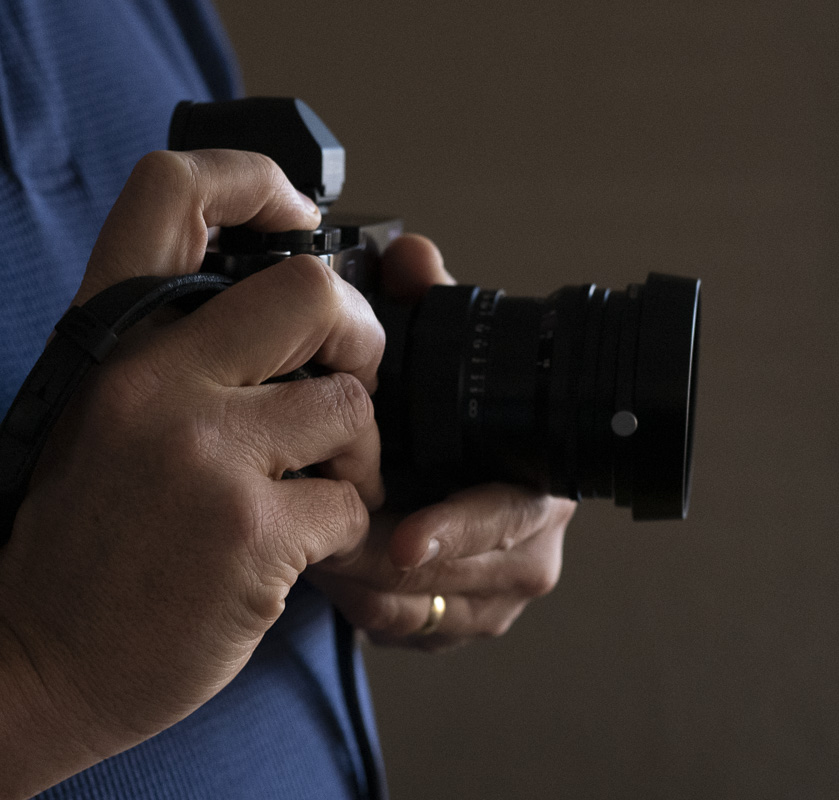
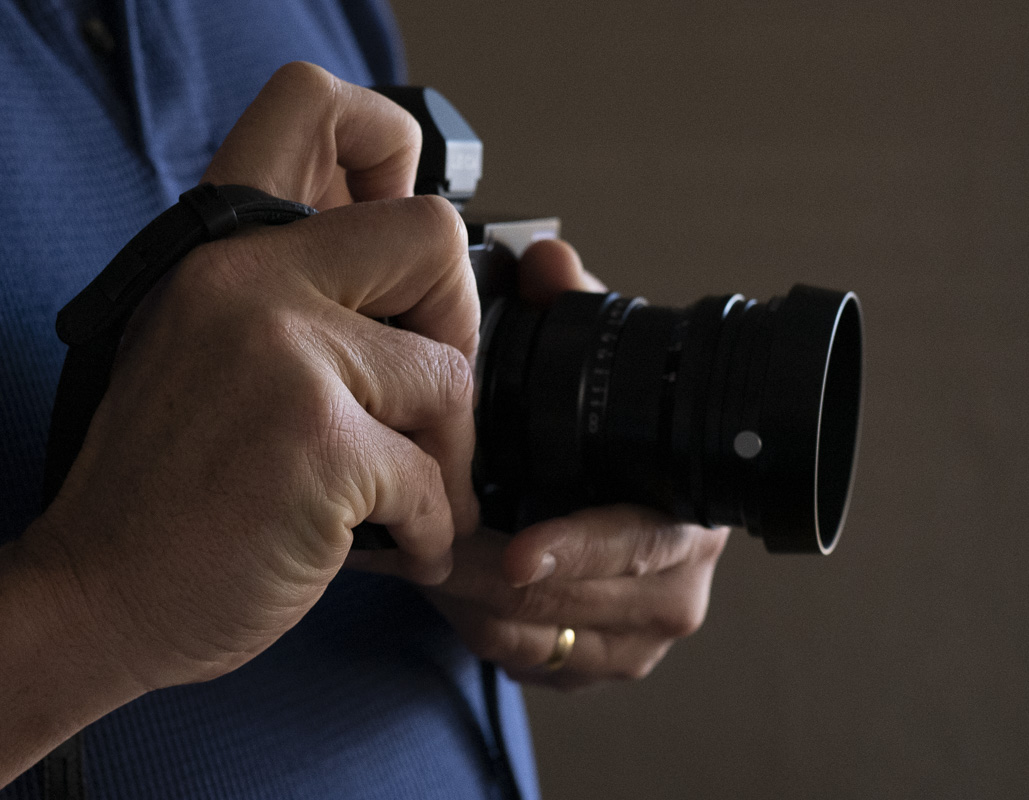
Edited on Feb 21, 2022 at 11:40 PM · View previous versions
I really miss being able to shoot with slower shutter speeds with IBIS
Prior to getting my first Leica (CL), I was concerned about the lack of IBIS. But, I reminded myself that back in the day, I could routinely shoot two stops below 1:1 SS:FL with the old Nikon FE.
Early on, it was a bit of an issue. Found that I needed to be more considerate of either raising the ISO a couple stops, or just underexpose a bit. I found that the noise pattern was more pleasing to me than with other cameras, if I did raise the ISO significantly. That's not to say it has less noise than some other cameras, but less intrusive noise (imo). That said, mostly to convey that I'm aware of the leaning on IBIS, too.
I sold my CL on the premise (rumor) that the CL2 was going to release last year and would have IBIS. Well, that never happened.
Since then, I've acquired my M-P (240) and found that my technique has improved. Along with this, my desire for IBIS is no longer commandeering my thoughts, regarding slower shutter speeds. Rather, I have come to realize that in those instances where I'm concerned about my technique ... I simply raise the ISO to what I find comfort with for the SS. Usually, that means a two stop bump. Big diff between 1/8 and 1/30. Not to suggest IBIS vs. non-IBIS debate, just a matter of how I've adapted sans IBIS.
And while that is all pretty fundamental stuff, the other issue I would point out is regarding technique.
As a reference, for those who have shot firearms, they know how critical trigger control impacts accuracy (i.e. imparting physical movement into the firearm). I would suggest that ours is much the same. Finding the finger position that mechanically transfers the least amount of force to the body is easily worth that stop or two.
I tend to think of it like shooting an 1911 with a 2 lb pull, and a crisp break, instead of shooting something with a long, heavy pull. When we've been accustomed to shooting with a different portion of the finger, it can make for relearning a different muscle memory.
For me, I find that when I use the pad of my fingertip, I achieve mediocre results ... the kind that make me want IBIS. However, when I "crook" my finger, so that the the very tip is vertically aligned to the axis of the shutter release, two things happen:
1) The force being applied is most efficient (trigonometry), and thus requires less external force to be applied. To the degree that I'm "off axis", then more force is required, and that force is in a non-axis direction, thereby inputting rogue directional force.
2) When my finger is "crooked", it becomes very "reflexive". The connection between my eye and my finger become much more intertwined. Now, I'm no longer "pressing" the shutter, but it's more of an autonomous "twitch". By that, it's like there is spring tension (muscle / potential energy) in holding up the "crook", Then, when my mind wants to capture the image, I "relax" the tension, which in turn brings the finger down and releases the shutter in a more reflex oriented way. I do wind up with a few frames taken that I didn't intend to sometimes ... but, no real harm there (unlike a firearm ID). Point being, it is a very efficient release, when I set up the kinetics well.
Now, the results afford me to return get those two stops back, and 1/8 is back on the table. 1/4 or slower are a bit sketchier, still ... but the point is to take regard of your technique.
And of course, this is a muscle memory thing ... so, just like shooting a firearm, it takes thousands of rounds to develop that superb trigger control. So it is for us that the muscle memory develops with time and consistency of use.
I know I used to look at the "funny way" people would hold their Leica, and think how odd. Now, I have my own "funny way" of holding it when I want to use the slowest SS possible and/or want that "reflexive" shutter release (i.e. trying to hold it this way ALL the time ... still building MM on my grip.)
A bit long, but hopefully there's a nugget in there fer ya.
A couple shots (could be better, but you get the gist) to demonstrate.
Take note of the joints as pivot points, linkages and levers for applying force. We spend a great deal of money and applaud the engineering involved with great mechanical devices ... and then, we get sloppy when using them and blame the device.
How you hold yours may be different, but it can be a bit surprising how much difference something so seemingly small can make. Try out different positions and run plenty of test shots to find what works best for you. Then, once you've proven it to yourself, commit to developing the muscle memory ... the rewards are yours to be had.
Edited on Feb 21, 2022 at 11:40 PM · View previous versions
Feb 20, 2022 at 09:19 AM
p.2 #6Learning Leica "M", a 30 day project
1bwana1 wrote:
For me, my motivation has nothing to do with anything about my Sony a1 experience. I am still loving that system as much as I ever have. I see the Leica M system as an "and" not an "or". Hopefully it will provide me a different experience that will influence how I think about imaging. I fully intend to keep and use both systems.
-Steve-
One can, certainly, continue to love one’s pre-Leica camera(s)/system(s). I actually bought a Nikon-mount Zeiss Otus 85mm ZF.2, at the same time I purchased my Summilux-M 50mm ASPH, and new M10, in April 2018. I had budgeted for a new or very-well-preserved, pre-owned Nikon “super-telephoto” lens, but, a left shoulder injury, plus, feeling age starting to catch up with me, prompted me to scuttle the plan to buy the huge, heavy Nikon lens. Instead, I bought a Leica lens, and camera, then added a perfect landscape lens, for the Nikon mount, in that order.
I had stumbled across images, reviews, and user reports, of the Leica Summilux-M 50mm ASPH, while researching 50mm SLR lenses. I knew that I wanted to try the 50 Summilux, before I had any idea that I would want to own a Leica M camera body. For some time, I had thought that I would buy a suitable mirror-deprived camera body, and an adapter, with which to use the Summilux. I had started using adapted Nikon lenses, on my Canon SLRs, by some time in 2011. This allowed my Nikon-devoted wife, and I, to share some lenses, which had normalized the use of high-quality adapters.
This particular pre-owned Summilux had been available, at this camera store, for some amount of time. I had tried it on demonstrator and/or pre-owned M9 and M Type 240 cameras, and liked the results, if not the viewfinder experience. Finally, on this visit, I told the employee that would buy the Summilux. She immediately got onto the computer, to pull the Summilux from the store’s on-line inventory.
Fortuitously, this was when M10 cameras were finally becoming available, for purchase, without the need to be on a waiting list. The employee asked the Leica specialist if an M10 might be available. Well, yes, two were available, and, they were willing to let me try the Summilux, on a new M10. Looking through the viewfinder, with my bespectacled eye, was a revelation. The M10 was a superior choice, for shooters who wear eyeglasses. I was easily hitting proper focus, with the lens wide-open. I “crunched the numbers,” which included Texas 8.25% sales tax. I told them that I was buying that M10.
At that point, the grail-quest for the 400/2.8, 600/4, or even 800mm Nikkor super-telephoto was dead, as, having just retired, I knew that I would not be able to budget such a large sum, again, in the foreseeable future, but I did not mourn. Instead, I bought the Otus, for Nikon mount, which had already been an alternate grail-quest.
Later, we got a very good deal on a pre-owned 500mm f/4E Nikon lens. This one is light enough for use to realistically carry, while chasing birds and wildlife, and I can shoot with it, hand-held, for meaningful periods of time. My becoming distracted, and adding the Leica M system, resulted in a better Nikon bird/wildlife lens, that cost thousands of US dollars less than the exotic monster lenses that had been the original goal.
To end this, with Leica gear, I love the way an M10 renders my wife’s skin tones. That, alone, would have been worth the price of admission. Life is good.

Edited on Feb 20, 2022 at 09:37 AM · View previous versions
For me, my motivation has nothing to do with anything about my Sony a1 experience. I am still loving that system as much as I ever have. I see the Leica M system as an "and" not an "or". Hopefully it will provide me a different experience that will influence how I think about imaging. I fully intend to keep and use both systems.
-Steve-
One can, certainly, continue to love one’s pre-Leica camera(s)/system(s). I actually bought a Nikon-mount Zeiss Otus 85mm ZF.2, at the same time I purchased my Summilux-M 50mm ASPH, and new M10, in April 2018. I had budgeted for a new or very-well-preserved, pre-owned Nikon “super-telephoto” lens, but, a left shoulder injury, plus, feeling age starting to catch up with me, prompted me to scuttle the plan to buy the huge, heavy Nikon lens. Instead, I bought a Leica lens, and camera, then added a perfect landscape lens, for the Nikon mount, in that order.
I had stumbled across images, reviews, and user reports, of the Leica Summilux-M 50mm ASPH, while researching 50mm SLR lenses. I knew that I wanted to try the 50 Summilux, before I had any idea that I would want to own a Leica M camera body. For some time, I had thought that I would buy a suitable mirror-deprived camera body, and an adapter, with which to use the Summilux. I had started using adapted Nikon lenses, on my Canon SLRs, by some time in 2011. This allowed my Nikon-devoted wife, and I, to share some lenses, which had normalized the use of high-quality adapters.
This particular pre-owned Summilux had been available, at this camera store, for some amount of time. I had tried it on demonstrator and/or pre-owned M9 and M Type 240 cameras, and liked the results, if not the viewfinder experience. Finally, on this visit, I told the employee that would buy the Summilux. She immediately got onto the computer, to pull the Summilux from the store’s on-line inventory.
Fortuitously, this was when M10 cameras were finally becoming available, for purchase, without the need to be on a waiting list. The employee asked the Leica specialist if an M10 might be available. Well, yes, two were available, and, they were willing to let me try the Summilux, on a new M10. Looking through the viewfinder, with my bespectacled eye, was a revelation. The M10 was a superior choice, for shooters who wear eyeglasses. I was easily hitting proper focus, with the lens wide-open. I “crunched the numbers,” which included Texas 8.25% sales tax. I told them that I was buying that M10.
At that point, the grail-quest for the 400/2.8, 600/4, or even 800mm Nikkor super-telephoto was dead, as, having just retired, I knew that I would not be able to budget such a large sum, again, in the foreseeable future, but I did not mourn. Instead, I bought the Otus, for Nikon mount, which had already been an alternate grail-quest.
Later, we got a very good deal on a pre-owned 500mm f/4E Nikon lens. This one is light enough for use to realistically carry, while chasing birds and wildlife, and I can shoot with it, hand-held, for meaningful periods of time. My becoming distracted, and adding the Leica M system, resulted in a better Nikon bird/wildlife lens, that cost thousands of US dollars less than the exotic monster lenses that had been the original goal.
To end this, with Leica gear, I love the way an M10 renders my wife’s skin tones. That, alone, would have been worth the price of admission. Life is good.
Edited on Feb 20, 2022 at 09:37 AM · View previous versions
Feb 20, 2022 at 09:30 AM
p.2 #7Learning Leica "M", a 30 day project
1bwana1 wrote:
Day 1 image:
So, after all of that, here is my first image post using the Leica M10-P and the CV 28mm Ultron. I made it using the Zone Focus method. I picked the mural on the wall because I liked it, and waited for someone to walk by presenting an opportunity for some interest. I seem to have been able to get both the focus, and the exposure (used the EC dial to protect highlights in the high contrast lighting) within a good range.
The EXIF data is useless because it reflects the wrong lens, which I had set manually and...Show more →
Wrong lens code: it won’t be the last time! It last happened to me on Friday, twice to boot! It’s one of my mental checklist items that I run through numerous times during an outing and a priority one when changing lenses if an uncoded one is in the mix. It’s the reason I eventually caught it, but clearly I was not being attentive enough during lens changes. This after more than 10 years using digital Ms.
It also reminded me of one other checklist item. Similar to Gordon’s advice to reset settings after each scene, I do an end of session run through of basic menu settings and bring them back to my preferred starting point, then turn the camera off. At least with the M240, doing so saves these settings in its memory and should the camera flake out (lock up) and I need to pull the battery, it will return to those settings, rather than whatever it was set to the last time it was properly turned off (if I hadn’t done my usual end of session ‘reset’). The M10-P might behave differently? My M lockups tend to happen when I’m in the middle of working a scene when I might be pushing the camera and paying less attention to certain menu settings. I’m more preoccupied with popping the battery and getting back to what I was shooting. I don’t want to spend time running through menu items for mismatches. So if I didn’t do my ‘reset’ before the last proper shutdown and it was set to a high ISO and a manual lens code, this is what will be set after popping out the battery for the ‘reboot’ and will probably mess up some shots before I catch it.
Exposure: I do a lot of my photography in daylight and know what the full sun exposure is at base ISO, and set this manually. If the light intensity doesn’t change, the settings don’t change. If the subject is backlit or in shade, I will adjust from the full sun exposure starting point. I generally don’t use auto ISO or aperture priority and do test shots, if light changes and time allows, to confirm exposure (checking the histogram). My intention is to get exposure in the ballpark while protecting highlights and fine tune exposure later in post. If my manually set exposure is a bit off, I prefer it to be consistently off for a session so that the selects get the same general tweaks in post, saving some time there.
Lens caps: leave them at home. Use a protective filter if you’re concerned about the exposed front element. Last thing I want is to forget the front cap is on and start shooting. Unlike every other system that is TTL viewing, the M isn’t (with the OVF).
Feb 20, 2022 at 09:33 AM
p.2 #8Learning Leica "M", a 30 day project
rscheffler wrote:
So, after all of that, here is my first image post using the Leica M10-P and the CV 28mm Ultron. I made it using the Zone Focus method. I picked the mural on the wall because I liked it, and waited for someone to walk by presenting an opportunity for some interest. I seem to have been able to get both the focus, and the exposure (used the EC dial to protect highlights in the high contrast lighting) within a good range.
The EXIF data is useless because it reflects the wrong lens, which I had set manually and forgot to switch when I switched lenses. DUH!Wrong lens code: it won’t be the last time! It last happened to me on Friday, twice to boot! It’s one of my mental checklist items that I run through numerous times during an outing and a priority one when changing lenses if an uncoded one is in the mix. It’s the reason I eventually caught it, but clearly I was not being attentive enough during lens changes. This after more than 10 years using digital Ms.
It also reminded me of one other checklist item. Similar to Gordon’s advice to reset settings after each scene, I do an end...Show more →
+1 for Sunny 16 and understanding basic EV values.
Often, folks tend to think that Sunny 16 is only suitable for Sunny conditions. But, as you are armed with the knowledge of what your incident lighting value is (incident meter, test shot, gray card / green grass, Sunny 16, etc.), this is liberating to be exposing for the light (incident metering) falling on / illuminating, rather than exposing for the subject (reflective metering).
https://en.wikipedia.org/wiki/Exposure_value
For all the excellence in today's advanced camera metering systems ... at their core ... they are STILL a REFLECTIVE metering device (with various levels of programming to try and decipher how much light is falling on the subject, based on the assumptions in the programming), not an INCIDENT metering device. Imo, this is one of the most glossed over aspects of metering / exposure that many folks don't understand what / why the difference it makes. When one understands and uses incident lighting as the basis for their exposure ... the reflective "in camera" metering takes on a different relevance.
There are times that I may use AV and reflective metering, but I prefer to lean toward understanding what the incident light is ... and then, I can use that knowledge to achieve my goals for an image (normal, low key, high key, etc.).
The main thing (imo) is to understand how exposing for the incident light vs. the subject's reflectance can be so simple, once you've established it. Kinda hard to fool an incident meter (not that anyone carries one anymore), but reflective meters get fooled routinely.
Edited on Feb 20, 2022 at 11:02 AM · View previous versions
1bwana1 wrote
Day 1 image:So, after all of that, here is my first image post using the Leica M10-P and the CV 28mm Ultron. I made it using the Zone Focus method. I picked the mural on the wall because I liked it, and waited for someone to walk by presenting an opportunity for some interest. I seem to have been able to get both the focus, and the exposure (used the EC dial to protect highlights in the high contrast lighting) within a good range.
The EXIF data is useless because it reflects the wrong lens, which I had set manually and forgot to switch when I switched lenses. DUH!
It also reminded me of one other checklist item. Similar to Gordon’s advice to reset settings after each scene, I do an end...Show more →
+1 for Sunny 16 and understanding basic EV values.
Often, folks tend to think that Sunny 16 is only suitable for Sunny conditions. But, as you are armed with the knowledge of what your incident lighting value is (incident meter, test shot, gray card / green grass, Sunny 16, etc.), this is liberating to be exposing for the light (incident metering) falling on / illuminating, rather than exposing for the subject (reflective metering).
https://en.wikipedia.org/wiki/Exposure_value
For all the excellence in today's advanced camera metering systems ... at their core ... they are STILL a REFLECTIVE metering device (with various levels of programming to try and decipher how much light is falling on the subject, based on the assumptions in the programming), not an INCIDENT metering device. Imo, this is one of the most glossed over aspects of metering / exposure that many folks don't understand what / why the difference it makes. When one understands and uses incident lighting as the basis for their exposure ... the reflective "in camera" metering takes on a different relevance.
There are times that I may use AV and reflective metering, but I prefer to lean toward understanding what the incident light is ... and then, I can use that knowledge to achieve my goals for an image (normal, low key, high key, etc.).
The main thing (imo) is to understand how exposing for the incident light vs. the subject's reflectance can be so simple, once you've established it. Kinda hard to fool an incident meter (not that anyone carries one anymore), but reflective meters get fooled routinely.
Edited on Feb 20, 2022 at 11:02 AM · View previous versions
Feb 20, 2022 at 09:51 AM
p.2 #9Learning Leica "M", a 30 day project
Day Two Image:
Thanks for all the support and advise after the day one image was posted. As always I appreciate your interest and efforts.
Some of your comments turned out to be prescient. Ron's warning about the lens cap in particular. I shot some great images through the Range Finder. However, when I went to review them on the rear screen they were all black. Yes, I had left the lens cap on. I lost about 10 images. Plus, once again I shot the whole session with the wrong lens set in the camera again. That darn Range Finder has no idea what the lens and sensor are seeing. I must learn to not rely on that. I am guessing this won't be the last time that I make these simple mistakes.

Yesterday afternoon was another perfect day here in La Jolla. I am blessed to live here. I live on Mt Soledad overlooking the City of San Diego, the Bay, and the Pacific Ocean. Nearby at the top of the mountain, there is a memorial to veterans of the U.S. Military Service Branches. It has amazing views, and is a popular spot for tourists. Especially when the weather is like it was yesterday. I reasoned that the activity and views up there would provide some great practice opportunities.
The image I have selected to post is of a Veteran from Arizona that had come to the memorial to visit the plaque for a soldier who had had served with in Iraq, and had lost there. He saw me take the image, so came over and told me his story. He asked if I would send a copy to him that he could share with some of his other troop mates. I of course instantly agreed. Luckily, I did get the focus and exposure the way I had intended. Progress! Once again I relied on the wide DOF and ease of Zone focus with the 28mm to take the image.
Normally I tend to avoid shooting in bright sunny days due to the high contrast. But, I am finding that there is something about the way the Leica camera handles the shadows, and blacks, that I really like. This is probably not the result of the sensor, but something in the Maestro Image Processor. I have decided to embrace and explore shadows, blacks, and tonality, more. Learning....
I am still being pleasantly surprised at how well I can shoot this camera hand held compared to my Sony system. It is not that much lighter, or smaller. I think it comes down to balance, and possibly hand position. An unexpected benefit.
In addition to my one image for this thread, I posted another from the shoot in the M image thread. I just love the way this camera handles tones.
https://www.fredmiranda.com/forum/topic/920070/1922#15869346
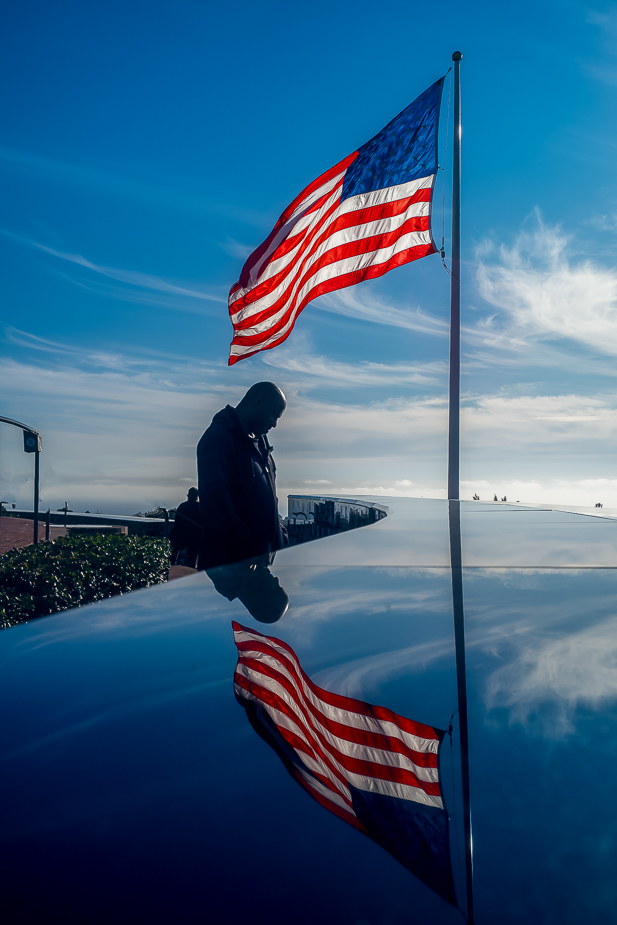
Edited on Feb 20, 2022 at 11:11 AM · View previous versions
Thanks for all the support and advise after the day one image was posted. As always I appreciate your interest and efforts.
Some of your comments turned out to be prescient. Ron's warning about the lens cap in particular. I shot some great images through the Range Finder. However, when I went to review them on the rear screen they were all black. Yes, I had left the lens cap on. I lost about 10 images. Plus, once again I shot the whole session with the wrong lens set in the camera again.
That darn Range Finder has no idea what the lens and sensor are seeing. I must learn to not rely on that. I am guessing this won't be the last time that I make these simple mistakes. Yesterday afternoon was another perfect day here in La Jolla. I am blessed to live here. I live on Mt Soledad overlooking the City of San Diego, the Bay, and the Pacific Ocean. Nearby at the top of the mountain, there is a memorial to veterans of the U.S. Military Service Branches. It has amazing views, and is a popular spot for tourists. Especially when the weather is like it was yesterday. I reasoned that the activity and views up there would provide some great practice opportunities.
The image I have selected to post is of a Veteran from Arizona that had come to the memorial to visit the plaque for a soldier who had had served with in Iraq, and had lost there. He saw me take the image, so came over and told me his story. He asked if I would send a copy to him that he could share with some of his other troop mates. I of course instantly agreed. Luckily, I did get the focus and exposure the way I had intended. Progress! Once again I relied on the wide DOF and ease of Zone focus with the 28mm to take the image.
Normally I tend to avoid shooting in bright sunny days due to the high contrast. But, I am finding that there is something about the way the Leica camera handles the shadows, and blacks, that I really like. This is probably not the result of the sensor, but something in the Maestro Image Processor. I have decided to embrace and explore shadows, blacks, and tonality, more. Learning....
I am still being pleasantly surprised at how well I can shoot this camera hand held compared to my Sony system. It is not that much lighter, or smaller. I think it comes down to balance, and possibly hand position. An unexpected benefit.
In addition to my one image for this thread, I posted another from the shoot in the M image thread. I just love the way this camera handles tones.
https://www.fredmiranda.com/forum/topic/920070/1922#15869346
Edited on Feb 20, 2022 at 11:11 AM · View previous versions
Feb 20, 2022 at 10:57 AM
p.2 #10Learning Leica "M", a 30 day project
1bwana1 wrote:
Day Two Image:
Thanks for all the support and advise after the day one image was posted. AS always I appreciate your interest and efforts.
Some of your comments turned out to be prescient. Ron's warning about the lens cap in particular. I shot some great images through the Range Finder. However, when I went to review them on the rear screen they were all black. Yes, I had left the lens cap on. I lost about 10 images. Plus once again I shot the whole session with the wrong lens set in the camera again. That darn Range Finder has...Show more →
Dig the story.
The gestalt qualities of tones and handling, etc. ... enjoy.
Day Two Image:
Thanks for all the support and advise after the day one image was posted. AS always I appreciate your interest and efforts.
Some of your comments turned out to be prescient. Ron's warning about the lens cap in particular. I shot some great images through the Range Finder. However, when I went to review them on the rear screen they were all black. Yes, I had left the lens cap on. I lost about 10 images. Plus once again I shot the whole session with the wrong lens set in the camera again.
That darn Range Finder has...Show more →Dig the story.
The gestalt qualities of tones and handling, etc. ... enjoy.
Feb 20, 2022 at 11:06 AM
p.2 #11Learning Leica "M", a 30 day project
RustyBug wrote:
The gestalt qualities of tones and handling, etc. ... enjoy.
Gestalt may be the perfect word to describe what I am experiencing with this camera. The specs don't read as that impressive. However, somehow the whole is so much better than the parts.
After all both Gestalt, and Leica are German concepts.
Feb 20, 2022 at 11:16 AM
p.2 #12Learning Leica "M", a 30 day project
Interesting to compare shooting a weapon with taking photographs with a Leica. Bresson made a comparison decades ago. I agree that the techniques that go into firing a weapon can also help with steading a camera. Things like when Kent compared the shutter with the trigger. Also the way you hold the camera. I would also say breathing and controlling that can also help. We learned to breathe and squeeze. Breath out, relax and at the bottom of that breath squeeze the trigger. Never jerk it.
Feb 20, 2022 at 11:17 AM
p.2 #13Learning Leica "M", a 30 day project
airfrogusmc wrote:
Interesting to compare shooting a weapon with taking photographs with a Leica. Bresson made a comparison decades ago. I agree that the techniques that go into firing a weapon can also help with steading a camera. Things like when Kent compared the shutter with the trigger. Also the way you hold the camera. I would also say breathing and controlling that can also help. We learned to breathe and squeeze. Breath out, relax and at the bottom of that breath squeeze the trigger. Never jerk it.
Exactly the way I have often thought of it. I have tried to use those techniques I learned from shooting, but nerve damage gets in the way.
Feb 20, 2022 at 11:44 AM
p.2 #15Learning Leica "M", a 30 day project
1bwana1 wrote:
Exactly the way I have often thought of it. I have tried to use those techniques I learned from shooting, but nerve damage gets in the way.
Just a thought: Use the timer, perhaps, at least for some shots? This separates the act of pressing the button, from the actuation of the shutter. True, it is a “tripod” technique, but, why limit ourselves? Press the shutter button, then, steady, steady, steady, click. Rather than shoot like one would a modern centerfire firearm, visualize using a match-lock firearm, with an interval between pulling the trigger, and the actual propellant beginning its controlled burn, requiring the shooter to maintain a sight picture. Two seconds should be enough time to press the button, and then either maintain or refine the hold, before the shutter clicks.
I may be way off-base, here. If so, I apologize. I was just trying to imagine having to use my weakened right ring and/or little finger, to do something precise, and very important.
airfrogusmc wrote
Interesting to compare shooting a weapon with taking photographs with a Leica. Bresson made a comparison decades ago. I agree that the techniques that go into firing a weapon can also help with steading a camera. Things like when Kent compared the shutter with the trigger. Also the way you hold the camera. I would also say breathing and controlling that can also help. We learned to breathe and squeeze. Breath out, relax and at the bottom of that breath squeeze the trigger. Never jerk it.Just a thought: Use the timer, perhaps, at least for some shots? This separates the act of pressing the button, from the actuation of the shutter. True, it is a “tripod” technique, but, why limit ourselves? Press the shutter button, then, steady, steady, steady, click. Rather than shoot like one would a modern centerfire firearm, visualize using a match-lock firearm, with an interval between pulling the trigger, and the actual propellant beginning its controlled burn, requiring the shooter to maintain a sight picture. Two seconds should be enough time to press the button, and then either maintain or refine the hold, before the shutter clicks.
I may be way off-base, here. If so, I apologize. I was just trying to imagine having to use my weakened right ring and/or little finger, to do something precise, and very important.
Feb 20, 2022 at 12:45 PM
p.2 #16Learning Leica "M", a 30 day project
A few small tips you might find useful:
For stop down shooting or zone focus on the street, always focus from infinity to mfd. This way is way quicker than other way around. (because how fast/much you need turn the barrel) though remember the tab location (without the need for focus) is still the way to shoot for most cases.
For portrait and wide open shooting, always shoot from mfd to infinity to get more accurate focus and in case mis focused, you want it front focus than back focus for portrait. You can always fire a few shots during rangefinder patch aligning to do focus bracket for fast glass shooting but you want at least get the moment first.
The beauty of rangefinder focus is you can get a sense of distance before subject in focus judge from how far away the rangefinder patch match. This is very useful to capture the moment.
Feb 20, 2022 at 02:17 PM
p.2 #17Learning Leica "M", a 30 day project
1bwana1 wrote:
Day Two Image:
Thanks for all the support and advise after the day one image was posted. As always I appreciate your interest and efforts.
Some of your comments turned out to be prescient. Ron's warning about the lens cap in particular. I shot some great images through the Range Finder. However, when I went to review them on the rear screen they were all black. Yes, I had left the lens cap on. I lost about 10 images. Plus, once again I shot the whole session with the wrong lens set in the camera again. That darn Range Finder has...Show more →
This is a very very good image. You have a good eye. Scrolling through the story to reveal the image was powerful.
Gordon
p.s. Am I the only one tempted to see this in mono?
p.p.s. It is possible to code CV lenses. You'll need a coder template, some model paint and the appropriate code.
Day Two Image:
Thanks for all the support and advise after the day one image was posted. As always I appreciate your interest and efforts.
Some of your comments turned out to be prescient. Ron's warning about the lens cap in particular. I shot some great images through the Range Finder. However, when I went to review them on the rear screen they were all black. Yes, I had left the lens cap on. I lost about 10 images. Plus, once again I shot the whole session with the wrong lens set in the camera again.
That darn Range Finder has...Show more →This is a very very good image. You have a good eye. Scrolling through the story to reveal the image was powerful.
Gordon
p.s. Am I the only one tempted to see this in mono?
p.p.s. It is possible to code CV lenses. You'll need a coder template, some model paint and the appropriate code.
Feb 20, 2022 at 03:04 PM
p.2 #18Learning Leica "M", a 30 day project
RexGig0 wrote:
Just a thought: Use the timer, perhaps, at least for some shots? This separates the act of pressing the button, from the actuation of the shutter. True, it is a “tripod” technique, but, why limit ourselves? Press the shutter button, then, steady, steady, steady, click. Rather than shoot like one would a modern centerfire firearm, visualize using a match-lock firearm, with an interval between pulling the trigger, and the actual propellant beginning its controlled burn, requiring the shooter to maintain a sight picture. Two seconds should be enough time to press the button, and then either maintain or refine the...Show more →
No need to apologize. Comments are encouraged and welcomed. I have actually tried using the timer hand held. Not very useful for me. But as I have said, I am doing well hand holding the M10-P for some reason.
Steve
Feb 20, 2022 at 08:06 PM
p.2 #19Learning Leica "M", a 30 day project
zhangyue wrote:
A few small tips you might find useful:
For stop down shooting or zone focus on the street, always focus from infinity to mfd. This way is way quicker than other way around. (because how fast/much you need turn the barrel) though remember the tab location (without the need for focus) is still the way to shoot for most cases.
For portrait and wide open shooting, always shoot from mfd to infinity to get more accurate focus and in case mis focused, you want it front focus than back focus for portrait. You can always fire a few shots during...Show more →
Thanks for the tips Michael, I will give those techniques a try!
Steve
Feb 20, 2022 at 08:07 PM
p.2 #20Learning Leica "M", a 30 day project
flash wrote:
This is a very very good image. You have a good eye. Scrolling through the story to reveal the image was powerful.
Gordon
p.s. Am I the only one tempted to see this in mono?
p.p.s. It is possible to code CV lenses. You'll need a coder template, some model paint and the appropriate code.
Gordon, thanks for the kind words. I did try a mono version but I much prefered the color because of the impact of the flag in color.
-Steve-
Feb 20, 2022 at 08:09 PM