This topic is in the 2022 archive. You can read it and like its posts here. It is read only.
Archive 2022Learning Leica "M", a 30 day project
p.1 #1Learning Leica "M", a 30 day project
The recent thread on visiting a Leica Store to explore the Leica system resulted in a predictable way. I found the whole Leica system and culture interesting. In the end, I purchased a Leica camera and 3 lenses in order to give the system a longer term test. I intend this thread to be a continuation of what was started in the Store Visit thread, but focused on the learning aspect.
In order to make this thread as valuable as possible to others that find themselves to be "Leica Curious" like me, I encourage every one to contribute opinions on the gear, the process, their experiences, and of course "constructive" comments on the images I will be posting.
My starting Leica system consist of the following.
A Leica M10-P in Chrome Black
Voigtlander Ultron 28mm f/2.0 v1
Voigtlander Nokton 50mm f/1.5 II MC
Voigtlander Nokton 75mm f/1.5
Leica has a deserved reputation for being expensive. Yes, I find that to be true. However, there is a robust used market in Leica M equipment. The M mount is also well supported by third party lens makers. Because of this I was able to put together a reasonably current, high quality, system for about the price of my Sony a1 body only. Since, my anticipated use case for the M10-P is more limited than it is for my a1 system it will actually end up being far less expensive because my lens library will be so much smaller. I do feel I need to either add, or substitute a Leica lens(es) to my system in order to have a more pure Leica experience in the long term. But, what I have now will work for the learning phase, and give me time to more fully understand what I want in my mature Leica camera system. Price should not be a barrier for those who want to give the system a good try. Their are affordable "Leica gateway" options to be had.
So, now begins the process of learning to make images with a Leica M rangefinder camera. It is such a different process. This is exactly what I find so attractive. Hopefully, it will expand my photographic skills and most importantly vision. I consider my investment in Leica to be tuition in the school of photographic self study. Worth it to me.
It is my intention to use my Leica system to make and post in this thread one image a day for the next 30 days. I will "wear" the camera all day, and look for photographic opportunities. When time allows I will do more focused exercises to increase my skill levels in the various aspects required to become efficient with the gear I have.
So to that end I will get started.
Edited on Feb 19, 2022 at 11:45 AM · View previous versions
Feb 19, 2022 at 11:18 AM
p.1 #2Learning Leica "M", a 30 day project
I wish this will be a pleasurable experience. During the first 30 days, I'm sure there will be frustrating days but just stick to it and try to rely on the rangefinder only. You may need to add a diopter to it depending on your needs. The enjoyment happens when focusing/composing and when the mechanical dials and lens tab become second nature to you.
I started with similar lenses and by far the CV 75/1.5 was the most challenging to focus accurately with the RF, especially at close distance.
I started with similar lenses and by far the CV 75/1.5 was the most challenging to focus accurately with the RF, especially at close distance.
Feb 19, 2022 at 11:31 AM

p.1 #4Learning Leica "M", a 30 day project

I'm a little ahead of you in the journey ... but, not by that much (in the grand scheme of Leica). Will be very interesting to learn of your maiden voyage(s).
Bring on the pics.

Feb 19, 2022 at 11:40 AM
p.1 #5Learning Leica "M", a 30 day project
The setup:
Before going out to shoot I needed to set up the camera. Since it is a used camera, the first thing I did was reset the camera to how it comes from the factory. I wanted to configure each item myself as part of the learning process. While waiting for the camera to arrive, I downloaded and read the manual. Yes, I am one of those guys. I also watched a few YouTube videos on the menu system and setting up the camera.
During my initial research I felt that this was a very low tech system, with a very limited technology feature set. This view is likely very much influenced by the incredible feature set in my Sony a1 camera. It has literally taken months to get a grasp of that, and get a setup that works for me in all the different shooting genres I like to shoot. However, during the setup of the M10 I am beginning to see the how efficiently the camera has been designed. It gives me what I need to do what I anticipate using this camera for. Simple, easy, uncomplicated. A simple page count of the manuals for the two cameras confirms what I am seeing. Even more surprising is that there are a couple of areas where the M3 is more advanced than my a1. I will discuss these areas when I post in this thread images I made using them.
I have added two accessories so far. First, a soft shutter button. I have nerve damage in my right had due to an injury. This causes tremors that are worse under load. I can already say that the small form factor, shape of the camera, and hand position result in less shaking than when I shoot my a1. I find I can shoot at reasonable shutter speeds, and still get sharp hand held images. The lack of IBIS not a big issue for me it seems. That is a huge surprise and I am extremely pleased with this development.
A very elegant system.
Second, I have used a Peak Design leash strap. At 6'5" the leather strap that cam with the camera is just way too short. The size and weight of the M10 and lenses are such that it is not an issue to wear all day. The unmounted two lenses fit in a small pouch, or even in my pockets when walking about. No more big camera bag. Very pleased with this
That is it for my starting setup.
Before going out to shoot I needed to set up the camera. Since it is a used camera, the first thing I did was reset the camera to how it comes from the factory. I wanted to configure each item myself as part of the learning process. While waiting for the camera to arrive, I downloaded and read the manual. Yes, I am one of those guys.
I also watched a few YouTube videos on the menu system and setting up the camera. During my initial research I felt that this was a very low tech system, with a very limited technology feature set. This view is likely very much influenced by the incredible feature set in my Sony a1 camera. It has literally taken months to get a grasp of that, and get a setup that works for me in all the different shooting genres I like to shoot. However, during the setup of the M10 I am beginning to see the how efficiently the camera has been designed. It gives me what I need to do what I anticipate using this camera for. Simple, easy, uncomplicated. A simple page count of the manuals for the two cameras confirms what I am seeing. Even more surprising is that there are a couple of areas where the M3 is more advanced than my a1. I will discuss these areas when I post in this thread images I made using them.
I have added two accessories so far. First, a soft shutter button. I have nerve damage in my right had due to an injury. This causes tremors that are worse under load. I can already say that the small form factor, shape of the camera, and hand position result in less shaking than when I shoot my a1. I find I can shoot at reasonable shutter speeds, and still get sharp hand held images. The lack of IBIS not a big issue for me it seems. That is a huge surprise and I am extremely pleased with this development.
A very elegant system.
Second, I have used a Peak Design leash strap. At 6'5" the leather strap that cam with the camera is just way too short. The size and weight of the M10 and lenses are such that it is not an issue to wear all day. The unmounted two lenses fit in a small pouch, or even in my pockets when walking about. No more big camera bag. Very pleased with this
That is it for my starting setup.
Feb 19, 2022 at 11:44 AM
p.1 #6Learning Leica "M", a 30 day project
For zone focusing, here is a video for you:
Interesting article at B&H Explora:
https://www.bhphotovideo.com/explora/photography/tips-and-solutions/f8-and-be-there-a-beginner’s-guide-to-zone-focusing
Interesting article at B&H Explora:
https://www.bhphotovideo.com/explora/photography/tips-and-solutions/f8-and-be-there-a-beginner’s-guide-to-zone-focusing
Feb 19, 2022 at 11:45 AM
p.1 #7Learning Leica "M", a 30 day project
I am looking forward to your thoughts as I find myself heading in a similar direction, probably in the form of an M10M. I am especially interested in hearing your thoughts on how well the camera meters.
Feb 19, 2022 at 12:10 PM
p.1 #8Learning Leica "M", a 30 day project
heres another video on zone focus that decent
Feb 19, 2022 at 12:17 PM
p.1 #9Learning Leica "M", a 30 day project
1bwana1 wrote:
..
Second, I have used a Peak Design leash strap. At 6'5" the leather strap that cam with the camera is just way too short. ..
Daang, is/was there any race car driver taller than you?
For me the way to use a digital Leica M is to act like it is a film M. So you are very specific with your captures (no taking hundreds of snaps then picking out the good ones) which makes it a much more satisfying experience. And definitely try to only use the RF.
The serious upside with learning the M way on a digicam vs film is that you're not wasting film while you do!
Have fun!
Feb 19, 2022 at 12:23 PM
p.1 #10Learning Leica "M", a 30 day project
I have never had any issues with metering on any of my M cameras. One just needs to learn to use M meters. Understand that with Leica M digital you do not have the head room in the highlights/shoulder that you might have in other cameras.
I don't shoot in any auto modes so what I do before I start shooting is I meter the bright side of the street and then take a test shot and see where my highlights are falling. remember the correct exposre for that. Meter the darker or shadow side. Do a test shot and remember what the corrcet exposure is for that and I am set. The more you do it the more it becomes second nature.
Edited on Feb 20, 2022 at 10:53 AM · View previous versions
Feb 19, 2022 at 12:25 PM
p.1 #11Learning Leica "M", a 30 day project
Day 1 image:
Yesterday afternoon I had a little time before dinner to begin the image shooting. I went down to Tourmaline Surfing Beach.
I decided to use only the CV 28mm f/2 Ultron v1 to shoot with. It is the easiest to get focus with because of the focal length. I walked around picking random subjects to practice with the range finder. I was pleasantly surprised that I didn't have as much trouble getting sharply focused subjects as I had anticipated. I found that is I started from a known position, and used a single motion stopping when aligned I got a decent hit rate. However, if I blew past this point and had to go back and forth it was more difficult. This seemed to work well for me at all apertures.
So far my focus using the Range Finder is one move to alignment, instantly push the shutter on alignment.
I also experimented with using Zone Focusing as well. To do this I sat in a single place, estimated the distance to the subject, and the DOF that I thought I would want. I then tried to set lens up appropriately. When I got it right it works brilliantly. Super fast to capture any opportunities in the zone. I had plenty of light, so pretty much settled on f/8 for this. Plenty of DOF at 28mm.
I was surprised at how much more difficulty I had getting spot on exposures. I am used to a WYSYWIG environment where it is instinctive for me to manage Aperture and shutter speed to fine tune exposures. That is definitely not the case with the Range Finder. It does work on the M10 using the rear screen, but I am not allowing myself to do it that way. The symbols and numbers I get in the Range Finder do not yet translate to auto adjustments I need to make at this time. The metering system also seems a little less precise than what I am used to. The good news is that I did get better as the session wore on. But I feel I have a lot of techniques I will need to develop to get this nailed down in the large range of lighting conditions I expect to encounter.
Like exposure, framing through the Range Finder is also not instinctive for me. I chose the 28mm FL to start with because it is very close to filling the Range Finder frame. Lots of practice needed here too.
All in all I find that shooting the M10 through the Range Finder is a level of abstraction away from the image you are making on the sensor. This will require me to develop a clear pre-vision of what image I am trying to make, and have techniques in my toolkit to get me there. Instinctively I feel that this will make me a better photographer in the end.
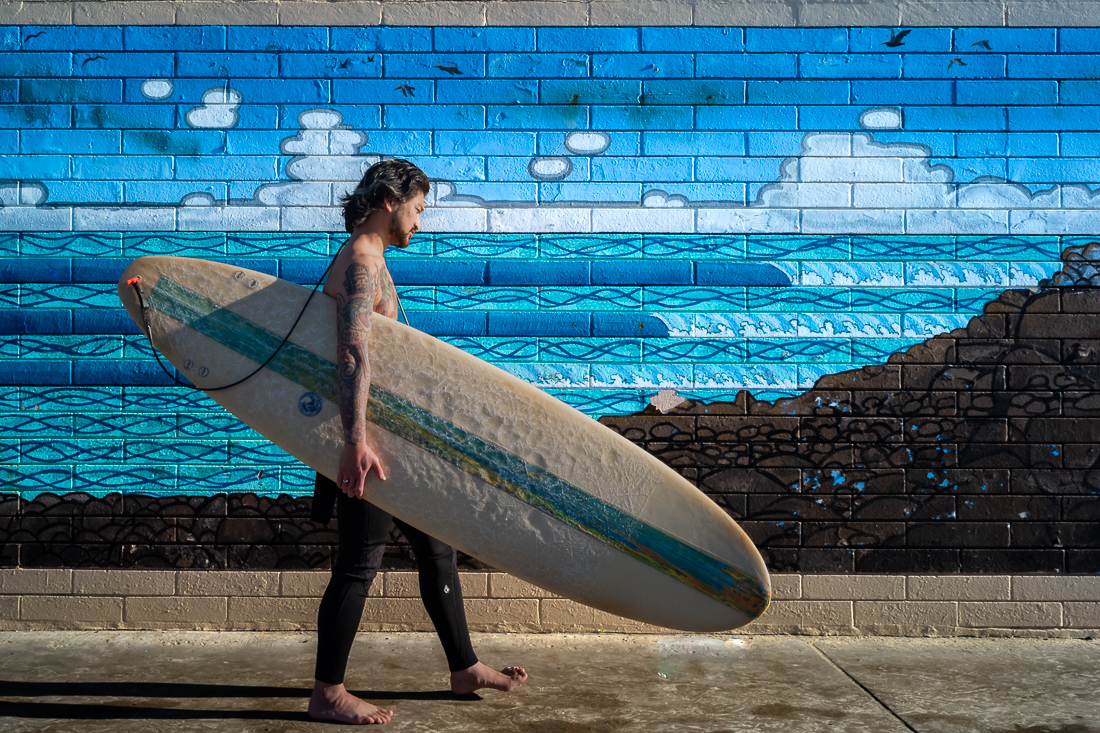
So, after all of that, here is my first image post using the Leica M10-P and the CV 28mm Ultron. I made it using the Zone Focus method. I picked the mural on the wall because I liked it, and waited for someone to walk by presenting an opportunity for some interest. I seem to have been able to get both the focus, and the exposure (used the EC dial to protect highlights in the high contrast lighting) within a good range.
The EXIF data is useless because it reflects the wrong lens, which I had set manually and forgot to switch when I switched lenses. DUH!
Enjoy!
Edited on Feb 19, 2022 at 12:37 PM · View previous versions
Yesterday afternoon I had a little time before dinner to begin the image shooting. I went down to Tourmaline Surfing Beach.
I decided to use only the CV 28mm f/2 Ultron v1 to shoot with. It is the easiest to get focus with because of the focal length. I walked around picking random subjects to practice with the range finder. I was pleasantly surprised that I didn't have as much trouble getting sharply focused subjects as I had anticipated. I found that is I started from a known position, and used a single motion stopping when aligned I got a decent hit rate. However, if I blew past this point and had to go back and forth it was more difficult. This seemed to work well for me at all apertures.
So far my focus using the Range Finder is one move to alignment, instantly push the shutter on alignment.
I also experimented with using Zone Focusing as well. To do this I sat in a single place, estimated the distance to the subject, and the DOF that I thought I would want. I then tried to set lens up appropriately. When I got it right it works brilliantly. Super fast to capture any opportunities in the zone. I had plenty of light, so pretty much settled on f/8 for this. Plenty of DOF at 28mm.
I was surprised at how much more difficulty I had getting spot on exposures. I am used to a WYSYWIG environment where it is instinctive for me to manage Aperture and shutter speed to fine tune exposures. That is definitely not the case with the Range Finder. It does work on the M10 using the rear screen, but I am not allowing myself to do it that way. The symbols and numbers I get in the Range Finder do not yet translate to auto adjustments I need to make at this time. The metering system also seems a little less precise than what I am used to. The good news is that I did get better as the session wore on. But I feel I have a lot of techniques I will need to develop to get this nailed down in the large range of lighting conditions I expect to encounter.
Like exposure, framing through the Range Finder is also not instinctive for me. I chose the 28mm FL to start with because it is very close to filling the Range Finder frame. Lots of practice needed here too.
All in all I find that shooting the M10 through the Range Finder is a level of abstraction away from the image you are making on the sensor. This will require me to develop a clear pre-vision of what image I am trying to make, and have techniques in my toolkit to get me there. Instinctively I feel that this will make me a better photographer in the end.
So, after all of that, here is my first image post using the Leica M10-P and the CV 28mm Ultron. I made it using the Zone Focus method. I picked the mural on the wall because I liked it, and waited for someone to walk by presenting an opportunity for some interest. I seem to have been able to get both the focus, and the exposure (used the EC dial to protect highlights in the high contrast lighting) within a good range.
The EXIF data is useless because it reflects the wrong lens, which I had set manually and forgot to switch when I switched lenses. DUH!
Enjoy!
Edited on Feb 19, 2022 at 12:37 PM · View previous versions
Feb 19, 2022 at 12:26 PM
p.1 #12Learning Leica "M", a 30 day project
My advice is learn to zone focus. 
Feb 19, 2022 at 12:31 PM
p.1 #13Learning Leica "M", a 30 day project
Desmolicious wrote:
Daang, is/was there any race car driver taller than you?
Yes, there are a few others I know. But yes, it was often a problem and we are limited to which series we can drive in. Most open wheel formula series are out. Cars must be custom built in many cases. Sharing with co-drivers can also be a problem. But it worked out.
Same with my other favorite sport which is surfing. It was fine in the long board days but a big competitive disadvantage in small waves with short boards.
Feb 19, 2022 at 12:35 PM
p.1 #14Learning Leica "M", a 30 day project
theHUN wrote:
I am looking forward to your thoughts as I find myself heading in a similar direction, probably in the form of an M10M. I am especially interested in hearing your thoughts on how well the camera meters.
Happy to share. If you have some specific thing you want me to try let me know and I will try to do it.
The M10-M is monochrome. Is there a big big difference in how the sensor handles images when compared to just setting a regular M10 to monochrome?
Feb 19, 2022 at 12:40 PM
p.1 #15Learning Leica "M", a 30 day project
I have both the M 10 and the M 10 Mono and the M 10 Mono is still really good at 50,000 ISO. So it is better in low light than the M 10 and it is 40 MPs. Have to watch your highlights just like if you were shooting transparency film and/or other Leica M digital models. I think the original MM was the trickiest at handling highlights.
Feb 19, 2022 at 12:50 PM
p.1 #16Learning Leica "M", a 30 day project
I really hope you enjoy this journey. And a journey it is. M's reward experience, practice and muscle memory. hat's one of the reasons we don't like big changes in a new model. We don't want to have to retrain as much.
1. Get a Thumbie.
https://www.ebay.com.au/itm/294509157444?hash=item44921d1c44:g:7~4AAOxy3yNTfGz0&frcectupt=true
Perfect for any M user but maybe more for you with a hand injury. You can still access the hotshoe for the EVF or flash.
2. Practice. The more you use an M the better you become. There's no secret sauce. The M is a tactile camera. treat it like a fidgit spinner. Watching TV? Practice focusing on objects during the ads. Learn to change aperture by counting click on the lens.
3. Have a starting position. And return after each shot. It's different for everybody but for me it's f5.6 ISO 200 and infinity focus plus sunny 16 or shady f5.6. If I decide I want f4 it's two clicks to the left. Take the shot and then return to my base. I always focus from infinity in one movement (unless zone focusing). So I always know which direction to focus and where the tab is before I grab the camera. I know tab down is 1.5m on my 50mm APO.
4. Exposure: Learn your stops. Grass is 0. Caucassian skin is +1. African skin is -.5 to -.1.5. Mid day sky is +1.5, etc. Knowing these values, I use aperture priority and exposure compensation a lot. The M meter is basic but consistant. If in doubt protect the highlights. there's also sunny 16.
Gordon
Feb 19, 2022 at 05:33 PM
p.1 #17Learning Leica "M", a 30 day project
I didn’t buy a Leica camera, but did get Fred’s A7R II with Kolari mod to play around with M-mount lenses. My lenses are 21mm, 28mm and 40mm. I’d be very wary going longer than that because focusing becomes harder. I figure longer than that, I’d be better off using my other kits (MFT, Canon FF).
Curious about what you find.
I should add that I did buy my stuff but it’s just sitting there because it’s not exactly the kind of weather to shoot in. Northern East Coast issues…
Curious about what you find.
I should add that I did buy my stuff but it’s just sitting there because it’s not exactly the kind of weather to shoot in. Northern East Coast issues…
Feb 19, 2022 at 06:04 PM
p.1 #18Learning Leica "M", a 30 day project
30 day project? I also recommend checking in at 30 months and 30 years
Feb 19, 2022 at 07:45 PM
p.1 #19Learning Leica "M", a 30 day project
I'm kind of in a similar situation. I was shooting with a Sony A7R2, but the shooting experience left a lot to be desired for me. I had my most enjoyable and successful photography experiences when I was shooting a Nikon D700 with some Zeiss manual focus lenses. After moving to Sony, while the images might have been technically better, I lost a lot of inspiration and desire to shoot. Autofocus just isn't fun for me, and since this is just a hobby the fun is even more important than the end result.
I recently picked up a well used Leica M-P 240 in an attempt to rekindle the photographic inspiration. My kit includes a Voigtlander 21mm f/3.5, Voigtlander 35mm f/1.2 V3, 7Artisans 35mm f/2, Zeiss ZM 50mm f/2, and Voigtlander 90mm f/2.8. The kit is about half the weight of my old Nikon setup, which I'm looking forward to taking when travelling and on long hikes with a reasonably wide focal length range.
So far I'm having a lot of fun, I really like the mechanical and optical viewfinder experience. It motivates me to go and shoot, and I enjoy the experience even when the resulting photos are mediocre, which are all my fault. The image quality compared to my A7R2 is lacklustre, but adequate. Especially in low light it is a pretty big step down, however not problematic for my shooting style.
Getting used to the focusing has been a big challenge, although I usually get very close. It just takes more time for me, and there are some things that I didn't even realize that have made it more complicated. Depending on the subject, it can be very difficult to figure out when the viewfinder patch lines up since the viewpoint of the viewfinder and the rangefinder window are different. I have had several times when the difference in perspective has the two projecting very different images (reflections on a subject are one that can be very confusing). Since the depth of field from the projected images are basically infinite some surfaces with regular patterns can also be difficult to focus on. These would not be as difficult with a traditional SLR-style split prism, where the depth of field can be used as an indication and the two halves of the split prism are representing the same perspective. With wider lenses that have focusing tabs (or equivalent), zone focusing is great, even though I tend to shoot with shallower depth of field where it's not useful.
I really miss being able to shoot with slower shutter speeds with IBIS, even taking into consideration that the Leica rangefinder is a more stable platform generally. I also wish that it had a lower ISO range and/or faster shutter speeds. I can't afford an M11, which would help with the latter.
It will be interesting to see what other peoples experience are, especially those new to the Leica M system and rangefinders in general. Still not sure whether it will be a lasting setup for me, but I'm hoping it will.
Feb 19, 2022 at 09:26 PM
p.1 #20Learning Leica "M", a 30 day project
highdesertmesa wrote:
30 day project? I also recommend checking in at 30 months and 30 years
For me a project like this must have a start and end that is reasonable, and achievable.
You are correct however, and it is my hope that the learning and exploration lasts the rest of my life.
Thanks for contributing, it is always appreciated.
Feb 19, 2022 at 10:26 PM