This topic is in the 2021 archive. You can read it and like its posts here. It is read only.
Archive 2021New Voigtlander 50mm f/1 Nokton in January 2022
p.9 #1New Voigtlander 50mm f/1 Nokton in January 2022
nehemiahphoto wrote:
Why do we need a refresh on this? It's still very well corrected. Or are you just hoping for a different draw?
genji wrote:
Maybe create a companion for the 35mm Distagon ZM by refreshing the focal length to 28mm.
Or a modern ZM 50/1.4? The ZM35/1.4 is 'only' from 2014, IIRC. I still think of it as new, but maybe it's not.
nehemiahphoto wrote:
This I support entirely. And they could release a new 85mm too.
I'd be fine with them letting Cosina re-release the ZM85/2 with cheaper Japanese production than the originals made in Germany. I'm sure Cosina could also tweak the design to APO, or APO-lite to counter some of the strong purple fringing of the original. So long as they don't mess with the Sonnar rendering.
That said, there's already the VM75/1.5, so maybe there's not much point.
LarsHP wrote:
What I am thinking of here is the amount of vignetting in the mid frame more than the extreme corners. So, regarding measurements, measuring only light loss in the corners may not be as informative as looking at the exposure in the whole frame.
I had both 28mm Ultron Asph II and Summicron-M Asph II and did quite a bit of testing side by side (before selling the Leica lens). The Summicron vignettes normally, I would say, but the Ultron II shows no exposure difference at all between f/2 and f/2.4 in the corners. That half stop only seems to affect...Show more →
My observation with the 35/1.7 is that the quality of bokeh/rendering does not change, nor does exposure, in the outer frame between wide open and f/2. I'd have to go through the notes from my 21mm shootout from ~2013, but I think the VM21/1.8 might be similar.
An ultra fast 50mm with a lot of vignetting is the 7A 50/1.1. Like the VM50/1.0, its rear element extends a fair amount past the mount flange, to the point where some M-mount rear lens caps won't attach if its at the infinity hard stop. I still think the restriction of the narrow M mount and the necessity to accommodate the rangefinder flange complicates the effective reduction of vignetting with some lenses such at fast 50s.
Dec 19, 2021 at 11:28 PM
p.9 #2New Voigtlander 50mm f/1 Nokton in January 2022
mapgraphs wrote:
I would love to see examples of increased DOF in corners due to vignetting and samples of vignetting in midframe...
BastianK wrote:
Guess you can find some of what you are looking for here.
From your link it appears to be about difference in field curvature, not DoF caused by vignetting? (The only reference to increased DoF due to vignetting is your graphics, but that also seems to suggest some reverse field curvature.)
Dec 20, 2021 at 02:25 AM
p.9 #3New Voigtlander 50mm f/1 Nokton in January 2022
rscheffler wrote:
Or a modern ZM 50/1.4? The ZM35/1.4 is 'only' from 2014, IIRC. I still think of it as new, but maybe it's not.
A modern ZM 50/1.4 would be wonderful though we all know that, with Zeiss dead in the water, it’s never going to happen. As for the ZM 35/1.4, it is both relatively new and superb—I’m hard pressed to think of a lens less in need of a refresh.
Dec 20, 2021 at 03:38 AM
p.9 #4New Voigtlander 50mm f/1 Nokton in January 2022
Vignetting:
https://photographylife.com/what-is-vignetting
and,
https://www.red.com/red-101/lens-vignetting
"All types of vignetting appear more pronounced at far focusing distances and with lower crop factors, or when high contrast tonal curves are added in post production."
https://www.sciencedirect.com/topics/earth-and-planetary-sciences/vignetting
"Optical vignetting is caused by the physical dimensions of a multiple element lens. Rear elements are shaded by elements in front of them, which reduces the effective lens opening for off-axis incident light. The result is a gradual decrease of the light intensity towards the image periphery. "
There's no mention anywhere of increased sharpness in corners or light drop-off midfield...
Dec 20, 2021 at 05:49 AM
p.9 #5New Voigtlander 50mm f/1 Nokton in January 2022
cary.z wrote:
. Now... if only we can get a refresh on the ZM 35mm 1.4 Distagon...
What needs refreshing? The only thing I don't like about mine is the size. Is that your concern?
. Now... if only we can get a refresh on the ZM 35mm 1.4 Distagon...
What needs refreshing? The only thing I don't like about mine is the size. Is that your concern?
Dec 20, 2021 at 11:34 AM
p.9 #6New Voigtlander 50mm f/1 Nokton in January 2022
Yes precisely, aside from the size the lens is superb. Not sure how realistic it is to get it into a smaller package, though given Cosina’s pace lately surely someone there must have had given that a thought…? In your experience is its size a deciding factor in becoming your everyday carry?
Desmolicious wrote:
What needs refreshing? The only thing I don't like about mine is the size. Is that your concern?
Desmolicious wrote:
cary.z wrote
. Now... if only we can get a refresh on the ZM 35mm 1.4 Distagon...Dec 20, 2021 at 02:38 PM
p.9 #7New Voigtlander 50mm f/1 Nokton in January 2022
cary.z wrote:
Yes precisely, aside from the size the lens is superb. Not sure how realistic it is to get it into a smaller package, though given Cosina’s pace lately surely someone there must have had given that a thought…? In your experience is its size a deciding factor in becoming your everyday carry?
What needs refreshing? The only thing I don't like about mine is the size. Is that your concern?
Size blows. Optics are fantastic. A 35mm lens just should not be this big on a rangefinder camera - it really eats into the VF.
But the optics make it so hard to pass up.
It does prevent me from using it 'casually' as it spoils the balance of an M, at least for me.
Yes precisely, aside from the size the lens is superb. Not sure how realistic it is to get it into a smaller package, though given Cosina’s pace lately surely someone there must have had given that a thought…? In your experience is its size a deciding factor in becoming your everyday carry?
Desmolicious wrote
cary.z wrote
. Now... if only we can get a refresh on the ZM 35mm 1.4 Distagon...Size blows. Optics are fantastic. A 35mm lens just should not be this big on a rangefinder camera - it really eats into the VF.
But the optics make it so hard to pass up.
It does prevent me from using it 'casually' as it spoils the balance of an M, at least for me.
Dec 20, 2021 at 03:18 PM
p.9 #8New Voigtlander 50mm f/1 Nokton in January 2022
mapgraphs wrote:
Vignetting:
https://photographylife.com/what-is-vignetting
and,
https://www.red.com/red-101/lens-vignetting
"All types of vignetting appear more pronounced at far focusing distances and with lower crop factors, or when high contrast tonal curves are added in post production."
https://www.sciencedirect.com/topics/earth-and-planetary-sciences/vignetting
"Optical vignetting is caused by the physical dimensions of a multiple element lens. Rear elements are shaded by elements in front of them, which reduces the effective lens opening for off-axis incident light. The result is a gradual decrease of the light intensity towards the image periphery. "
There's no mention anywhere of increased sharpness in corners or light drop-off midfield...
I'll take a stab:
There isn't necessarily increased 'real' sharpness, rather a decreased amount of perceived off-axis blur (when focus is at a close or medium distance and one evaluates the quality of background OOF blur). The wide open off-axis blur is of similar (but not exact) quality to that when the lens is stopped down. Optical vignetting blocks peripheral areas of the sensor from seeing the full image circle of the lens when wide open, which acts as smaller aperture/diaphragm, resulting in a similar effect to stopping down, in terms of general depth of field characteristics/appearance. When the lens is stopped down past a certain amount, the aperture opening is small enough to avoid optical vignetting. All areas of the sensor see the full, smaller aperture opening through which all image-forming light passes (disregarding any sensor-related light loss from off-axis light rays), resulting in a more consistent across-frame rendering/character quality.
Maybe another way to think about it: a single OOF 'bokeh ball' is the blur of a specular light source and its size is directly related to the aperture. Wide open it's big. Stopped down, it's smaller. Put a specular light source on-axis at wide open, defocus it and note the size. Recompose to put it far off-axis. Note the change in size and shape - i.e. cats eyes. Light is effectively passing through a smaller aperture, though one that is not uniformly circular, which may influence how defocus in that region appears. Strong tendency for cats eyes correlates to a tendency for swirly OOF rendering. Stop the lens down enough and repeat the previous steps. Note that the now smaller OOF bokeh ball is consistent in appearance across the frame. IMO it's no coincidence that to 'calm down' or smooth the background OOF rendering of lenses, it's typical to stop them down 1-2 stops, which results in a more uniform background blur quality across the frame.
Out of curiosity and in the spirit of "no photos = no proof" I did a quick test to determine if my theory above holds water.
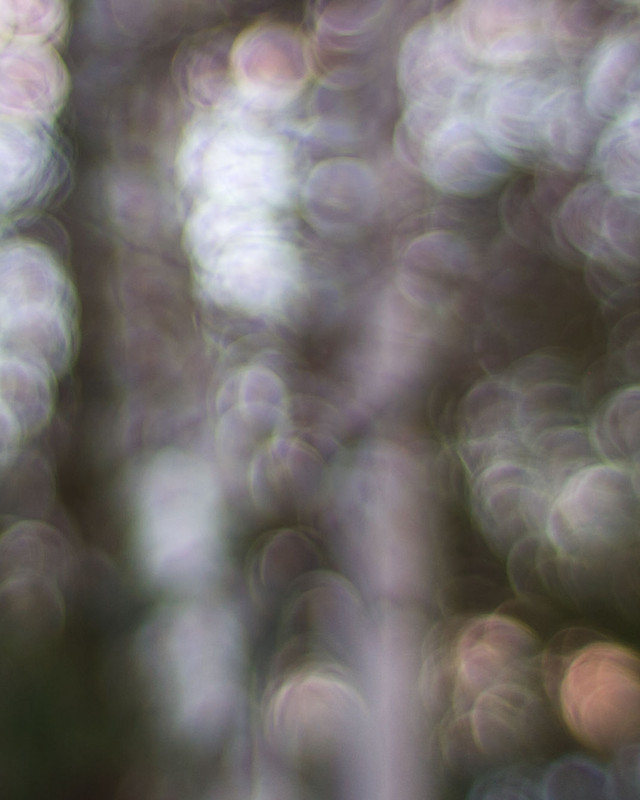
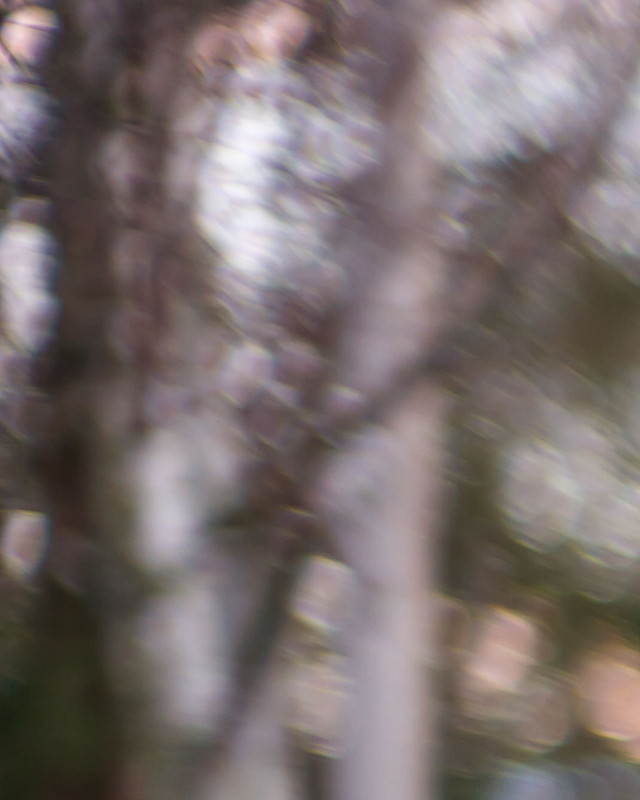
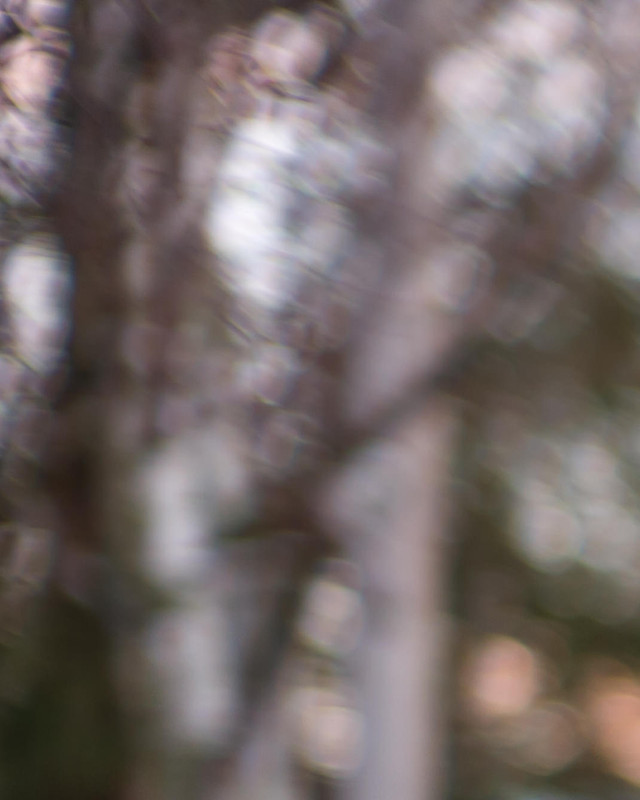
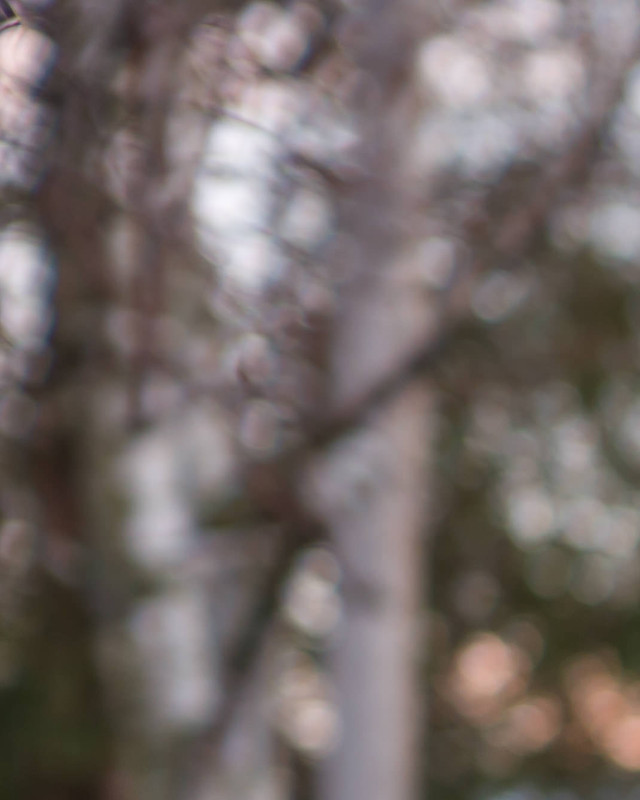
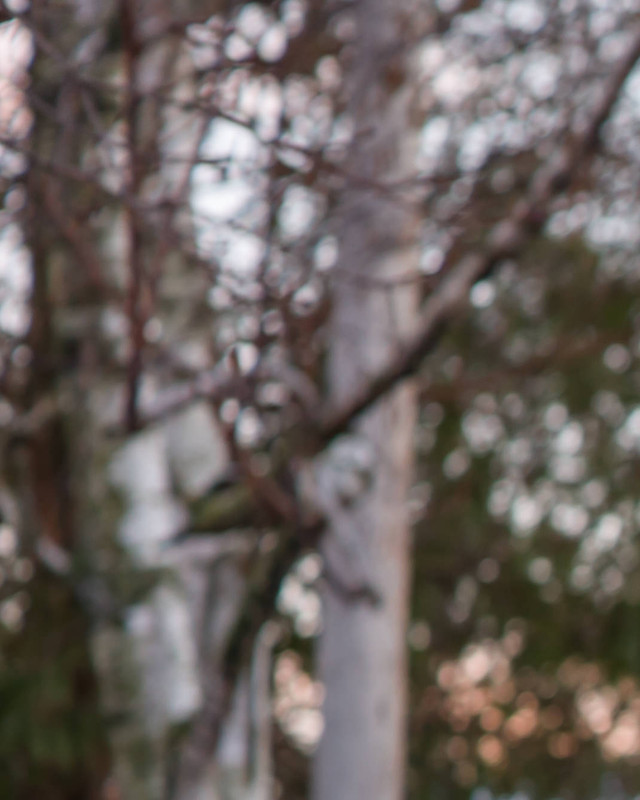
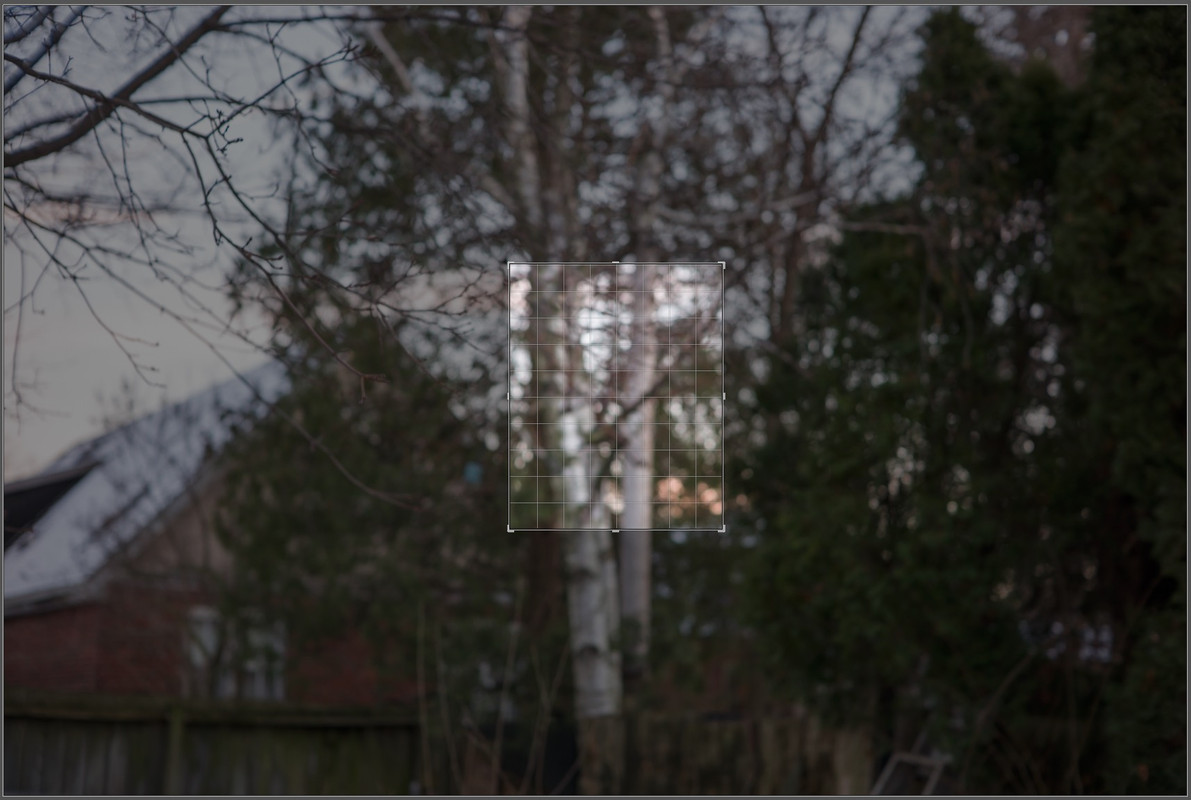
Below are images with the 7Artisans 50/1.1 on the M240 focused at 2m and aimed at bare trees in the background, probably about 7-8m away, shot from f/1.1 to f/4. Each aperture was shot with a specific area of trees at the center of the frame and then recomposed and shot again with that same area at the top left of the frame. I brought them into Lightroom and applied the same size crop to all images and tweaked exposures so they're all fairly similar. The edge crops required more exposure boost and you'll notice some color shift too, which I didn't correct. You'll also notice some perspective shift in the edge crops due to the change in framing.
Comparing center and edge crops from the same aperture, the edge crops show greater definition in the branches wide open and at f/1.4. At f/2 there is still slightly more definition in the edge crop.
To my eyes, the f/1.1 and f/1.4 edge crops have some definition that is similar to f/2 from the center of the frame, but it's not the same quality of blur, probably in part due to the non-circular shape of the OOF bokeh balls caused by optical vignetting.
Link to the gallery if anyone is interested in downloading and comparing: https://postimg.cc/gallery/bqWPdwT
Center f/1.1:
Edge f/1.1:
Center f/1.4:

Edge f/1.4:
Center f/2.0:

Edge f/2.0:
Center f/2.8:

Edge f/2.8:
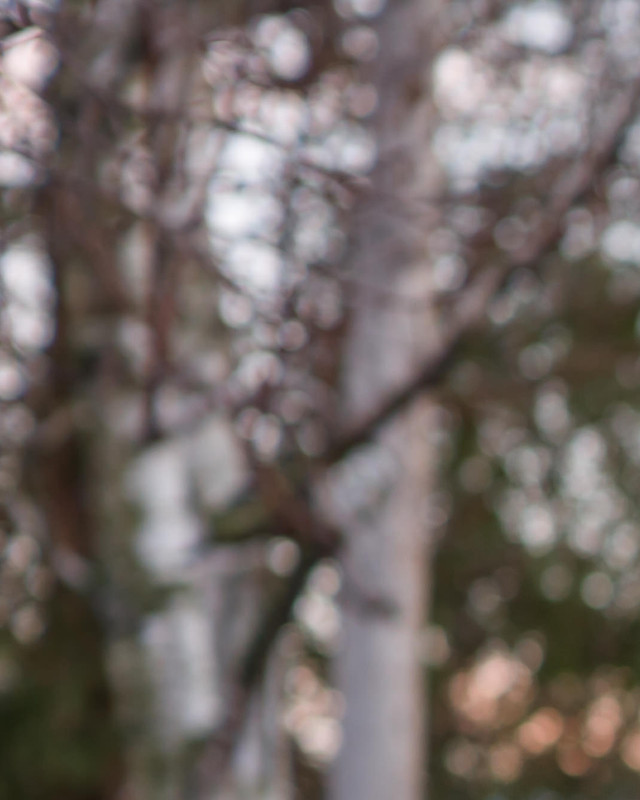
Center f/4.0:
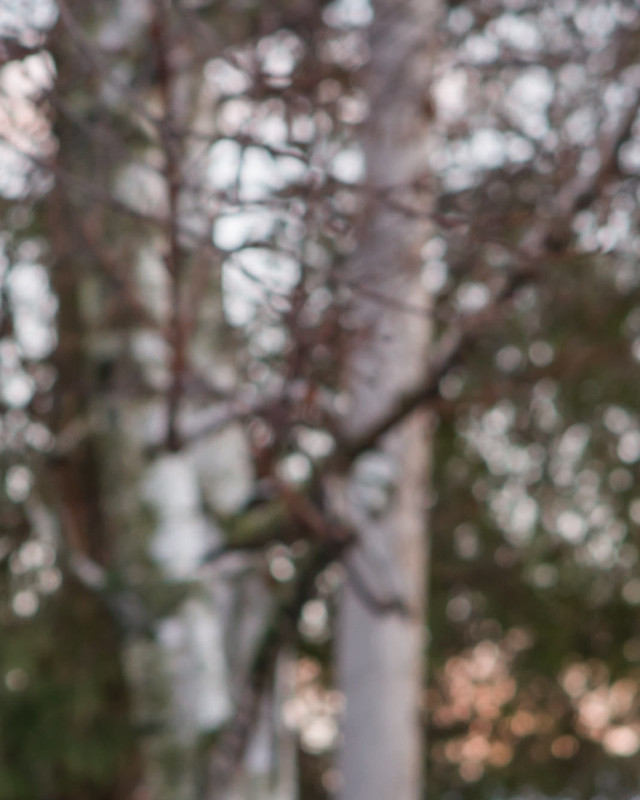
Edge f/4.0:
For reference, here's the overall frame with the crop in LR:
Edited on Dec 20, 2021 at 05:01 PM · View previous versions
Vignetting:
https://photographylife.com/what-is-vignetting
and,
https://www.red.com/red-101/lens-vignetting
"All types of vignetting appear more pronounced at far focusing distances and with lower crop factors, or when high contrast tonal curves are added in post production."
https://www.sciencedirect.com/topics/earth-and-planetary-sciences/vignetting
"Optical vignetting is caused by the physical dimensions of a multiple element lens. Rear elements are shaded by elements in front of them, which reduces the effective lens opening for off-axis incident light. The result is a gradual decrease of the light intensity towards the image periphery. "
There's no mention anywhere of increased sharpness in corners or light drop-off midfield...
I'll take a stab:
There isn't necessarily increased 'real' sharpness, rather a decreased amount of perceived off-axis blur (when focus is at a close or medium distance and one evaluates the quality of background OOF blur). The wide open off-axis blur is of similar (but not exact) quality to that when the lens is stopped down. Optical vignetting blocks peripheral areas of the sensor from seeing the full image circle of the lens when wide open, which acts as smaller aperture/diaphragm, resulting in a similar effect to stopping down, in terms of general depth of field characteristics/appearance. When the lens is stopped down past a certain amount, the aperture opening is small enough to avoid optical vignetting. All areas of the sensor see the full, smaller aperture opening through which all image-forming light passes (disregarding any sensor-related light loss from off-axis light rays), resulting in a more consistent across-frame rendering/character quality.
Maybe another way to think about it: a single OOF 'bokeh ball' is the blur of a specular light source and its size is directly related to the aperture. Wide open it's big. Stopped down, it's smaller. Put a specular light source on-axis at wide open, defocus it and note the size. Recompose to put it far off-axis. Note the change in size and shape - i.e. cats eyes. Light is effectively passing through a smaller aperture, though one that is not uniformly circular, which may influence how defocus in that region appears. Strong tendency for cats eyes correlates to a tendency for swirly OOF rendering. Stop the lens down enough and repeat the previous steps. Note that the now smaller OOF bokeh ball is consistent in appearance across the frame. IMO it's no coincidence that to 'calm down' or smooth the background OOF rendering of lenses, it's typical to stop them down 1-2 stops, which results in a more uniform background blur quality across the frame.
Out of curiosity and in the spirit of "no photos = no proof" I did a quick test to determine if my theory above holds water.
Below are images with the 7Artisans 50/1.1 on the M240 focused at 2m and aimed at bare trees in the background, probably about 7-8m away, shot from f/1.1 to f/4. Each aperture was shot with a specific area of trees at the center of the frame and then recomposed and shot again with that same area at the top left of the frame. I brought them into Lightroom and applied the same size crop to all images and tweaked exposures so they're all fairly similar. The edge crops required more exposure boost and you'll notice some color shift too, which I didn't correct. You'll also notice some perspective shift in the edge crops due to the change in framing.
Comparing center and edge crops from the same aperture, the edge crops show greater definition in the branches wide open and at f/1.4. At f/2 there is still slightly more definition in the edge crop.
To my eyes, the f/1.1 and f/1.4 edge crops have some definition that is similar to f/2 from the center of the frame, but it's not the same quality of blur, probably in part due to the non-circular shape of the OOF bokeh balls caused by optical vignetting.
Link to the gallery if anyone is interested in downloading and comparing: https://postimg.cc/gallery/bqWPdwT
Center f/1.1:
Edge f/1.1:
Center f/1.4:
Edge f/1.4:
Center f/2.0:
Edge f/2.0:
Center f/2.8:
Edge f/2.8:
Center f/4.0:
Edge f/4.0:
For reference, here's the overall frame with the crop in LR:
Edited on Dec 20, 2021 at 05:01 PM · View previous versions
Dec 20, 2021 at 04:39 PM
p.9 #9New Voigtlander 50mm f/1 Nokton in January 2022
rscheffler wrote:
https://photographylife.com/what-is-vignetting
and,
https://www.red.com/red-101/lens-vignetting
"All types of vignetting appear more pronounced at far focusing distances and with lower crop factors, or when high contrast tonal curves are added in post production."
https://www.sciencedirect.com/topics/earth-and-planetary-sciences/vignetting
"Optical vignetting is caused by the physical dimensions of a multiple element lens. Rear elements are shaded by elements in front of them, which reduces the effective lens opening for off-axis incident light. The result is a gradual decrease of the light intensity towards the image periphery. "
There's no mention anywhere of increased sharpness in corners or light drop-off midfield...I'll take a stab:
There isn't necessarily increased 'real' sharpness, rather a decreased amount of perceived off-axis blur (when focus is at a close or medium distance and one evaluates the quality of background OOF blur). The wide open off-axis blur is of similar (but not exact) quality to that when the lens is stopped down. Optical vignetting blocks peripheral areas of the sensor from seeing the full image circle of the lens when wide open, which acts as smaller aperture/diaphragm, resulting in a similar effect to stopping down, in terms of general depth of field characteristics/appearance. When the lens is...Show more →
Nice illustration, Ron. You might want to label your images with aperture and corner/center information.
I think this is not a rocket science if you think about how cat eye developed. The edge or corner pass through a effectively smaller aperture to hit the sensor compare to center and midframe. This obviously will increase DOF which is proportionally to aperture size.
https://i.stack.imgur.com/SuwoO.jpg
mapgraphs wrote
Vignetting:https://photographylife.com/what-is-vignetting
and,
https://www.red.com/red-101/lens-vignetting
"All types of vignetting appear more pronounced at far focusing distances and with lower crop factors, or when high contrast tonal curves are added in post production."
https://www.sciencedirect.com/topics/earth-and-planetary-sciences/vignetting
"Optical vignetting is caused by the physical dimensions of a multiple element lens. Rear elements are shaded by elements in front of them, which reduces the effective lens opening for off-axis incident light. The result is a gradual decrease of the light intensity towards the image periphery. "
There's no mention anywhere of increased sharpness in corners or light drop-off midfield...
There isn't necessarily increased 'real' sharpness, rather a decreased amount of perceived off-axis blur (when focus is at a close or medium distance and one evaluates the quality of background OOF blur). The wide open off-axis blur is of similar (but not exact) quality to that when the lens is stopped down. Optical vignetting blocks peripheral areas of the sensor from seeing the full image circle of the lens when wide open, which acts as smaller aperture/diaphragm, resulting in a similar effect to stopping down, in terms of general depth of field characteristics/appearance. When the lens is...Show more →
Nice illustration, Ron. You might want to label your images with aperture and corner/center information.
I think this is not a rocket science if you think about how cat eye developed. The edge or corner pass through a effectively smaller aperture to hit the sensor compare to center and midframe. This obviously will increase DOF which is proportionally to aperture size.
https://i.stack.imgur.com/SuwoO.jpg
Dec 20, 2021 at 04:55 PM
p.9 #10New Voigtlander 50mm f/1 Nokton in January 2022
Nice illustration, too!
zhangyue wrote:
Nice illustration, Ron. You might want label your image with aperture and corner/center information.
Thanks. I've already procrastinated finishing "real" work this afternoon and don't want to spend more time on this. Everyone will just have to read the text for the relevant info. I thought until f/2.8 it's pretty obvious.
zhangyue wrote:
I think this is not a rocket science if you think about how cat eye developed. The edge or corner pass through a effectively smaller aperture to hit the sensor compare to center and midframe. This obviously will increase DOF which is proportionally to aperture size.
The wide open lens example at the bottom left, with the off-axis perspective, you'll note though that the full wide open DOF effect still occurs for the part of the image formed from light coming through the full length of the 'cats eye' but not for the part across the narrow part. This is where difference in tangential and sagittal rendering complicates things. One will render based on wide open aperture and the other will render as though the lens was stopped down somewhat and mash that all together for something different than on-axis rendering wide open or stopped down.
IMO this is a reason why the wider aperture corner crops above have some definition similar to stopped down center crops, but not the same character/rendering.
zhangyue wrote:
Nice illustration, Ron. You might want label your image with aperture and corner/center information.
Thanks. I've already procrastinated finishing "real" work this afternoon and don't want to spend more time on this. Everyone will just have to read the text for the relevant info. I thought until f/2.8 it's pretty obvious.
zhangyue wrote:
I think this is not a rocket science if you think about how cat eye developed. The edge or corner pass through a effectively smaller aperture to hit the sensor compare to center and midframe. This obviously will increase DOF which is proportionally to aperture size.
The wide open lens example at the bottom left, with the off-axis perspective, you'll note though that the full wide open DOF effect still occurs for the part of the image formed from light coming through the full length of the 'cats eye' but not for the part across the narrow part. This is where difference in tangential and sagittal rendering complicates things. One will render based on wide open aperture and the other will render as though the lens was stopped down somewhat and mash that all together for something different than on-axis rendering wide open or stopped down.
IMO this is a reason why the wider aperture corner crops above have some definition similar to stopped down center crops, but not the same character/rendering.
Dec 20, 2021 at 04:59 PM
p.9 #11New Voigtlander 50mm f/1 Nokton in January 2022
rscheffler wrote:
Nice illustration, too!
Thanks. I've already procrastinated finishing "real" work this afternoon and don't want to spend more time on this. Everyone will just have to read the text for the relevant info. I thought until f/2.8 it's pretty obvious.
The wide open lens example at the bottom left, with the off-axis perspective, you'll note though that the full wide open DOF effect still occurs for the part of the image formed from light coming through the full length of the 'cats eye' but not for the part across the narrow part. This is where difference in tangential and sagittal rendering...Show more →
Yes, well stated and correct. It is also a reason that you can sometimes get the impression of "swirl," since the tangential and saggital planes rotate around as you go around the image (it is the saggital plane that always sees the full aperture).
Nice illustration, too!
zhangyue wrote
Nice illustration, Ron. You might want label your image with aperture and corner/center information.zhangyue wrote
I think this is not a rocket science if you think about how cat eye developed. The edge or corner pass through a effectively smaller aperture to hit the sensor compare to center and midframe. This obviously will increase DOF which is proportionally to aperture size.Yes, well stated and correct. It is also a reason that you can sometimes get the impression of "swirl," since the tangential and saggital planes rotate around as you go around the image (it is the saggital plane that always sees the full aperture).
Dec 20, 2021 at 05:26 PM
p.9 #12New Voigtlander 50mm f/1 Nokton in January 2022
rscheffler wrote:
https://photographylife.com/what-is-vignetting
and,
https://www.red.com/red-101/lens-vignetting
"All types of vignetting appear more pronounced at far focusing distances and with lower crop factors, or when high contrast tonal curves are added in post production."
https://www.sciencedirect.com/topics/earth-and-planetary-sciences/vignetting
"Optical vignetting is caused by the physical dimensions of a multiple element lens. Rear elements are shaded by elements in front of them, which reduces the effective lens opening for off-axis incident light. The result is a gradual decrease of the light intensity towards the image periphery. "
There's no mention anywhere of increased sharpness in corners or light drop-off midfield...I'll take a stab:
There isn't necessarily increased 'real' sharpness, rather a decreased amount of perceived off-axis blur (when focus is at a close or medium distance and one evaluates the quality of background OOF blur). The wide open off-axis blur is of similar (but not exact) quality to that when the lens is stopped down. Optical vignetting blocks peripheral areas of the sensor from seeing the full image circle of the lens when wide open, which acts as smaller aperture/diaphragm, resulting in a similar effect to stopping down, in terms of general depth of field characteristics/appearance. When the lens is...Show more →
Nice Ron. Good work and thank you.
mapgraphs wrote
Vignetting:https://photographylife.com/what-is-vignetting
and,
https://www.red.com/red-101/lens-vignetting
"All types of vignetting appear more pronounced at far focusing distances and with lower crop factors, or when high contrast tonal curves are added in post production."
https://www.sciencedirect.com/topics/earth-and-planetary-sciences/vignetting
"Optical vignetting is caused by the physical dimensions of a multiple element lens. Rear elements are shaded by elements in front of them, which reduces the effective lens opening for off-axis incident light. The result is a gradual decrease of the light intensity towards the image periphery. "
There's no mention anywhere of increased sharpness in corners or light drop-off midfield...
There isn't necessarily increased 'real' sharpness, rather a decreased amount of perceived off-axis blur (when focus is at a close or medium distance and one evaluates the quality of background OOF blur). The wide open off-axis blur is of similar (but not exact) quality to that when the lens is stopped down. Optical vignetting blocks peripheral areas of the sensor from seeing the full image circle of the lens when wide open, which acts as smaller aperture/diaphragm, resulting in a similar effect to stopping down, in terms of general depth of field characteristics/appearance. When the lens is...Show more →
Nice Ron. Good work and thank you.
Dec 20, 2021 at 06:08 PM
p.9 #13New Voigtlander 50mm f/1 Nokton in January 2022
photonoclast wrote:
Yes, well stated and correct. It is also a reason that you can sometimes get the impression of "swirl," since the tangential and saggital planes rotate around as you go around the image (it is the saggital plane that always sees the full aperture).
Thanks for confirming! I always get the directions of tangential and sagittal mixed up, so I tried to word it as vaguely as possible.
Dec 20, 2021 at 06:23 PM
p.9 #14New Voigtlander 50mm f/1 Nokton in January 2022
I haven’t touched my gear in over a year, and I really want this one.
Looks great.
Looks great.
Dec 20, 2021 at 07:42 PM
p.9 #15New Voigtlander 50mm f/1 Nokton in January 2022
LarsHP wrote:
What I am thinking of here is the amount of vignetting in the mid frame more than the extreme corners. So, regarding measurements, measuring only light loss in the corners may not be as informative as looking at the exposure in the whole frame.
I had both 28mm Ultron Asph II and Summicron-M Asph II and did quite a bit of testing side by side (before selling the Leica lens). The Summicron vignettes normally, I would say, but the Ultron II shows no exposure difference at all between f/2 and f/2.4 in the corners. That half stop only seems to affect...Show more →
So I spent some more time today looking at various lenses.
Below is a comparison of the 'bokeh ball' from the VM35/1.7 at 70cm. Light source is the LED of my phone at approximately 2m distance.
These are image pairs, starting at the upper left. The first is the wide open center crop, the second is the wide open crop of the upper right corner. The next pair is f/2.0 and then in full stops to f/5.6
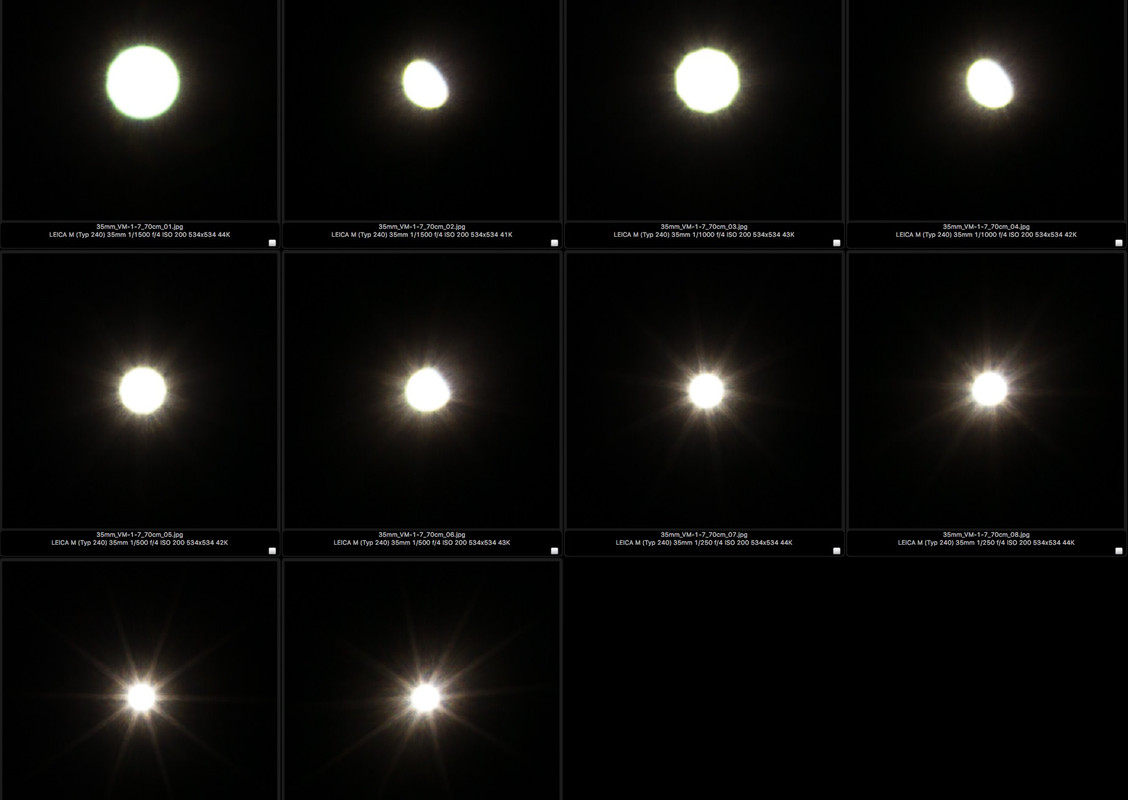
You'll see that the shape of the bokeh ball in the corner stays the same wide open and f/1.7, pretty much confirming my impression that in the image periphery the lens is not f/1.7.
And for the 7Artisans lens I used for the earlier images, I did the same:
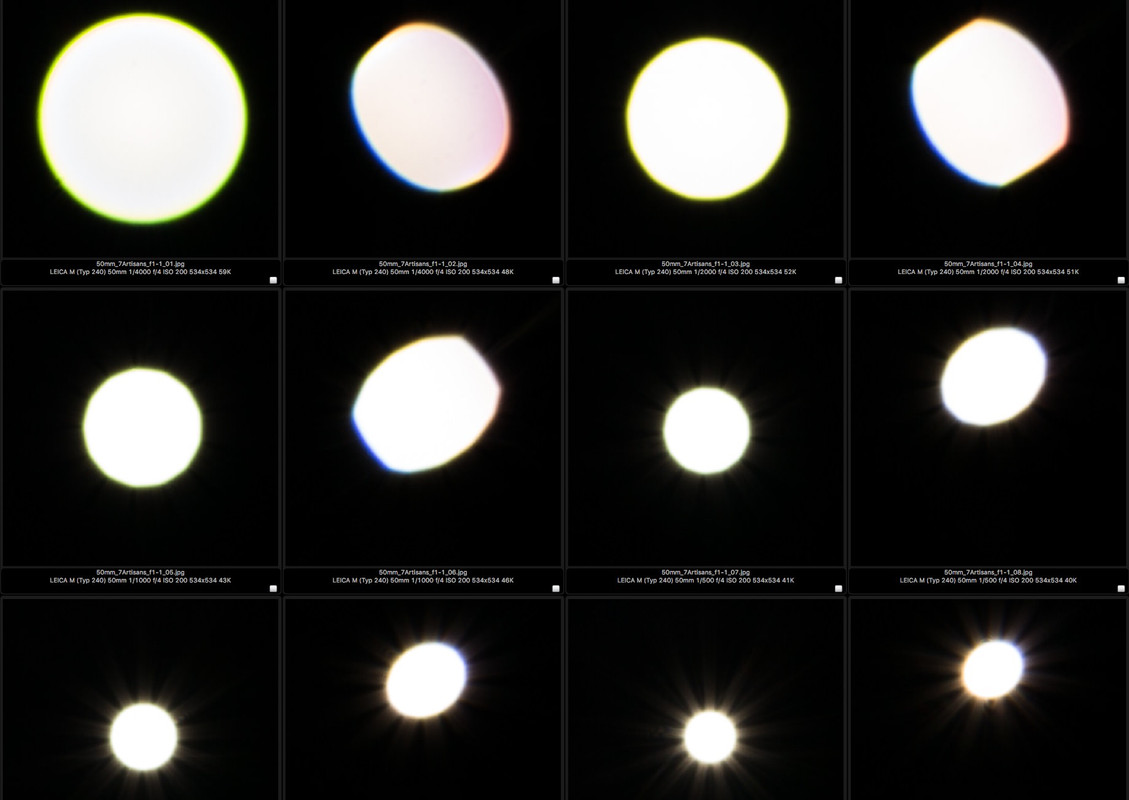
Here's the Leica 50 Lux ASPH for comparison. BTW, these were shot one after the other at pretty much the same distance, both focused at MFD. Note that the Lux appears to focus closer than 70cm on the focusing ring. Perhaps 65cm or so. Interestingly, the bokeh ball size wide open is pretty much the same. I guess the better comparison would be to shoot something at a fixed distance and compare background rendering.
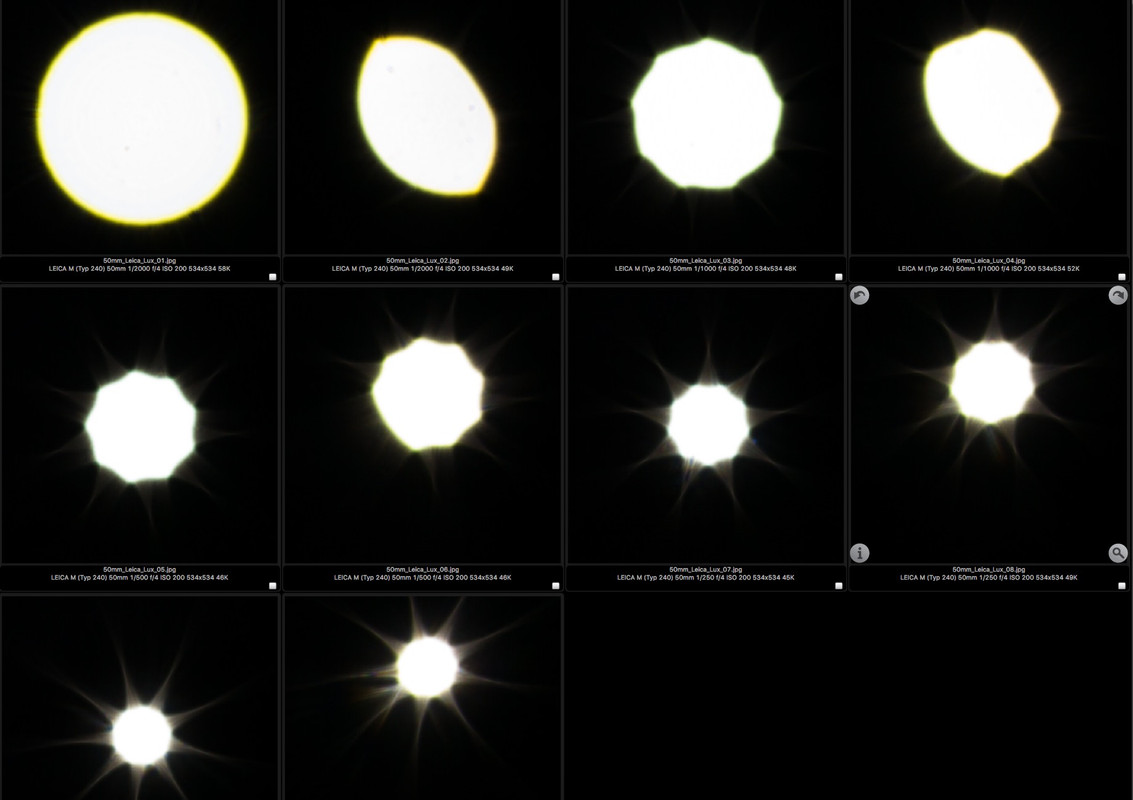
I also found it interesting that the circle projected by the Lux into the corner of the image more quickly becomes evenly circular/round (ignoring the ninja star shape due to the aperture blades). In comparison, stopped down the 7A projects an oblong bokeh ball that kind of 'smears' across the sensor. IOW, it's not projected as nearly perpendicular as the Lux, which would imply to me the 7A has a much shorter exit pupil distance. And this can be seen by looking at the aperture from the rear element. One can view the 7A's full, round aperture, say at f/5.6, from a much greater off-axis angle than one can with the Lux. But the Lux at f/2.8 is already projecting a nearly fully round image of the aperture opening, where as the 7A's is still cut off until f/4.
As some may know, the 50 Lux ASPH has a 'saw blade' or 'ninja star' aperture shape from f/2-5.6. In the images above f/4 and f/5.6 don't clearly show this saw blade shape because of the unique sunstar shape. In a normal situation where the specular light source of the bokeh balls wasn't so intensely overpowering compared to the rest of the scene, the saw blade shape would be clearly noticeable.
I made sets of comparison images for a bunch of M and LTM lenses I had at hand. Maybe I should start a new thread...
What I am thinking of here is the amount of vignetting in the mid frame more than the extreme corners. So, regarding measurements, measuring only light loss in the corners may not be as informative as looking at the exposure in the whole frame.
I had both 28mm Ultron Asph II and Summicron-M Asph II and did quite a bit of testing side by side (before selling the Leica lens). The Summicron vignettes normally, I would say, but the Ultron II shows no exposure difference at all between f/2 and f/2.4 in the corners. That half stop only seems to affect...Show more →
So I spent some more time today looking at various lenses.
Below is a comparison of the 'bokeh ball' from the VM35/1.7 at 70cm. Light source is the LED of my phone at approximately 2m distance.
These are image pairs, starting at the upper left. The first is the wide open center crop, the second is the wide open crop of the upper right corner. The next pair is f/2.0 and then in full stops to f/5.6
You'll see that the shape of the bokeh ball in the corner stays the same wide open and f/1.7, pretty much confirming my impression that in the image periphery the lens is not f/1.7.
And for the 7Artisans lens I used for the earlier images, I did the same:
Here's the Leica 50 Lux ASPH for comparison. BTW, these were shot one after the other at pretty much the same distance, both focused at MFD. Note that the Lux appears to focus closer than 70cm on the focusing ring. Perhaps 65cm or so. Interestingly, the bokeh ball size wide open is pretty much the same. I guess the better comparison would be to shoot something at a fixed distance and compare background rendering.
I also found it interesting that the circle projected by the Lux into the corner of the image more quickly becomes evenly circular/round (ignoring the ninja star shape due to the aperture blades). In comparison, stopped down the 7A projects an oblong bokeh ball that kind of 'smears' across the sensor. IOW, it's not projected as nearly perpendicular as the Lux, which would imply to me the 7A has a much shorter exit pupil distance. And this can be seen by looking at the aperture from the rear element. One can view the 7A's full, round aperture, say at f/5.6, from a much greater off-axis angle than one can with the Lux. But the Lux at f/2.8 is already projecting a nearly fully round image of the aperture opening, where as the 7A's is still cut off until f/4.
As some may know, the 50 Lux ASPH has a 'saw blade' or 'ninja star' aperture shape from f/2-5.6. In the images above f/4 and f/5.6 don't clearly show this saw blade shape because of the unique sunstar shape. In a normal situation where the specular light source of the bokeh balls wasn't so intensely overpowering compared to the rest of the scene, the saw blade shape would be clearly noticeable.
I made sets of comparison images for a bunch of M and LTM lenses I had at hand. Maybe I should start a new thread...
Dec 20, 2021 at 09:30 PM
p.9 #16New Voigtlander 50mm f/1 Nokton in January 2022
rscheffler wrote:
You'll see that the shape of the bokeh ball in the corner stays the same wide open and f/1.7, pretty much confirming my impression that in the image periphery the lens is not f/1.7.
Your assumption is already completely wrong from the start, as no lens has the stated aperture value in the corner.
The f-stop is measured in the center of the frame and at infinity.
When we leave perspective distortion out of the equation you can measure the effective f-stop by comparing
the area of light circles in the center of the frame and in the corner
(diameter would be easier, but due to the deteoriated shapes in the corners we have to take a detour and check the area first).
I did that for some lenses a few weeks ago, as I initally wanted to use this for my bokeh article
but after consulting with the Laowa lens designer decided to leave it out due to the inaccury caused by
the aforementioned perspective distortion.
Due to perspective distortion wider lenses will fare better than longer ones, so keep that in mind when judging the following lenses.
We start with something special, Sony FE 85mm 1.4 GM:
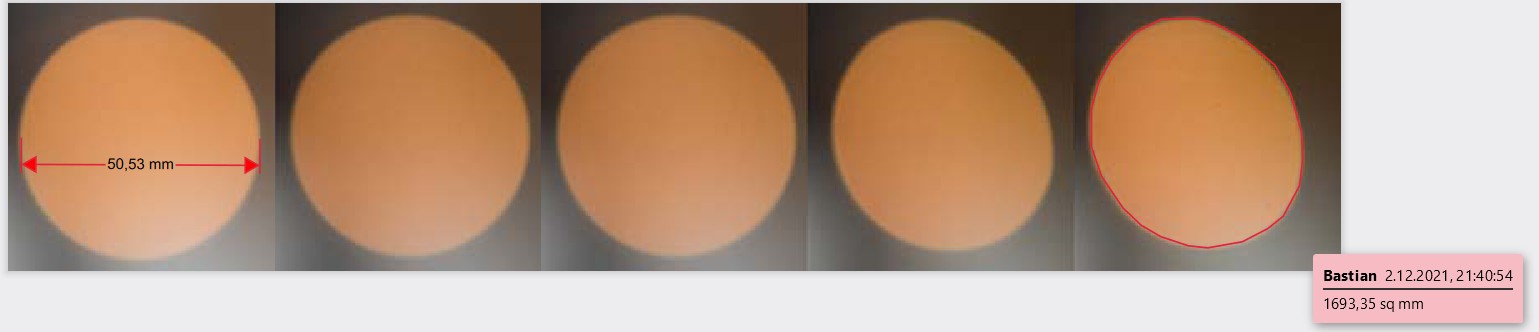
Area in the center is ~2000 (50.5mm diameter), corner is 1700 (equals diameter of 46.5mm), the unit is irrelevant here, only the ratio is important.
With an 85mm lens perspective distortion in the corners is very low, so we are getting a rather accurate value here.
Center f/1.4, corner f/1.4*50.5/46.5 = f/1.5
Laowa 45mm 0.95:
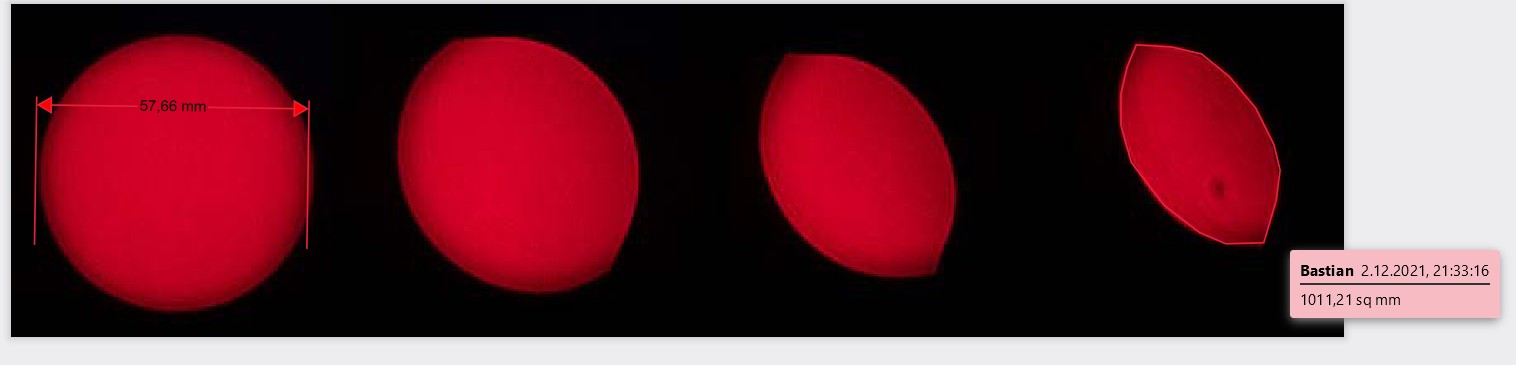
Center 2611 -> 57.7 diameter
Corner 1011 -> 35.9 diameter
Center f/0.95, corner f/0.95*57.7/35.9 = f/1.5
Laowa 35mm 0.95:
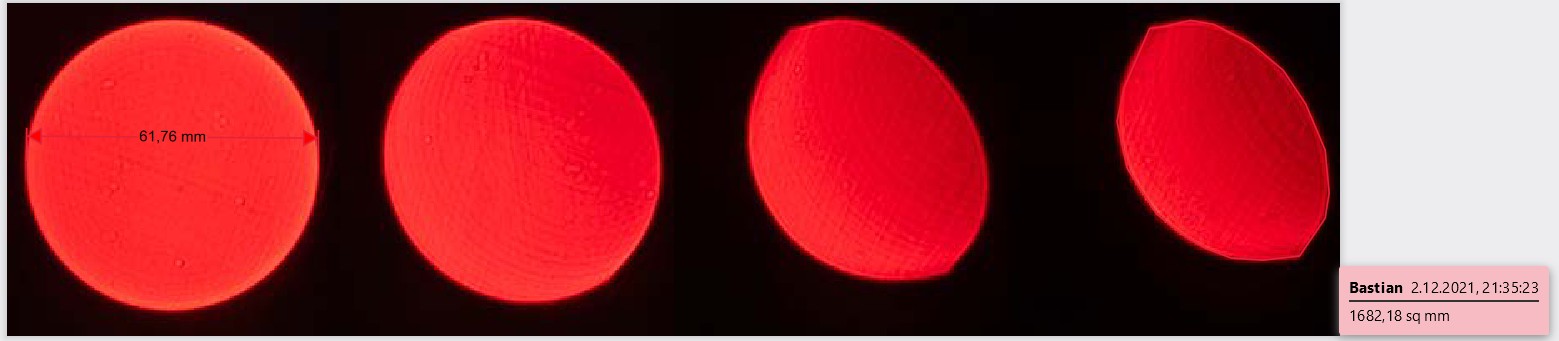
Center 3000 -> 61.8
Corner 1700 ->46.5
Center f/0.95, corner f/0.95*61.8/46.5 = f/1.27
*Caution: with a 35mm lens perspective distortion will have a bigger impact, so technically the 35mm is a bit worse than the numbers suggest.
PS:
There are several lenses that show little to no change in the corners on stopping down, a more recent example is the Sigma 35mm 1.2 Art DG DN:
f/1.2

f/1.4

The effective f-stop in the corner is something around f/1.7 with the Sigma lens (so obviously you will also have the depth of field of an f/1.7 lens here ).
Claiming that this lens is not f/1.2 is just as wrong as claiming the Voigtlander VM 35mm 1.7 is not an f/1.7 lens.
You'll see that the shape of the bokeh ball in the corner stays the same wide open and f/1.7, pretty much confirming my impression that in the image periphery the lens is not f/1.7.
Your assumption is already completely wrong from the start, as no lens has the stated aperture value in the corner.
The f-stop is measured in the center of the frame and at infinity.
When we leave perspective distortion out of the equation you can measure the effective f-stop by comparing
the area of light circles in the center of the frame and in the corner
(diameter would be easier, but due to the deteoriated shapes in the corners we have to take a detour and check the area first).
I did that for some lenses a few weeks ago, as I initally wanted to use this for my bokeh article
but after consulting with the Laowa lens designer decided to leave it out due to the inaccury caused by
the aforementioned perspective distortion.
Due to perspective distortion wider lenses will fare better than longer ones, so keep that in mind when judging the following lenses.
We start with something special, Sony FE 85mm 1.4 GM:
Area in the center is ~2000 (50.5mm diameter), corner is 1700 (equals diameter of 46.5mm), the unit is irrelevant here, only the ratio is important.
With an 85mm lens perspective distortion in the corners is very low, so we are getting a rather accurate value here.
Center f/1.4, corner f/1.4*50.5/46.5 = f/1.5
Laowa 45mm 0.95:
Center 2611 -> 57.7 diameter
Corner 1011 -> 35.9 diameter
Center f/0.95, corner f/0.95*57.7/35.9 = f/1.5
Laowa 35mm 0.95:
Center 3000 -> 61.8
Corner 1700 ->46.5
Center f/0.95, corner f/0.95*61.8/46.5 = f/1.27
*Caution: with a 35mm lens perspective distortion will have a bigger impact, so technically the 35mm is a bit worse than the numbers suggest.
PS:
There are several lenses that show little to no change in the corners on stopping down, a more recent example is the Sigma 35mm 1.2 Art DG DN:
f/1.2
f/1.4
The effective f-stop in the corner is something around f/1.7 with the Sigma lens (so obviously you will also have the depth of field of an f/1.7 lens here
).Claiming that this lens is not f/1.2 is just as wrong as claiming the Voigtlander VM 35mm 1.7 is not an f/1.7 lens.
Dec 21, 2021 at 02:57 AM
p.9 #17New Voigtlander 50mm f/1 Nokton in January 2022
BastianK wrote:
Claiming that this lens is not f/1.2 is just as wrong as claiming the Voigtlander VM 35mm 1.7 is not an f/1.7 lens.
Of course Bastian's excellent point is a definitional one in part. The F-stop is defined in terms of the centre and infinity like he says.
And, of course, real lenses wide open behave in the corners like somewhat less fast lenses (or like our fantasy of how somewhat less fast lenses perform in the corners - because those somewhat less fast lenses will in turn behave in the corners like less fast still lenses......): it's a rare lens that does not have more depth of field, for example, in the corners than in the centre wide open. This does of course vary a little from lens to lens. But I've never seen a wide to normal lens of any speed that doesn't have more DOF as well as light falloff in the corners...
Dec 21, 2021 at 04:05 AM
p.9 #18New Voigtlander 50mm f/1 Nokton in January 2022
Hm interesting but very theoretical discussion that's going on here.
With real lenses there are so many factors influencing bokeh / depth perception that it's impossible to narrow it down to one specific factor. For example the Voigtländer VM 35mm 1.7 also has significant field curvature, at least on non-Leica M bodies.
I think the best way to assess this is to just shoot the same subject(s) with different lenses and see how different the rendering /depth actually is
Dec 21, 2021 at 05:38 AM
p.9 #19New Voigtlander 50mm f/1 Nokton in January 2022
...and tweaked exposures so they're all fairly similar. The edge crops required more exposure boost
Vignetting is not Field Curvature and Field Curvature is not Vignetting. You can't use one to define the other. Lens speed or maximum Aperture is the focal length divided by the effective aperture diameter. Aperture is not Light Transmission (T value). Light Transmission is not Aperture. You can't use one to define the other.
Bottom line is that manipulating one file and comparing it to an unmanipulated file is comparing apples to walnuts.
It's the ubiquitous "... all I did was ..."
Dec 21, 2021 at 05:38 AM
p.9 #20New Voigtlander 50mm f/1 Nokton in January 2022
Thanks @BastianK@ and @rscheffler@ for your elaborate contributions regarding the impact of optical vignetting.
From the test Ron Scheffler did with the 7Artisans 50mm f/1.1, we have a visual demonstration that optical vignetting in fact causes more depth of field / less blur. This means theory matches reality. :-)
And thanks to Bastian Kratzke (via the lens designer at Laowa), we know we need to take image deformation into account when looking at bokeh balls far from the center with (rectilinear) wide angle lenses. (As I understand it, a fish-eye lens won't introduce this as much as a super-wide lens.)
After thinking more about it, I had both the Voigtländer 35mm f/1.2 Asph II and 21mm f/1.8 VM and don't recall them having that "hot spot" like the 50/1.2 and 28/2 II has. And in order to further adjust my initial comment about one brand vignetting more or less than the other, I should add that the Leica 90mm Summarit-M vignettes much more than the Elmarit-M, so much so that I don't see why one would get the Summarit-M over the Elmarit-M from a transmission or background blur viewpoint (in fact, I see no reason at all).
In order to get this thread back on track:
All - or much - of the above came out of the discussion whether the Nokton 50mm f/1.0 will have half a stop more blur than the f/1.2 version. It is obvious that this will be the case in the center. However, the amount of vignetting will determine how much difference there is between the two lenses we compare.
Judging by the size and how short the f/1 lens is, I expect it to perform reasonably well regarding vignetting.
Dec 21, 2021 at 07:35 AM