This topic is in the 2021 archive. You can read it and like its posts here. It is read only.
Archive 2021New Voigtlander 50mm f/1 Nokton in January 2022
p.10 #1New Voigtlander 50mm f/1 Nokton in January 2022
DavidBM wrote:
it's a rare lens that does not have more depth of field, for example, in the corners than in the centre wide open. This does of course vary a little from lens to lens. But I've never seen a wide to normal lens of any speed that doesn't have more DOF as well as light falloff in the corners...
I'd say it varies mostly with lens speed, where slower lenses generally give a lot less mechanical vignetting (and thus more uniform DOF across the frame) than fast lenses. This is one of many reasons that larger formats with slower lenses won't look the same as an otherwise equivalent image shot on a smaller format with a faster lens, even though DOF is roughly the same in the middle of the frame.
It's relatively easy to design an f/2.8 normal lens with very little mechanical vignetting, but it's difficult already at f/1.4, and more or less impossible at f/1.
Dec 21, 2021 at 07:59 AM
p.10 #2New Voigtlander 50mm f/1 Nokton in January 2022
Makten wrote:
I'd say it varies mostly with lens speed, where slower lenses generally give a lot less mechanical vignetting (and thus more uniform DOF across the frame) than fast lenses.
This is another claim I would like to see some proof for.
For the Zeiss Loxia 85mm 2.4 it is clearly not true:

A Leica 90mm 2.0 also does not do a better job than most f/1.4 lenses in this focal length range:

Lens makers rarely make the lens elements bigger than absolutely necessary, also with slower lenses.
I even have my doubts keeping optical vignetting in check has ever been a design criteria for any lens except for some of the Sony GM lenses.
In case of the Nokton 50mm f/1.0 the small M-mount bayonet will clearly be the main issue though.
And when it comes to medium format (are we talking 6x6 or Fullframe+ (44x33)?) it will be very hard
to find lenses that rival the shallow DoF of a fullframe 50mm f/1.0, 85mm f/1.2 let alone more exotic options like a 135mm f/1.4 and 200mm f/1.8...
At least that was my conclusion when looking for lenses that might make sense on a MF -> FF Speedbooster.
I'd say it varies mostly with lens speed, where slower lenses generally give a lot less mechanical vignetting (and thus more uniform DOF across the frame) than fast lenses.
This is another claim I would like to see some proof for.
For the Zeiss Loxia 85mm 2.4 it is clearly not true:
A Leica 90mm 2.0 also does not do a better job than most f/1.4 lenses in this focal length range:
Lens makers rarely make the lens elements bigger than absolutely necessary, also with slower lenses.
I even have my doubts keeping optical vignetting in check has ever been a design criteria for any lens except for some of the Sony GM lenses.
In case of the Nokton 50mm f/1.0 the small M-mount bayonet will clearly be the main issue though.
And when it comes to medium format (are we talking 6x6 or Fullframe+ (44x33)?) it will be very hard
to find lenses that rival the shallow DoF of a fullframe 50mm f/1.0, 85mm f/1.2 let alone more exotic options like a 135mm f/1.4 and 200mm f/1.8...
At least that was my conclusion when looking for lenses that might make sense on a MF -> FF Speedbooster.
Dec 21, 2021 at 09:23 AM

p.10 #3New Voigtlander 50mm f/1 Nokton in January 2022
deleted to get correct quotes as below
Edited on Dec 21, 2021 at 09:55 AM · View previous versions
Edited on Dec 21, 2021 at 09:55 AM · View previous versions
Dec 21, 2021 at 09:53 AM
p.10 #4New Voigtlander 50mm f/1 Nokton in January 2022
deleted to get correct quotes as below
Edited on Dec 21, 2021 at 09:55 AM · View previous versions
Edited on Dec 21, 2021 at 09:55 AM · View previous versions
Dec 21, 2021 at 09:54 AM
p.10 #5New Voigtlander 50mm f/1 Nokton in January 2022
BastianK wrote:
And when it comes to medium format (are we talking 6x6 or Fullframe+ (44x33)?) it will be very hard
to find lenses that rival the shallow DoF of a fullframe 50mm f/1.0, 85mm f/1.2 let alone more exotic options like a 135mm f/1.4 and 200mm f/1.8...
At least that was my conclusion when looking for lenses that might make sense on a MF -> FF Speedbooster.
There are several lenses for 44 X 33 that will get you that kind of shallow DoF. Fuji now makes an 80 f/1.7 and have announced a 55 f/1.7 (these are f/1.2 equivalents if you want to use a 4 X 3 aspect ratio). Mikaton also makes a 65 f/1.4 and an 85 f/1.4 (these are f/1.0 equivalent if you want to use 4 X 3 aspect ratio). If you really want a a shallower depth of field than a 135 f/1.4, you can get that on 44 X 33 by putting the Canon 200 f/1.8 (which covers the sensor well) on a 44 X 33 camera giving you an equivalent of a 146 f/1.3 lens if you want a 4 X 3 aspect ratio. The Nikon 200 f/2 VR also works well and basically gets you there with an easier to adapt solution and is a 146 f/1.5 equivalent if you want a 4 X 3 aspect ratio, and if you want a smaller lens the Angeniex 180 f/2.3 is a really nice solution for the 44 X 33 sensor giving you a 131 f/1.7 equivalent that weighs less than 1,000 grams. And if you want something similar to a 200 f/2 lens then a cheap and very good solution is the Canon nFD 200 f/2.8L on a 44 X 33 sensor, which gives you the equivalent of a 220 f/2 lens if you want a 4 X 3 aspect ratio.
Oh, and if you go with 6 X 6 there is always the Zeiss/Hassy 110 f/2 which if you want a square aspect ratio is the equivalent of a 47 f/0.86. So, shallow depth of field is certainly possible with medium format, but it isn't that much shallower than FF 35mm when it is shallower at all and you have to want to use the aspect ratio of MF to really get the equivalent shallow depth of field, and FF 35mm has a lot more options. All that said it simply isn't true that medium format can't get the same shallow depth of field as FF 35mm.
Edited on Dec 21, 2021 at 10:08 AM · View previous versions
Dec 21, 2021 at 09:54 AM
p.10 #6New Voigtlander 50mm f/1 Nokton in January 2022
Regarding mount and super fast lenses, I remember that a Nikon lens designer presenting the Z mount explained that the maximum possible aperture is not only about how wide the rear lens element can be, but also how short the distance to the sensor (or film) can be. In other words, the maximum possible aperture is determined by how big the angle to the rear element can become, when looking from the sensor. (The lens elements further away must of course also be of appropriate size to realize a certain aperture, but outside the mount there are only practical limitations, no technical.)
This may explain why the rear element of the Nokton f/1 protrudes so deeply from the mount and into the camera.
This may explain why the rear element of the Nokton f/1 protrudes so deeply from the mount and into the camera.
Dec 21, 2021 at 09:59 AM
p.10 #7New Voigtlander 50mm f/1 Nokton in January 2022
Steve Spencer wrote:
Oh, and if you go with 6 X 6 there is always the Zeiss/Hassy 110 f/2 which if you want a square aspect ratio is the equivalent of a 47 f/0.86. So, shallow depth of field is certainly possible with medium format, but it isn't that much shallower than FF 35mm when it is shallower at all and you have to want to use the aspect ratio of MF to really get the equivalent shallow depth of field, and FF 35mm has a lot more options. All that said it simply isn't true that medium format can't get the...Show more →
On a Mamiya Universal Press, the Mamiya 100mm f/2.8 gives an 35mm equivalent of 43mm f/1.2 on 6x9 120 film.
It's actually quite difficult to get the kind of narrow DOF available for 35mm without going to large format and even then until you get to 8x10 (where a common 300mm f/5.6 normal lens = 42mm f/.78 on the diagonal). Fast 4x5 lenses are much more exotic (Zeiss 135mm f/3.5 Planar & Scheider 135mm f/3.5 & 150mm f/2.8 Xenotars), but more common 150mm f/5.6 lenses are "only" ~42mm f/1.6 equivalent.
Dec 21, 2021 at 10:11 AM
p.10 #8New Voigtlander 50mm f/1 Nokton in January 2022
MAubrey wrote:
On a Mamiya Universal Press, the Mamiya 100mm f/2.8 gives an 35mm equivalent of 43mm f/1.2 on 6x9 120 film.
It's actually quite difficult to get the kind of narrow DOF available for 35mm without going to large format and even then until you get to 8x10 (where a common 300mm f/5.6 normal lens = 42mm f/.78 on the diagonal). Fast 4x5 lenses are much more exotic (Zeiss 135mm f/3.5 Planar & Scheider 135mm f/3.5 & 150mm f/2.8 Xenotars), but more common 150mm f/5.6 lenses are "only" ~42mm f/1.6 equivalent.
I think the piece you are missing is that aspect ration is very important for these calculations. If you love a 3 X 2 aspect ratio, then FF 35mm is great for shallow DoF, but if you like other aspect ratios then larger formats give you similar or slightly shallower depth of field. Another way to say that is that if you like a square aspect ratio, then a 6 X 9 camera has no advantage over a 6 X 6 camera and you can get a lot shallower depth of field with a 110 f/2 on a 6 X 6 camera than a 100 f/2.8 on a 6 X9 camera if you want a square aspect ratio. To me comparing on the diagonal makes no sense unless you don't care about the aspect ratio of your shots and for me I think aspect ratio is an important part of my artistic decision about a shot so I think it makes no sense to ignore it.
Steve Spencer wrote
Oh, and if you go with 6 X 6 there is always the Zeiss/Hassy 110 f/2 which if you want a square aspect ratio is the equivalent of a 47 f/0.86. So, shallow depth of field is certainly possible with medium format, but it isn't that much shallower than FF 35mm when it is shallower at all and you have to want to use the aspect ratio of MF to really get the equivalent shallow depth of field, and FF 35mm has a lot more options. All that said it simply isn't true that medium format can't get the same shallow depth of field as FF 35mm.It's actually quite difficult to get the kind of narrow DOF available for 35mm without going to large format and even then until you get to 8x10 (where a common 300mm f/5.6 normal lens = 42mm f/.78 on the diagonal). Fast 4x5 lenses are much more exotic (Zeiss 135mm f/3.5 Planar & Scheider 135mm f/3.5 & 150mm f/2.8 Xenotars), but more common 150mm f/5.6 lenses are "only" ~42mm f/1.6 equivalent.
I think the piece you are missing is that aspect ration is very important for these calculations. If you love a 3 X 2 aspect ratio, then FF 35mm is great for shallow DoF, but if you like other aspect ratios then larger formats give you similar or slightly shallower depth of field. Another way to say that is that if you like a square aspect ratio, then a 6 X 9 camera has no advantage over a 6 X 6 camera and you can get a lot shallower depth of field with a 110 f/2 on a 6 X 6 camera than a 100 f/2.8 on a 6 X9 camera if you want a square aspect ratio. To me comparing on the diagonal makes no sense unless you don't care about the aspect ratio of your shots and for me I think aspect ratio is an important part of my artistic decision about a shot so I think it makes no sense to ignore it.
Dec 21, 2021 at 10:26 AM
p.10 #9New Voigtlander 50mm f/1 Nokton in January 2022
Steve Spencer wrote:
There are several lenses for 44 X 33 that will get you that kind of shallow DoF. Fuji now makes an 80 f/1.7 and have announced a 55 f/1.7 (these are f/1.2 equivalents if you want to use a 4 X 3 aspect ratio). Mikaton also makes a 65 f/1.4 and an 85 f/1.4 (these are f/1.0 equivalent if you want to use 4 X 3 aspect ratio). If you really want a a shallower depth of field than a 135 f/1.4, you can get that on 44 X 33 by putting the Canon 200 f/1.8 (which covers the...Show more →
I think most of what you wrote there only underlines what I said here:
BastianK wrote:
And when it comes to medium format (are we talking 6x6 or Fullframe+ (44x33)?) it will be very hard
to find lenses that rival the shallow DoF of a fullframe 50mm f/1.0, 85mm f/1.2 let alone more exotic options like a 135mm f/1.4 and 200mm f/1.8...
I never said there are no options, I just said they are hard to find.
You could have also said: if you like 4:3 or 1:1 ratios more there are some lenses that are similar to the fullframe options.
But even here: most of the lenses you mention are just fullframe lenses that maybe somewhat cover the 44x33 sensor (quite ironic, isn't it?).
And my definition of "coverage" means something entirely different than "no black corners".
Out of the image circle lenses are designed for there are usually plenty of issues (field curvature, optical vignetting and all other kinds of aberrations).
Talking about the 200mm 1.8 I also wonder how many people would like a 146mm f/1.3 lens with a minimum focus distance of 2.5m. Count me out.
I am also not aware of a MF 85mm 1.4 from Mitakon.
They do offer their FF 85mm 1.2 with GFX mount though, I can imagine what that will look like.
Dec 21, 2021 at 11:05 AM
p.10 #10New Voigtlander 50mm f/1 Nokton in January 2022
Makten wrote:
I'd say it varies mostly with lens speed, where slower lenses generally give a lot less mechanical vignetting (and thus more uniform DOF across the frame) than fast lenses. This is one of many reasons that larger formats with slower lenses won't look the same as an otherwise equivalent image shot on a smaller format with a faster lens, even though DOF is roughly the same in the middle of the frame.
It's relatively easy to design an f/2.8 normal lens with very little mechanical vignetting, but it's difficult already at f/1.4, and more or less impossible at f/1.
Generally, I would agree that the faster the lens, the stronger the optical vignetting. However, there are many exceptions to this rule so it's something that can be corrected if desired by optical designers.
The compromise for low optical vignetting in fast lenses may be designing a shorter lens (less elements, usually less corrected) with a larger diameter than needed to avoid mechanical vignetting.
Basically designing a lens for a larger image circle than 35mm.
Going back to the Voigtlander 50/1 Nokton, I think it's unlikely we'll see low optical vignetting for this lens, especially because based on past designs, where controlled optical vignetting does not seem to be major goal for Cosina.
DavidBM wrote
it's a rare lens that does not have more depth of field, for example, in the corners than in the centre wide open. This does of course vary a little from lens to lens. But I've never seen a wide to normal lens of any speed that doesn't have more DOF as well as light falloff in the corners...It's relatively easy to design an f/2.8 normal lens with very little mechanical vignetting, but it's difficult already at f/1.4, and more or less impossible at f/1.
Generally, I would agree that the faster the lens, the stronger the optical vignetting. However, there are many exceptions to this rule so it's something that can be corrected if desired by optical designers.
The compromise for low optical vignetting in fast lenses may be designing a shorter lens (less elements, usually less corrected) with a larger diameter than needed to avoid mechanical vignetting.
Basically designing a lens for a larger image circle than 35mm.
Going back to the Voigtlander 50/1 Nokton, I think it's unlikely we'll see low optical vignetting for this lens, especially because based on past designs, where controlled optical vignetting does not seem to be major goal for Cosina.
Dec 21, 2021 at 11:33 AM
p.10 #11New Voigtlander 50mm f/1 Nokton in January 2022
Steve Spencer wrote:
On a Mamiya Universal Press, the Mamiya 100mm f/2.8 gives an 35mm equivalent of 43mm f/1.2 on 6x9 120 film.
It's actually quite difficult to get the kind of narrow DOF available for 35mm without going to large format and even then until you get to 8x10 (where a common 300mm f/5.6 normal lens = 42mm f/.78 on the diagonal). Fast 4x5 lenses are much more exotic (Zeiss 135mm f/3.5 Planar & Scheider 135mm f/3.5 & 150mm f/2.8 Xenotars), but more common 150mm f/5.6 lenses are "only" ~42mm f/1.6 equivalent.I think the piece you are missing is that aspect ration is very important for these calculations. If you love a 3 X 2 aspect ratio, then FF 35mm is great for shallow DoF, but if you like other aspect ratios then larger formats give you similar or slightly shallower depth of field. Another way to say that is that if you like a square aspect ratio, then a 6 X 9 camera has no advantage over a 6 X 6 camera and you can get a lot shallower depth of field with a 110 f/2 on a 6...Show more →
For sure, the diagonal is just faster for me to calculate. Beyond that I was simple offering other lenses that fit the category of fast MF.
Of course aspect ratio matters. I wasn't trying to argue or contradict you. I was just giving more data.
MAubrey wrote
Steve Spencer wrote
Oh, and if you go with 6 X 6 there is always the Zeiss/Hassy 110 f/2 which if you want a square aspect ratio is the equivalent of a 47 f/0.86. So, shallow depth of field is certainly possible with medium format, but it isn't that much shallower than FF 35mm when it is shallower at all and you have to want to use the aspect ratio of MF to really get the equivalent shallow depth of field, and FF 35mm has a lot more options. All that said it simply isn't true that medium format can't get the same shallow depth of field as FF 35mm.It's actually quite difficult to get the kind of narrow DOF available for 35mm without going to large format and even then until you get to 8x10 (where a common 300mm f/5.6 normal lens = 42mm f/.78 on the diagonal). Fast 4x5 lenses are much more exotic (Zeiss 135mm f/3.5 Planar & Scheider 135mm f/3.5 & 150mm f/2.8 Xenotars), but more common 150mm f/5.6 lenses are "only" ~42mm f/1.6 equivalent.
For sure, the diagonal is just faster for me to calculate. Beyond that I was simple offering other lenses that fit the category of fast MF.
Of course aspect ratio matters. I wasn't trying to argue or contradict you. I was just giving more data.
Dec 21, 2021 at 11:58 AM
p.10 #12New Voigtlander 50mm f/1 Nokton in January 2022
BastianK wrote:
This is another claim I would like to see some proof for.
For the Zeiss Loxia 85mm 2.4 it is clearly not true:
https://phillipreeve.net/blog/wp-content/uploads/2018/05/bokeh_loxia_85_2.4_2.4.jpg
A Leica 90mm 2.0 also does not do a better job than most f/1.4 lenses in this focal length range:
https://phillipreeve.net/blog/wp-content/uploads/2021/02/summicron_90_2.0_pre-asph_optical_vignetting_2.0.jpg
Lens makers rarely make the lens elements bigger than absolutely necessary, also with slower lenses.
I even have my doubts keeping optical vignetting in check has ever been a design criteria for any lens except for some of the Sony GM lenses.
In case of the Nokton 50mm f/1.0 the small M-mount bayonet will clearly be the main issue though.
And when it...Show more →
I agree and I do think it is hard to generalize like what Makten did. Fuji did quite dramatic vignette correction for their 45mm and 30mm lenses I had.
I do notice a trend that manufacture pay more attention on sharpness, color correction, lens size than corner rendering and corner coverage which is not on most test or review. The material and cost will be wasted if nobody pay attention for those anyway.
I also feel this should be case by case to make judgement. I haven't seen a fast lenses have no cat eye. I guess it is impossible unless you design a glass way bigger than it should be. That is why I like use fast glasses with stop 0.5~1.5 stop if I am not trying to achieve max blur but natural look image. Stop down a little, they offer way better rendering than native f2 or f2.8 lenses. Nikon 58G, 85D, Leica 80lux, 100mm APO all have very generous coverage, so is Sony 85G. These character are under valued for final images look IMHO.
Leica Summicron C was design for super 35, however, I saw many images use those on Leica M through PL mount adapter that they are easily cover FF. Lenses like those must offer great corner rendering on Super 35 shots.
Adapt Hasselblad V, contax 645, Mamiya 645 or Pentax any MF lenses on GFX or Leica S, you instantly notice how incapable they are in term of sharpness and color correction, however, at the same time, the look are just natural and organic. (I try to avoid subjective description, however, this thing is not always pure science )
Makten wrote
I'd say it varies mostly with lens speed, where slower lenses generally give a lot less mechanical vignetting (and thus more uniform DOF across the frame) than fast lenses.For the Zeiss Loxia 85mm 2.4 it is clearly not true:
https://phillipreeve.net/blog/wp-content/uploads/2018/05/bokeh_loxia_85_2.4_2.4.jpg
A Leica 90mm 2.0 also does not do a better job than most f/1.4 lenses in this focal length range:
https://phillipreeve.net/blog/wp-content/uploads/2021/02/summicron_90_2.0_pre-asph_optical_vignetting_2.0.jpg
Lens makers rarely make the lens elements bigger than absolutely necessary, also with slower lenses.
I even have my doubts keeping optical vignetting in check has ever been a design criteria for any lens except for some of the Sony GM lenses.
In case of the Nokton 50mm f/1.0 the small M-mount bayonet will clearly be the main issue though.
And when it...Show more →
I agree and I do think it is hard to generalize like what Makten did. Fuji did quite dramatic vignette correction for their 45mm and 30mm lenses I had.
I do notice a trend that manufacture pay more attention on sharpness, color correction, lens size than corner rendering and corner coverage which is not on most test or review. The material and cost will be wasted if nobody pay attention for those anyway.
I also feel this should be case by case to make judgement. I haven't seen a fast lenses have no cat eye. I guess it is impossible unless you design a glass way bigger than it should be. That is why I like use fast glasses with stop 0.5~1.5 stop if I am not trying to achieve max blur but natural look image. Stop down a little, they offer way better rendering than native f2 or f2.8 lenses. Nikon 58G, 85D, Leica 80lux, 100mm APO all have very generous coverage, so is Sony 85G. These character are under valued for final images look IMHO.
Leica Summicron C was design for super 35, however, I saw many images use those on Leica M through PL mount adapter that they are easily cover FF. Lenses like those must offer great corner rendering on Super 35 shots.
Adapt Hasselblad V, contax 645, Mamiya 645 or Pentax any MF lenses on GFX or Leica S, you instantly notice how incapable they are in term of sharpness and color correction, however, at the same time, the look are just natural and organic. (I try to avoid subjective description, however, this thing is not always pure science
)Dec 21, 2021 at 12:11 PM
p.10 #13New Voigtlander 50mm f/1 Nokton in January 2022
LarsHP wrote:
Regarding mount and super fast lenses, I remember that a Nikon lens designer presenting the Z mount explained that the maximum possible aperture is not only about how wide the rear lens element can be, but also how short the distance to the sensor (or film) can be. In other words, the maximum possible aperture is determined by how big the angle to the rear element can become, when looking from the sensor. (The lens elements further away must of course also be of appropriate size to realize a certain aperture, but outside the mount there are only practical limitations,...Show more →
The big mount will be suitable more to telecentric lens design which should not only offer better optical performance but also less corner constrain because light dont need bending as much. (I remember saw this from both Nikon and Canon material and designer interviews) This will not offer size advantage I would think. That is the design path Nikon pick and that could be the reason Nikon's 50mm f1.2 is so huge so is coming 85mm.
However, for most manual focus lens design manufacture, they either choose small E or smaller M mount as base so that the design can be ported to other platform. This is a sad situation I would say that design will not be optimized for certain mount like Z or R. Who knows, if VC designed this 50mm for Nikon Z or Canon R mount, it may perform even better.
Discuss only, please no flame
Dec 21, 2021 at 12:22 PM
p.10 #14New Voigtlander 50mm f/1 Nokton in January 2022
Now available for pre-order at B&H Photo:
https://www.bhphotovideo.com/c/product/1680316-REG/voigtlander_ba370a_nokton_50mm_f_1_0_aspherical.html
https://www.bhphotovideo.com/c/product/1680316-REG/voigtlander_ba370a_nokton_50mm_f_1_0_aspherical.html
 |
||
 |
||
|
Dec 21, 2021 at 12:59 PM
p.10 #15New Voigtlander 50mm f/1 Nokton in January 2022
BastianK wrote:
I think most of what you wrote there only underlines what I said here:
to find lenses that rival the shallow DoF of a fullframe 50mm f/1.0, 85mm f/1.2 let alone more exotic options like a 135mm f/1.4 and 200mm f/1.8...I never said there are no options, I just said they are hard to find.
You could have also said: if you like 4:3 or 1:1 ratios more there are some lenses that are similar to the fullframe options.
But even here: most of the lenses you mention are just fullframe lenses that maybe somewhat cover the 44x33 sensor (quite ironic, isn't it?).
And my definition of "coverage" means something entirely different than "no black corners".
Out of the image circle lenses are designed for there are usually plenty...Show more →
Well only a couple of the lenses I mentioned are hard to find. Most are not. The Fuji 80 f/1.7 certainly isn't hard to find and I can't imagine the Fuji 55 f/1.7 will be hard to find once they make it. Neither are the Mikaton lenses and you are right. the 85 is f/1.2 not f/1.4. Neither are most of the long FF lenses I suggested for shallow depth of field. Certainly the Nikon 200 f/2 VR is pretty easy to find (and it has a substantially shorter MFD than the Canon 200 f/1.8). The Canon nFD 300 f/2.8 isn't hard to find either and while it is generally true that lenses used outside their design image circle have lots of problems, it isn't true for these fast 200 and 300 mm lenses. I have the Nikon 200 f/2 VR and it is great on the Fuji GFX without serious problems in the outer image circle and the same can be said about the Canon nFD 300 f/2.8. So, although it isn't true that most of the lenses I suggested were FF lenses as you claimed (I only suggested on 180mm lens, 2 200mm lenses and 1 300mm lens), it is true that this small handful of lenses offer great fast alternatives on a 44 X 33 sensor and I have used the Angenieux 180, the Nikon 200 and the Canon nFD 300 extensively. I don't suggest many FF lens for the GFX. I haven't found a single lens (outside of tilt/shift lenses that obviously have a bigger image circle) shorter than 135mm that I think works well without at least some problems in the out image circle, but these longer focal length wide aperture lenses do work well in my experience.
Oh, I and did say repeatedly, "if you want a 4 X 3 aspect ratio," or "if you want a square aspect ratio." I would think that would make it patently clear that I was saying, "if you like 4:3 or 1:1 ratios more there are some lenses that are similar to the fullframe options." We are not disagreeing about that, but you seem to be taking 3 X 2 as a default aspect ratio and to me that is nonsense. There is no default aspect ratio in photography and historically 3 X 2, 4 X 3 and 4 X 5 have all been common and have their claim to be iconic.
In the context of this thread, the 50 f/1.0 is a very fast aperture lens, but if you want to shoot 44 X 33, or 645 film, or 6 X 6 film or 6 X 9 film you can get a lens with similar shallow depth of field for the native aspect ratio of each format.
Steve Spencer wrote
There are several lenses for 44 X 33 that will get you that kind of shallow DoF. Fuji now makes an 80 f/1.7 and have announced a 55 f/1.7 (these are f/1.2 equivalents if you want to use a 4 X 3 aspect ratio). Mikaton also makes a 65 f/1.4 and an 85 f/1.4 (these are f/1.0 equivalent if you want to use 4 X 3 aspect ratio). If you really want a a shallower depth of field than a 135 f/1.4, you can get that on 44 X 33 by putting the Canon 200 f/1.8 (which covers the sensor well) on a 44 X 33 camera giving you an equivalent of a 146 f/1.3 lens if you want a 4 X 3 aspect ratio. The Nikon 200 f/2 VR also works well and basically gets you there with an easier to adapt solution and is a 146 f/1.5 equivalent if you want a 4 X 3 aspect ratio, and if you want a smaller lens the Angeniex 180 f/2.3 is a really nice solution for the 44 X 33 sensor giving you a 131 f/1.7 equivalent that weighs less than 1,000 grams. And if you want something similar to a 200 f/2 lens then a cheap and very good solution is the Canon nFD 200 f/2.8L on a 44 X 33 sensor, which gives you the equivalent of a 220 f/2 lens if you want a 4 X 3 aspect ratio.BastianK wrote
And when it comes to medium format (are we talking 6x6 or Fullframe+ (44x33)?) it will be very hardto find lenses that rival the shallow DoF of a fullframe 50mm f/1.0, 85mm f/1.2 let alone more exotic options like a 135mm f/1.4 and 200mm f/1.8...
You could have also said: if you like 4:3 or 1:1 ratios more there are some lenses that are similar to the fullframe options.
But even here: most of the lenses you mention are just fullframe lenses that maybe somewhat cover the 44x33 sensor (quite ironic, isn't it?).
And my definition of "coverage" means something entirely different than "no black corners".
Out of the image circle lenses are designed for there are usually plenty...Show more →
Well only a couple of the lenses I mentioned are hard to find. Most are not. The Fuji 80 f/1.7 certainly isn't hard to find and I can't imagine the Fuji 55 f/1.7 will be hard to find once they make it. Neither are the Mikaton lenses and you are right. the 85 is f/1.2 not f/1.4. Neither are most of the long FF lenses I suggested for shallow depth of field. Certainly the Nikon 200 f/2 VR is pretty easy to find (and it has a substantially shorter MFD than the Canon 200 f/1.8). The Canon nFD 300 f/2.8 isn't hard to find either and while it is generally true that lenses used outside their design image circle have lots of problems, it isn't true for these fast 200 and 300 mm lenses. I have the Nikon 200 f/2 VR and it is great on the Fuji GFX without serious problems in the outer image circle and the same can be said about the Canon nFD 300 f/2.8. So, although it isn't true that most of the lenses I suggested were FF lenses as you claimed (I only suggested on 180mm lens, 2 200mm lenses and 1 300mm lens), it is true that this small handful of lenses offer great fast alternatives on a 44 X 33 sensor and I have used the Angenieux 180, the Nikon 200 and the Canon nFD 300 extensively. I don't suggest many FF lens for the GFX. I haven't found a single lens (outside of tilt/shift lenses that obviously have a bigger image circle) shorter than 135mm that I think works well without at least some problems in the out image circle, but these longer focal length wide aperture lenses do work well in my experience.
Oh, I and did say repeatedly, "if you want a 4 X 3 aspect ratio," or "if you want a square aspect ratio." I would think that would make it patently clear that I was saying, "if you like 4:3 or 1:1 ratios more there are some lenses that are similar to the fullframe options." We are not disagreeing about that, but you seem to be taking 3 X 2 as a default aspect ratio and to me that is nonsense. There is no default aspect ratio in photography and historically 3 X 2, 4 X 3 and 4 X 5 have all been common and have their claim to be iconic.
In the context of this thread, the 50 f/1.0 is a very fast aperture lens, but if you want to shoot 44 X 33, or 645 film, or 6 X 6 film or 6 X 9 film you can get a lens with similar shallow depth of field for the native aspect ratio of each format.
Dec 21, 2021 at 01:20 PM
p.10 #16New Voigtlander 50mm f/1 Nokton in January 2022
Fred Miranda wrote:
Now available for pre-order at B&H Photo:
https://www.bhphotovideo.com/c/product/1680316-REG/voigtlander_ba370a_nokton_50mm_f_1_0_aspherical.html
Anyone here pre-ordering?
Now available for pre-order at B&H Photo:
https://www.bhphotovideo.com/c/product/1680316-REG/voigtlander_ba370a_nokton_50mm_f_1_0_aspherical.html
Anyone here pre-ordering?
Dec 21, 2021 at 02:51 PM
p.10 #17New Voigtlander 50mm f/1 Nokton in January 2022
nehemiahphoto wrote:
https://www.bhphotovideo.com/c/product/1680316-REG/voigtlander_ba370a_nokton_50mm_f_1_0_aspherical.htmlAnyone here pre-ordering?
Will do through Fred's link. My payboo card is at home and I am at office today.
Fred Miranda wrote
Now available for pre-order at B&H Photo:https://www.bhphotovideo.com/c/product/1680316-REG/voigtlander_ba370a_nokton_50mm_f_1_0_aspherical.html
Will do through Fred's link. My payboo card is at home and I am at office today.
Dec 21, 2021 at 03:57 PM
p.10 #18New Voigtlander 50mm f/1 Nokton in January 2022
BastianK wrote:
This is another claim I would like to see some proof for.
For the Zeiss Loxia 85mm 2.4 it is clearly not true:
https://phillipreeve.net/blog/wp-content/uploads/2018/05/bokeh_loxia_85_2.4_2.4.jpg
A Leica 90mm 2.0 also does not do a better job than most f/1.4 lenses in this focal length range:
https://phillipreeve.net/blog/wp-content/uploads/2021/02/summicron_90_2.0_pre-asph_optical_vignetting_2.0.jpg
I wrote "mostly" and "generally", and I thought we mainly were talking about normal lenses here. DavidBM certainly did in the post I was quoting.
Those are short teles and they are very compact compared to f/1.4 lenses of similar focal length.
Lens makers rarely make the lens elements bigger than absolutely necessary, also with slower lenses.
I even have my doubts keeping optical vignetting in check has ever been a design criteria for any lens except for some of the Sony GM lenses.
In case of the Nokton 50mm f/1.0 the small M-mount bayonet will clearly be the main issue though.
Which is another thing that separate the design goals across format sizes. A lot of people whine over the lack of fast lenses for medium format, but they fail to understand that it's because those lenses are designed to be uniform across the field. You can't get that with super fast lenses unless they are gigantic and very, very expensive.
And when it comes to medium format (are we talking 6x6 or Fullframe+ (44x33)?) it will be very hard
to find lenses that rival the shallow DoF of a fullframe 50mm f/1.0, 85mm f/1.2 let alone more exotic options like a 135mm f/1.4 and 200mm f/1.8...
At least that was my conclusion when looking for lenses that might make sense on a MF -> FF Speedbooster.
Yes, for the above reasons. The question is; why would you want such short DOF if it comes at the cost of huge vignetting and all sorts of aberrations? I certainly prefer a slower lens on a larger format because of nicer rendering.
Edit: By the way, here's your FF ~50/1.0 equivalent on 33x44. I sold it because I hated the character and I waaaay prefer the slower native lens at the same focal length.
Edit 2: It's shot through a fence, so that's why the bokeh is a bit extra funky here and there.
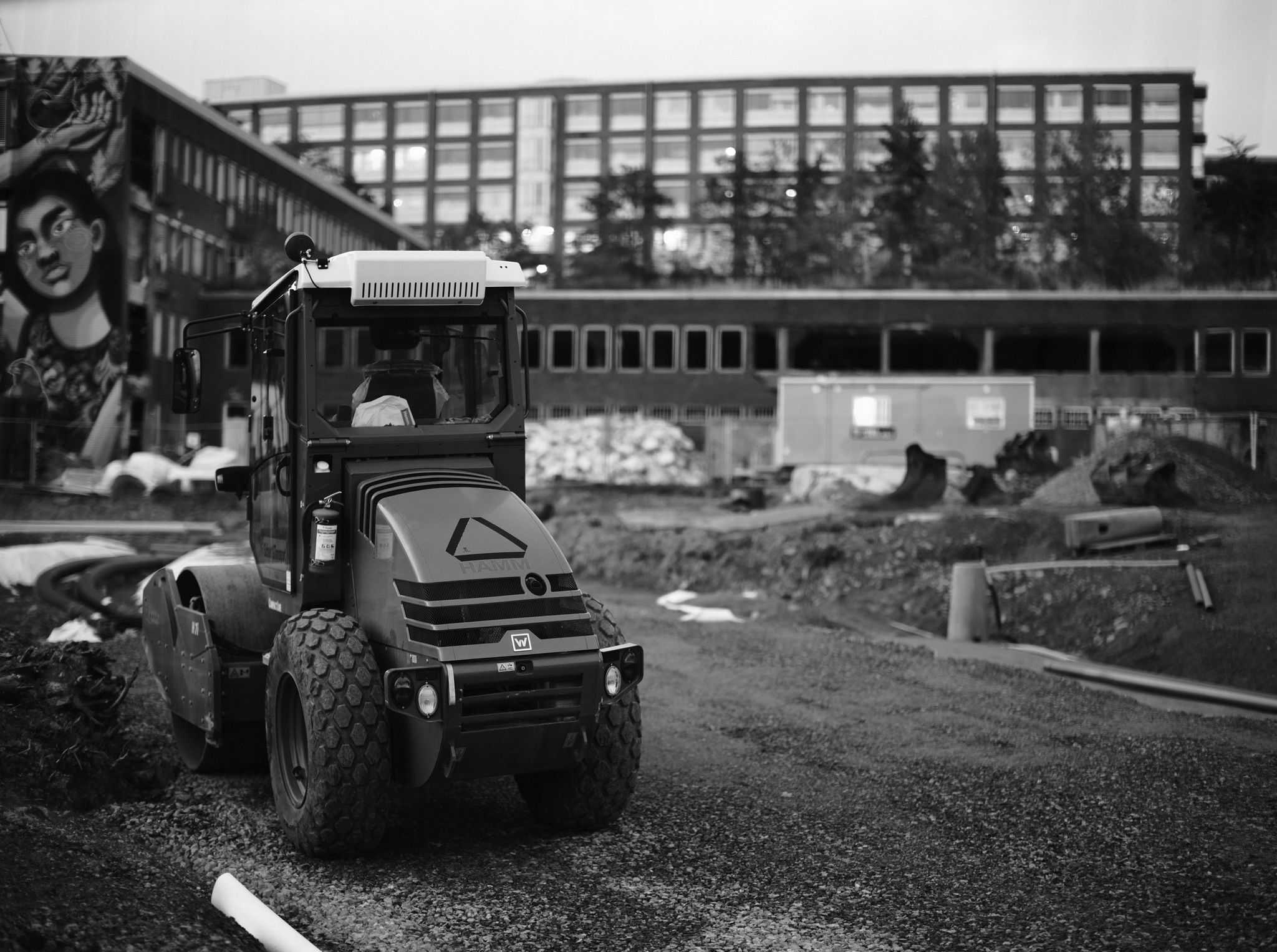
Edited on Dec 22, 2021 at 02:05 AM · View previous versions
Makten wrote
I'd say it varies mostly with lens speed, where slower lenses generally give a lot less mechanical vignetting (and thus more uniform DOF across the frame) than fast lenses.For the Zeiss Loxia 85mm 2.4 it is clearly not true:
https://phillipreeve.net/blog/wp-content/uploads/2018/05/bokeh_loxia_85_2.4_2.4.jpg
A Leica 90mm 2.0 also does not do a better job than most f/1.4 lenses in this focal length range:
https://phillipreeve.net/blog/wp-content/uploads/2021/02/summicron_90_2.0_pre-asph_optical_vignetting_2.0.jpg
I wrote "mostly" and "generally", and I thought we mainly were talking about normal lenses here. DavidBM certainly did in the post I was quoting.
Those are short teles and they are very compact compared to f/1.4 lenses of similar focal length.
Lens makers rarely make the lens elements bigger than absolutely necessary, also with slower lenses.
I even have my doubts keeping optical vignetting in check has ever been a design criteria for any lens except for some of the Sony GM lenses.
In case of the Nokton 50mm f/1.0 the small M-mount bayonet will clearly be the main issue though.
Which is another thing that separate the design goals across format sizes. A lot of people whine over the lack of fast lenses for medium format, but they fail to understand that it's because those lenses are designed to be uniform across the field. You can't get that with super fast lenses unless they are gigantic and very, very expensive.
And when it comes to medium format (are we talking 6x6 or Fullframe+ (44x33)?) it will be very hard
to find lenses that rival the shallow DoF of a fullframe 50mm f/1.0, 85mm f/1.2 let alone more exotic options like a 135mm f/1.4 and 200mm f/1.8...
At least that was my conclusion when looking for lenses that might make sense on a MF -> FF Speedbooster.
Yes, for the above reasons. The question is; why would you want such short DOF if it comes at the cost of huge vignetting and all sorts of aberrations? I certainly prefer a slower lens on a larger format because of nicer rendering.
Edit: By the way, here's your FF ~50/1.0 equivalent on 33x44.
I sold it because I hated the character and I waaaay prefer the slower native lens at the same focal length. Edit 2: It's shot through a fence, so that's why the bokeh is a bit extra funky here and there.
Edited on Dec 22, 2021 at 02:05 AM · View previous versions
Dec 21, 2021 at 04:20 PM
p.10 #19New Voigtlander 50mm f/1 Nokton in January 2022
Makten wrote:
This is another claim I would like to see some proof for.
For the Zeiss Loxia 85mm 2.4 it is clearly not true:
https://phillipreeve.net/blog/wp-content/uploads/2018/05/bokeh_loxia_85_2.4_2.4.jpg
A Leica 90mm 2.0 also does not do a better job than most f/1.4 lenses in this focal length range:
https://phillipreeve.net/blog/wp-content/uploads/2021/02/summicron_90_2.0_pre-asph_optical_vignetting_2.0.jpgI wrote "mostly" and "generally", and I thought we mainly were talking about normal lenses here. Those are short teles and they are very compact compared to f/1.4 lenses of similar focal length.
I even have my doubts keeping optical vignetting in check has ever been a design criteria for any lens except for some of the Sony GM lenses.
In case of the Nokton 50mm f/1.0 the small M-mount bayonet will clearly be the main issue though.Which is another thing that separate the design goals across format sizes. A lot of people whine over the lack of fast lenses for medium format, but they fail to understand that it's because those lenses are designed to be uniform across the field. You can't get that with super fast lenses unless they are gigantic and very, very expensive.
to find lenses that rival the shallow DoF of a fullframe 50mm f/1.0, 85mm f/1.2 let alone more exotic options like a 135mm f/1.4 and 200mm f/1.8...
At least that was my conclusion when looking for lenses that might make sense on a MF -> FF Speedbooster.Yes, for the above reasons. The question...Show more →
Have you forgotten stopping your fast FF glass down a stop or two? I still remember your planar 50mm shot in ZE/ZF thread.
I found planar 50mm at f2.5, ZF35mm f1.4 at f1.8~2.5, Planar 80mm at f2~f2.8 quite special. Maybe it is nostalgia but I just love the old ZF/ZE classic look. They are definitely remind me MF "slow" glasses at those aperture.
I notice one thing that FUJI GFX glass seems always have big rear element but small front element to take advantage of that huge mount size. (30, 45, 63) Sigma 45mm has similar diagram with relative big rear element at back end. Maybe this help with corner rendering with smaller size for short flanging distance lenses?
BastianK wrote
Makten wrote
I'd say it varies mostly with lens speed, where slower lenses generally give a lot less mechanical vignetting (and thus more uniform DOF across the frame) than fast lenses.For the Zeiss Loxia 85mm 2.4 it is clearly not true:
https://phillipreeve.net/blog/wp-content/uploads/2018/05/bokeh_loxia_85_2.4_2.4.jpg
A Leica 90mm 2.0 also does not do a better job than most f/1.4 lenses in this focal length range:
https://phillipreeve.net/blog/wp-content/uploads/2021/02/summicron_90_2.0_pre-asph_optical_vignetting_2.0.jpg
Those are short teles and they are very compact compared to f/1.4 lenses of similar focal length.Earlier quote
Lens makers rarely make the lens elements bigger than absolutely necessary, also with slower lenses.I even have my doubts keeping optical vignetting in check has ever been a design criteria for any lens except for some of the Sony GM lenses.
In case of the Nokton 50mm f/1.0 the small M-mount bayonet will clearly be the main issue though.
Earlier quote
And when it comes to medium format (are we talking 6x6 or Fullframe+ (44x33)?) it will be very hardto find lenses that rival the shallow DoF of a fullframe 50mm f/1.0, 85mm f/1.2 let alone more exotic options like a 135mm f/1.4 and 200mm f/1.8...
At least that was my conclusion when looking for lenses that might make sense on a MF -> FF Speedbooster.
Have you forgotten stopping your fast FF glass down a stop or two
? I still remember your planar 50mm shot in ZE/ZF thread. I found planar 50mm at f2.5, ZF35mm f1.4 at f1.8~2.5, Planar 80mm at f2~f2.8 quite special. Maybe it is nostalgia but I just love the old ZF/ZE classic look. They are definitely remind me MF "slow" glasses at those aperture.
I notice one thing that FUJI GFX glass seems always have big rear element but small front element to take advantage of that huge mount size. (30, 45, 63) Sigma 45mm has similar diagram with relative big rear element at back end. Maybe this help with corner rendering with smaller size for short flanging distance lenses?
Dec 21, 2021 at 04:42 PM
p.10 #20New Voigtlander 50mm f/1 Nokton in January 2022
zhangyue wrote:
This is another claim I would like to see some proof for.
For the Zeiss Loxia 85mm 2.4 it is clearly not true:
https://phillipreeve.net/blog/wp-content/uploads/2018/05/bokeh_loxia_85_2.4_2.4.jpg
A Leica 90mm 2.0 also does not do a better job than most f/1.4 lenses in this focal length range:
https://phillipreeve.net/blog/wp-content/uploads/2021/02/summicron_90_2.0_pre-asph_optical_vignetting_2.0.jpgI wrote "mostly" and "generally", and I thought we mainly were talking about normal lenses here. Those are short teles and they are very compact compared to f/1.4 lenses of similar focal length.
I even have my doubts keeping optical vignetting in check has ever been a design criteria for any lens except for some of the Sony GM lenses.
In case of the Nokton 50mm f/1.0 the small M-mount bayonet will clearly be the main issue though.Which is another thing that separate the design goals across format sizes. A lot of people whine over the lack of fast lenses for medium format, but they fail to understand that it's because those lenses are designed to be uniform across the field. You can't get that with super fast lenses unless they are gigantic and very, very expensive.
to find lenses that rival the shallow DoF of a fullframe 50mm f/1.0, 85mm f/1.2 let alone more exotic options like a 135mm f/1.4 and 200mm f/1.8...
At least that was my conclusion when looking for lenses that might make sense on a MF -> FF Speedbooster.Yes, for the above reasons. The question is; why would you want such short DOF if it comes at the cost of huge vignetting and all sorts of aberrations? I certainly prefer a slower lens on a larger format because of nicer rendering.Have you forgotten stopping your fast FF glass down a stop or two ? I still remember your planar 50mm shot in ZE/ZF thread.
I found planar 50mm at f2.5, ZF35mm f1.4 at f1.8~2.5, Planar 80mm at f2~f2.8 quite special. Maybe it is nostalgia but I just love the old ZF/ZE classic look. They are definitely remind me MF "slow" glasses at those aperture.
I agree and I love that look too! But even stopped down to the same DOF, it doesn't quite look the same even if it can get very close. However, I think (or rather know) that if Zeiss had put the same effort and money into designing slower lenses, they would have been even better at the same aperture. It's simpy not possible to correct aberrations as well in a very fast lens as with a slower lens.
I will keep the ZF 50/1.4 (it's my third) for when I want that look at 1:1. Unfortunately I believe it plays extra badly with the GFX because of the extremely thick sensor stack.
I notice one thing that FUJI GFX glass seems always have big rear element but small front element to take advantage of that huge mount size. (30, 45, 63) Sigma 45mm has similar diagram with relative big rear element at back end. Maybe this help with corner rendering with smaller size for short flanging distance lenses?
Possibly, yes. The GF 50/3.5 is even more extreme and I think it's something of a rethinking of general lens design when there is no mirror box. Most of the corrective elements are behind the aperture instead of on both sides. I've seen this from other manufacturers too (Sony RX1 for instance) and it will probably be common in those cases where the mount permits it.
Makten wrote
BastianK wrote
Makten wrote
I'd say it varies mostly with lens speed, where slower lenses generally give a lot less mechanical vignetting (and thus more uniform DOF across the frame) than fast lenses.For the Zeiss Loxia 85mm 2.4 it is clearly not true:
https://phillipreeve.net/blog/wp-content/uploads/2018/05/bokeh_loxia_85_2.4_2.4.jpg
A Leica 90mm 2.0 also does not do a better job than most f/1.4 lenses in this focal length range:
https://phillipreeve.net/blog/wp-content/uploads/2021/02/summicron_90_2.0_pre-asph_optical_vignetting_2.0.jpg
Those are short teles and they are very compact compared to f/1.4 lenses of similar focal length.Earlier quote
Lens makers rarely make the lens elements bigger than absolutely necessary, also with slower lenses.I even have my doubts keeping optical vignetting in check has ever been a design criteria for any lens except for some of the Sony GM lenses.
In case of the Nokton 50mm f/1.0 the small M-mount bayonet will clearly be the main issue though.
Earlier quote
And when it comes to medium format (are we talking 6x6 or Fullframe+ (44x33)?) it will be very hardto find lenses that rival the shallow DoF of a fullframe 50mm f/1.0, 85mm f/1.2 let alone more exotic options like a 135mm f/1.4 and 200mm f/1.8...
At least that was my conclusion when looking for lenses that might make sense on a MF -> FF Speedbooster.
? I still remember your planar 50mm shot in ZE/ZF thread. I found planar 50mm at f2.5, ZF35mm f1.4 at f1.8~2.5, Planar 80mm at f2~f2.8 quite special. Maybe it is nostalgia but I just love the old ZF/ZE classic look. They are definitely remind me MF "slow" glasses at those aperture.
I agree and I love that look too! But even stopped down to the same DOF, it doesn't quite look the same even if it can get very close.
However, I think (or rather know) that if Zeiss had put the same effort and money into designing slower lenses, they would have been even better at the same aperture. It's simpy not possible to correct aberrations as well in a very fast lens as with a slower lens. I will keep the ZF 50/1.4 (it's my third) for when I want that look at 1:1. Unfortunately I believe it plays extra badly with the GFX because of the extremely thick sensor stack.
I notice one thing that FUJI GFX glass seems always have big rear element but small front element to take advantage of that huge mount size. (30, 45, 63) Sigma 45mm has similar diagram with relative big rear element at back end. Maybe this help with corner rendering with smaller size for short flanging distance lenses?
Possibly, yes. The GF 50/3.5 is even more extreme and I think it's something of a rethinking of general lens design when there is no mirror box. Most of the corrective elements are behind the aperture instead of on both sides. I've seen this from other manufacturers too (Sony RX1 for instance) and it will probably be common in those cases where the mount permits it.
Dec 21, 2021 at 05:01 PM