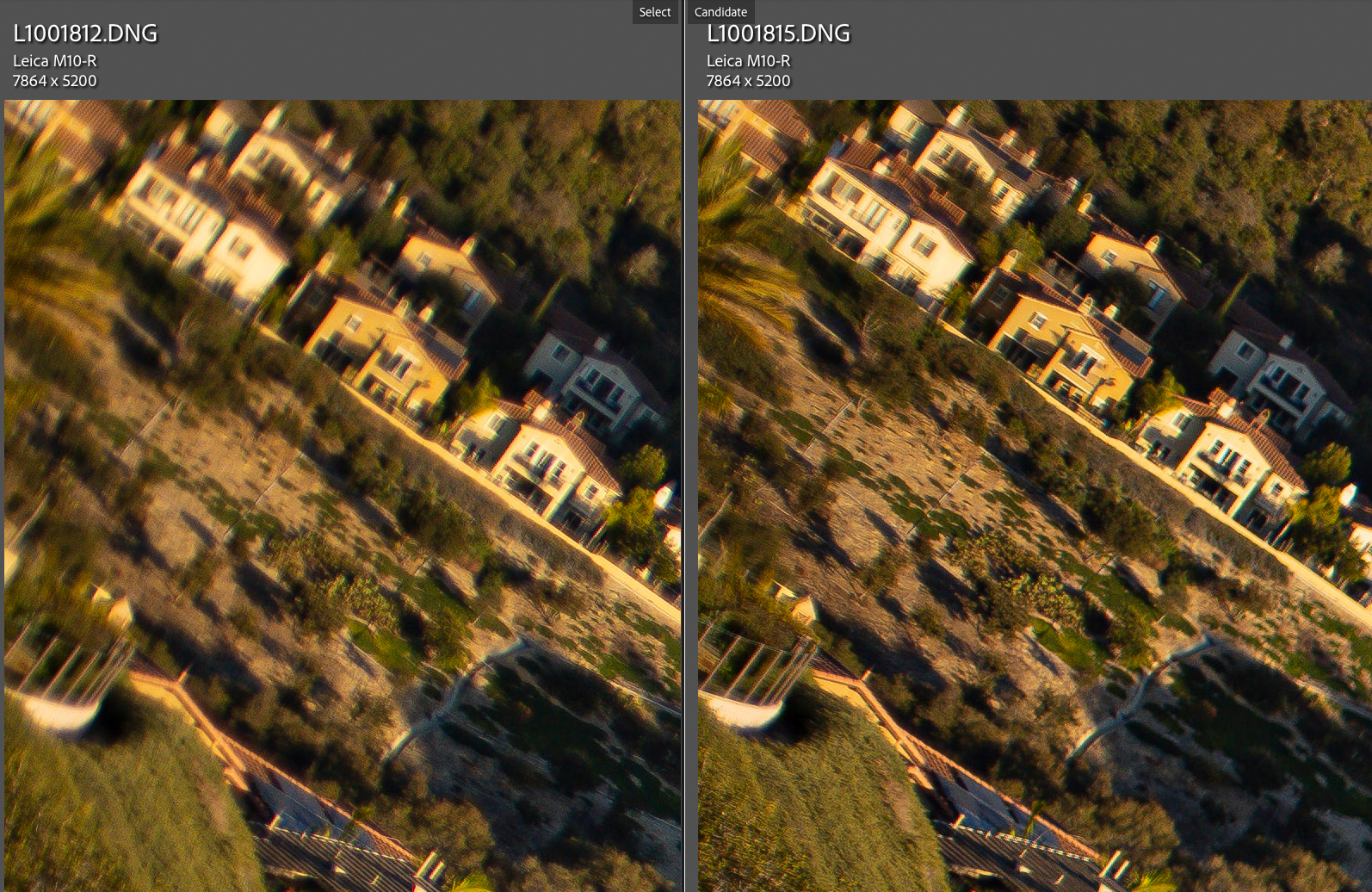
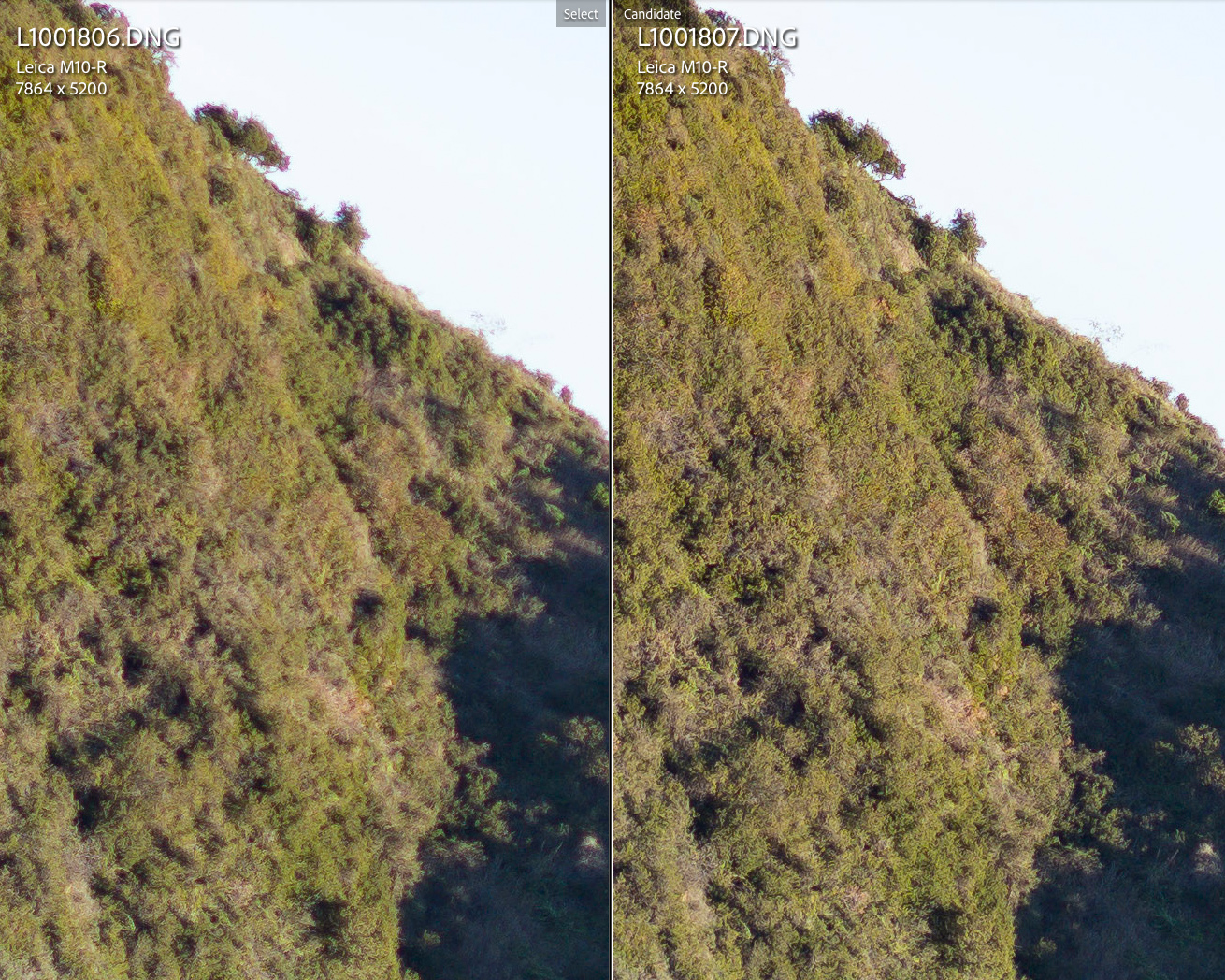
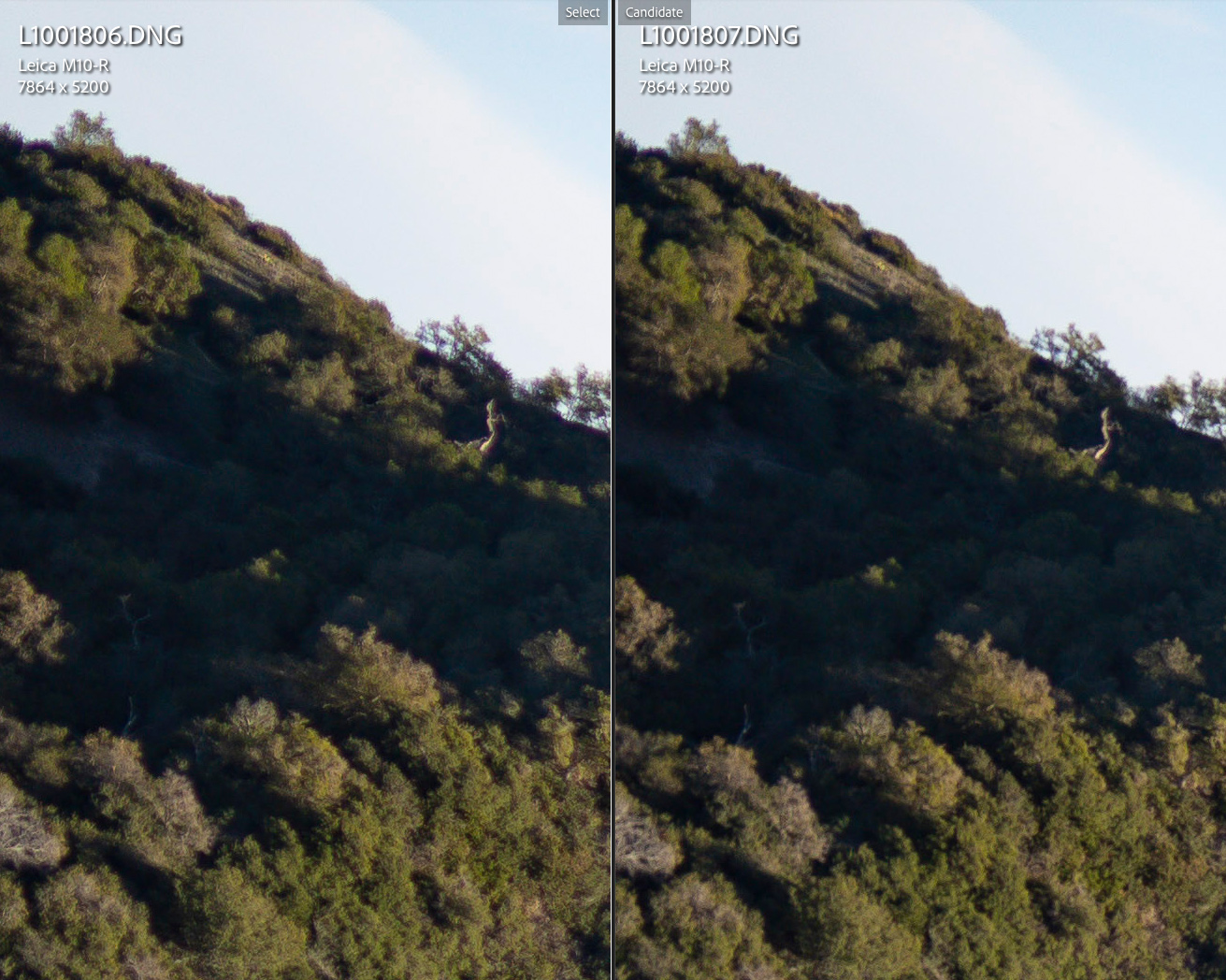
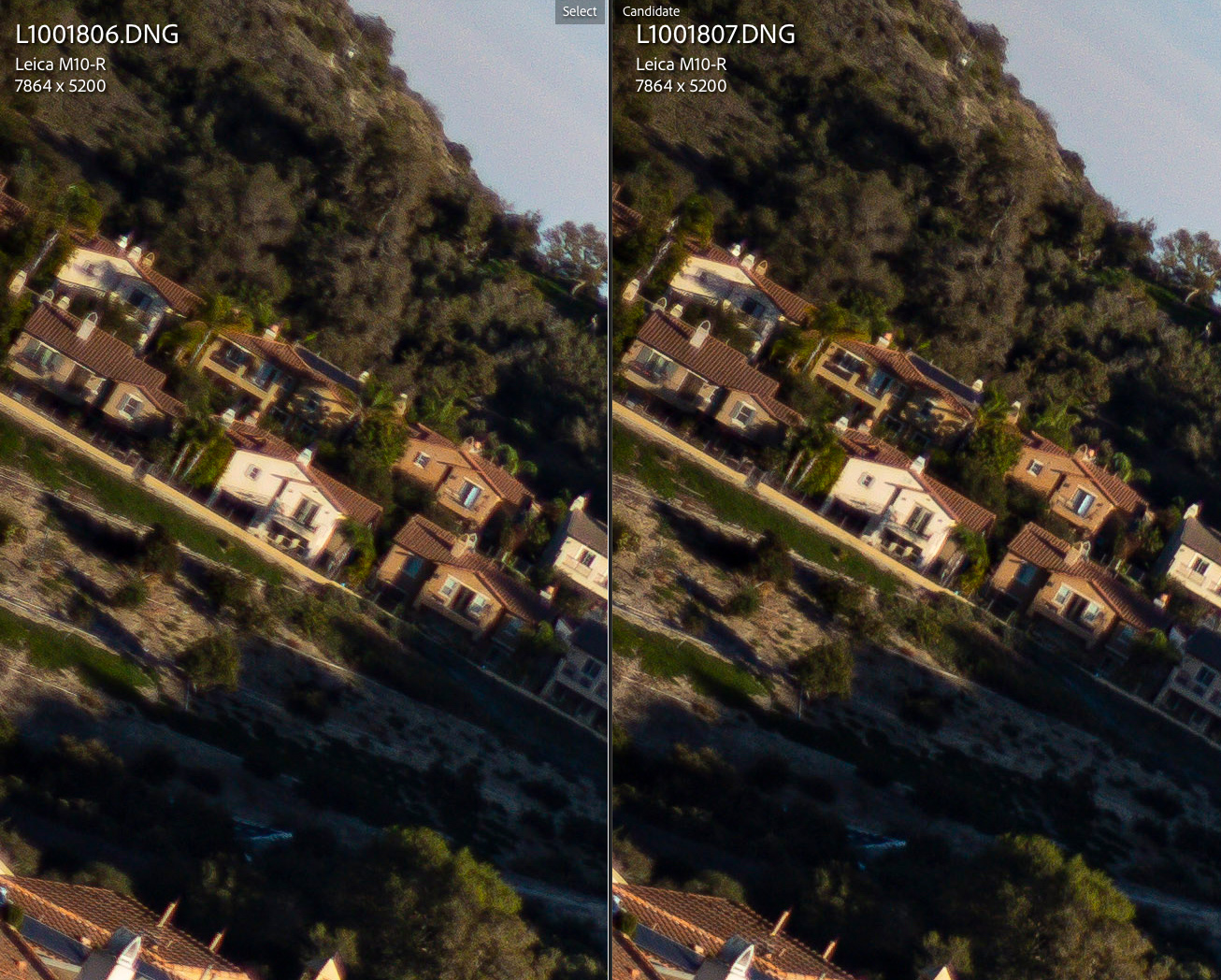
p.5 #1 · Leica 50/1.4 Lux vs Voigtlander 50/1.2 Nokton vs 50/2 APO
Fred Miranda wrote:
So, I have updated the crops showing the new Voigtlander 50/2 APO copy. It does much better than the previous copy which was slightly tilted. This was only noticeable on 41MP.
My take on the results: The Voigtlander 50mm f/2 APO is one of the best 50mm lenses on the market in terms of resolution and contrast across the image field. I highly recommend it, especially if you have a Leica M10-R.
The Voigtlander 50mm f/2 APO is already outstanding from wide open at center, mid-field and extreme corners only improving slightly at smaller apertures.
The Leica 50/1.4 Lux performed great around the center area even at f/2 but could not keep up with the Voigtlander APO's high resolution at mid-field and corners. Having said that, stopping it down to f/4 and smaller, makes it a strong performer as well. The Leica's optimal apertures for highest resolution/contrast across the field is f/5.6 and f/8.
Perhaps the Leica APO-Summicron-M 50mm f/2 is able to match the Voigtlander APO's image quality, but that's a test for another day. ...Show more →
Thanks for this. It's quite the improvement for the VM APO. Did you also reshoot the Lux images? Just wondering because the tonal separation of the VM at mid-field looks a lot better.... trying to understand if it could be lighting variation if each lens was from a different day.
p.5 #2 · Leica 50/1.4 Lux vs Voigtlander 50/1.2 Nokton vs 50/2 APO
rscheffler wrote:
Thanks for this. It's quite the improvement for the VM APO. Did you also reshoot the Lux images? Just wondering because the tonal separation of the VM at mid-field looks a lot better.... trying to understand if it could be lighting variation if each lens was from a different day.
You're welcome. Thanks for pointing it the APO could do better. I was also a bit underwhelmed with my previous copy knowing how good the E-mount is.
Yes, both re-shot side by side (probably a minute apart). Same lighting and settings in LR.
p.5 #3 · Leica 50/1.4 Lux vs Voigtlander 50/1.2 Nokton vs 50/2 APO
I've tested all my M-mount lenses on the SL2 today and they performed great even at the corners with one exception: The Voigtlander 50/2 APO-Lanthar didn't not do well at the corners. Still scratching my head as it performs noticeable better on the M10-R. Will repeat it. It's still better than when adapted to the Sony but not quite M10 level.
Lenses tested:
CV 15/4.5 III, CV 28/2 II, CV 35/1.7, CV 50/2 APO, Leica 50/1.4 Lux, CV 75/1.5, Leica 90/2.8 and Leica 135/4.
p.5 #4 · Leica 50/1.4 Lux vs Voigtlander 50/1.2 Nokton vs 50/2 APO
Fred Miranda wrote:
I've tested all my M-mount lenses on the SL2 today and they performed great even at the corners with one exception: The Voigtlander 50/2 APO-Lanthar didn't not do well at the corners. Still scratching my head as it performs noticeable better on the M10-R. Will repeat it. It's still better than when adapted to the Sony but not quite M10 level.
Lenses tested:
CV 15/4.5 III, CV 28/2 II, CV 35/1.7, CV 50/2 APO, Leica 50/1.4 Lux, CV 75/1.5, Leica 90/2.8 and Leica 135/4.
Both the CV APOs performed poorly in the corners on my R5 – that's why I was surprised at how well the 28 Lux did on the R5. This makes me want to try out the rest of my M lenses on the R5 – I'd seen how the APOs performed and assumed the rest would do worse.
p.5 #5 · Leica 50/1.4 Lux vs Voigtlander 50/1.2 Nokton vs 50/2 APO
highdesertmesa wrote:
Both the CV APOs performed poorly in the corners on my R5 – that's why I was surprised at how well the 28 Lux did on the R5. This makes me want to try out the rest of my M lenses on the R5 – I'd seen how the APOs performed and assumed the rest would do worse.
From the M lenses listed above, only the 50/2 APO didn't perform well on the SL2. However, it does even worse on the Sony and I can imagine it not doing well on the Canon either.
This was surprising to me because I was impressed by how well my other m-lenses were performing on the SL2 including the Voigtlander 28/2 Ultron II.
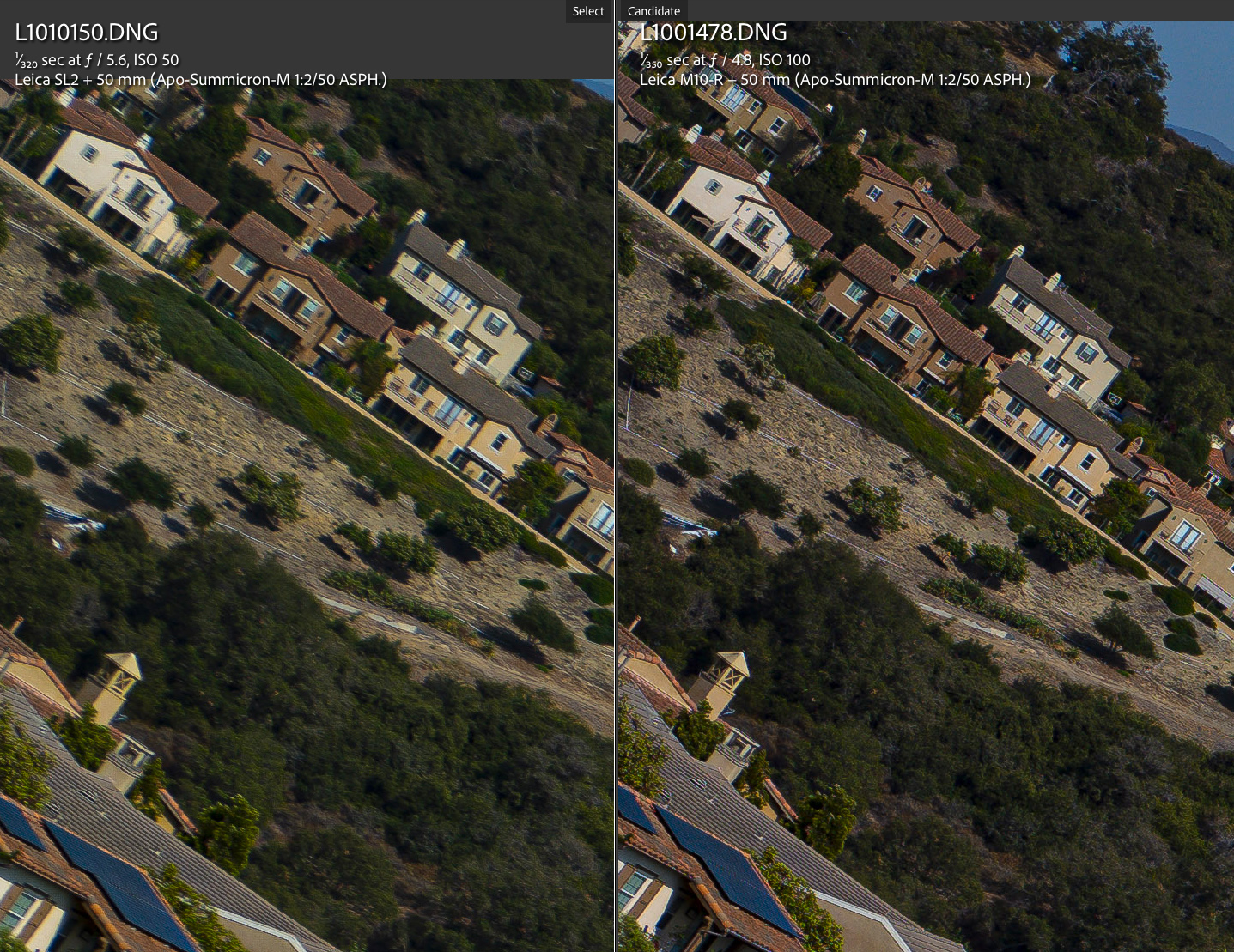
Here are they at f/5.6: (SL2 vs M10-R)
Based on this result, I would say the CV 50/2 APO is not really optimal for landscapes on the SL2. All other tested lenses listed above would work well for landscapes and perform similarly on both cameras.
Both at f/5.6 (extreme corners) SL2 vs M10-R with Voigtlander 50/2 APO
p.5 #6 · Leica 50/1.4 Lux vs Voigtlander 50/1.2 Nokton vs 50/2 APO
Fred Miranda wrote:
From the M lenses listed above, only the 50/2 APO didn't perform well on the SL2. However, it does even worse on the Sony and I can imagine it not doing well on the Canon either.
This was surprising to me because I was impressed by how well my other m-lenses were performing on the SL2 including the Voigtlander 28/2 Ultron II.
Here are they at f/5.6: (SL2 vs M10-R)
Based on this result, I would say the CV 50/2 APO is not really optimal for landscapes on the SL2. All other tested lenses listed above would work well for landscapes and perform similarly on both cameras. ...Show more →
I wonder if turning off IBIS on the SL2 might help as it did with the 28 Lux for me on the R5. I'm going to retest both CV APOs on the R5 with IBIS off and see if that helps at all. It makes no sense to me how the APOs would perform worse than the others.
Only other thing that might be affecting it would be if you 6-bit coded it to a Leica lens – the SL2 will write the correction to the DNG for Lightroom to automatically apply, right?
Outside of that I'm only left with speculations such as: The CV APOs were so perfectly designed for the unique angles of the M sensor microlenses that they fall apart in the corners on other sensors.
p.5 #7 · Leica 50/1.4 Lux vs Voigtlander 50/1.2 Nokton vs 50/2 APO
highdesertmesa wrote:
I wonder if turning off IBIS on the SL2 might help as it did with the 28 Lux for me on the R5. I'm going to retest both CV APOs on the R5 with IBIS off and see if that helps at all. It makes no sense to me how the APOs would perform worse than the others.
Only other thing that might be affecting it would be if you 6-bit coded it to a Leica lens – the SL2 will write the correction to the DNG for Lightroom to automatically apply, right?
Outside of that I'm only left with speculations such as: The CV APOs were so perfectly designed for the unique angles of the M sensor microlenses that they fall apart in the corners on other sensors....Show more →
I think you nailed it on your last paragraph.
BTW: IBIS is always off for these tests and the lens correction does not affect resolution or distortion.
p.5 #8 · Leica 50/1.4 Lux vs Voigtlander 50/1.2 Nokton vs 50/2 APO
Continuing on the Voigtlander 50/2 APO's performance on the SL sensor compared to M...
So, I've tested with in-camera lens profile on (using Leica 50/2 APO) vs "off" and the only difference I see is a vignetting correction by 2/3 stop when using the Leica 50/2 APO profile compared to no profile. Corner resolution looks identical as expected...
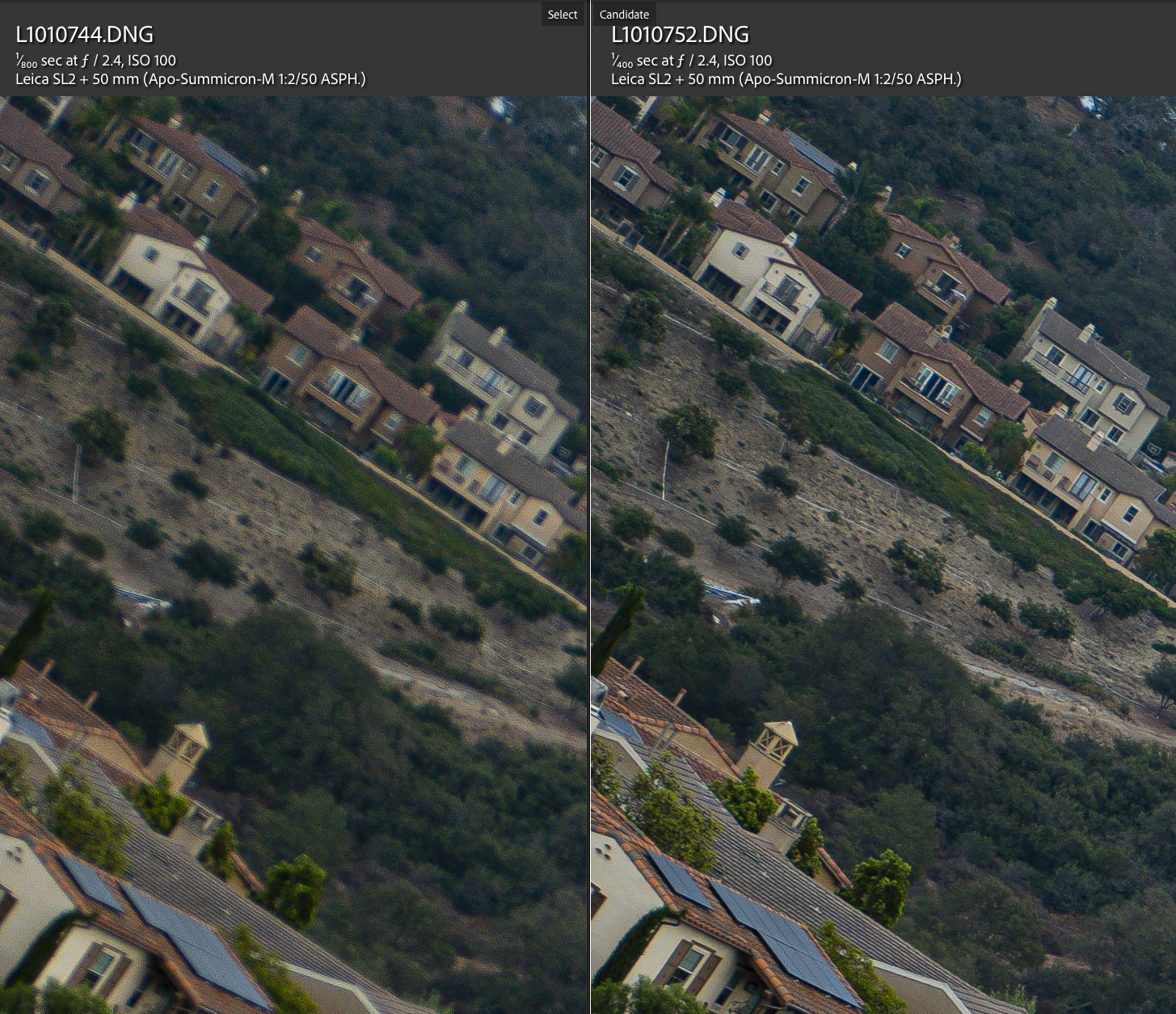
The fact is that the SL sensor introduces noticeable field curvature (induced) with the CV 50/2 APO. I've tested focusing on center and focusing on corner and here are the differences in corner performance. (On the M sensor, the 50/2 APO is a flat-field lens)
Extreme corner crop -- Left: focused on center | Right: focused on corner
p.5 #10 · Leica 50/1.4 Lux vs Voigtlander 50/1.2 Nokton vs 50/2 APO
Fred Miranda wrote:
Next week I will compare the performance of the 50/1.4 LUX and 21/3.5 SEM on M10-R and SL2 bodies.
How about testing the Voigtländer VM 40mm f1.2 on the SL2 vs the M10-R? The M-mount version is so small and nimble, but the focal length a bit tricky on M-bodies, but of course no problem on the SL2, in that regard. I think we are few that would be very happy to see if the VM version is great on the SL2 as well! As good as on the M10-R? (Or would you use the E-mount version on the SL2? So much bigger...). Thanks!
p.5 #11 · Leica 50/1.4 Lux vs Voigtlander 50/1.2 Nokton vs 50/2 APO
Arvaker wrote:
How about testing the Voigtländer VM 40mm f1.2 on the SL2 vs the M10-R? The M-mount version is so small and nimble, but the focal length a bit tricky on M-bodies, but of course no problem on the SL2, in that regard. I think we are few that would be very happy to see if the VM version is great on the SL2 as well! As good as on the M10-R? (Or would you use the E-mount version on the SL2? So much bigger...). Thanks!
Hi Arvaker,
I no longer have my CV 40/1.2 M but the 50/1.2 version didn't perform well on the SL2 sensor. and these lenses have a similar optical design.
p.5 #12 · Leica 50/1.4 Lux vs Voigtlander 50/1.2 Nokton vs 50/2 APO
Something I noticed when using the Voigtlander 50/2 APO adapted to the Leica SL2...
At infinity distance, it's obvious that the thicker sensor stack from the SL2 denigrates IQ from this stellar lens. (crops posted on this thread). So, even stopped down to f/5.6, the corners suffer from astigmatism and resolution loss due to induced field curvature. For this reason, I would not advice using it for landscapes or any other application that requires even focus across the field.
However, when using it at close and mid-distance wide open, I get very sharp results as long as the subject is focused at its location. (not using focus recompose). That happens because the major IQ deterioration is due to induced field curvature but the subject will still be sharp when focusing directly on it.
What may happen is rendering weirdness but I have not seen anything abnormal so far. This is more of an issue with wide angle lenses and induced field curvature.
p.5 #13 · Leica 50/1.4 Lux vs Voigtlander 50/1.2 Nokton vs 50/2 APO
Field curvature shape comparison:
Voigtlander 50mm f/1.2 Nokton vs Leica 50mm f/1.4 Lux (Tested on the Leica M10-R with both lenses wide open)
Leica 50mm f/1.4 Lux:
The field curvature is mostly flat at most distances, but it curves outward in the extreme corners at longer distances. Focusing slightly closer than infinity can improve sharpness in the corners, though it may compromise the resolution in the center and mid-field.
When setting the lens to the infinity hard stop, the center and mid-field will be optimal, but the extreme corners may not be as sharp. However, by focusing just before the infinity mark, you can achieve stronger sharpness even in the extreme corners, starting from wide open.
Here are some example crops demonstrating this effect:
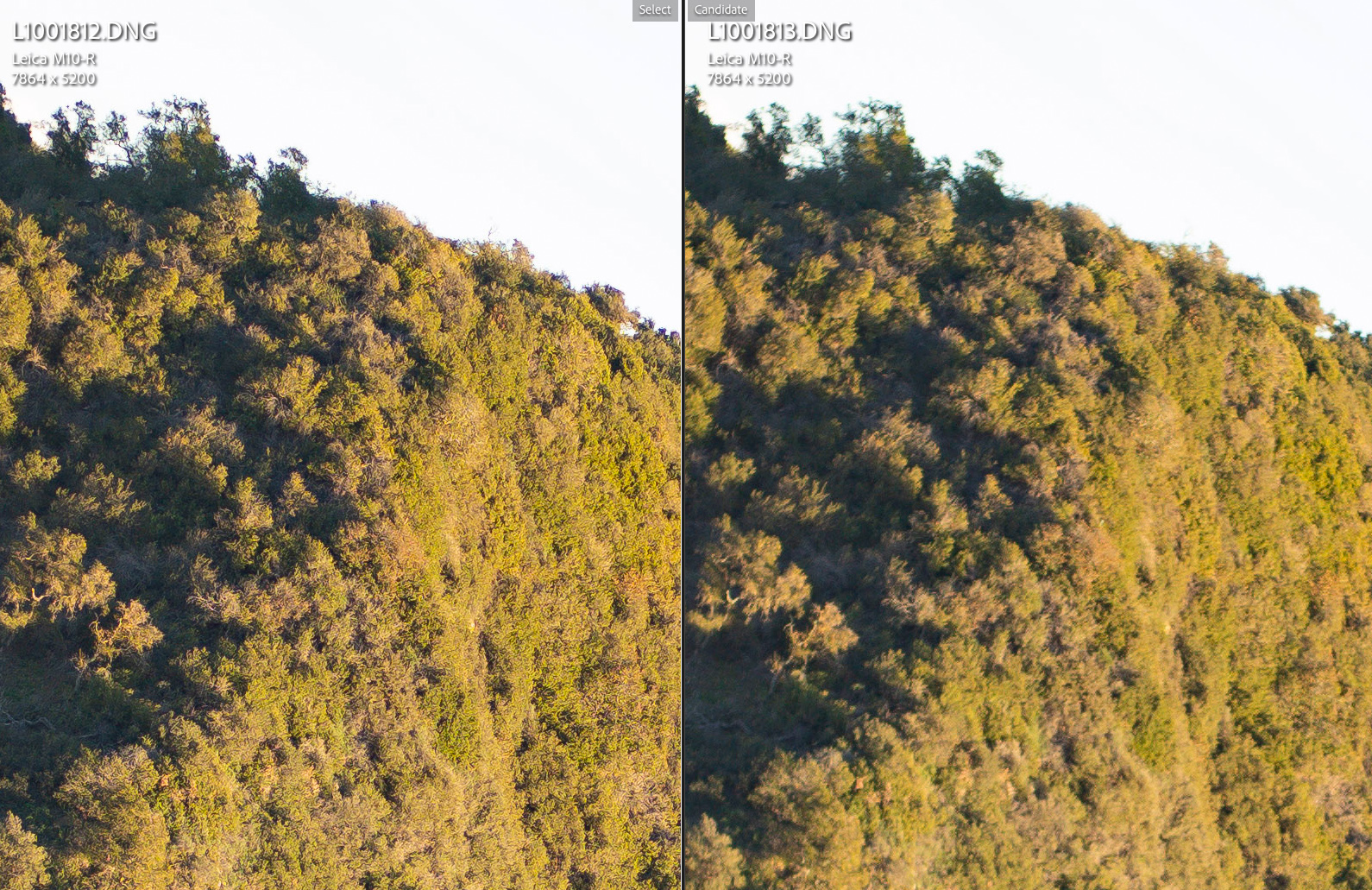
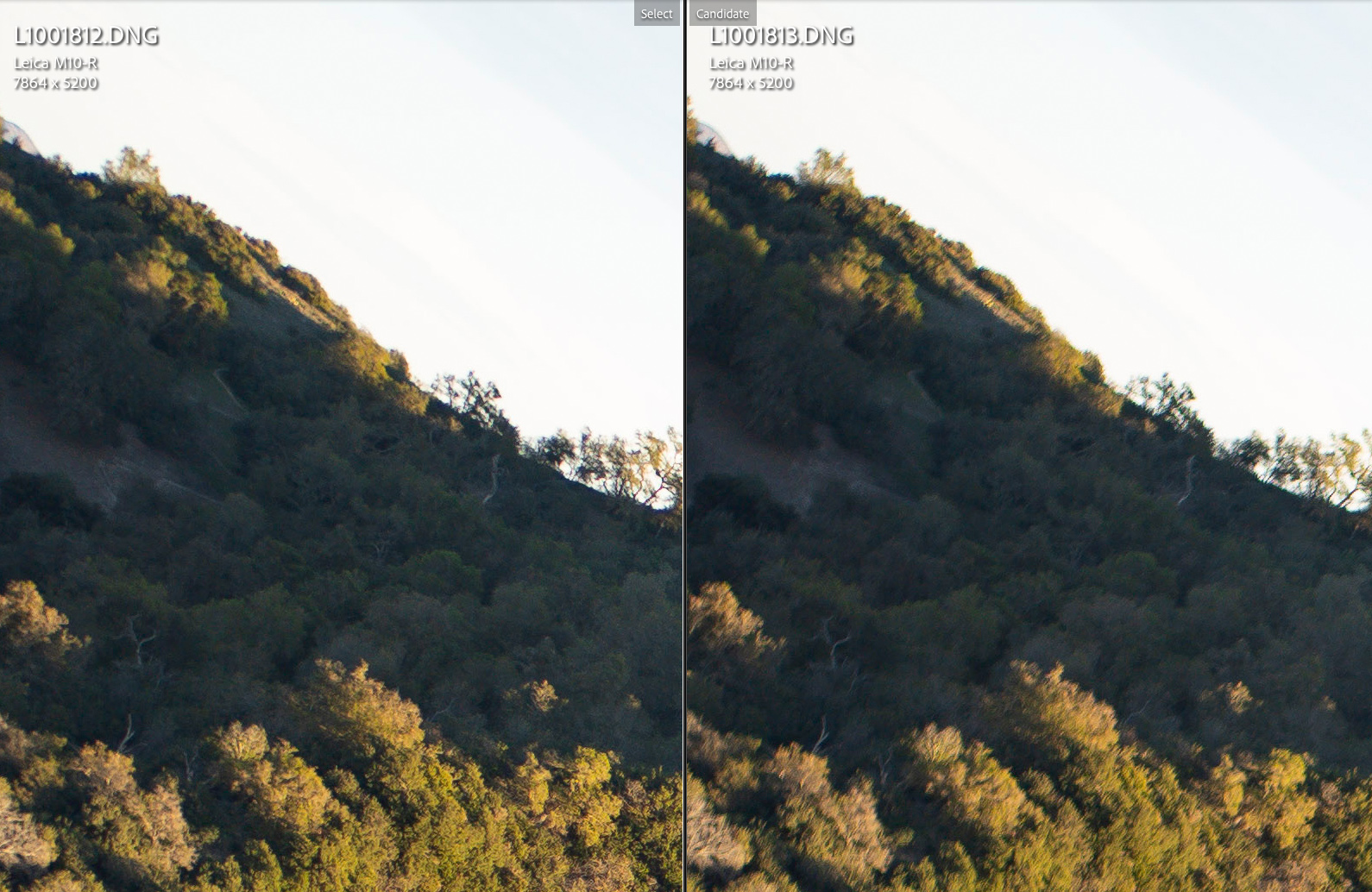
CENTER: LEFT CROP: focused at infinity hard stop (OPTIMAL) | RIGHT CROP: focused a tad before the infinity hard stop
MID-FIELD: LEFT CROP: focused at infinity hard stop (OPTIMAL) | RIGHT CROP: focused a tad before the infinity hard stop
EXTREME CORNER: LEFT CROP: focused at infinity hard stop | RIGHT CROP: focused a tad before the infinity hard stop (OPTIMAL)
p.5 #14 · Leica 50/1.4 Lux vs Voigtlander 50/1.2 Nokton vs 50/2 APO
Voigtlander 50/1.2 Nokton:
With the Voigtlander 50mm f/1.2 Nokton, FC's shape is wavy at long distance. If I focus at the infinity hard stop, the mid-zone looks stronger than center. However, if I focus a tad before infinity, the center gets noticeable stronger in detriment of mid-zone performance. The extreme corner seems to perform similarly to center being stronger a tad before the hard stop.
CENTER: LEFT CROP: focused at infinity hard stop | RIGHT CROP: focused a tad before the infinity hard stop (OPTIMAL)
MID-FIELD: LEFT CROP: focused at infinity hard stop (OPTIMAL) | RIGHT CROP: focused a tad before the infinity hard stop
EXTREME CORNER: LEFT CROP: focused at infinity hard stop | RIGHT CROP: focused a tad before the infinity hard stop (OPTIMAL)
p.5 #16 · Leica 50/1.4 Lux vs Voigtlander 50/1.2 Nokton vs 50/2 APO
sirimiri wrote:
Man that is some difference!
At f/8, DOF even things out. The Leica 50/1.4 lux is a great landscape lens at f/8 but the Voigtlander 50/2 APO is the ultimate tool for this application.
p.5 #17 · Leica 50/1.4 Lux vs Voigtlander 50/1.2 Nokton vs 50/2 APO
Fred Miranda wrote: Field curvature shape comparison:
Voigtlander 50mm f/1.2 Nokton vs Leica 50mm f/1.4 Lux (Tested on the Leica M10-R with both lenses wide open)
Leica 50mm f/1.4 Lux:
The field curvature is mostly flat at most distances, but it curves outward in the extreme corners at longer distances. Focusing slightly closer than infinity can improve sharpness in the corners, though it may compromise the resolution in the center and mid-field.
When setting the lens to the infinity hard stop, the center and mid-field will be optimal, but the extreme corners may not be as sharp. However, by focusing just before the infinity mark, you can achieve stronger sharpness even in the extreme corners, starting from wide open.
Here are some example crops demonstrating this effect:...Show more →
Fred, is it not field curvature that's running slightly outwards at the corners?
If the corners are sharp at infinity with focusing slightly before the infinity hard stop, that means field curvature is moving outward (further away) at the corners.
p.5 #18 · Leica 50/1.4 Lux vs Voigtlander 50/1.2 Nokton vs 50/2 APO
hmzimelka wrote:
Fred, is it not field curvature that's running slightly outwards at the corners?
If the corners are sharp at infinity with focusing slightly before the infinity hard stop, that means field curvature is moving outward (further away) at the corners.
p.5 #19 · Leica 50/1.4 Lux vs Voigtlander 50/1.2 Nokton vs 50/2 APO
Fred Miranda wrote:
Yes,
It's field curvature.
Fred, I was probably not very clear... you said its inwards running FC.
By the samples you posted should it not be outward running field curvature seeing its sharper when rotating focusing ring closer for the edges?
Sep 10, 2022 at 11:16 AM
Steve Spencer Offline • • • • • • • Upload & Sell: On
p.5 #20 · Leica 50/1.4 Lux vs Voigtlander 50/1.2 Nokton vs 50/2 APO
hmzimelka wrote:
Fred, I was probably not very clear... you said its inwards running FC.
By the samples you posted should it not be outward running field curvature seeing its sharper when rotating focusing ring closer for the edges?
No, think of it this way. The center and edges are optimally focussed at 2,000 M (i.e., the infinity stop), but the corners are optimally focussed just at little closer at 1,000 M (i.e., a tad before the infinity stop). This is mild inward field curvature.
I'm sure those numbers are not exactly correct, but they should suffice to illustrate how the pattern Fred has shown is inward field curvature.