This topic is in the 2021 archive. You can read it and like its posts here. It is read only.
Archive 2021Leica lens rendering or look
p.2 #1Leica lens rendering or look
pmeheut wrote:
...
I would argue that the ones you refer to are indeed from two different eras.
Yes and no, ten years is not a long time. Those lenses I mentioned could all be bought brand new concurrently, however the later ('90s) lenses were certainly a new direction for Leica being better corrected and often apo and/or aspherical too. I would argue the lenses from the '70s and earlier are another era, the '80s lenses too just less so.
Jun 14, 2021 at 02:05 AM
p.2 #2Leica lens rendering or look
JohnJ wrote:
There isn't a 'Leica look' there are many. If you want to pick and choose a few that look similar then I'm sure it can be done but at the same time there are lenses that are dramatically different to each other too.
I have about a dozen R lenses and they are largely quite different, not all R lenses are Leica designs. My summilux-r 35 and 80 are kind of close but nothing like the Elmarit-R 28E55 or apo-summicron-r 180, and they are from about the same era too so it's not comparing lenses fro the '60s with lenses from...Show more →
One could argue that with the Summilux-R 80mm you even get multiple looks within the same lens...
Jun 14, 2021 at 06:09 AM
p.2 #3Leica lens rendering or look
rw11 wrote:
I'm interested in learning about the "look" or rendering of certain Leica lenses for landscapes or portraits.
I keep hearing that some of their lenses (esp. some of the older lenses?) have a special quality to them.
Can anyone explain this?
Took me a bit to find this Leica Look definition again by John Kriedler from his YouTube video "A Leica Story..."
https://youtu.be/sERX4vGICrw
Maybe all encompassing, modern definition of the Leica Look? I also noticed it's similar to how Peter Karbe describes the Leica Look in one of his Youtube presentations where he goes into technical detail about how he/Leica creates part of the Leica Look.
I think the part about "how natural and 3D the image looks" aligns closely with what I think I see or would describe as the Leica Look"
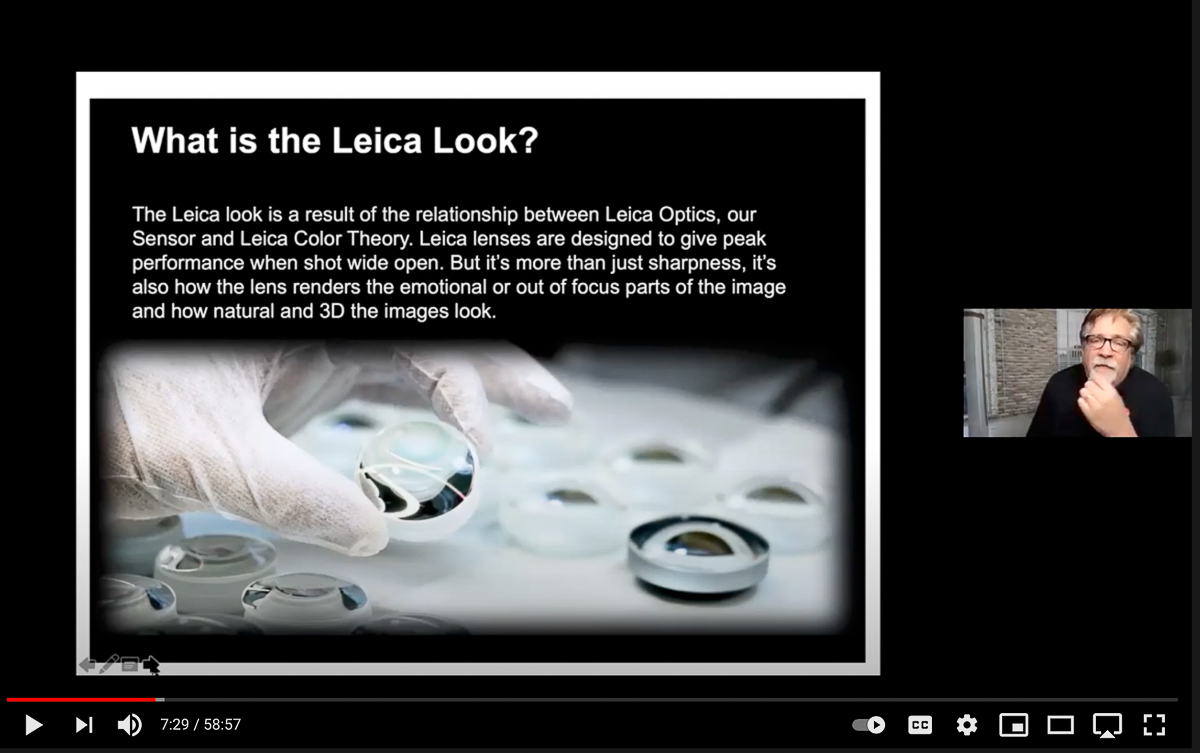
I'm interested in learning about the "look" or rendering of certain Leica lenses for landscapes or portraits.
I keep hearing that some of their lenses (esp. some of the older lenses?) have a special quality to them.
Can anyone explain this?
Took me a bit to find this Leica Look definition again by John Kriedler from his YouTube video "A Leica Story..."
https://youtu.be/sERX4vGICrw
Maybe all encompassing, modern definition of the Leica Look? I also noticed it's similar to how Peter Karbe describes the Leica Look in one of his Youtube presentations where he goes into technical detail about how he/Leica creates part of the Leica Look.
I think the part about "how natural and 3D the image looks" aligns closely with what I think I see or would describe as the Leica Look"
Jun 14, 2021 at 07:31 AM
p.2 #4Leica lens rendering or look
Since people start dropping video links, here's my all time favourite:
Jun 14, 2021 at 08:08 AM
p.2 #5Leica lens rendering or look
I found this:
https://en.wikipedia.org/wiki/Walter_Mandler
It's the older lenses I was talking about in the OP
https://en.wikipedia.org/wiki/Walter_Mandler
It's the older lenses I was talking about in the OP
Jun 15, 2021 at 11:19 AM
p.2 #6Leica lens rendering or look
rw11 wrote:
It's the older lenses I was talking about in the OP
For those older Mandler-era lenses, the two relevant aspects are usability and optical imperfection. By usability, I mean placement of controls, long focus throw, readable DOF scales, the smaller size (M particularly), and the physical feel of the lens (haptics). Optical imperfections that resulted from computational limits of that era, finite glass types, and the need for smaller size (M again) means the designer needed to balance one deficiency against another. I have many lenses from this era but don't believe in Leica "secret sauce", just sensible choices that were made. Each lens has its own personality, although some Leica characteristics prevail like mid-field dip, and poor control of stray light.
A standout prime was mentioned by genji, namely the Summaron 35/2.8 which is a masterpiece.
Jun 15, 2021 at 01:00 PM
p.2 #7Leica lens rendering or look
After having a bozo on a film site tell me there was no Leica look, Zeiss 3D pop and that he loved Sigma fART lenses I searched the web for some folks who knew. He said micro contrast was a myth. I recently walked into a gallery of black and whites shot by an older gentleman who had been a newspaper reporter. I looked around at the work on the walls and said to him, you shoot Leica. He smiled. Now, I don't shoot leica but have several stellar manual focus older zeiss lenses, the 35 mm distagon, the 85 planar and 100 makro planar. All low element count lenses. I see a separation, micro contrast in b&w missing on say a 22 element zoom. In addition, I understand both Zeiss and Leica continue to use leaded glass while nikon and canon have stopped. From the above posts, I am understanding that Leica users see the amazing subject separation/3d pop or look. Also the incredible shadow detail filtered out by high element count lenses. If I understand it correctly, my older zeiss and Leica have chosen to preserve those characteristics rather than strive for super sharp rendering. I too am a portraitist and believe me, older ladies don't want super sharp rendering of their wrinkles. Oh, and the bozo said the only reason folks purchase Leica or Zeiss is for status. Like I said, bozo. I shoot nikon slrs. Is it possible to use an adapter with leica lenses on nikon slrs?
Jul 01, 2021 at 09:14 AM

p.2 #8Leica lens rendering or look
mrca wrote:
After having a bozo on a film site tell me there was no Leica look, Zeiss 3D pop and that he loved Sigma fART lenses I searched the web for some folks who knew. He said micro contrast was a myth. I recently walked into a gallery of black and whites shot by an older gentleman who had been a newspaper reporter. I looked around at the work on the walls and said to him, you shoot Leica. He smiled. Now, I don't shoot leica but have several stellar manual focus older zeiss lenses, the 35 mm distagon, the 85...Show more →
Many Leica R lenses can be used on Nikon SLRs. See this site for details on the mount conversion that is required (it is really pretty easy to do this) and the lenses that can and cannot be used:
http://leitax.com
Leica M lenses cannot be used on Nikon SLRs, but can be used on Nikon mirrorless cameras. There are complication with the thicker sensor cover glass of Nikon mirrorless cameras compared to Leica cameras, however,.
Jul 01, 2021 at 10:05 AM
p.2 #9Leica lens rendering or look
rw11 wrote:
I found this:
https://en.wikipedia.org/wiki/Walter_Mandler
It's the older lenses I was talking about in the OP
I'm a fan of Mandler designs.
https://www.fredmiranda.com/forum/topic/1294615/0
I found this:
https://en.wikipedia.org/wiki/Walter_Mandler
It's the older lenses I was talking about in the OP
I'm a fan of Mandler designs.
https://www.fredmiranda.com/forum/topic/1294615/0
Jul 01, 2021 at 01:00 PM
p.2 #10Leica lens rendering or look
mrca wrote:
After having a bozo on a film site tell me there was no Leica look, Zeiss 3D pop and that he loved Sigma fART lenses I searched the web for some folks who knew. He said micro contrast was a myth. I recently walked into a gallery of black and whites shot by an older gentleman who had been a newspaper reporter. I looked around at the work on the walls and said to him, you shoot Leica. He smiled. Now, I don't shoot leica but have several stellar manual focus older zeiss lenses, the 35 mm distagon, the 85...Show more →
I've done several blind tests with both Leica, Zeiss and other lenses with non photographer friends and family. Not scientific, but within my circle and many "not again" blind tests, I quickly noticed there are some that can see "something" and can call it out consistently and there are others who can't see anything out of the ordinary.
It is what it is and probably why the debate will never conclude. Some just don't perceive any special look whatsoever and think those that think they can delusional. Ha ha
Jul 01, 2021 at 01:10 PM
p.2 #11Leica lens rendering or look
LBJ2 wrote:
I've done several blind tests with both Leica, Zeiss and other lenses with non photographer friends and family. Not scientific, but within my circle and many "not again" blind tests, I quickly noticed there are some that can see "something" and can call it out consistently and there are others who can't see anything out of the ordinary.
It is what it is and probably why the debate will never conclude. Some just don't perceive any special look whatsoever and think those that think they can delusional. Ha ha
The Leica look used to be more noticeable particularly when shooting and viewing transparencies in particular or in prints. It is more difficult to see today in digital form.
Rich
mrca wrote
After having a bozo on a film site tell me there was no Leica look, Zeiss 3D pop and that he loved Sigma fART lenses I searched the web for some folks who knew. He said micro contrast was a myth. I recently walked into a gallery of black and whites shot by an older gentleman who had been a newspaper reporter. I looked around at the work on the walls and said to him, you shoot Leica. He smiled. Now, I don't shoot leica but have several stellar manual focus older zeiss lenses, the 35 mm distagon, the 85 planar and 100 makro planar. All low element count lenses. I see a separation, micro contrast in b&w missing on say a 22 element zoom. In addition, I understand both Zeiss and Leica continue to use leaded glass while nikon and canon have stopped. From the above posts, I am understanding that Leica users see the amazing subject separation/3d pop or look. Also the incredible shadow detail filtered out by high element count lenses. If I understand it correctly, my older zeiss and Leica have chosen to preserve those characteristics rather than strive for super sharp rendering. I too am a portraitist and believe me, older ladies don't want super sharp rendering of their wrinkles. Oh, and the bozo said the only reason folks purchase Leica or Zeiss is for status. Like I said, bozo. I shoot nikon slrs. Is it possible to use an adapter with leica lenses on nikon slrs?It is what it is and probably why the debate will never conclude. Some just don't perceive any special look whatsoever and think those that think they can delusional. Ha ha
The Leica look used to be more noticeable particularly when shooting and viewing transparencies in particular or in prints. It is more difficult to see today in digital form.
Rich
Jul 01, 2021 at 01:33 PM
p.2 #12Leica lens rendering or look
Steve thanks. Will check it out. My zeiss glass does double duty, on 2 film bodies and several digital and I expect the same would be true adapting leica glass. LBJ, I have had similar results with my older nikon glass, the 135dc in particular. Folks like those images but don't know why. Heck, many people who take pictures don't understand. I have shown examples to disbelieving photographers and they just don't see the difference. Usually I just don't bother but got sucked into a pissing match with a guy that now I remember spewing the same misinformation on another site. Nature, I have a printer the size of a piano in my livingroom so I print alot. On larger prints, everything becomes more apparent than on a cell phone or even a monitor. Large prints will reveal flaws that might be missed otherwise. I also shoot medium format film, a Mamiya RB67 with 5 element glass and the images are stunning and have wonderful character. It produces resolution that rivals my 46 mp camera. The guy denied a different look from that format. How does the quality of the slr leica lenses compare with the rangefinder glass? Seems most folks I know shooting Leica are shooting rangefinders.
Jul 02, 2021 at 07:54 AM
p.2 #13Leica lens rendering or look
mrca wrote:
Steve thanks. Will check it out. My zeiss glass does double duty, on 2 film bodies and several digital and I expect the same would be true adapting leica glass. LBJ, I have had similar results with my older nikon glass, the 135dc in particular. Folks like those images but don't know why. Heck, many people who take pictures don't understand. I have shown examples to disbelieving photographers and they just don't see the difference. Usually I just don't bother but got sucked into a pissing match with a guy that now I remember spewing the same misinformation on another...Show more →
I stopped shooting film in 2008/2009. So, I can't really say. But when I was shooting Leica R cameras with Leica R glass, it was always back and forth between M and R glass as to how they performed. Of course the M wide angle glass was better than the R wide angle glass. When you got to 50mm to 135mm that is the area where the 2 systems were particularly back and forth in performance. And for long glass and macro, it was the R system all the way. But there were certain lenses in each line that were considered better. Of course the R system was discontinued in 2009 and the M system, the S system, and L system lens have continued on and Leica has continued to advance forward in its optical performance.
Rich
Jul 02, 2021 at 08:24 AM
p.2 #14Leica lens rendering or look
The Leica look runs through many decades of Leica’s history.
People talked about it in the film era, during the Mandler era, during the Karbe era, and even today. But the characteristics of all these lens generations are sometimes so different… and yet people keep referring to “the Leica look.” There are so many different Leica looks…
Someone once said the Leica look is the look your wife gives you when she finds out the price of your new Leica camera or lens 😁
Others say: subject in the center → Leica look
Both the pre-ASPH Summilux and the APO-Summicron are said to have the Leica look. Their rendering couldn’t be more different… 😌
Dec 03, 2025 at 12:46 PM
p.2 #15Leica lens rendering or look
Nice piece on the topic
https://www.artphotoacademy.com/the-leica-look/
https://www.artphotoacademy.com/the-leica-look/
Dec 03, 2025 at 01:02 PM
p.2 #16Leica lens rendering or look
So many words…so little images. Why not just show us this magical look rather than write about it. Should be quite simple to display the look.
Dec 03, 2025 at 02:17 PM
p.2 #17Leica lens rendering or look
chez wrote:
So many words…so little images. Why not just show us this magical look rather than write about it. Should be quite simple to display the look.
Some time ago I found this image on the internet and to me this is a good example of what I might consider the Leica Look. Others are certain to see things differently 😉
"This image was taken with "...the Leica Summilux 50 mm f/1.4 Asph, on the Leica M9." –Ashwin Rao, October 11, 2010
https://www.stevehuffphoto.com/2010/10/11/the-leica-look-comments-thoughts-by-ashwin-rao/
http://www.stevehuffphoto.com/wp-content/uploads/2010/10/ashwinleicalook.jpg
Edited on Dec 03, 2025 at 02:40 PM · View previous versions
Dec 03, 2025 at 02:31 PM
p.2 #18Leica lens rendering or look
'..and yet people keep referring to “the Leica look.”'
If you know a little about mind control, repetition and message simplicity are all-important to achieving the goal. People can be convinced of almost anything, but you have to keep clear and straightforward information 'nuggets' for them to grasp - it's akin to the receptors in the human brain.
Nuance and context (and of course alternative messaging) are anathema to the process, because doubt has to be expunged from the take up stage. Propaganda is a fascinating and complex field, if somewhat depressing for the unprepared. One big tell: layering of flowery prose extolling superiority with abstract ill-defined terms, to the point where supporting material, let alone evidence or comparisons, is no longer required. A Leica example:
'I learned that this new range of lenses would raise the bar with regards to optical performance. Again. The XXX lenses would represent the best prime lenses Leica has ever made. In his words, “These primes redefine everything. They are simply amazing in terms of total optical performance, as well as mechanical. Fast autofocus. Next level image quality.”'
https://www.reddotforum.com/content/2018/05/leica-apo-summicron-sl-75mm-f-2-asph-review/
Dec 03, 2025 at 02:35 PM
p.2 #19Leica lens rendering or look
Some examples in the piece I posted and lots of photos in the Leica thread.
Dec 03, 2025 at 06:38 PM
p.2 #20Leica lens rendering or look
I have a different perspective on the Leica look and that perspective is that it has been consistent throughout Leica's history. It is not the lenses. It is the look on your face after you check your bank balance after buying Leica gear.
Dec 03, 2025 at 06:57 PM