p.2 #1 · Leica M10 and M10-P: Stay way from ISO 100 in contrasty lighting
Desmolicious wrote:
Never had blown highlight issues using my M3.
And I've shot all the way down to ISO 6...
I can't say the same as I've blown highlights with an M3 in Thailand shooting Tri-X. I don't avoid shooting at noon in Bangkok, and am talking about light that makes you squint when not wearing sunglasses: it's the sort of light that flares out the rangefinder patch, making you have to set the focus by estimating the distance.
One problem with digital is that people have made a religion of not blowing out the highlights, so that even with the M10-M many people on LUF produce muddy tonality in bright light because that what you get SOOC. But the M10 can handle this kind of light: in the first shot below, surprisingly, without underexposing; and in the second by underexposing only by ½ a stop.
p.2 #2 · Leica M10 and M10-P: Stay way from ISO 100 in contrasty lighting
If you are shooting B&W film at the box rated asa/iso there is a ton of room in the shoulder (highlights) so very hard to blow them. With transparency film like say Kodachrome 25 there was very little room in the shoulder (highlights). If the highlights went off the scale with those type of films those areas on the film would be clear over film base plus fog. So clear would mean absolutely no density thus no information. Gone, nothing there. You learned to work around it. You had no way to chimp to check.
p.2 #3 · Leica M10 and M10-P: Stay way from ISO 100 in contrasty lighting
Here are the ISO 100 and ISO 200 original DNG files used on this test. They were overexposed intentionally, so in your post-processing software, reduce exposure 1-2 stops to normalize and compare them:
p.2 #5 · Leica M10 and M10-P: Stay way from ISO 100 in contrasty lighting
Mitch Alland wrote:
One problem with digital is that people have made a religion of not blowing out the highlights...
This is so true and I'm guilty as charged. Blown out highlights should not be too much of a concern for the overall image when properly lighting our main subjects. For me, this started with Sony's incredible sensor DR range but I should stop caring about it so much. :-)
p.2 #7 · Leica M10 and M10-P: Stay way from ISO 100 in contrasty lighting
Mitch Alland wrote:
Fred - When I first got my M10, I was frustrated by how easy it was to blow out highlights, much easier than with the M9 and MM cameras that I had sold to finance the M10. Then, I read about shooting at ISO 200 rather than ISO 100: a bit better, but still frustrating when shooting in the bright, tropical light of Thailand, where it was difficult to predict how much I needed to underexpose when shooting into the light with strong side light — sometimes I had to underexpose by more than 1 stop.
Andy Piper ("adan" on LUF), studied the M10 in comparison to the M9 and M240 and concluded that Leica must have applied a contrast curve to the M10 DNGs that distributed the available dynamic range more to the shadows than to the highlights — presumably in an attempt to made the SOOC DNGs a bit more like those of the M9.
Now, many people feel that the M10-R has more dynamic range and better highlight falloff than the M10. However, the photonstophotos charts show that the dynamic range of the M10 and M10-R is about the same and that the shadow recovery of the M10 is better than that of the M10-R — and both the DR and the shadow recovery of these two cameras are substantially better than that of the M9:
My feeling is that the M10-R distributes more of the available DR to the highlights than the M10 does — and that this is why people feel that the M10-R has better treatment of highlights or, even, more dynamic range than the M10; but note, as shown in the charts linked above, that the shadow recovery of the M10-R is not as good as that of the M10 — and this poorer shadow recovery aspect is what some M10-R have recognized. (I should note that the fact that the M10-R has the same DR as the M10 is an achievement by Leica, considering that the 41MP sensor of M10-R has smaller, more tightly packed photo sites than the M10).
My feeling is that Leica could substantially improve the highlight treatment of the M10 through a firmware upgrade designed to produce a flatter DNG, with an increased allocation of the DR to the highlights but, unfortunately that is unlikely to happen.
Question: I believe that you have the Cobalt-Image Profiles for the M10, about which you've written in another thread. Do you find that these profiles help tame the issues of the M10 highlights?
____________________ Frog Leaping photobook: https://www.frogleaping.org
The P2P chart compares the below-base ISO (100) on M10-P to base ISO (100) on M10-R. That's a flawed comparison as we've all seen what ISO 100 on the M10-P does to the highlights.
You have to compare M10-P at ISO 200 to M10-R at ISO 100, and in that P2P comparison, the M10-R has higher PDR.
Jun 01, 2021 at 11:26 AM
Steve Spencer Offline • • • • • • • Upload & Sell: On
p.2 #8 · Leica M10 and M10-P: Stay way from ISO 100 in contrasty lighting
Hi Fred,
In your comparison mode what metering mode did you use? I find at anything close to wide open with a lot of M lenses what Leica calls multi-field metering mode leads to overexposure. I typically use center weighted and given the relatively heavy vignette on a lot of M lenses it makes sense to me that multi-field will over expose when center weighted won't especially for central highlights. I do use ISO 100 a fair bit with my M10, I just try to be extra careful not to overexpose and I find using center weighted metering helps.
p.2 #9 · Leica M10 and M10-P: Stay way from ISO 100 in contrasty lighting
Steve Spencer wrote:
Hi Fred,
In your comparison mode what metering mode did you use? I find at anything close to wide open with a lot of M lenses what Leica calls multi-field metering mode leads to overexposure. I typically use center weighted and given the relatively heavy vignette on a lot of M lenses it makes sense to me that multi-field will over expose when center weighted won't especially for central highlights. I do use ISO 100 a fair bit with my M10, I just try to be extra careful not to overexpose and I find using center weighted metering helps.
Hi Steve,
I've used the center weighted and intentionally over-exposed the image to amply the issue.
I find that ISO 100 is fine under low contrast lighting or if you expose for the highlights.
p.2 #10 · Leica M10 and M10-P: Stay way from ISO 100 in contrasty lighting
The way reflective meters read the world is 18 or some 13% gray. When dealing with color something bright yellow reflects light differently than say a deep red. So you can get a very different reading in the exact same light from the bright yellow as you can from the deep red. And then throw in dark shadows and bright light. Thats why if you want consistent exposures, chasing the meter in the same light can give you very inconsistent densities. I usually get a reading off of something that reflects about 18% gray, do a quick test shot in that light before I start shooting. Making sure I am keeping detail in the areas that are important to me and the way I process and just leave the exposure there for everything I shoot in that light.
p.2 #11 · Leica M10 and M10-P: Stay way from ISO 100 in contrasty lighting
Also wanted to say if folks put as much energy into their actual photographs as they do camera A is bettet than B because it has less shadow noise when viewed at 400% then we would see a much better output of work in the digital world.
Some of the greats words that are just as relevant todau as when they were spoken/written:
"The fact is that relatively few photographers ever master their medium. Instead they allow the medium to master them and go on an endless squirrel cage chase from new lens to new paper to new developer to new gadget, never staying with one piece of equipment long enough to learn its full capacities, becoming lost in a maze of technical information that is of little or no use since they don't know what to do with it." - Edward Weston
"The camera doesn't make a bit of difference. All of them can record what you are seeing. But, you have to SEE." - Ernst Haas
p.2 #12 · Leica M10 and M10-P: Stay way from ISO 100 in contrasty lighting
airfrogusmc wrote:
Also wanted to say if folks put as much energy into their actual photographs as they do camera A is bettet than B because it has less shadow noise when viewed at 400% then we would see a much better output of work in the digital world.
Just some food for thought.
It's a good point. But this thread is technical in nature and I feel there is nothing wrong with doing both.
Personally I think it's important to learn about our camera capabilities because it helps us in the pursuit to get better results when taking real pictures.
p.2 #13 · Leica M10 and M10-P: Stay way from ISO 100 in contrasty lighting
Fred Miranda wrote:
...That's a great question Mitch. I've tried the Cobalt M10 stardard and "repro" profiles and it does not recover the clipped highlights in the ISO 100 sample posted here. I am assuming there is not much the profile can do since it works with clipped data from the camera but I've asked the developer about it.
Fred - I should, therefore, reformulate the question: If we underexpose with the M10 so as to preserve the highlights and then lift shadows in post-processing, will the Cobalt-Image DNG Profiles make it easier to achieve good highlight falloff and accurate color than either the M10 embedded profile or the Adobe profiles — or, for that matter, other profile or preset packages like VSCO, RNI, Mastin, The Archetype Process ("TAP")? From reading your thread on the Cobalt-Image Profiles the obvious answer would be "yes", but can you elaborate on this in practical terms with regard to providing the best basis to get an image that one wants?
Am I making sense? I'm asking this question because I bought RNI on the basis of what I read about it and find that RNI doesn't help me at all. Maybe I should have asked this question in your Cobalt thread, but I've placed it here because I'm interested from the context of the M10.
____________________ Frog Leaping photobook: https://www.frogleaping.org
p.2 #14 · Leica M10 and M10-P: Stay way from ISO 100 in contrasty lighting
Mitch Alland wrote:
Fred - I should, therefore, reformulate the question: If we underexpose with the M10 so as to preserve the highlights and then lift shadows in post-processing, will the Cobalt-Image DNG Profiles make it easier to achieve good highlight falloff and accurate color than either the M10 embedded profile or the Adobe profiles — or, for that matter, other profile or preset packages like VSCO, RNI, Mastin, The Archetype Process ("TAP")? From reading your thread on the Cobalt-Image Profiles the obvious answer would be "yes", but can you elaborate on this in practical terms with regard to providing the best basis to get an image that one wants?
Am I making sense? I'm asking this question because I bought RNI on the basis of what I read about it and find that RNI doesn't help me at all. Maybe I should have asked this question in your Cobalt thread, but I've placed it here because I'm interested from the context of the M10.
____________________ Frog Leaping photobook: https://www.frogleaping.org...Show more →
Looking at the histogram when applying Cobalt profiles, I'd say the answer is yes but will play with it today.
The profiles I've tried so far pay attention to tonal range and maintains all the data. I've seen emulation presets from other brands sometimes clipping information in the shadows and/or highlights using curves.
p.2 #15 · Leica M10 and M10-P: Stay way from ISO 100 in contrasty lighting
Fred Miranda wrote:
It's a good point. But this thread is technical in nature and I feel there is nothing wrong with doing both.
Personally I think it's important to learn about our camera capabilities because it helps us in the pursuit to get better results when taking real pictures.
Fair enough but I rarely see anything taken today that is as visually moving as many of those images made with equipment that is seen as archaic by many today.
p.2 #16 · Leica M10 and M10-P: Stay way from ISO 100 in contrasty lighting
This issue is not one that turns on marginal differences between cameras. The blown highlights lead to ugly pictures. Learning about how to avoid them is not an academic issue.
p.2 #17 · Leica M10 and M10-P: Stay way from ISO 100 in contrasty lighting
airfrogusmc wrote:
Fair enough but I rarely see anything taken today that is as visually moving as many of those images made with equipment that is seen as archaic by many today.
It makes me really sad when people let their feedback loop contain their taste to their preferred temporal and spatial limits, and being dismissive of anything outside of it due to a lack of effort of looking.
I would need lifetimes just to explore a condensed curated period of past works of just a single previous epoch, let alone the exponential near-cambrianic levels of creative works being output right now in all direct and derivative mediums related to photography.
Can you honestly say you've explored the contemporary space with a large enough sample size to make a definitive opinion on it?
Also, Weston was one of the most technically-centric photographers of his time. He upgraded his equipment as such.
You can bet he would have weighed the pros and cons of each currently existing system and chose the best system for his needs. That requires knowing detailed technical nuances. Scientific applications go even a step further than what we think is obsessively overkill.
If we don't care about information fidelity, we should all just be using phones right now. How many of us have mastered computational limits of the incredible protocols available on github? The interpolation is insane.
When I look at images from my own personal past, I zoom in and enjoy all the little details I might have missed on that day or any subsequently viewing. I WANT to see that flower petal's color on the side of her shoulder where the sun hit just so, and would have been blown out if I didn't underexpose. I WANT to see my long gone dog in the shade AND the other one jumping in a bright field at the same time.
You can always add increased highlites for artistic effect to add to atmosphere or accent. In audio, yeah you can add distortion for artistic effect the same way but I'd never want peaky messes as a starting point. That's why RAW and 32-bit float is awesome.
I haven't eaten today, I apologize for the long post.
p.2 #18 · Leica M10 and M10-P: Stay way from ISO 100 in contrasty lighting
Very interesting thread.
Reminds of the a99, which supposedly has optimal DR at the non-native ISO of 50 according to P2P. Yet, when you read elsewhere, like DPreview, it states:
"As is the case with Nikon and Canon DSLRs, the A99's ISO 50 mode is an 'extension' ISO sensitivity setting, which gives roughly 0.7 EV less highlight dynamic range than ISO settings of 100 and higher." which is my experience with that camera.
I have wondered this for years, even asked it several times on these forums. In my experience from owning the a99, I would not shoot at ISO 50 for optimal DR. Perhaps a similar phenom is happening as others have explained with the Leicas here, where the DR range shifts so we get less DR in the highlights but more overall DR.
I am a big fan of the DR being based more in the highlights than shadows--it really changes the look and feel of the files. Despite the way my a7x cameras handle total DR and especially shadows, I find the highlight treatment lacking compared to some other brands. I like the highlight treatment on analog compared to digital, broadly speaking, despite the lesser DR. I also have found some cameras like the Sony 850 or m240 to have a wonderful tone and feel, despite the the now crappy DR, and preferable treatments of lights, even though they do blow more easily. They seem to balance the DR differently aside from being a smaller range. I know many loved the Fuji s5 Pro for the treatment of lights and highlights as well.
I have also found the way highlights and total shifts is handled more delicately with some lenses and others even on the same sensor. So I think if we are comparing sensors, it is good to not only shoot the same light, but you these exact same lens for comparative purposes.
As for the collective habit of not blowing highlights, I used to be guilty. What I have found is that if you blow the highlights in a natural type way, a bit more gradual and in tonal symmetry with the rest of the photo, I don't mind it at all---and often prefer it. Same with absolute blacks. I used to avoid and process and shoot around, now I like and will often crush or leave them rather than balance them, despite it's less technical and that I often have the data in the file if I chose to harness it. I think it often makes for more compelling less homogenous photos if executed well. It’s a stylistic choice, but below are all examples where I didn’t extract as much balanced DR but I prefer them:
Wr should have a dedicated thread for crushed shadows or blown highlights, I bet it would be about two pages
p.2 #19 · Leica M10 and M10-P: Stay way from ISO 100 in contrasty lighting
ftllens wrote:
It makes me really sad when people let their feedback loop contain their taste to their preferred temporal and spatial limits, and being dismissive of anything outside of it due to a lack of effort of looking.
I would need lifetimes just to explore a condensed curated period of past works of just a single previous epoch, let alone the exponential near-cambrianic levels of creative works being output right now in all direct and derivative mediums related to photography.
Can you honestly say you've explored the contemporary space with a large enough sample size to make a definitive opinion on it?
Also, Weston was one of the most technically-centric photographers of his time. He upgraded his equipment as such.
You can bet he would have weighed the pros and cons of each currently existing system and chose the best system for his needs. That requires knowing detailed technical nuances. Scientific applications go even a step further than what we think is obsessively overkill.
If we don't care about information fidelity, we should all just be using phones right now. How many of us have mastered computational limits of the incredible protocols available on github? The interpolation is insane.
When I look at images from my own personal past, I zoom in and enjoy all the little details I might have missed on that day or any subsequently viewing. I WANT to see that flower petal's color on the side of her shoulder where the sun hit just so, and would have been blown out if I didn't underexpose. I WANT to see my long gone dog in the shade AND the other one jumping in a bright field at the same time.
You can always add increased highlites for artistic effect to add to atmosphere or accent. In audio, yeah you can add distortion for artistic effect the same way but I'd never want peaky messes as a starting point. That's why RAW and 32-bit float is awesome.
I haven't eaten today, I apologize for the long post.
"Simplicity is the prime requisite. The equipment of Alfred Stieglitz or Edward Weston represents less in cost and variety than many an amateur "can barely get along with."Their magnificent photographs were made with intelligence and sympathy-not with merely the machines."-Ansel Adams.
What i was referring to is many get caught on the gadget go round and forget the gadget is only a tool and all of the tools available today can capture what one is seeing. But one has to see. That is the important part. No amount of MPs or DR can help if one can't see or has nothing to say.
Adams and Weston both used equipment that matched their visions. They were not ones to chase the latest and so called greatest. They used equipment that worked for them.
p.2 #20 · Leica M10 and M10-P: Stay way from ISO 100 in contrasty lighting
I watched several Ansel Adams episodes a couple months ago on our local tv. I found them online if you have time to watch:
"Art does not reproduce the visible. Rather, it makes visible. The artist can give many interpretations as possible as he is able to perceive. They all depend on his point of view."
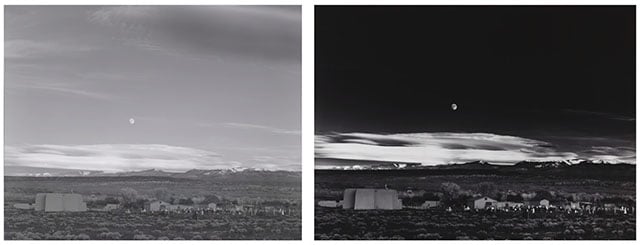
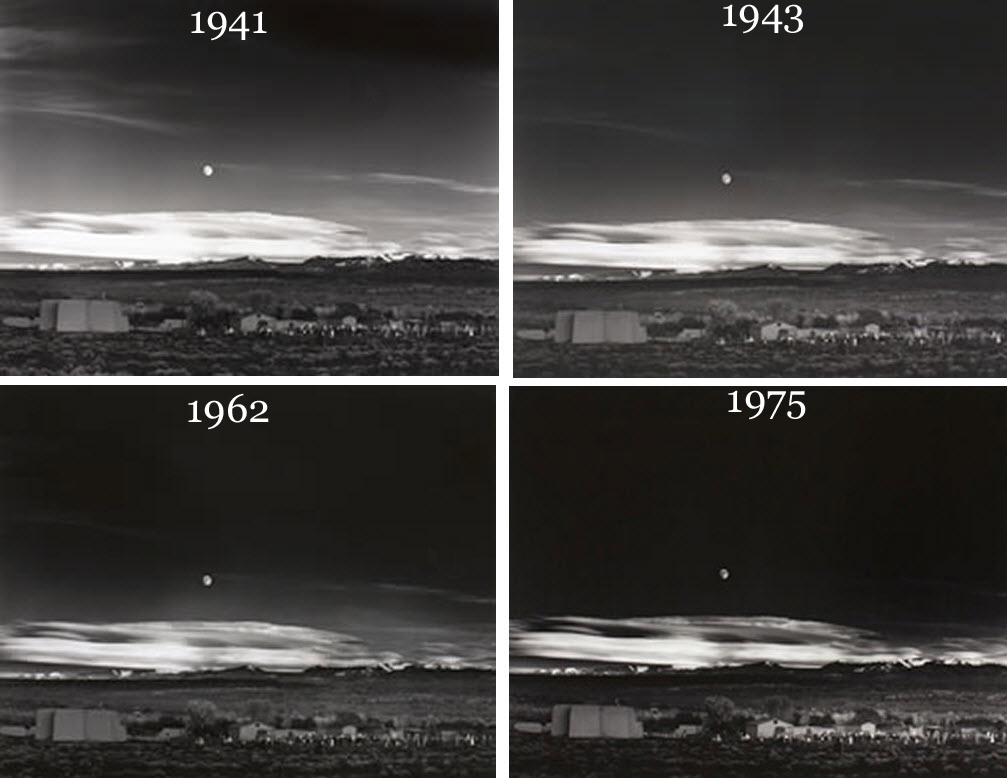
In the videos, he was measuring the lightest and darkest areas of the composition area with lightmeter and made calculations to run the film exposure longer/shorter. He was mentioning touch ups in one of the portrait shot review as unethical... But he was doing the different processing/printing methods to change his prints, eg Moonrise, Hernandez image - an early print (left - exposure matches to the calculated time of the shot eg before sunset) versus a later print (right-looks like night). It is interesting how his vision changed as years passed:
"He had to know his cameras, so he could quickly set them up to capture the image in focus when the moment arrived. He had to know his film, so he'd know just how to expose it, without using a light meter if necessary. He had to know his chemicals so he could create fine grain on his large format negative to give him the detail and contrast he wanted. He had to understand the colors in front of him so he'd know which filter to use to darken the blues, or bring out the detail in the greens when transformed into black and white.
In the darkroom, once Adams had developed his negatives, he would return to them over and over again to create the image he'd envisioned."