p.1 #1 · Leica M10 and M10-P: Stay way from ISO 100 in contrasty lighting
The Leica M10 series' dynamic range has been discussed for many years and a lot of Leica shooters still believe that ISO 100 looks very similar to ISO 200 in terms of dynamic range.
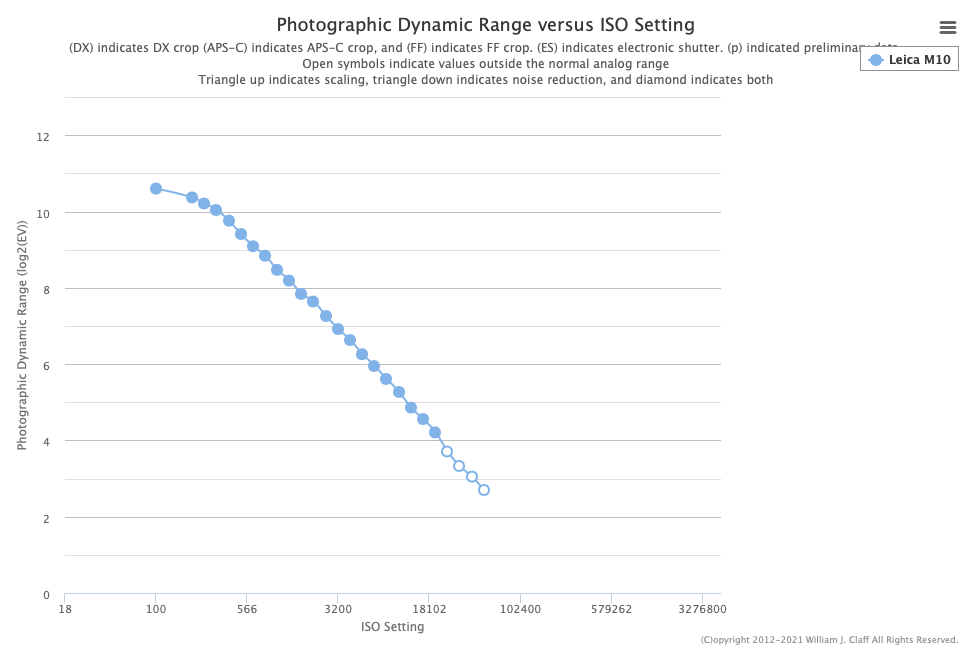
Photonstophotos.net is an expert site regarding this subject and I trust their results. It's interesting that it shows the M10 having higher dynamic range at ISO 100 compared to ISO 200. See here:
However, when analyzing my own ISO 100 and ISO 200 real world images, I see highlights getting crushed when shooting at ISO 100.
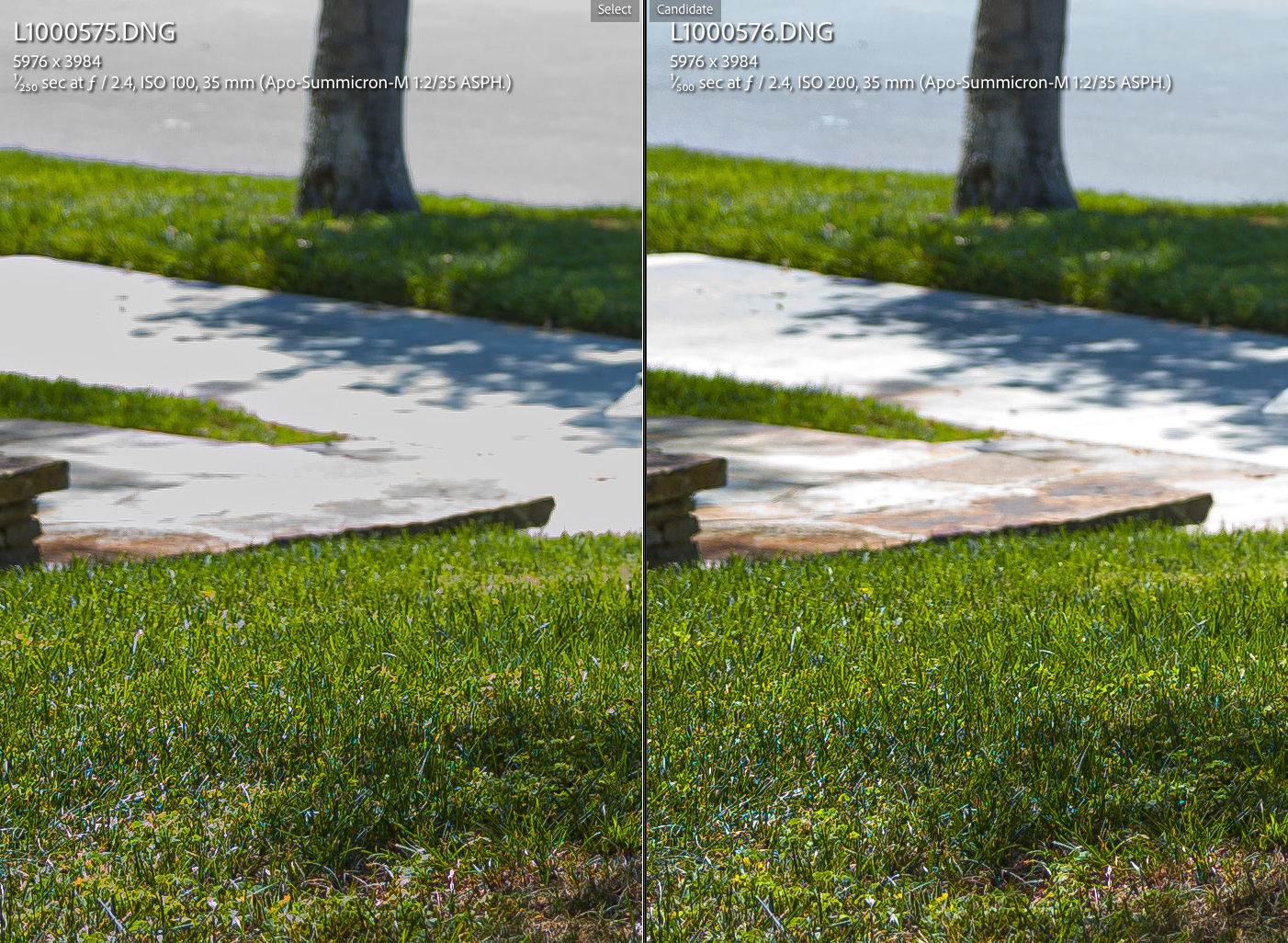
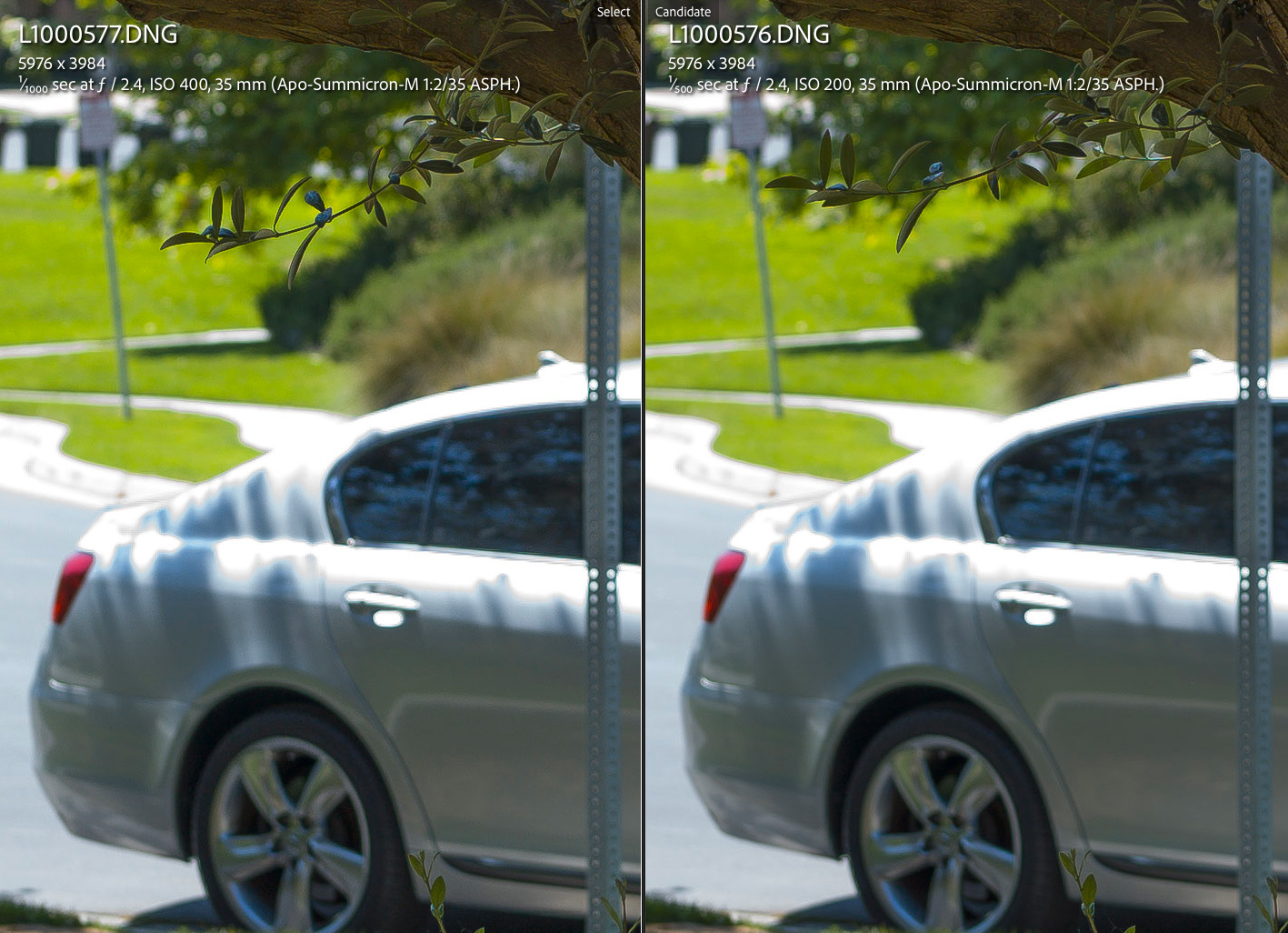
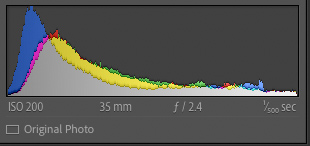
Today, I decided to run a quick test showing a high contrast scene over-exposed by 1EV, at ISO 100, 200 and 400. In Lightroom, I only added sharpening and reduced exposure by 1.5 EV for all three images.
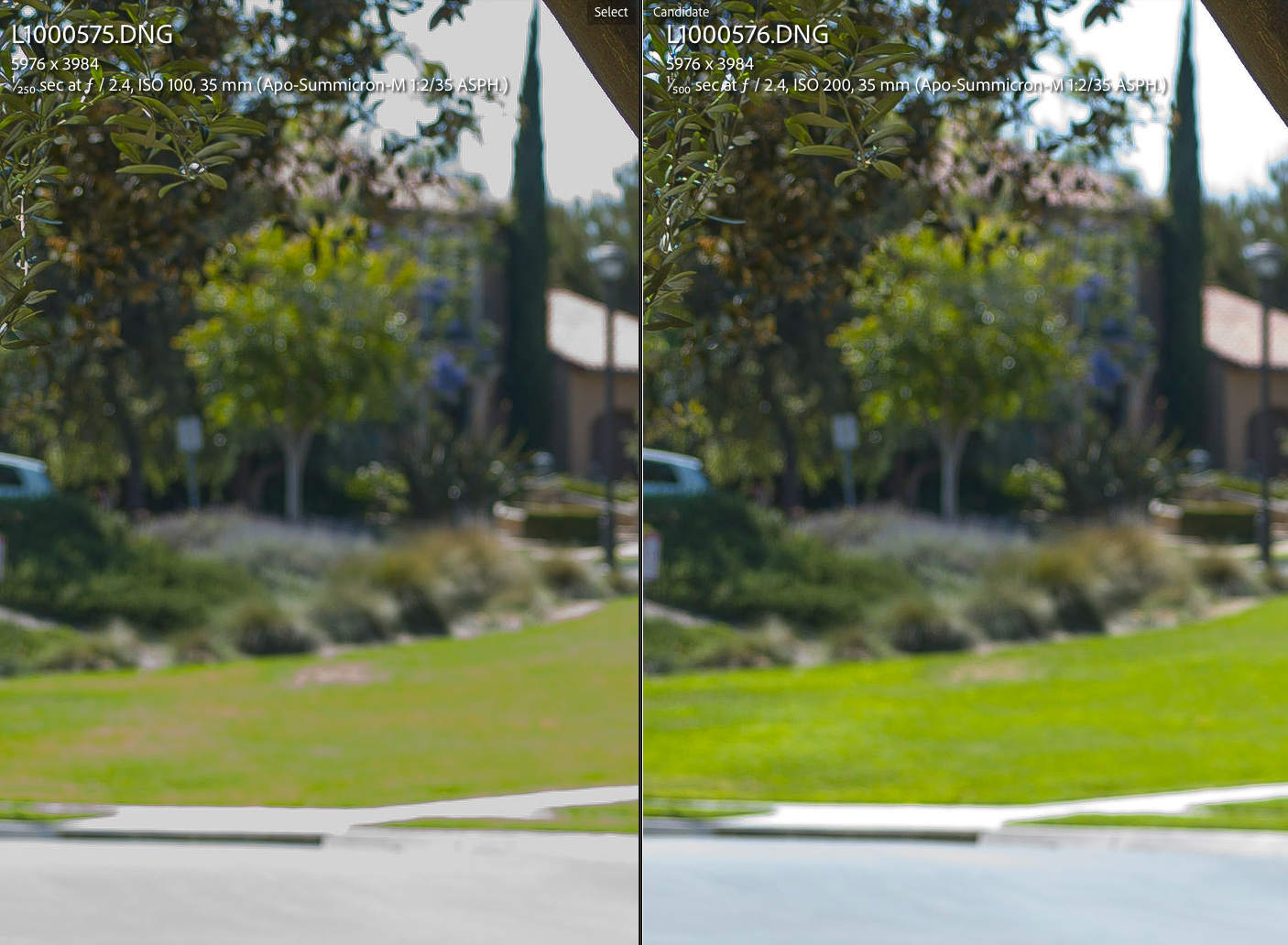
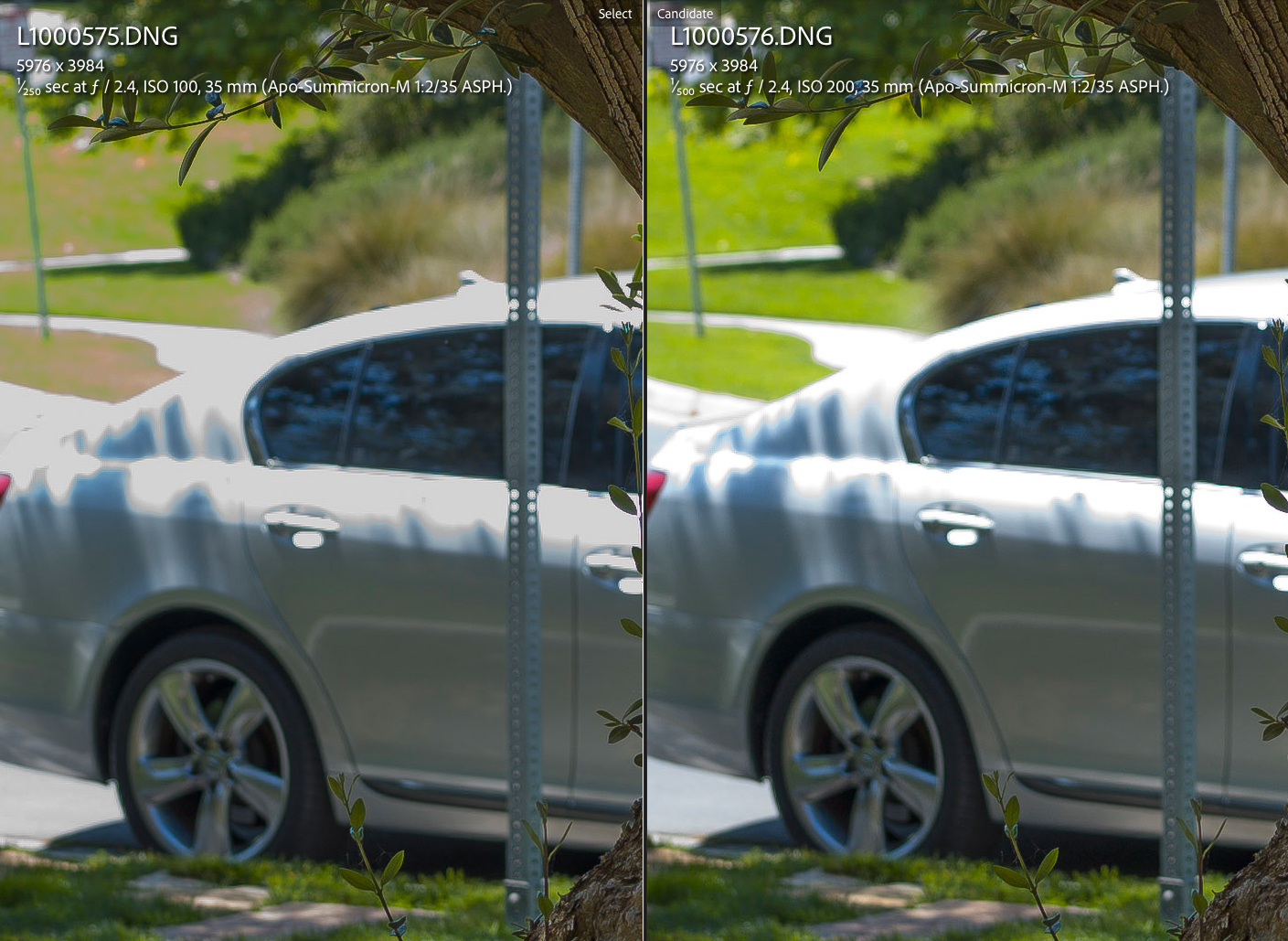
The results confirm that ISO 100 clips highlight detail while benefiting the shadows only very slightly. IMO, not a worth trade-off most of the time but it really depends on lighting contrast.
Slightly improved shadow detail is likely the reason for Photonstophotos' dynamic range results (and DXO's) as they likely only look at the noise floor, not the highlight roll-off, which is the main issue here. Perhaps the M10/P sensor base ISO is somewhere between 100 and 200 (probably 160) but unfortunately that option is not available as a ISO setting.
This seems to be the main reason Leica upgraded the firmware a while go making Auto-ISO rely on ISO 200 instead of ISO 100. That was the correct decision in my opinion but it would be great if they would also allow ISO 160 as an option for us. Perhaps as one of the "M" ISO options (super easy to do). It may not be very relevant but it could mean an extra ~1/3 stop of data for the shadows without sacrificing any highlight detail which would be ideal.
Here are the comparison images side by side:
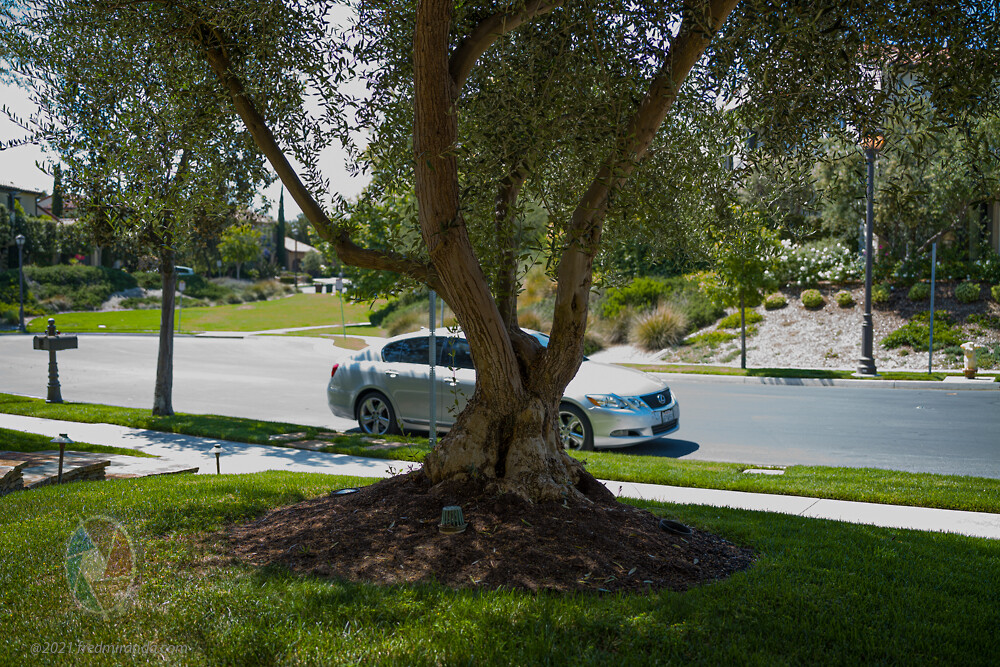
Full image at ISO 200
1:1 crop from image above: the ISO 100 crop (LEFT) shows loss of highlight detail
1:1 crop from image above: the ISO 100 crop (LEFT) shows loss of highlight detail
1:1 crop from image above: the ISO 100 crop (LEFT) shows loss of highlight detail
1:1 crop from image above: ISO 200 and ISO 400 show similar highlight roll-off
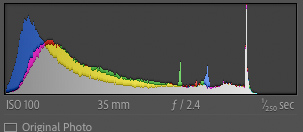
ISO 100 Histogram: Pay attention to the clipped highlight data
p.1 #2 · Leica M10 and M10-P: Stay way from ISO 100 in contrasty lighting
I think the P2P testing of the M10-P and/or M10-R is fundamentally flawed in some way given how much easier it is to manipulate files from the M10-R, even in the shadows. Is it really possible to (hypothetically) distribute the 10.6 PDR of the M10 as 10 PDR into Zones 0 through VII and the remaining .6 PDR into Zones VIII through X?
And if DR is distributed unevenly from 0 to X, then why are there not charts that show for any given ISO how the DR is distributed? Seems like all of the "this cameras is better with the shadows" and "this camera is better with the highlights" never ends up being charted with data.
p.1 #3 · Leica M10 and M10-P: Stay way from ISO 100 in contrasty lighting
Found this on the P2P site. It sounds like the way they calculate DR seems to be a compromised choice to use Full Well Capacity over White Level as the latter requires too much data. So perhaps some of the DR of the M10/M10-P we see in their DR chart at ISO 100 is being overestimated.
In any case, as you've shown in your examples, ISO 200 should be the base ISO for the M10-P, and at ISO 200, the M10-P shows on P2P to have a PDR of 10.2 while the M10-R at ISO 100 shows a PDR of 10.7.
Given the above, the M10-P only equals the M10-R for DR (according to P2P chart) if you're ok with throwing away almost all the DR in the highlights by using ISO 100. And if the P2P chart is wrong, as I suspect it is, then you may actually be getting lower DR on the M10-P at ISO 100 than you do at ISO 200.
Although the sensor is not linear beyond the White Level, with proper calibration; corrected values can be determined.
In fact, a properly calibrated sophisticated decoder can recover highlight values beyond the ADC clipping point.
Given this fact, it is unclear whether White Level or Full Well Capacity should be used as the upper bound in Dynamic Range calculations.
As a practical matter, because determining White Level requires a great deal of data, I use Full Well Capacity in my Dynamic Range calculations.
p.1 #4 · Leica M10 and M10-P: Stay way from ISO 100 in contrasty lighting
highdesertmesa wrote:
Found this on the P2P site. It sounds like the way they calculate DR seems to be a compromised choice to use Full Well Capacity over White Level as the latter requires too much data. So perhaps some of the DR of the M10/M10-P we see in their DR chart at ISO 100 is being overestimated.
In any case, as you've shown in your examples, ISO 200 should be the base ISO for the M10-P, and at ISO 200, the M10-P shows on P2P to have a PDR of 10.2 while the M10-R at ISO 100 shows a PDR of 10.7.
Given the above, the M10-P only equals the M10-R for DR (according to P2P chart) if you're ok with throwing away almost all the DR in the highlights by using ISO 100. And if the P2P chart is wrong, as I suspect it is, then you may actually be getting lower DR on the M10-P at ISO 100 than you do at ISO 200.
Could you run a similar test on your Leica M10-R?
Shoot under high contrast lighting over-exposing the scene by 1EV (use exposure compensation for example). Set the shutter dial to "A" and do not change aperture between shots. So only change ISO from ISO 100 to ISO 200. In post, just normalize the files (usually by reducing exposure back to normal) and compare the highlight areas at 1:1.
p.1 #5 · Leica M10 and M10-P: Stay way from ISO 100 in contrasty lighting
Fred Miranda wrote:
Could you run a similar test on your Leica M10-R?
Shoot under high contrast lighting over-exposing the scene by 1EV (use exposure compensation for example). Set the shutter dial to "A" and do not change aperture between shots. So only change ISO from ISO 100 to ISO 200. In post, just normalize the files (usually by reducing exposure back to normal) and compare the highlight areas at 1:1.
Sure, I'll give it a try. There may be some non-equal footing, though, due to the fact that the M10-R meter may be less likely to overexpose in the first place. Did you use Live View or the optical finder when getting the exposure? If you used Live View, which metering method do you have it set for? Just want to make sure I mimic what you did as closely as possible. I'll use the CV 35 APO like you did as well.
p.1 #6 · Leica M10 and M10-P: Stay way from ISO 100 in contrasty lighting
highdesertmesa wrote:
Sure, I'll give it a try. There may be some non-equal footing, though, due to the fact that the M10-R meter may be less likely to overexpose in the first place. Did you use Live View or the optical finder when getting the exposure? If you used Live View, which metering method do you have it set for? Just want to make sure I mimic what you did as closely as possible.
It does not really matter much as long as you over-expose the high contrast scene by about 1 or 1.5 stop from what the camera metering is suggesting. I used live view for this one. From my sample, you can see that even 1 stop over exposure is already too much even for ISO 200.
p.1 #9 · Leica M10 and M10-P: Stay way from ISO 100 in contrasty lighting
I have noticed a similar characteristic with the SL2. I hadn’t thought of moving to ISO 200, although I do normally underexposed by two thirds of a stop, or so.
p.1 #10 · Leica M10 and M10-P: Stay way from ISO 100 in contrasty lighting
Somebody mentioned the issue a few weeks ago also in regard to the M 240. The recommendation was to stay with ISO 200 if possible. ISO 200 seems the lowest "real" ISO the sensor and/or the image processing allows - at lower ISO 100 other algorithms kick in which have some culprits. I wonder if a firmware update could resolve this issue at ISO 100, or if the sensor itself is limited here.
Don't want to compare apples with oranges here, but my now 7 years old Sony sensor of my A7R can easily go down to ISO 50 without issues. I have used this often for long exposure photography (even ISO 50 is also coming from an algorithm there).
p.1 #11 · Leica M10 and M10-P: Stay way from ISO 100 in contrasty lighting
Goodrich wrote:
I have noticed a similar characteristic with the SL2. I hadn’t thought of moving to ISO 200, although I do normally underexposed by two thirds of a stop, or so.
Underexposing ISO 100 by about a stop is pretty much the same thing as shooting at ISO 200. In order for this camera to provide ISO 100, what is doing is "overexposing" its base ISO (probably ISO 160 or something close to ISO 200) and then normalizing the exposure in-camera. For the M10, they didn't want to call ISO 100 a "pull ISO" but that's exactly what it is. (Probably the same for the M10-R and M10-M models as well)
This is not necessarily a bad thing, just something to be aware and learn about the camera.
p.1 #12 · Leica M10 and M10-P: Stay way from ISO 100 in contrasty lighting
retrofocus wrote:
Somebody mentioned the issue a few weeks ago also in regard to the M 240. The recommendation was to stay with ISO 200 if possible. ISO 200 seems the lowest "real" ISO the sensor and/or the image processing allows - at lower ISO 100 other algorithms kick in which have some culprits. I wonder if a firmware update could resolve this issue at ISO 100, or if the sensor itself is limited here.
Don't want to compare apples with oranges here, but my now 7 years old Sony sensor of my A7R can easily go down to ISO 50 without issues. I have used this often for long exposure photography (even ISO 50 is also coming from an algorithm there). ...Show more →
I had the M240 for about a year and it behaves in a similar way. The difference is that for this camera, Leica acknowledged from the start that the base ISO is 200 and 100 is just a pull.
You can make a "pull" ISO 100 in post if you want. Just shoot at ISO 200 and overexpose the shot by 1 stop. In post, reduce the exposure by 1 stop. The resulting ISO 200 image will look identical to ISO 100 out of the camera.
p.1 #13 · Leica M10 and M10-P: Stay way from ISO 100 in contrasty lighting
Fred Miranda wrote:
...From my sample, you can see that even 1 stop over exposure is already too much even for ISO 200.
Fred - When I first got my M10, I was frustrated by how easy it was to blow out highlights, much easier than with the M9 and MM cameras that I had sold to finance the M10. Then, I read about shooting at ISO 200 rather than ISO 100: a bit better, but still frustrating when shooting in the bright, tropical light of Thailand, where it was difficult to predict how much I needed to underexpose when shooting into the light with strong side light — sometimes I had to underexpose by more than 1 stop.
Andy Piper ("adan" on LUF), studied the M10 in comparison to the M9 and M240 and concluded that Leica must have applied a contrast curve to the M10 DNGs that distributed the available dynamic range more to the shadows than to the highlights — presumably in an attempt to made the SOOC DNGs a bit more like those of the M9.
Now, many people feel that the M10-R has more dynamic range and better highlight falloff than the M10. However, the photonstophotos charts show that the dynamic range of the M10 and M10-R is about the same and that the shadow recovery of the M10 is better than that of the M10-R — and both the DR and the shadow recovery of these two cameras are substantially better than that of the M9:
My feeling is that the M10-R distributes more of the available DR to the highlights than the M10 does — and that this is why people feel that the M10-R has better treatment of highlights or, even, more dynamic range than the M10; but note, as shown in the charts linked above, that the shadow recovery of the M10-R is not as good as that of the M10 — and this poorer shadow recovery aspect is what some M10-R have recognized. (I should note that the fact that the M10-R has the same DR as the M10 is an achievement by Leica, considering that the 41MP sensor of M10-R has smaller, more tightly packed photo sites than the M10).
My feeling is that Leica could substantially improve the highlight treatment of the M10 through a firmware upgrade designed to produce a flatter DNG, with an increased allocation of the DR to the highlights but, unfortunately that is unlikely to happen.
Question: I believe that you have the Cobalt-Image Profiles for the M10, about which you've written in another thread. Do you find that these profiles help tame the issues of the M10 highlights?
____________________ Frog Leaping photobook: https://www.frogleaping.org
p.1 #14 · Leica M10 and M10-P: Stay way from ISO 100 in contrasty lighting
Mitch Alland wrote:
Fred - When I first got my M10, I was frustrated by how easy it was to blow out highlights, much easier than with the M9 and MM cameras that I had sold to finance the M10. Then, I read about shooting at ISO 200 rather than ISO 100: a bit better, but still frustrating when shooting in the bright, tropical light of Thailand, where it was difficult to predict how much I needed to underexpose when shooting into the light with strong side light — sometimes I had to underexpose by more than 1 stop.
Andy Piper ("adan" on LUF), studied the M10 in comparison to the M9 and M240 and concluded that Leica must have applied a contrast curve to the M10 DNGs that distributed the available dynamic range more to the shadows than to the highlights — presumably in an attempt to made the SOOC DNGs a bit more like those of the M9.
Now, many people feel that the M10-R has more dynamic range and better highlight falloff than the M10. However, the photonstophotos charts show that the dynamic range of the M10 and M10-R is about the same and that the shadow recovery of the M10 is better than that of the M10-R — and both the DR and the shadow recovery of these two cameras are substantially better than that of the M9:
My feeling is that the M10-R distributes more of the available DR to the highlights than the M10 does — and that this is why people feel that the M10-R has better treatment of highlights or, even, more dynamic range than the M10; but note, as shown in the charts linked above, that the shadow recovery of the M10-R is not as good as that of the M10 — and this poorer shadow recovery aspect is what some M10-R have recognized. (I should note that the fact that the M10-R has the same DR as the M10 is an achievement by Leica, considering that the 41MP sensor of M10-R has smaller, more tightly packed photo sites than the M10).
My feeling is that Leica could substantially improve the highlight treatment of the M10 through a firmware upgrade designed to produce a flatter DNG, with an increased allocation of the DR to the highlights but, unfortunately that is unlikely to happen.
Question: I believe that you have the Cobalt-Image Profiles for the M10, about which you've written in another thread. Do you find that these profiles help tame the issues of the M10 highlights?
____________________ Frog Leaping photobook: https://www.frogleaping.org...Show more →
That's a great question Mitch. I've tried the Cobalt M10 stardard and "repro" profiles and it does not recover the clipped highlights in the ISO 100 sample posted here. I am assuming there is not much the profile can do since it works with clipped data from the camera but I've asked the developer about it.
On the opposite side for Q2/SL2, ISO 50 gives you much less noise from the image shadows as long as you are careful with highlights. ISO 100 is not that great on shadow recovery noise. That matches to photonstophotos calculations for SL2/Q2 and is similar to M10 comment from Mitch that Leica pushed the dynamic range to shadows for Leica M10. Same Panasonic S1R sensor behaves differently. You can check the dpreview Raw Dynamic Range samples from a1 review by changing one of the comparison cameras to Q2 (no M10/M10R) with ISO 50 +6EV & ISO 100 +6EV: https://www.dpreview.com/reviews/sony-a1-review/5
In the dpreview comparison GFX100S is the best that I saw. Z7 II is better at ISO 64 than ISO 100. R5 is much worse with the electronic shutter. It is an interesting comparison for the shadow recovery.
Goodrich wrote:
I have noticed a similar characteristic with the SL2. I hadn’t thought of moving to ISO 200, although I do normally underexposed by two thirds of a stop, or so.
p.1 #19 · Leica M10 and M10-P: Stay way from ISO 100 in contrasty lighting
@Mitch Alland:
I just got this from the Cobalt developer:
"Clipped data are "lost", always for cmos sensor."
However, he wants to check the ISO 100 and ISO 200 dng files posted here for further evaluation. I will make them available for everyone to play with them.
Leica could correct this very easily by adding ISO 160 to the custom "M" ISO setting. The only reason I can think they are not doing this is perhaps because the sensor base ISO is very close to ISO 200 and not ISO 160.
I will write them about it. It would be great if other do that as well.