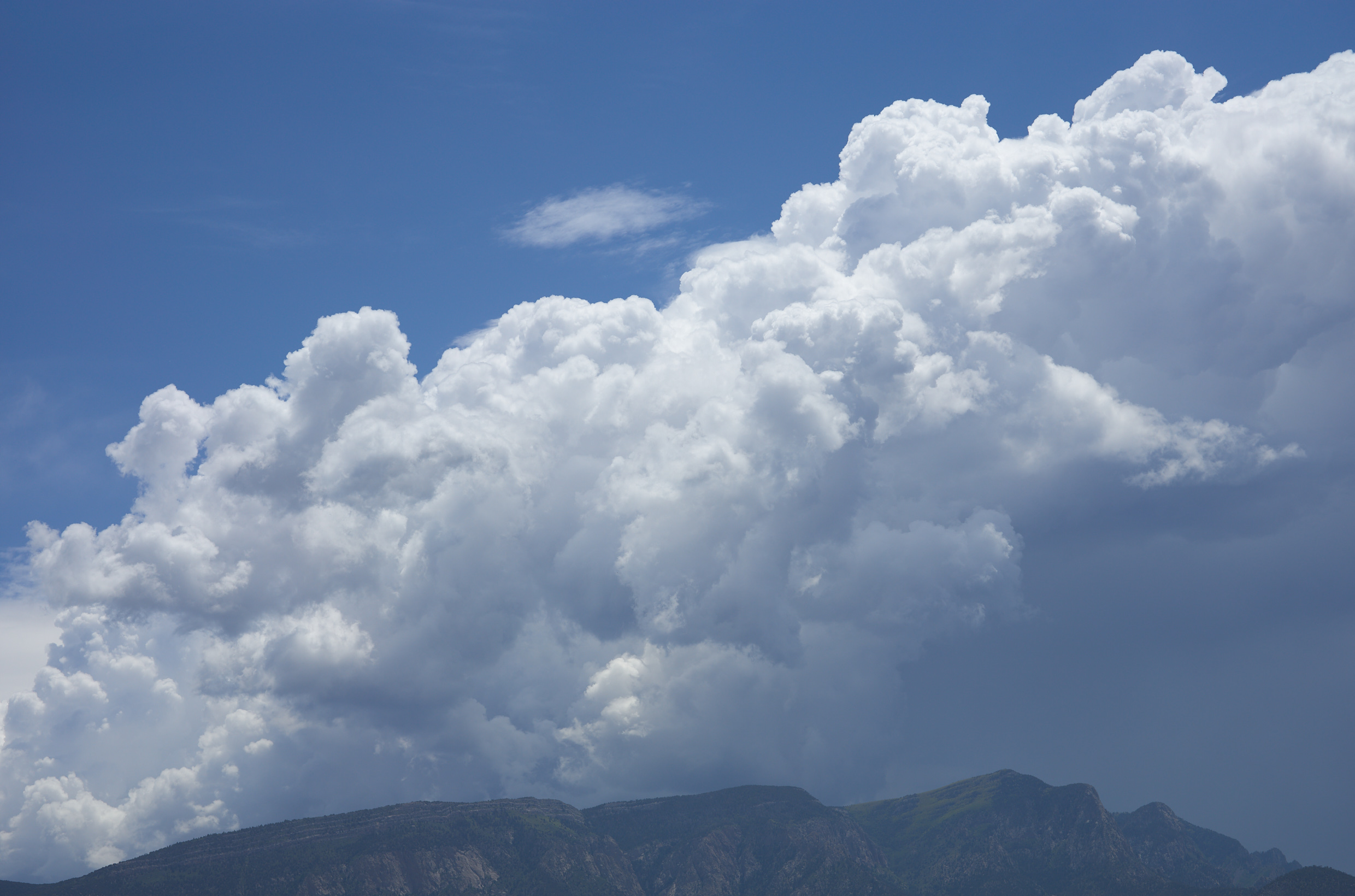
p.3 #1 · Leica M10 and M10-P: Stay way from ISO 100 in contrasty lighting
When I was in college I had 2 semesters of the zone system. I did all the test. I am going to way over simplify here. But once one tests and finds out the proper asa/iso for the film, developer, camera, lens being used one would spot meter to place exposure of the shadows ussualy zone II or zone III and base exposure on that and then meter the highlights and control them through development time of the negative. If the highlights were to hot one would cut development time (also tested). Say it was one full stop to much one could pull the highlights back by using an N-1 development time. 2 stops to hot N-2. If the scene was to flat just the opposite. N+1. Two stops to flat N+2 etc. Further control contrast with graded papers, Adams was the one to first fully articulate this.
A few years back the Art Institute Chicago had an Adams exhibit and they had 3 different Moonrise prints from 3 different periods. He tended printed darker as he got older.
p.3 #2 · Leica M10 and M10-P: Stay way from ISO 100 in contrasty lighting
airfrogusmc wrote:
"Simplicity is the prime requisite. The equipment of Alfred Stieglitz or Edward Weston represents less in cost and variety than many an amateur "can barely get along with."Their magnificent photographs were made with intelligence and sympathy-not with merely the machines."-Ansel Adams.
What i was referring to is many get caught on the gadget go round and forget the gadget is only a tool and all of the tools available today can capture what one is seeing. But one has to see. That is the important part. No amount of MPs or DR can help if one can't see or has nothing to say.
Adams and Weston both used equipment that matched their visions. They were not ones to chase the latest and so called greatest. They used equipment that worked for them.
...Show more →
I agree about thinking about gear as tools and using tools that work best with their respective wielders.
My point is an extension of that: if the MP and DR helps an artist who can already see reach the translation of their vision more directly with less resistance with more reliability, then I think staying on top of technology can accelerate that portal rather than slowing it down. So, it's more along the lines: if you can already see, the better tool can make life a lot more fun.
Often I wonder what the old masters of any art would use if they had access to modern tech. Rather what they would output using them.
Now imagine the horror of Ansel Adams being a brand maximalist and posting in this forum
p.3 #3 · Leica M10 and M10-P: Stay way from ISO 100 in contrasty lighting
Yeah the forum thing probably wouldn't have happened. He was already thinking about digital when he died. I have a feeling he would have come up with a really good zone system for digital. Probably a large format digital back kinda guy though.
p.3 #4 · Leica M10 and M10-P: Stay way from ISO 100 in contrasty lighting
I have seen so many great photographs made with limited DR. Eggleston's die transfers from Kodachrome transparencies immediately come to mind. As does Subway by Davidson, also Kodachrome.
p.3 #5 · Leica M10 and M10-P: Stay way from ISO 100 in contrasty lighting
highdesertmesa wrote:
The P2P chart compares the below-base ISO (100) on M10-P to base ISO (100) on M10-R. That's a flawed comparison as we've all seen what ISO 100 on the M10-P does to the highlights.
You have to compare M10-P at ISO 200 to M10-R at ISO 100, and in that P2P comparison, the M10-R has higher PDR.
Don't undertstand what you're saying, since at ISO 200 the P2P chart shows that the DR is the same for the M10 and the M10-R. Indeed, the chart compares the DR for the range of ISOs up to 51,200.
____________________ Frog Leaping photobook: https://www.frogleaping.org
p.3 #6 · Leica M10 and M10-P: Stay way from ISO 100 in contrasty lighting
Mitch Alland wrote:
Don't undertstand what you're saying, since at ISO 200 the P2P chart shows that the DR is the same for the M10 and the M10-R. Indeed, the chart compares the DR for the range of ISOs up to 51,200.
____________________ Frog Leaping photobook: https://www.frogleaping.org
I was saying to compare M10 at 200 to M10-R at 100, which is base ISO for both (not 200 vs 200). Basically best possible PDR for each at the ISOs at which they hold highlight detail.
p.3 #7 · Leica M10 and M10-P: Stay way from ISO 100 in contrasty lighting
Fred Miranda wrote:
Could you run a similar test on your Leica M10-R?
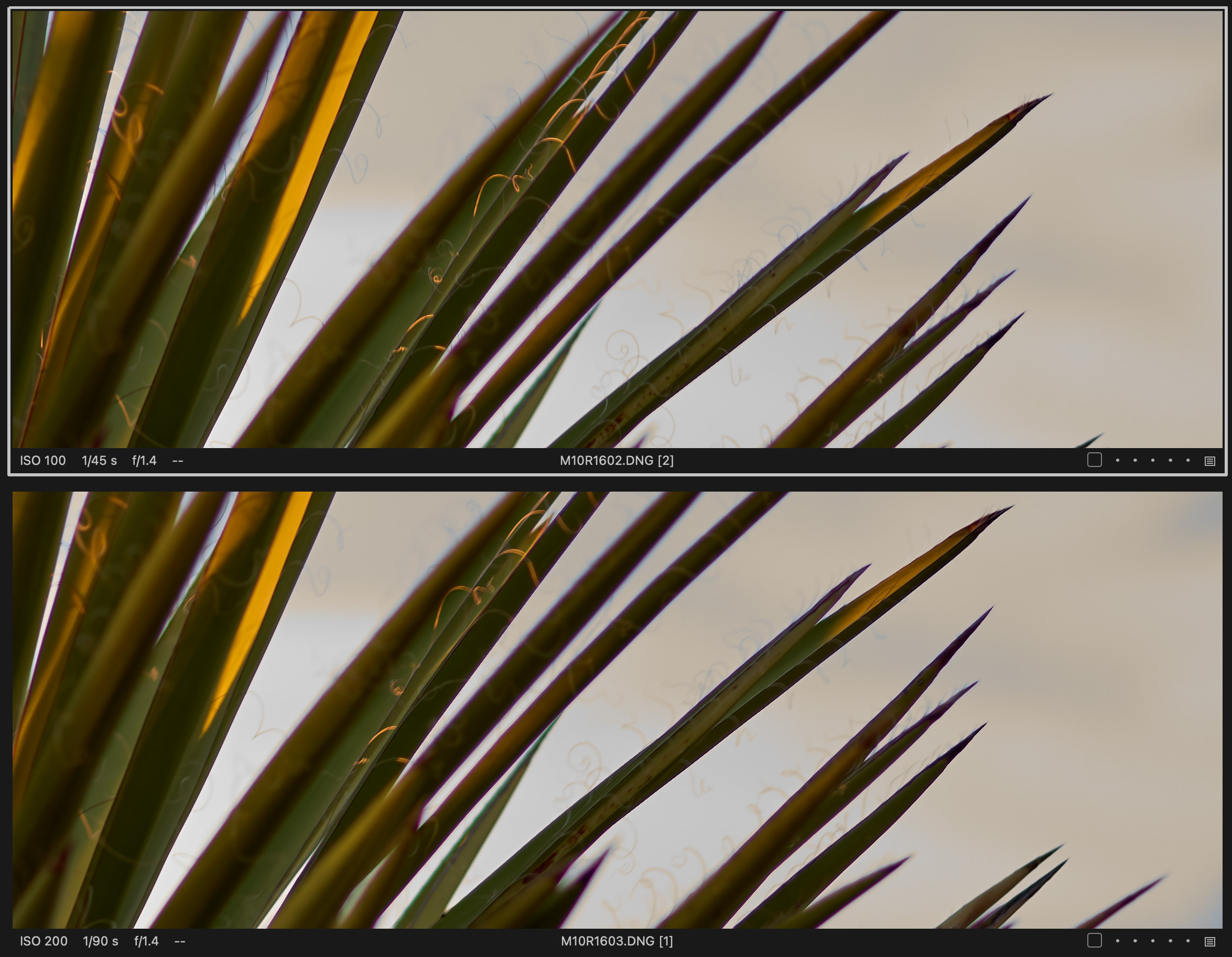
Shoot under high contrast lighting over-exposing the scene by 1EV (use exposure compensation for example). Set the shutter dial to "A" and do not change aperture between shots. So only change ISO from ISO 100 to ISO 200. In post, just normalize the files (usually by reducing exposure back to normal) and compare the highlight areas at 1:1.
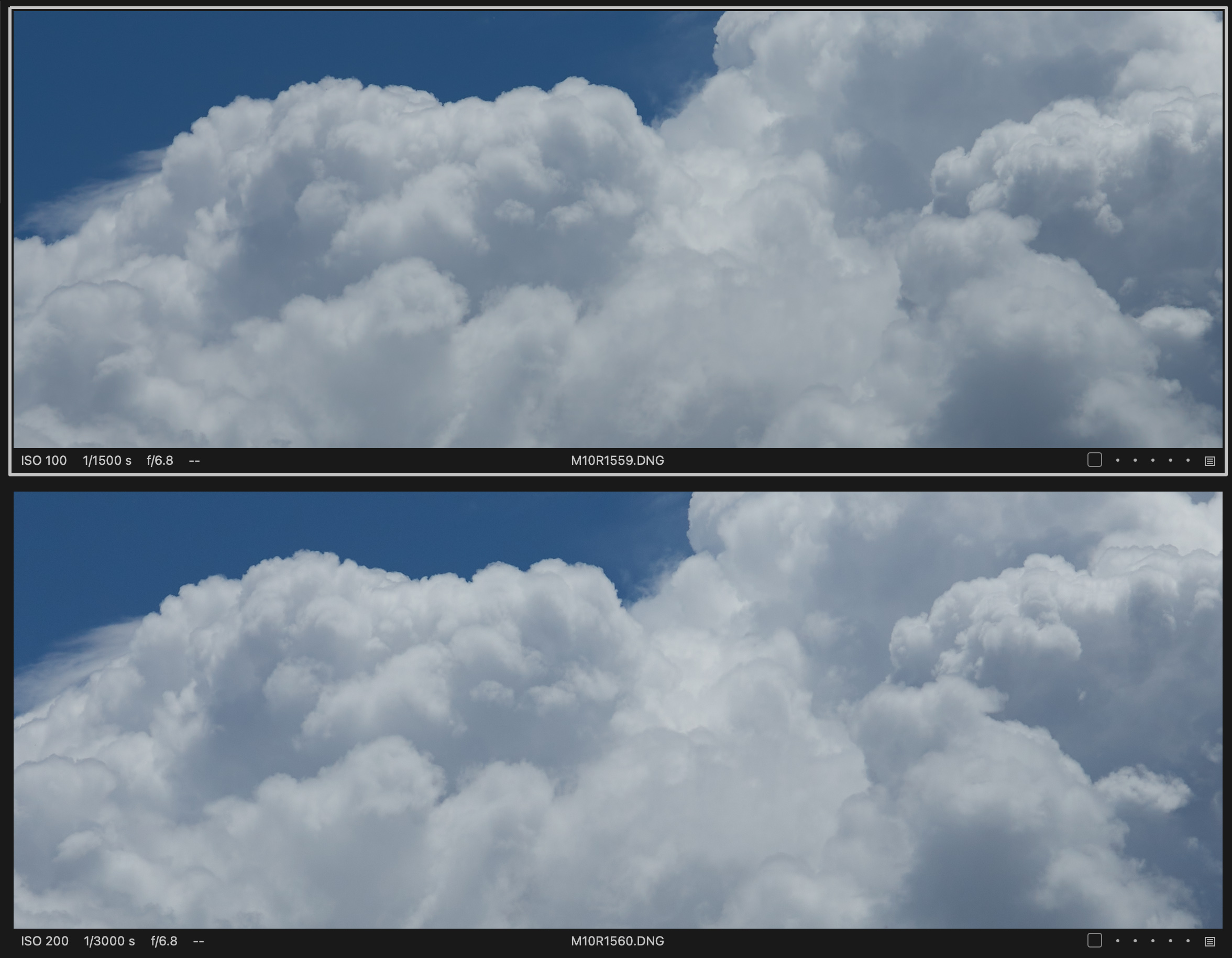
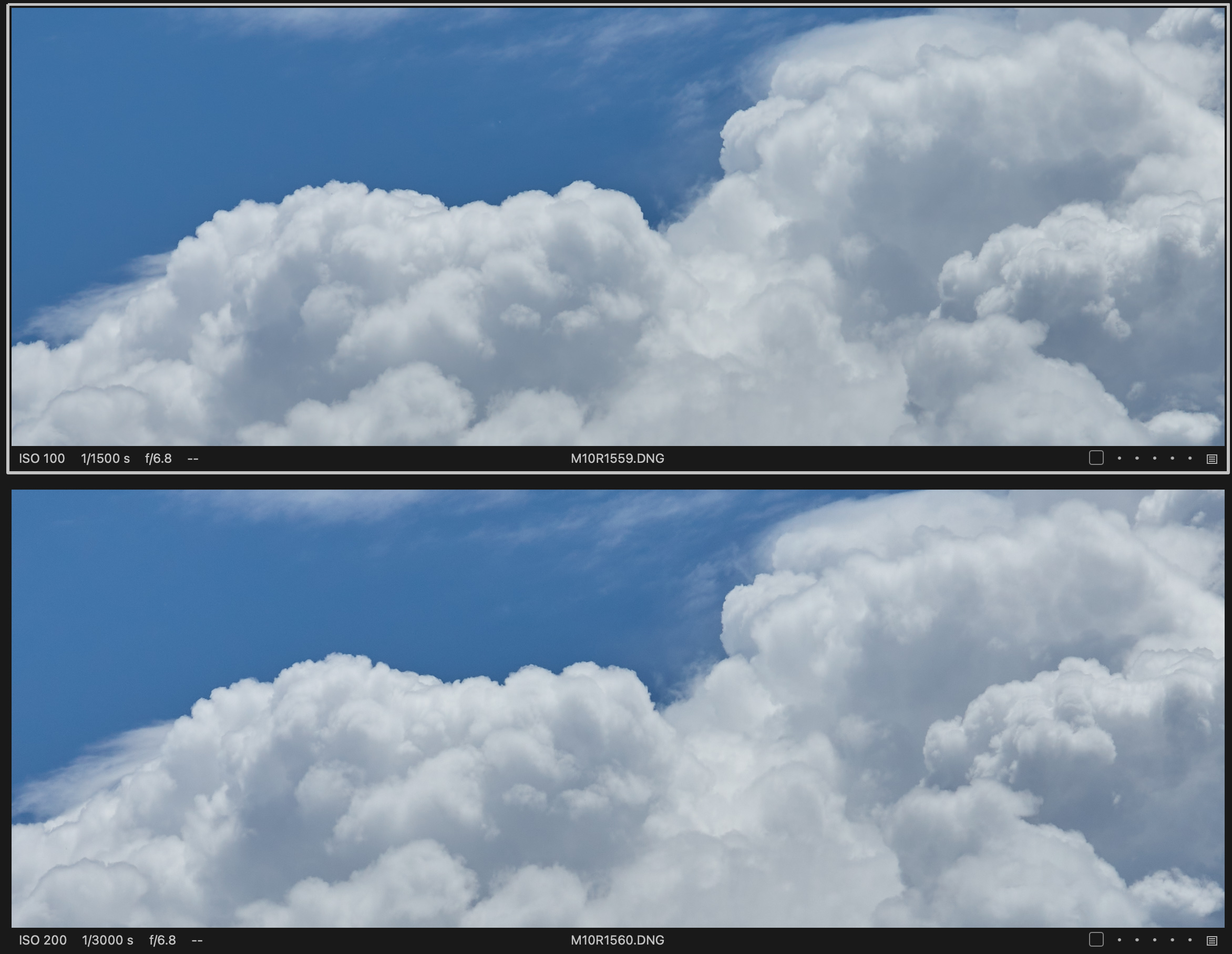
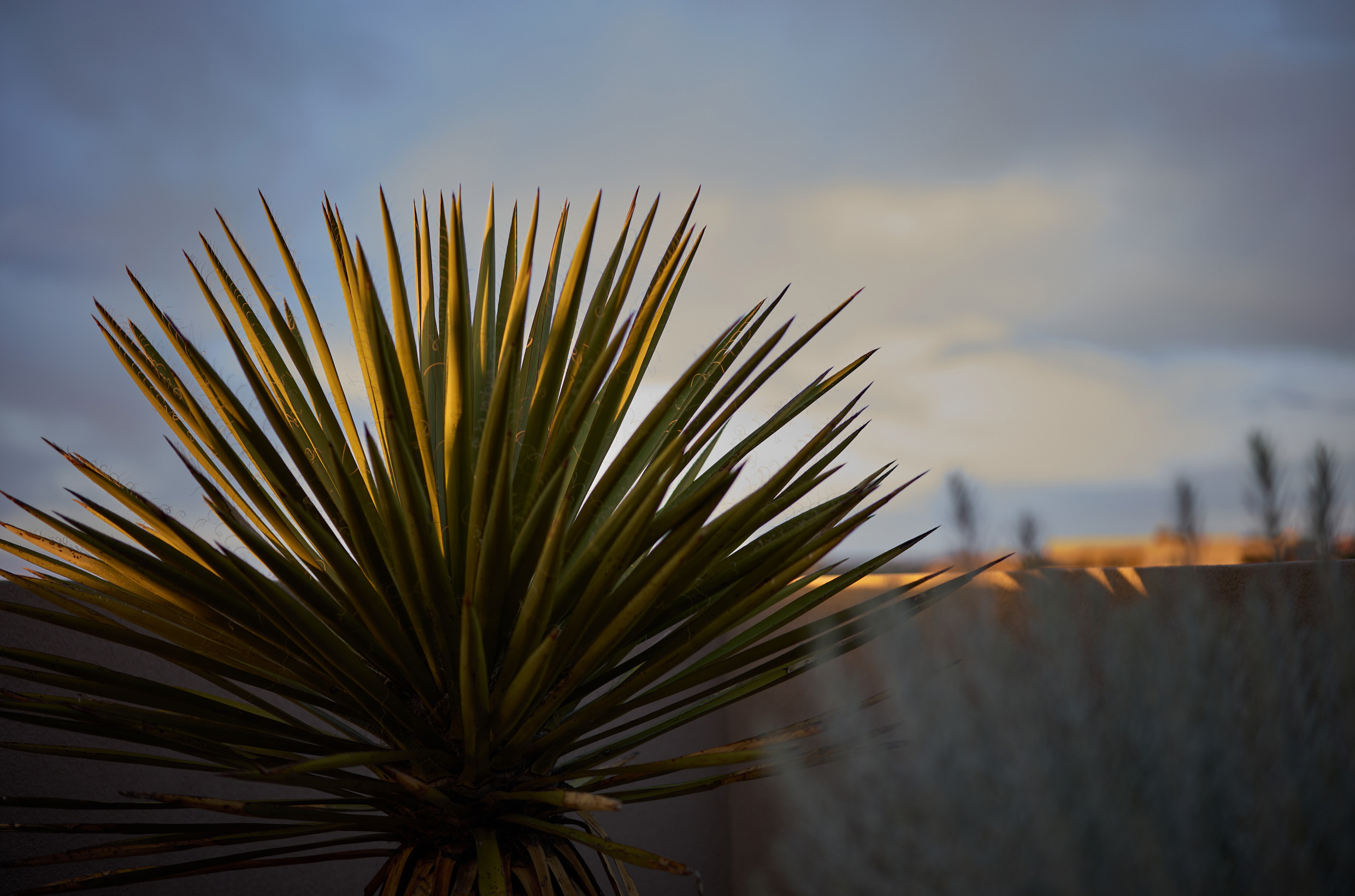
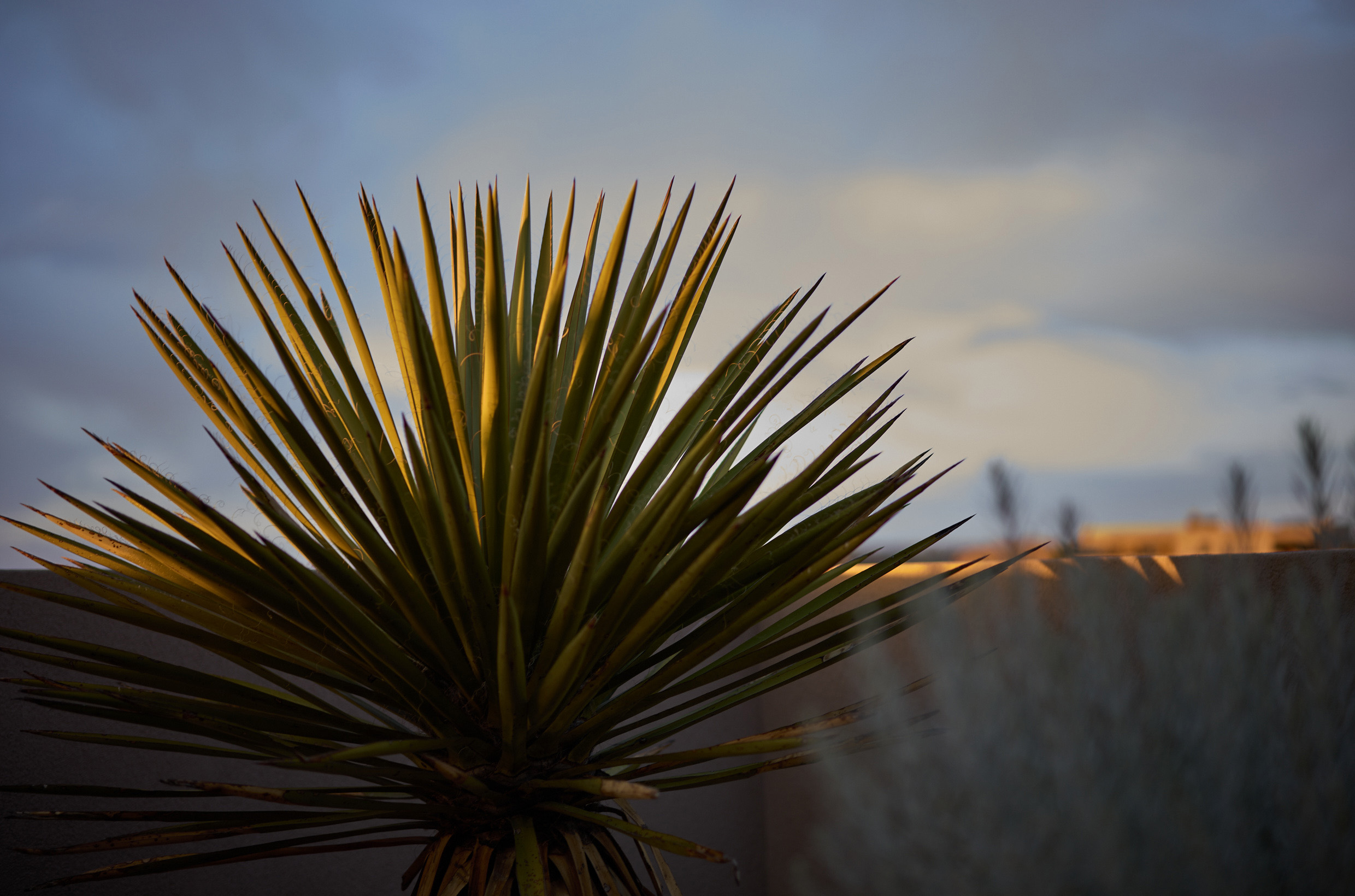
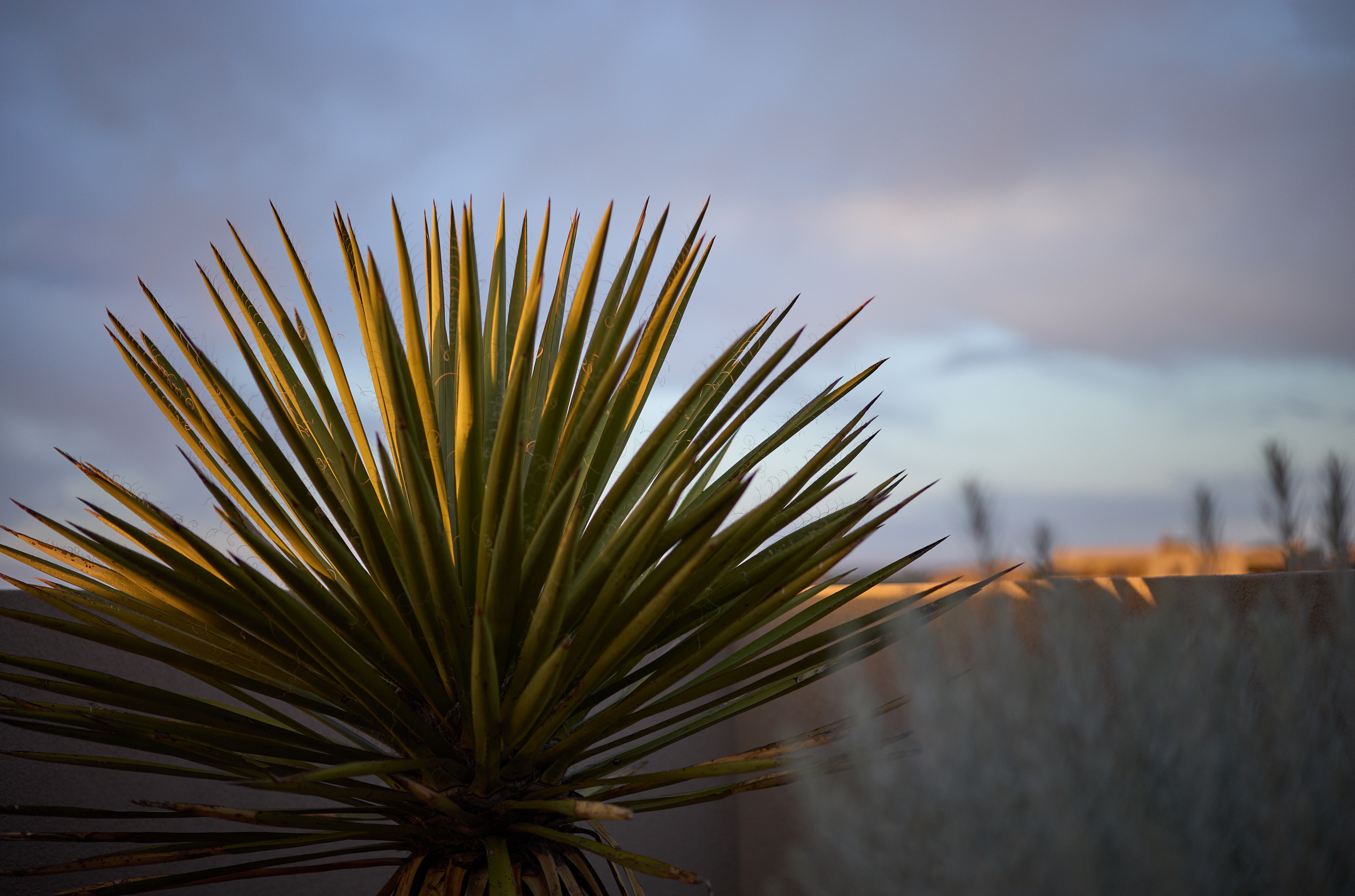
Results below on the M10-R using the CV 75 1.5. I can redo with the CV 35 APO to better match your scene, but today the only thing in bright sunlight was further away.
p.3 #8 · Leica M10 and M10-P: Stay way from ISO 100 in contrasty lighting
highdesertmesa wrote:
Results below on the M10-R using the CV 75 1.5. I can redo with the CV 35 APO to better match your scene, but today the only thing in bright sunlight was further away.
That's a perfect scene but +1EV was actually the correct compensation for this scene, therefore it's not an ideal setting for us to see a difference between ISO 100 and 200. For scenes like this try adding +2 or +3EV, so we can compare how the different ISO settings behave when recovering highlights.
p.3 #9 · Leica M10 and M10-P: Stay way from ISO 100 in contrasty lighting
Fred Miranda wrote:
That's a perfect scene but +1EV was actually the correct compensation for this scene, therefore it's not an ideal setting for us to see a difference between ISO 100 and 200. For scenes like this try adding +2 or +3EV, so we can compare how the different ISO settings behave when recovering highlights.
See if these are better with +3EV. Added some shadow recovery for the heck of it, but it does take away some of the detail in the highlights. ISO 100 and 200 look about the same to me on the M10-R. I'm not seeing the striking difference you do on the M10-P.
p.3 #10 · Leica M10 and M10-P: Stay way from ISO 100 in contrasty lighting
highdesertmesa wrote:
See if these are better with +3EV. Added some shadow recovery for the heck of it, but it does take away some of the detail in the highlights. ISO 100 and 200 look about the same to me on the M10-R. I'm not seeing the striking difference you do on the M10-P.
Great comparison. The ISO 200 image seems to recover the highlights a little better but it looks similar to the ISO 100 image. Perhaps the "R" has more latitude for the highlights. Does the M10-R uses ISO 100 or ISO 200 for auto-ISO?
p.3 #11 · Leica M10 and M10-P: Stay way from ISO 100 in contrasty lighting
Fred Miranda wrote:
Great comparison. The ISO 200 image seems to recover the highlights a little better but it looks similar to the ISO 100 image. Perhaps the "R" has more latitude for the highlights. Does the M10-R uses ISO 100 or ISO 200 for auto-ISO?
Can you share the RAW files? TIA!
I'm guessing it's normal to get a bit better highlight recovery as ISO increases since Fujifilm has that expanded DR feature that raises the ISO. Anyway, yeah I'm not seeing the M10-R "bleed out" so much highlight detail like the M10-P does at ISO 100.
p.3 #13 · Leica M10 and M10-P: Stay way from ISO 100 in contrasty lighting
I've just checked the DNGs. Thanks for posting!
Your sample shows that the Leica M10-R's sensor recovers more detail in the highlights than the M10/P at ISO 100. Good to know.
p.3 #16 · Leica M10 and M10-P: Stay way from ISO 100 in contrasty lighting
Fred Miranda wrote:
I just bought a Leica M10-R and will be testing this further.
Very cool! I look forward to your tests and observations.
Yesterday I sent my Q2M and Q-P in for trade-in toward an M10M. The M10M DNG samples I downloaded from DPR show much better highlight recovery than I was getting with the Q2M. And this lets me move from three different batteries and charger sizes to one. Thinking I will mainly use the CV 35 and 50 APO on the Monochrom since they both share the same 49mm filter size as my Q2M did, and I already have all the b&w color filters in that size
p.3 #17 · Leica M10 and M10-P: Stay way from ISO 100 in contrasty lighting
highdesertmesa wrote:
Very cool! I look forward to your tests and observations.
Yesterday I sent my Q2M and Q-P in for trade-in toward an M10M. The M10M DNG samples I downloaded from DPR show much better highlight recovery than I was getting with the Q2M. And this lets me move from three different batteries and charger sizes to one. Thinking I will mainly use the CV 35 and 50 APO on the Monochrom since they both share the same 49mm filter size as my Q2M did, and I already have all the b&w color filters in that size
Dueling the M10-R and M10-M ? That's the dream-team right there 🤩🤩
p.3 #18 · Leica M10 and M10-P: Stay way from ISO 100 in contrasty lighting
airfrogusmc wrote:
He was already thinking about digital when he died. I have a feeling he would have come up with a really good zone system for digital.
I spoke with Dr. Michael Adams about his father on the matter of digital ... Michael said (my paraphrase) his dad was "full throttle" on what the unlimited possibilities were regarding digital.
Bear in mind, that Adams was continuously explorative (as new developers came to market, testing, experimentation, etc.), as we can see in his different printed renderings of a given image over the years. So, it would make sense that the premise of "pushing the envelope" to see how far / where it might go would just continue into the digital tool set for him ... forever the explorer (imo), both in the field and in the lab.
In the film realm, we pushed and pulled with chemistry formulas and time. Now, we push and pull with different math formulas. Which is why I find it helpful to understand which operations are linear, multiplication, exponential, formulaic. Depending on the (mathematical) sequence and choice of operators can influence how you are pushing / pulling your numbers around. Most folks (masses) don't even have a clue how the different mathematical operations are involved. But, I'm most certain Adams would know the mathematical difference(s) (similar to his understanding of film / developer differences, etc.) and work extensively to find the combinations that he desired to create the outcomes he wanted to produce ... as he understood the process of both capture and development > final product.
The numbers we capture, and the math we put them through after we capture them ... well, you get the gist.
Which btw, the numbers are always somewhere between 0 - 1 (even though we may use the RGB scale of 0-255 or LAB scale of 0-100) for mathematical operations.
p.3 #19 · Leica M10 and M10-P: Stay way from ISO 100 in contrasty lighting
RustyBug wrote:
as he understood the process of both capture and development > final product.
I agree with almost everything except the words process was greater than the final product. For Adams the process was to get him to the final product. To consistently capture what he saw in his minds eye at the moment of exposure and getting the final print of what he saw at that moment he exposed the film.. That means controlling the entire process to get exactly what he envisioned the final print would be. That is the reason for the zone system.
p.3 #20 · Leica M10 and M10-P: Stay way from ISO 100 in contrasty lighting
highdesertmesa wrote:
Very cool! I look forward to your tests and observations.
Yesterday I sent my Q2M and Q-P in for trade-in toward an M10M. The M10M DNG samples I downloaded from DPR show much better highlight recovery than I was getting with the Q2M. And this lets me move from three different batteries and charger sizes to one. Thinking I will mainly use the CV 35 and 50 APO on the Monochrom since they both share the same 49mm filter size as my Q2M did, and I already have all the b&w color filters in that size
The Voigtlander 35mm f/2 and 50mm f/2 APO lenses are fantastic on the high resolution Leica M bodies. Have you tried any of the TTArtisan lenses like their 50/0.95?