Fred Miranda wrote:
I just talked to Stephen Gandy (camera quest) and he told me that they have not shipped to Canada for years.
Canada has their own Voigtlander Distributor.
Thanks for checking and also the link you posted. I bought one from B&H last year, which made me wonder.. not an issue anyway, it's just that the used market here in Canada isn't as large as the US.
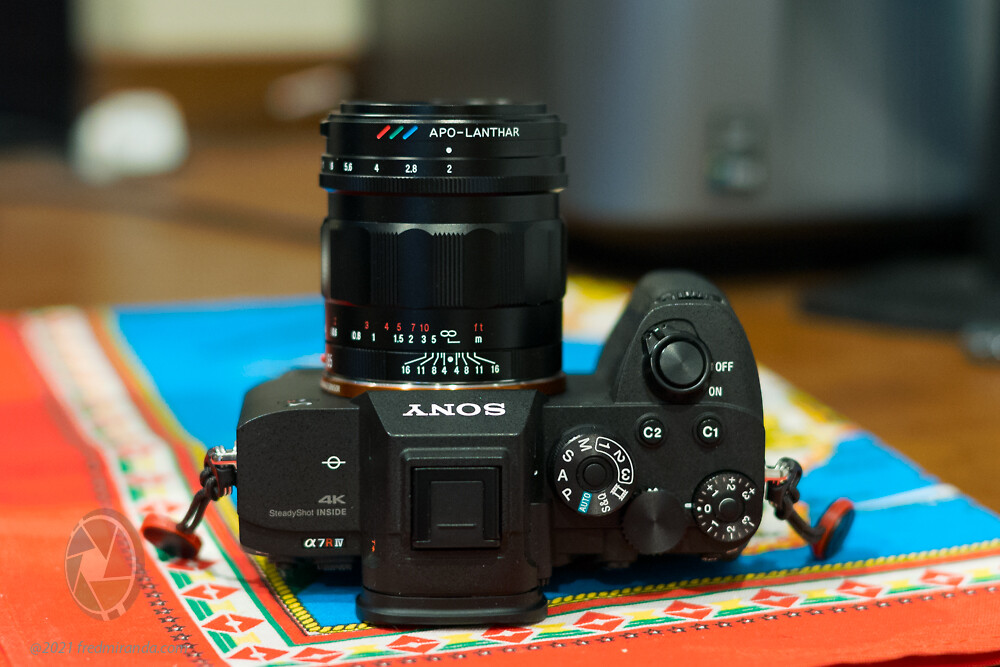
May I ask why my E-mount apo 35/2 is focusing past infinity?
It's no big deal, but for mirrorless, is that a common thing or my copy has a slight issue?
To be exact, there's a line after the infinity sign. Focusing on very far objects i.e. infinity, the focusing point is somewhere near the middle of the line following the infinity sign.
dr. harout wrote:
May I ask why my E-mount apo 35/2 is focusing past infinity?
It's no big deal, but for mirrorless, is that a common thing or my copy has a slight issue?
To be exact, there's a line after the infinity sign. Focusing on very far objects i.e. infinity, the focusing point is somewhere near the middle of the line following the infinity sign.
---------------------------------------------
dr. harout wrote:
I mean infinity is not on the hard stop.
This is completely normal and for the most part, the hard stop of lenses usually go beyond the infinity symbol. Lens manufactures do this intentionally in order to account for drastic temperature oscillations and flange tolerance in mirrorless and SLR bodies.
With Leica and other rangefinder bodies, infinity is "at" the hard stop and in my experience, this works well if your camera/lens is properly calibrated. However, it's not a perfect solution because it does not account for extreme temperature variation.
Here is where the 'true' infinity distance is at my Voigtlander 35mm f/2 APO's focusing ring. The beginning of the white "circle" is positioned at the perpendicular line of the infinity symbol:
Just a bit of clarification. I have been to Downtown Camera in Toronto and Camtec in Montreal, both are big shops which in my experience have good customer service and they have the full line of Voigtlander lenses. These are great places to go if you want to try out the lenses in store. Some of the other shops on the list are pretty small shops that only carry a smallish part of the catalog. For example, J & L photos in Waterloo is a nice small shop but they don't carry many of the lenses in store, although they might be able to get them. So, if you want to go to the store and check lenses out in hand you might want to check first to see what they actually have in stock
Hornhauer wrote:
Can't decide between the Voigtländer Apo Lanthar 35 2.0, Ultron 35 1.7 or Nokton 40 1.2
I went with the ultron (I've had it a few years now) and picked up the 40mm 1.4 classic. I do plan on upgrading the 40mm 1.2 but will still keep the ultron. I'm finding the FL's are distinct enough to warrant using both.
ReleaseDrive wrote:
I went with the ultron (I've had it a few years now) and picked up the 40mm 1.4 classic. I do plan on upgrading the 40mm 1.2 but will still keep the ultron. I'm finding the FL's are distinct enough to warrant using both.
I just received the 35/1.2 to replace the 35/1.7. Brought both at the park to play around and I'm still amazed of how sharp the Ultron is wide open.
Lloyd Chambers compared the Voigtlander 35mm APO with the new Sony 35 GM for landscape use. I'm not sure what he's getting at regarding focus shift with the Voigtlander; it doesn't seem that Fred noted any such problem, and I never thought to check.
zugzwang2 wrote:
Lloyd Chambers compared the Voigtlander 35mm APO with the new Sony 35 GM for landscape use. I'm not sure what he's getting at regarding focus shift with the Voigtlander; it doesn't seem that Fred noted any such problem, and I never thought to check.
The Voigtlander has a floating element so should have close to no focus shift. If one of these two lenses has focus shift, the I would think it is the 35 GM. I haven't heard reports of focus shift with the GM, but I don't see any claims of floating elements either, so a bit of focus shift with the 35 GM wouldn't be all that surprising.
I have not read this article as I'm not currently subscribed, but Lloyd reported previously of focus "creep" where a tripod mounted camera aimed down a bit would change focus on it's own due to gravity moving the internal focusing unit.
Lloyd told me about it but I could not replicate what he's described. Perhaps what he is calling focus shift is not what I consider to be focus shift which usually happens with lenses under-corrected for spherical aberration. If you look at my infinity resolution test, I've focused at f/2 (center) and stopped down by one stop until f/8. At every aperture change, resolution improves throughout the image field (until diffraction is visible). For my focus shift test, I've focused on a subject at f/2 and took pictures at f/2.8 and f/4. I got very similar results when focusing at f/2, f/2.8 and f/4 while comparing them to the set only focused at f/2.
I've play with this at closer distances as well and got similar results. In a later email, he told me it may not be focus shift as he believed there was some sort of "friction" in the aperture ring causing the focus ring to move slightly and therefore causing this discrepancy. I could not replicate this with my copy either.
At first I thought this was due to copy variation and perhaps he had a defective lens but he continued seeing issues with another copy. I respect his opinion and value his reviews but even if this is real, it's not something I can detected in any of my tests or any of my real world images taken with this lens. This goes for both E mount and VM mount versions.
Whilst I'm very interested in reading more about this lens I wouldn't trust the opinion of anyone who thinks they can get away with charging $90 a year for basic photography articles in 2021. Dream on Lloyd! 😂
P.S. it really doesn't help when the website looks like it's straight out of 1999!
Fred Miranda wrote:
Lloyd told me about it but I could not replicate what he's described. Perhaps what he is calling focus shift is not what I consider to be focus shift which usually happens with lenses under-corrected for spherical aberration. If you look at my infinity resolution test, I've focused at f/2 (center) and stopped down by one stop until f/8. At every aperture change, resolution improves throughout the image field (until diffraction is visible). For my focus shift test, I've focused on a subject at f/2 and took pictures at f/2.8 and f/4. I got very similar results when focusing at f/2, f/2.8 and f/4 while comparing them to the set only focused at f/2.
I've play with this at closer distances as well and got similar results. In a later email, he told me it may not be focus shift as he believed there was some sort of "friction" in the aperture ring causing the focus ring to move slightly and therefore causing this discrepancy. I could not replicate this with my copy either.
At first I thought this was due to copy variation and perhaps he had a defective lens but he continued seeing issues with another copy. I respect his opinion and value his reviews but even if this is real, it's not something I can detected in any of my tests or any of my real world images taken with this lens. This goes for both E mount and VM mount versions....Show more →
Steve Spencer wrote:
The Voigtlander has a floating element so should have close to no focus shift. If one of these two lenses has focus shift, the I would think it is the 35 GM. I haven't heard reports of focus shift with the GM, but I don't see any claims of floating elements either, so a bit of focus shift with the 35 GM wouldn't be all that surprising.
What do you mean with floating element? Neither the CV 35/2 Apo Lanthar nor the Sony 35/1.4 GM are unit focusing.
bjornthun wrote:
What do you mean with floating element? Neither the CV 35/2 Apo Lanthar nor the Sony 35/1.4 GM are unit focusing.
"The optical construction consists of 9 groups with 11 lens elements, two of which are double-sided aspherical elements, five with abnormal partial dispersion and floating elements for optimal focusing performance."
Steve Spencer wrote:
The Voigtlander has a floating element so should have close to no focus shift. If one of these two lenses has focus shift, the I would think it is the 35 GM. I haven't heard reports of focus shift with the GM, but I don't see any claims of floating elements either, so a bit of focus shift with the 35 GM wouldn't be all that surprising.
The GM is, as it were, post floating elements.
"floating elements" as a concept makes sense with helicoid lenses where you have a group that moves differently from the rest is a way governed by mechanical linkages. The obvious contrast is unit focus.
The GM has at least two focussing groups, controlled independently by different focus motors, and they don't move in sync and nor do the differences between have to be a simple result of the shaping of the grooves in a helicoid. Any relationship at different distances whatsoever can be programmed in, so it's a bit more flexible than traditional floating elements. I think this is part of the secret of the great near to infinity performance of the 35 and 50GM lenses. The obvious contrast here is not with unit focus, but with internal focus with only one group.
I think this idea had its debut in the GM70-200, but everything about that lens was a big "bleeding edge" so while it's good, it wasn't as good as Sony hoped (judging from the too and from between Roger Cicala and Sony). But that research is now paying off...
Jun 02, 2021 at 09:04 PM
Steve Spencer Offline • • • • • • • Upload & Sell: On
DavidBM wrote:
The GM is, as it were, post floating elements.
"floating elements" as a concept makes sense with helicoid lenses where you have a group that moves differently from the rest is a way governed by mechanical linkages. The obvious contrast is unit focus.
The GM has at least two focussing groups, controlled independently by different focus motors, and they don't move in sync and nor do the differences between have to be a simple result of the shaping of the grooves in a helicoid. Any relationship at different distances whatsoever can be programmed in, so it's a bit more flexible than traditional floating elements. I think this is part of the secret of the great near to infinity performance of the 35 and 50GM lenses. The obvious contrast here is not with unit focus, but with internal focus with only one group.
I think this idea had its debut in the GM70-200, but everything about that lens was a big "bleeding edge" so while it's good, it wasn't as good as Sony hoped (judging from the too and from between Roger Cicala and Sony). But that research is now paying off......Show more →
Thanks for this response David. That is a really good point. With the Sony system of linear focussing it really doesn't make sense to talk about floating elements anymore, and it make sense that this system also generally works well for focussing up close.
Steve Spencer wrote:
Thanks for this response David. That is a really good point. With the Sony system of linear focussing it really doesn't make sense to talk about floating elements anymore, and it make sense that this system also generally works well for focussing up close.
I guess that’s right, just so long as there’s more than one independent focus group. Some of the older or smaller Sony lenses are linear focussing with just one group, which is just classic internal focussing, which is sometimes better than unit focus for consistency across distances but maybe not always....