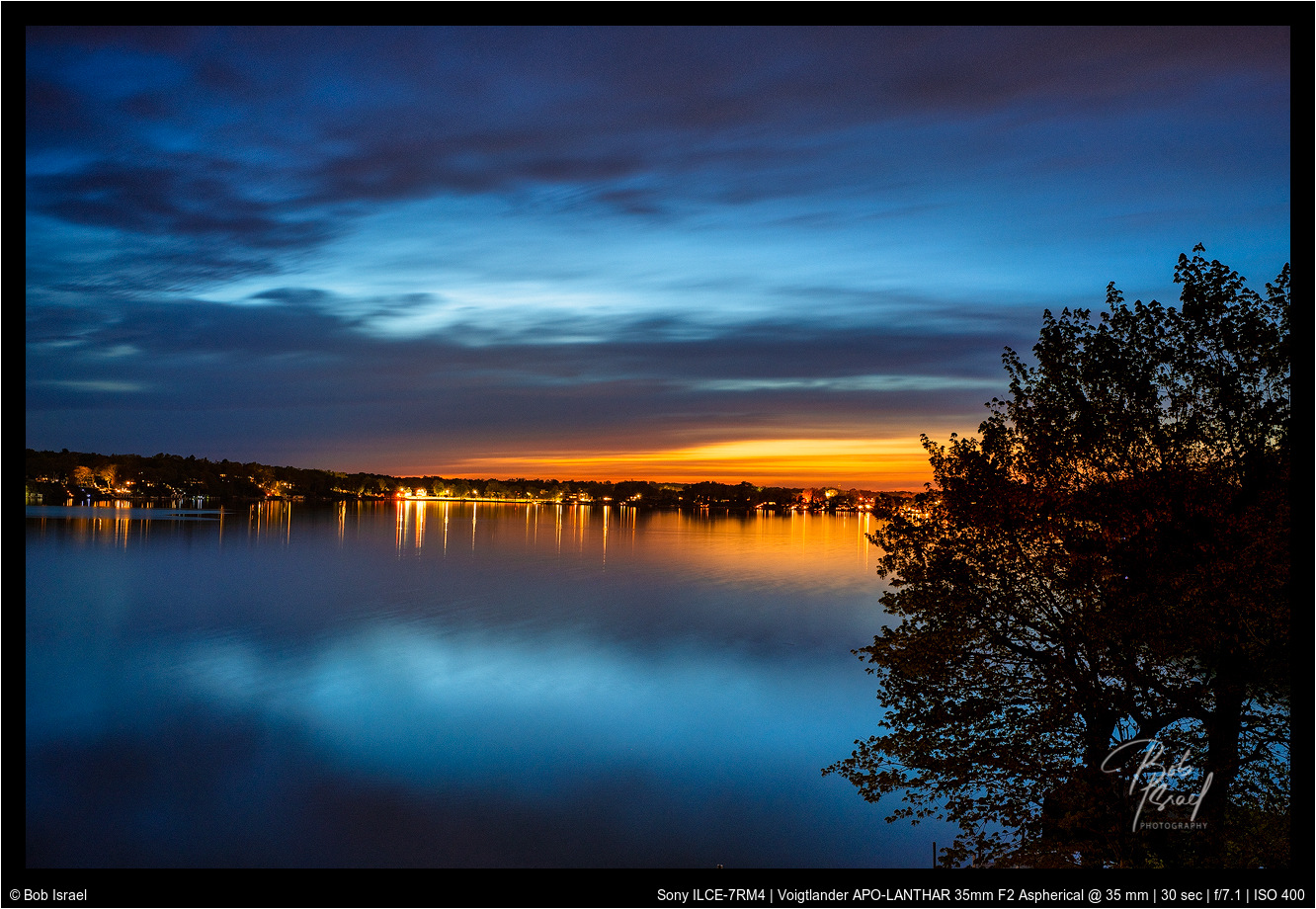
It would seem to me with the APO, you barely need to stop down for optimum across-frame performance. This would seem to be attractive for those working with high-MP sensors and wishing to avoid diffraction effects where DoF in that aperture range is sufficient (or focus stacking is an option).
rscheffler wrote:
It would seem to me with the APO, you barely need to stop down for optimum across-frame performance. This would seem to be attractive for those working with high-MP sensors and wishing to avoid diffraction effects where DoF in that aperture range is sufficient (or focus stacking is an option).
According to Wikipedia, for green (0.5 μm wavelength) the airy disk diameter is 1.22*F μm, where F is the aperture.
So f/2, should be good to resolve 2.44 μm pixels, i.e. ~150 MP on full frame.
I don’t know what the focus field shape is for the APO, but I wouldn’t mind having to stop down a bit for sharper landscapes.
Very valid points – Thanks all...still looking forward to seeing the comparison!
I would be shooting at F5.6 or higher nearly all of the time for depth of field....so picking up a used loxia 35 that someone dumps for 500 bucks to subsidize their their 35 GM 1.4 is an option that's hard to not consider.
Diffraction is something that, for me, is much more visible on 100% crops on forum posts then in prints on the wall...
I took delivery of the 35 APO a few hours back and the lens is well centered. I did some comparisons already and will post some results tomorrow after I manage to take a couple of exterior shots.
Ben
Irving wrote:
I would be very curious to see these comparisons as well. Especially distortion near edge of frame and mid zone focus dip due to field curvature on loxia. My hunch is that around 5.6/8 that they won't be that far apart, with the exception of the loxia going a little soft on mid zone and having slightly more vignetting.
One could compare the crops with the CV 35/2 APO crops here to get an idea of how they compare at infinity.
Rendering-wise, the Loxia is capable of nice subject separation starting at f/3.2 but the APO's rendering is smoother and free of CA. Honestly, the Loxia only wins on price, so if your budget allows, just get the 35/2 APO and don't look back.
Fred Miranda wrote:
Honestly, the Loxia only wins on price, so if your budget allows, just get the 35/2 APO and don't look back.
Totally agree for the Sony versions.
Though on Leica M someone might still care about size and weight. The APO is bigger, and ~50% (+112g) heavier than the ZM.
This guy has a nice video with size comparison:
Irving wrote:
Very valid points – Thanks all...still looking forward to seeing the comparison!
I would be shooting at F5.6 or higher nearly all of the time for depth of field....so picking up a used loxia 35 that someone dumps for 500 bucks to subsidize their their 35 GM 1.4 is an option that's hard to not consider.
Diffraction is something that, for me, is much more visible on 100% crops on forum posts then in prints on the wall...
Sure, it depends on final display size and viewing distance. Where something like the APO might be appealing is for the *potentially* larger range of display sizes and closer viewing distances.
I'm kind of in the same situation. A lot of my work is stopped down around f/8, on average, and I'm only capturing at 24MP. Does the APO net me much over what I already use (VM35/1.7 on a Leica M240)? Really, are there any bad modern 35mm lenses at f/8?
CheshireCat wrote:
Totally agree for the Sony versions.
Though on Leica M someone might still care about size and weight. The APO is bigger, and ~50% (+112g) heavier than the ZM.
This guy has a nice video with size comparison:
The bigger size for the APO compared to the ZM is a fair point and the main reason I didn't get it for my Leica. However, the higher number of elements is what makes it better corrected for aberrations and therefore superior optically.
If one values compactness more than IQ, perhaps the Voigtlander 35mm f/2 Ultron could be an even better choice.
CheshireCat wrote:
Though on Leica M someone might still care about size and weight. The APO is bigger, and ~50% (+112g) heavier than the ZM.
This guy has a nice video with size comparison:
---------------------------------------------
rscheffler wrote:
Sure, it depends on final display size and viewing distance. Where something like the APO might be appealing is for the *potentially* larger range of display sizes and closer viewing distances.
I'm kind of in the same situation. A lot of my work is stopped down around f/8, on average, and I'm only capturing at 24MP. Does the APO net me much over what I already use (VM35/1.7 on a Leica M240)? Really, are there any bad modern 35mm lenses at f/8?
As much as I like the APO, I'm holding on to my ZM 35/2 for when I want something:
* smaller and lighter;
* to use at f/8; and
* for on-camera flash work.
Here are my results comparing the Loxia 35mm against the CV 35mm APO. I have had the Loxia for a few years, it is a lens with many flaws but for the stuff I used it for (stopped down architecture and panorama stitiching) I never found it lacking in particular.
Well, the CV 35mm makes short work of it in most respects but it does not mean the Loxia becomes useless all over a sudden.
But first things first:
Here is a physical side by side image, the weight is near identical but the CV is longer and will occupy a bit more space in a bag. Both work beautifully in terms of mechanical precision, the handling on the CV is easier due to more pronounced shapes making it easier to grip/adjust.
Focus @ infinity:
Focus @MFD:
The Loxia's frontelement is strongly convex while the CV's is flat.