If you shoot close though the GM looks to be the better lens. I read the Sigma f2 doesn't get very sharp up close unless you stop it down a few clicks.
lukecookphoto wrote:
That's true, from MFD the Sigma is not so great! If you get a bit further back from MFD it sharpens up nicely.
I'll have to look at some f/1.4 vs. f/2 examples on a 35mm and see how I feel. Seems like it'd be better to have a fast 55 or 65 for when I want to blow out backgrounds though as a 35 is still a 35.
chiron wrote:
Good point. I personally don't shoot a 35mm up close because I don't like distortion in my images, but for some people this would be a bit of difficulty. But the Voigtlander 40/1.2 had the same issue, and that didn't stop it becoming a favorite for many people.
Speaking as someone who has had to deal with RSA with the Batis 40 for a few years now, I will say the biggest impact you'll normally have with this is low light shooting indoors. To clarify: outdoors it's possible to distance yourself from a subject enough that f2 is usable—but indoors that isn't an option.
If a location has enough lighting, this won't be an issue. However, in poorly lit indoor conditions I find the glow up close exacerbates noise based image degradation. SA glow might not give a huge reduction in resolution, but the loss of contrast and halation makes things look... extra flat when you have the all-aspects image degradation that noise brings. I often find that within the range of RSA (with my 40—again, but that and the 35i look very similar in this regard) that despite the added noise, images look better stopped down to the point that RSA disappears.
If you have another lens to use in these conditions this won't be a problem at all. Just something I'd keep in mind if I were planning to use this lens in the described circumstances.
Speaking as someone who has had to deal with RSA with the Batis 40 for a few years now, I will say the biggest impact you'll normally have with this is low light shooting indoors. To clarify: outdoors it's possible to distance yourself from a subject enough that f2 is usable—but indoors that isn't an option.
If a location has enough lighting, this won't be an issue. However, in poorly lit indoor conditions I find the glow up close exacerbates noise based image degradation. SA glow might not give a huge reduction in resolution, but the loss of contrast and halation makes things look... extra flat when you have the all-aspects image degradation that noise brings. I often find that within the range of RSA (with my 40—again, but that and the 35i look very similar in this regard) that despite the added noise, images look better stopped down to the point that RSA disappears.
If you have another lens to use in these conditions this won't be a problem at all. Just something I'd keep in mind if I were planning to use this lens in the described circumstances....Show more →
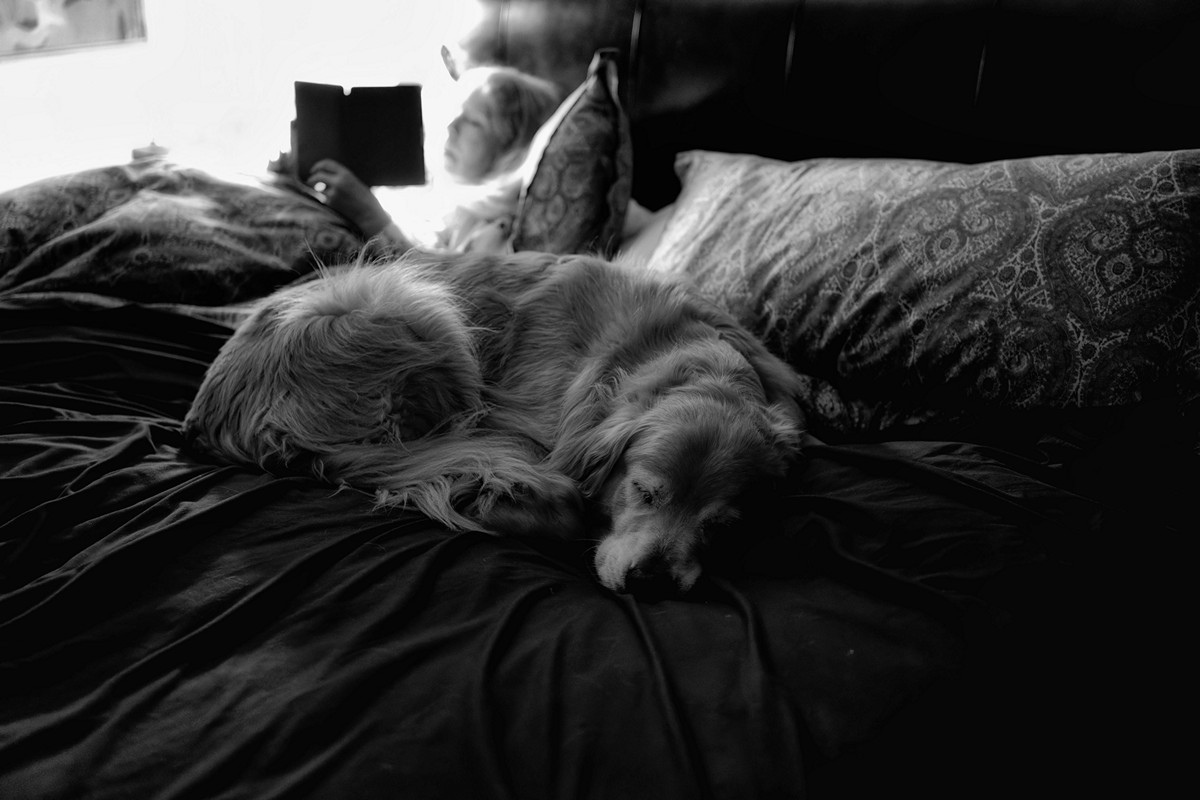
This is a shot indoors in very dim light with the Batis at f2.0 at 5000 ISO and underexposed by 2/3rds of a stop. Focus was on the dog's eyes.
chiron wrote:
This is a shot indoors in very dim light with the Batis at f2.0 at 5000 ISO and underexposed by 2/3rds of a stop. Focus was on the dog's eyes.
Great image, saw it in the 40 image thread
To be even more pedantic, this is what Zeiss' forced aperture values (f2→2.5 at 0.6→.25m) are aimed at correcting and its a little difficult to get f2 RSA issues to manifest. I'd say that I've found at ~0.6-0.8m you can get the RSA-based image degradation to manifest under the right conditions... and it looks much better in black and white as you've shown. To be fair, I don't have a proper setup to do scientific testing. This is just observations from continued use, so I expect I'm a little off on the exact details.
If interested, I can try to dig up some photos that demonstrate the RSA issues using flash. It isn't exactly equivalent to this issue in bad lighting, but logically it should follow as I've described and I've observed as much. I just don't have as clear as of a RSA/no RSA (stopping down the lens on the same subject at same distance) that I do with the flash image.
With the Sigma I haven't really noticed a loss in contrast or anything drastic when shooting up close at f/2, definitely a reduction in resolution though. The A7R III is so good in low light that I'm happy to bump that ISO up to 12,800 or maybe even a touch beyond if need be!
fotografur wrote:
If you shoot close though the GM looks to be the better lens. I read the Sigma f2 doesn't get very sharp up close unless you stop it down a few clicks.
Just about every lens get sharper a couple stops down from wide open...just the nature of lens design.
The question to consider is if the 35 F2 is competently sharp enough wide open at F2 given real world use cases. The 35GM will undoubtedly be sharper at F2, but realistically most lenses releases these days are so competently sharp wide open that it isn't the first consideration anymore. i.e. the 85GM is not as sharp as the 135GM, but the superior rendering and easier to work with focal length take priority for me and I never feel the 85GM isn't sufficiently sharp. It has tons of RSA wide open and this contributes to the rendering that it is beloved for.
I doubt anyone will ever say the 35 F2 is soft wide open. If you want test chart killing sharpness, get the 35GM. Looking at things comprehensively including the shooting experience....if you want a more compact option that renders well and is more that competent optically, then the 35i might be the better option and its cheaper to boot.
Decided to dig up the photos anyway. Here's the f2 version first:
And the close up. @lukecookphoto I'd say there is a bit of resolution loss along with the loss in contrast, again—not the same lens but it should translate.
By contrast, here's the f2.8 version:
Corresponding close up:
In any case, unless proven otherwise I'd still expect the 35i to perform worse than a lens without RSA in poor lighting conditions.
Mystik wrote:
Just about every lens get sharper a couple stops down from wide open...just the nature of lens design.
The question to consider is if the 35 F2 is competently sharp enough wide open at F2 given real world use cases. The 35GM will undoubtedly be sharper at F2, but realistically most lenses releases these days are so competently sharp wide open that it isn't the first consideration anymore. i.e. the 85GM is not as sharp as the 135GM, but the superior rendering and easier to work with focal length take priority for me and I never feel the 85GM isn't sufficiently sharp. It has tons of RSA wide open and this contributes to the rendering that it is beloved for.
I doubt anyone will ever say the 35 F2 is soft wide open. If you want test chart killing sharpness, get the 35GM. Looking at things comprehensively including the shooting experience....if you want a more compact option that renders well and is more that competent optically, then the 35i might be the better option and its cheaper to boot.
I'm aware most lenses are sharper closed down a few stops. I'm talking about close up.
As in Fed's reveiw
"Close-up performance, SA and Focus Shift
The Sigma 35mm f/2 DG DN focuses as close as 0.27m and at around this distance, there is noticeable spherical aberration (SA).
This optical design provides a great balance between ultimate resolution and pleasant rendering. At close distance, the lens performs best at f/3.2 where residual SA goes away."
fotografur wrote:
I'm aware most lenses are sharper closed down a few stops. I'm talking about close up.
As in Fed's reveiw
"Close-up performance, SA and Focus Shift
The Sigma 35mm f/2 DG DN focuses as close as 0.27m and at around this distance, there is noticeable spherical aberration (SA).
This optical design provides a great balance between ultimate resolution and pleasant rendering. At close distance, the lens performs best at f/3.2 where residual SA goes away."
Ah ok apologies mis-read.
Yes its similar to the 85GM in this regard. If the RSA becomes problematic, then stop down even 1/3 stop and things improve, or frame a bit looser.
RSA isn't always a negative though. The reason the 35 tends to have more pleasing samples than the 65 is the slight glow wide open. Again similar to the 85GM
JVan_02 wrote:
Great image, saw it in the 40 image thread
To be even more pedantic, this is what Zeiss' forced aperture values (f2→2.5 at 0.6→.25m) are aimed at correcting and its a little difficult to get f2 RSA issues to manifest. I'd say that I've found at ~0.6-0.8m you can get the RSA-based image degradation to manifest under the right conditions... and it looks much better in black and white as you've shown. To be fair, I don't have a proper setup to do scientific testing. This is just observations from continued use, so I expect I'm a little off on the exact details.
If interested, I can try to dig up some photos that demonstrate the RSA issues using flash. It isn't exactly equivalent to this issue in bad lighting, but logically it should follow as I've described and I've observed as much. I just don't have as clear as of a RSA/no RSA (stopping down the lens on the same subject at same distance) that I do with the flash image.
fotografur wrote:
I'm aware most lenses are sharper closed down a few stops. I'm talking about close up.
As in Fed's reveiw
"Close-up performance, SA and Focus Shift
The Sigma 35mm f/2 DG DN focuses as close as 0.27m and at around this distance, there is noticeable spherical aberration (SA).
This optical design provides a great balance between ultimate resolution and pleasant rendering. At close distance, the lens performs best at f/3.2 where residual SA goes away."
The 45/2.8 behaves this way as well, only worse. In the real world, it's very unusual that I'm close to MFD wide open as DOF is too shallow. But it is one of the tradeoffs the designers chose, so it's worth being aware of. Both the Sigma I and the Sony GM look excellent.
In the above examples of the boy, the sharpness and contrast in both examples looks excellent. If I keep looking from one to another, the second may be a very little sharper, and a tiny bit more contrasty. Nothing there that I would not expect as the difference between f2 and f2.8 (given slight differences in depth of field) in a very well corrected lens. How could you be even slightly dissatisfied? I'm baffled.
wolfloid wrote:
In the above examples of the boy, the sharpness and contrast in both examples looks excellent. If I keep looking from one to another, the second may be a very little sharper, and a tiny bit more contrasty. Nothing there that I would not expect as the difference between f2 and f2.8 (given slight differences in depth of field) in a very well corrected lens. How could you be even slightly dissatisfied? I'm baffled.
What are you viewing this on? Just curious.
Anyway, like it if you want. No one is forcing you to have an opinion. But SA glow is a pretty divisive topic and to me the first picture (especially with the close up) looks like vaseline has been smeared over the front element.
I'm viewing on an ipad pro. Depth of focus seems to cover most of the small difference. You really don't think your vaseline simile is simply excessive?
Might want to be very explicit about what lens was used when posting samples. Just to avoid misinterpretation/confusion.
Are these from the Batis 40, or Sigma 35i? I realize there is enough comment in the post to infer it's not the 35i, but I wonder how many people would just scan through and miss that.
JVan_02 wrote:
Decided to dig up the photos anyway. Here's the f2 version first:
And the close up. @lukecookphoto@ I'd say there is a bit of resolution loss along with the loss in contrast, again—not the same lens but it should translate.
tsdevine wrote:
Might want to be very explicit about what lens was used when posting samples. Just to avoid misinterpretation/confusion.
Are these from the Batis 40, or Sigma 35i? I realize there is enough comment in the post to infer it's not the 35i, but I wonder how many people would just scan through and miss that.
The 40, and I actually say this in post (admittedly not at the header). However, from all I've seen in this way these two lenses fare similar (RSA wide open until ~1m). The 35i may be slightly better, but this is meant to be a broad strokes comparison.
wolfloid wrote:
I'm viewing on an ipad pro. Depth of focus seems to cover most of the small difference. You really don't think your vaseline simile is simply excessive?
No. Dunno if there is a difference between a good dedicated monitor and the pro, but I wouldn't call that excessive at all from what I'm seeing.
No argument for the reasoning for posting those. Just wasn’t clear what lens was involved:
JVan_02 wrote:
The 40, and I actually say this in post (admittedly not at the header). However, from all I've seen in this way these two lenses fare similar (RSA wide open until ~1m). The 35i may be slightly better, but this is meant to be a broad strokes comparison.
No. Dunno if there is a difference between a good dedicated monitor and the pro, but I wouldn't call that excessive at all from what I'm seeing.
The Sigma 35mm f/2 DG DN is the lens Sony shooters were waiting for.
Besides being small, light and extremely well built, it has a balanced optical design capable of high resolution and contrast, without neglecting rendering. Landscape photographers take note: The Sigma 35mm f/2 DG DN is flat-field at infinity distance. Axial and lateral chromatic aberration are both well corrected and above average for a 35mm lens. Some residual spherical aberration is visible which contributes to smooth rendering at transition zone in exchange for a slight resolution/contrast loss at close distance, especially MFD.
The only negative is noticeable optical vignetting which not only affects the specular highlights' shape off-axis (cat-eyes) but also affects rendering uniformity. Flare resistance and distortion are average compared to other 35mm lenses.
Pros:
High resolution/contrast at infinity even wide open
Smooth rendering at close and mid-distance
Very low field curvature at infinity. Flat-field design
Even resolution across the field without a mid-zone dip
High tolerance metal build including features like aperture ring and AF-MF button
Linear manual focus response
Low axial and lateral color error
Quick and accurate AF-S (CDAF) and AF-C (PDAF) modes.
Well defined 18-point sunstar at f/20-22
Average:
Moderate Barrel Distortion
Flare resistance
Cons:
Noticeable optical vignetting wide open which unfortunately is common with modern 35mm lenses
The Sigma 35mm f/2 DG DN could be the lens many Sony shooters were waiting for.
Besides being small, light and extremely well built, it has a balanced optical design capable of high resolution and contrast, without neglecting rendering. Axial and lateral chromatic aberration are both well corrected and above average for a 35mm lens. Some residual spherical aberration is visible which contributes to smooth rendering at transition zone in exchange for a slight resolution/contrast loss at close distance, especially MFD. Landscape photographer take note: The Sigma 35mm f/2 DG DN is flat-field at infinity distance.
The main negative is the noticeable optical vignetting which not only affects the specular highlights' shape off-axis (cat-eyes) but also affects rendering uniformity. Flare resistance and distortion are average compared to other 35mm lenses.
Pros:
High resolution/contrast at infinity even wide open
Smooth rendering at close and mid-distance
Very low field curvature at infinity. Flat-field design
Even resolution across the field without a mid-zone dip
High tolerance metal build including features like aperture ring and AF-MF button
Linear manual focus response
Low axial and lateral color error
Quick and accurate AF-S (CDAF) and AF-C (PDAF) modes.
Well defined 18-point sunstar at f/20-22
Average:
Distortion
Flare resistance
Cons:
Noticeable optical vignetting wide open which unfortunately is common with modern 35mm lenses
Good summary list and thanks for the testing! 2 things which I find notable which you have not mentioned: it vignettes somewhat heavily all over the frame, and the coma correction is very good for 35, and much better than the FE 35/1.8