The only thing in my head that makes sense is that there are more focus points than don't chooses to use in FF mode but I don't understand why they would do that. Unless like you said it continues to track outside the cropped image but then that won't provide any real advantage for eye af other than having to calculate the eye from less image pixels.
Daran wrote:
Sounds plausible, at least I can see how that might work. What I have a harder time wrapping my head around is why that would break simply because a lens isn't a true FF lens that happens to be cropped vs an APSC lens that must be cropped. My current hypotheses is that this uses light from the outer edge of the image circle, which would be completely dark for an APSC lens. Nah, doesn't work either.
Daran wrote:
Sounds plausible, at least I can see how that might work. What I have a harder time wrapping my head around is why that would break simply because a lens isn't a true FF lens that happens to be cropped vs an APSC lens that must be cropped. My current hypotheses is that this uses light from the outer edge of the image circle, which would be completely dark for an APSC lens. Nah, doesn't work either.
Yeah I don't understand why it isn't the same for an APS-C lens.
buffalowolff wrote:
The only thing in my head that makes sense is that there are more focus points than don't chooses to use in FF mode but I don't understand why they would do that. Unless like you said it continues to track outside the cropped image but then that won't provide any real advantage for eye af other than having to calculate the eye from less image pixels.
That is a thought I had...is it just meaning that it is still doing AF calculations over the entire FF sensor even though it is just showing you the APS-C view in the EVF? I don't get what the advantage of that would be....seems it would just waste processing power. Maybe it could be beneficial if you are rapidly panning with a bird in APS-C mode and you loose the bird off the frame edge, but then you correct yourself (ie catch up on your panning) and the camera was still tracking the bird over the FF sensor and therefore you are back on it faster?? I don't think that is what they are doing but who knows??
Daran wrote:
Sounds plausible, at least I can see how that might work. What I have a harder time wrapping my head around is why that would break simply because a lens isn't a true FF lens that happens to be cropped vs an APSC lens that must be cropped. My current hypotheses is that this uses light from the outer edge of the image circle, which would be completely dark for an APSC lens. Nah, doesn't work either.
I knew I'd seen someone talk/show that the focus points stay close together in APS-C mode....here it is at the 1:30 mark. If my auto English subs are correct in what he is saying. I'm sure you can confirm!
So it seems that it is just using more PDAF points for a given area of sensor when in APS-C mode and using an FE lens (still no idea why not with a crop lens?).
Back to our German friends, I borrowed some frames (BTW, auto-translate to English now shows up for me on that video so I'm re-watching it)
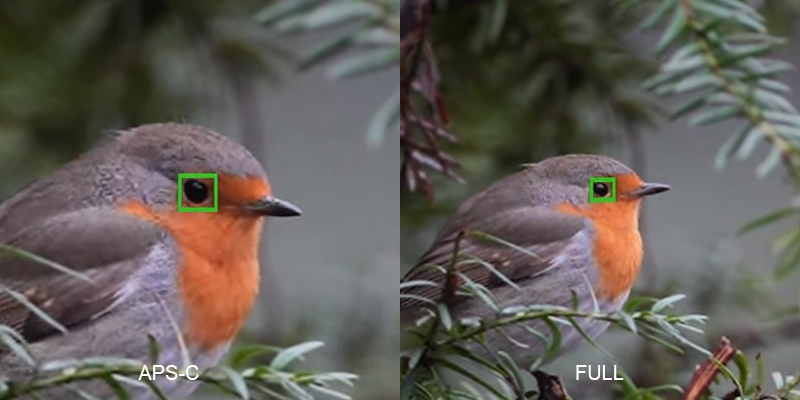
They switch from FF to APS-C on that cool little robin, notice the focus square enlarges in APS-C mode which leads me to believe there is no super secret hidden AF density. So either the AF goes farther than you can see, or the specs are a typo.
arbitrage wrote:
That is a thought I had...is it just meaning that it is still doing AF calculations over the entire FF sensor even though it is just showing you the APS-C view in the EVF? I don't get what the advantage of that would be....seems it would just waste processing power. Maybe it could be beneficial if you are rapidly panning with a bird in APS-C mode and you loose the bird off the frame edge, but then you correct yourself (ie catch up on your panning) and the camera was still tracking the bird over the FF sensor and therefore you are back on it faster?? I don't think that is what they are doing but who knows??...Show more →
The simplest explanation is the preferred explanation.
The camera continues to track the subject outside the APS fov.
Won't work with APS lens because image formation is limited to the central part of the sensor.
buffalowolff wrote:
Back to our German friends, I borrowed some frames (BTW, auto-translate to English now shows up for me on that video so I'm re-watching it)
They switch from FF to APS-C on that cool little robin, notice the focus square enlarges in APS-C mode which leads me to believe there is no super secret hidden AF density. So either the AF goes farther than you can see, or the specs are a typo.
I see what you are saying....but if you watch a lot of the BEAF stuff you will see that box change sizes at random depending on how well the system is detecting the eye. In that Robin example the box perfectly outlines the eye so maybe Sony would never draw a smaller box once it gets down to the accuracy of drawing a box tight around the black eye? Also the eye-AF box doesn't correspond to the size of a standard green dot on the Wide/Zone AF view. It seems to be able to draw the box at varying sizes as needed.
At the 1:30 mark in that video he goes into APS-C mode for the mallard. You get to see the dancing dots...on previous Sony cameras those dancing dots in APS-C mode get spaced out (in fact that is actually my quick method to see if I'm in FF or APS-C mode on my Sony cameras...guess that won't work in for the A1 anymore). On the A1 they stay close together like they do in FF. That means if you could light up all the dots possible you'd have the same number (759 according to the specs) for both FF and APS-C. This is again, not how it works on the A7RIV, A9II etc...
This is not how APS-C mode green boxes look on previous Sony cameras...
dclark wrote:
The simplest explanation is the preferred explanation.
The camera continues to track the subject outside the APS fov.
Won't work with APS lens because image formation is limited to the central part of the sensor.
Anything else would be extremely complex.
But as I've pointed out in these videos, it is actually able to show 759 green squares in both APS-C mode and FF mode in the FOV of the EVF. Previous Sony cameras didn't do this. APS-C mode spaced out the green squares so that you would have less of them over the APS-C FOV.
So it is using more PDAF points per area of sensor in APS-C vs FF. Why it can't do that with APS-C lenses makes no sense.
In 26 days give or take we can all wide focus on a flat wall and count the dots :-)
arbitrage wrote:
But as I've pointed out in these videos, it is actually able to show 759 green squares in both APS-C mode and FF mode in the FOV of the EVF. Previous Sony cameras didn't do this. APS-C mode spaced out the green squares so that you would have less of them over the APS-C FOV.
So it is using more PDAF points per area of sensor in APS-C vs FF. Why it can't do that with APS-C lenses makes no sense.
This review is the best I have seen so far.
Some good data on file sizes and write speeds to CFE and SD cards.
Also they report that there is one lock-out while the buffer is clearing. Can't start a video recording until the buffer clears. I wonder if that is still true if you write stills to one card slot and video to the other.
arbitrage wrote:
But as I've pointed out in these videos, it is actually able to show 759 green squares in both APS-C mode and FF mode in the FOV of the EVF. Previous Sony cameras didn't do this. APS-C mode spaced out the green squares so that you would have less of them over the APS-C FOV.
So it is using more PDAF points per area of sensor in APS-C vs FF. Why it can't do that with APS-C lenses makes no sense.
I missed where you were able to see 759 green squares in APS mode. Can you give me directions?
I am only spending 7 hours a day on this site so I have not read all the posts, not even all the posts in this thread.
baltmin wrote:
I wouldn't pay too much attention on that comparison. Dpreview equalizes brightness and white balance before they post the results. So what you see is not ACR default settings and the comparisons are more or less unreliable unless the file curves are similar. Try it with canon R5 and sony A7RIV. I downloaded the raw files and opened them on ACR. The grey tones are far from similar. Dpreview has equalised them and this means a lot when you compare noise. The file having had reduced brightness benefits from underexposure in terms of noise. The one with increased brightness shows more noise....Show more →
I get your point, and it is a good one to keep in mind, but I mainly interested on checking the noise and detail levels for various ISO levels on a subject that I more familiar with that I care to admit. It also make it doable to compare to the A7r III, A9 II and A7r IV to get a bearing on where we are at.
photonoclast wrote:
Is she withholding her approval until you get her real solid noise data ??
Well, it needs to get my approval before I'm even going that far! I hope that the sensor will be able to match the A7r III in terms of both DR at base ISO and noise at mid-high ISO range. I want better DR at base ISO than the A9 II and a bit better noise performance at mid-high ISO range compared to the A7rIV. Whether this stacked sensor can provide just that remains to be seen.
dclark wrote:
I missed where you were able to see 759 green squares in APS mode. Can you give me directions?
I am only spending 7 hours a day on this site so I have not read all the posts, not even all the posts in this thread.
No video shows them all, I’m just saying that when we do see them they are the same size and spacing in APS-C as FF. On previous Sony cameras they are the same size in both format but spaced further apart in APS-C mode. So I’m interpolating that if it can display 759 green squares in FF and they are the same size and spacing in APS-C then it can display 759 in APS-C (as Sony specs say).
dclark wrote:
This review is the best I have seen so far.
Some good data on file sizes and write speeds to CFE and SD cards.
Also they report that there is one lock-out while the buffer is clearing. Can't start a video recording until the buffer clears. I wonder if that is still true if you write stills to one card slot and video to the other.
Dave
SD card writing is slow, but it looks pretty comparable to the A9/A9ii despite the file size difference.
nobody23 wrote:
Lossless comp = ~57MB
You should be fine with V90 SDXC cards....
I guess that will result in 3 pics written per second.
See DPReviewTV.
I shoot compressed RAW on my A9ii with 24~ megabyte files and it probably writes 5 or 6 files per second to my UHS-II SDXC cards (Sony brand, advertised write speed of 299 MB/s), so it seems pretty comparable.
I will probably shoot normal compressed RAW on the A1 most of the time, too, unless I find there is a dramatic difference in dynamic range between it and lossless compressed.
arbitrage wrote:
That is a thought I had...is it just meaning that it is still doing AF calculations over the entire FF sensor even though it is just showing you the APS-C view in the EVF? I don't get what the advantage of that would be....seems it would just waste processing power. Maybe it could be beneficial if you are rapidly panning with a bird in APS-C mode and you loose the bird off the frame edge, but then you correct yourself (ie catch up on your panning) and the camera was still tracking the bird over the FF sensor and therefore you are back on it faster?? I don't think that is what they are doing but who knows??...Show more →
The AF calculations don’t seem to take up so much time, and the resulting tracking should potentially be more accurate.
The camera also does 120 AF corrections every second, regardless of what speed you chose to shoot at. This results in less situations where it loses track.
Herein might also lie the answer over why so many lenses are in the 30fps focus speed category. The lineair motor lenses can do 120 corrections per second, potentially less prone to errors (with very fast moving subjects). In the table they all are in the 30fps performance category because the A1 can not shoot faster currently. (I bet it could for APS-C for instance)


 ). On the A1 they stay close together like they do in FF. That means if you could light up all the dots possible you'd have the same number (759 according to the specs) for both FF and APS-C. This is again, not how it works on the A7RIV, A9II etc...