This topic is in the 2020 archive. You can read it and like its posts here. It is read only.
Archive 2020Electronic Shutter Artifacts in Sony A9 and Canon 1DX3 Images
p.1 #1Electronic Shutter Artifacts in Sony A9 and Canon 1DX3 Images
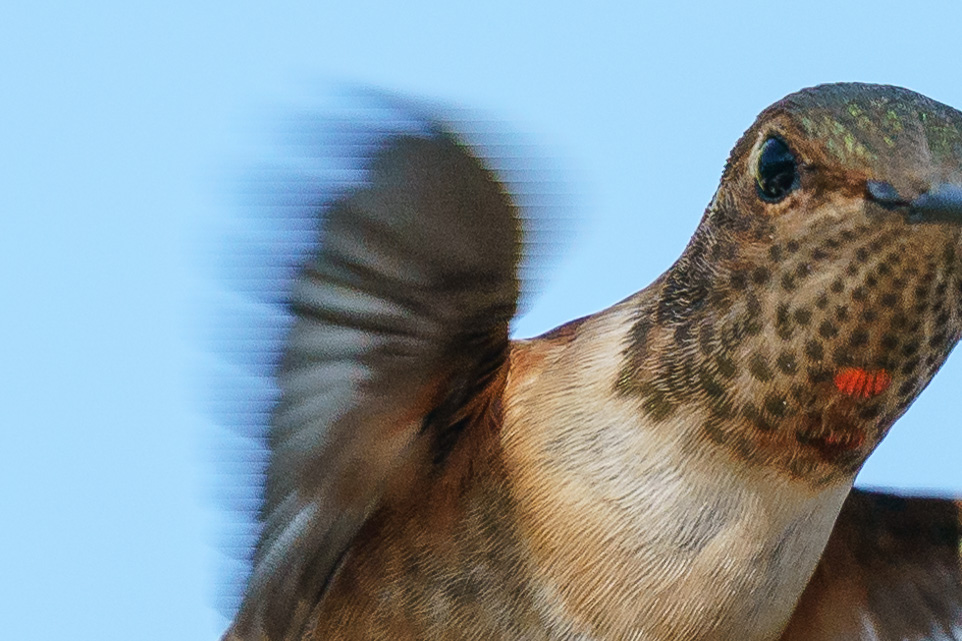
The high speed electronic shutter in the Sony A9 and Canon 1DX3 show some image artifacts that are not present with slower electronic shutters or mechanical shutters. The images below show the banding and streaking that can be seen in A9 ES images. Similar artifacts can be seen in 1DX3 ES images.
The explanation of these artifacts in a bit lengthy but you can read the PDF at the following link.
ES Artifacts
If you have any problems accessing the file, let me know.
The conclusions are:
"My conclusion is that this banding/streaking artifact is present in cameras that accelerate ES readout by simultaneously resetting and reading groups of rows and feeding the pixels to multiple ADCs per column. This ES image artifact is seen in images with horizontal motion blur and is caused by the interaction of the overall rolling shutter with the absence of rolling shutter in the 8 or 12 row groups. That interaction causes a luminosity step change at the edge of the bands. The step change is made more visible, and objectionable, by image sharpening and the way the human visual system perceives the luminance edge discontinuity."
Dave
 |
||
 |
||
|
|
||
 |
||
|
Sep 13, 2020 at 07:12 PM
p.1 #2Electronic Shutter Artifacts in Sony A9 and Canon 1DX3 Images
Thanks for this work Dave. Interesting read.
Sep 13, 2020 at 07:39 PM
p.1 #3Electronic Shutter Artifacts in Sony A9 and Canon 1DX3 Images
Very interesting Dave. Thanks for sharing.
Sep 13, 2020 at 10:53 PM
p.1 #4Electronic Shutter Artifacts in Sony A9 and Canon 1DX3 Images
arbitrage wrote:
Thanks for this work Dave. Interesting read.
---------------------------------------------
2xbass wrote:
Very interesting Dave. Thanks for sharing.
Geoff and Adrian,
Thanks for reading it and commenting.
Dave
Thanks for this work Dave. Interesting read.
---------------------------------------------
2xbass wrote:
Very interesting Dave. Thanks for sharing.
Geoff and Adrian,
Thanks for reading it and commenting.
Dave
Sep 14, 2020 at 05:31 PM
p.1 #5Electronic Shutter Artifacts in Sony A9 and Canon 1DX3 Images
Great article Dave and while you referred to the effect in the R5 have you seen any images demonstrating it? The few smaller birds I’ve shot with ES have not exhibited this effect though there have to be the right combination of variables involved for it to manifest.
Sep 14, 2020 at 07:35 PM
p.1 #6Electronic Shutter Artifacts in Sony A9 and Canon 1DX3 Images
armd wrote:
Great article Dave and while you referred to the effect in the R5 have you seen any images demonstrating it? The few smaller birds I’ve shot with ES have not exhibited this effect though there have to be the right combination of variables involved for it to manifest.
Thanks for your comment.
I have no data on the R5 and I do not have access to an R5 to make some measurements. I have not followed the posts of R5 images, but I assume any images with artifacts may be deleted rather than posted. Hopefully if someone has an image they will post it.
It would be interesting to see how the 20 fps ES works on a 45MP camera. I assume it is an upscaled version of the IDX3 with a rolling shutter about sqrt(45/20) larger than the IDX3 (i.e. sensor readout speed of ~1/40sec and readout in groups of 8 rows). The readout has to be faster than 1/20 sec which means they must be reading out rows in groups. Also there has to be a little bit of time to do some AF.
Also, I assume the ES on the R6 is essentially identical to the 1DX3 since I have read they share a sensor. I have not found any real data on the R5 or R6 ES, but I must admit that I have not done a diligent search so maybe the information is available.
Maybe you can do a setup similar to the fan test I did to make some measurements on your R5. It's not so difficult. If you want details, send me a PM.
The other way is to find some cooperative hummingbirds.
Dave
Sep 15, 2020 at 12:23 AM
p.1 #7Electronic Shutter Artifacts in Sony A9 and Canon 1DX3 Images
Good write up Dave. Thanks
Mike
Mike
Sep 15, 2020 at 03:48 AM
p.1 #8Electronic Shutter Artifacts in Sony A9 and Canon 1DX3 Images
dclark wrote:
Thanks for your comment.
I have no data on the R5 and I do not have access to an R5 to make some measurements. I have not followed the posts of R5 images, but I assume any images with artifacts may be deleted rather than posted. Hopefully if someone has an image they will post it.
It would be interesting to see how the 20 fps ES works on a 45MP camera. I assume it is an upscaled version of the IDX3 with a rolling shutter about sqrt(45/20) larger than the IDX3 (i.e. sensor readout speed of ~1/40sec and readout in groups...Show more →
The R5 readout is 17ms which is 1/58 or 1/60.
armd wrote
Great article Dave and while you referred to the effect in the R5 have you seen any images demonstrating it? The few smaller birds I’ve shot with ES have not exhibited this effect though there have to be the right combination of variables involved for it to manifest.I have no data on the R5 and I do not have access to an R5 to make some measurements. I have not followed the posts of R5 images, but I assume any images with artifacts may be deleted rather than posted. Hopefully if someone has an image they will post it.
It would be interesting to see how the 20 fps ES works on a 45MP camera. I assume it is an upscaled version of the IDX3 with a rolling shutter about sqrt(45/20) larger than the IDX3 (i.e. sensor readout speed of ~1/40sec and readout in groups...Show more →
The R5 readout is 17ms which is 1/58 or 1/60.
Sep 15, 2020 at 05:50 AM
p.1 #9Electronic Shutter Artifacts in Sony A9 and Canon 1DX3 Images
Zenon Char wrote:
Thanks for your comment.
I have no data on the R5 and I do not have access to an R5 to make some measurements. I have not followed the posts of R5 images, but I assume any images with artifacts may be deleted rather than posted. Hopefully if someone has an image they will post it.
It would be interesting to see how the 20 fps ES works on a 45MP camera. I assume it is an upscaled version of the IDX3 with a rolling shutter about sqrt(45/20) larger than the IDX3 (i.e. sensor readout speed of ~1/40sec and readout in groups of 8 rows). The readout has to be faster than 1/20 sec which means they must be reading out rows in groups. Also there has to be a little bit of time to do some AF.
Also, I assume the ES on the R6 is essentially identical to the 1DX3 since I have read they share a sensor. I have not found any real data on the R5 or R6 ES, but I must admit that I have not done a diligent search so maybe the information is available.
Maybe you can do a setup similar to the fan test I did to make some measurements on your R5. It's not so difficult. If you want details, send me a PM.
The other way is to find some cooperative hummingbirds.
DaveThe R5 readout is 17ms which is 1/58 or 1/60.
Where is the most up to date info on that? Is it still the testing done on DPR with the light source bands?
I had read that in APS-C mode it is more like 1/100
dclark wrote
armd wrote
Great article Dave and while you referred to the effect in the R5 have you seen any images demonstrating it? The few smaller birds I’ve shot with ES have not exhibited this effect though there have to be the right combination of variables involved for it to manifest.I have no data on the R5 and I do not have access to an R5 to make some measurements. I have not followed the posts of R5 images, but I assume any images with artifacts may be deleted rather than posted. Hopefully if someone has an image they will post it.
It would be interesting to see how the 20 fps ES works on a 45MP camera. I assume it is an upscaled version of the IDX3 with a rolling shutter about sqrt(45/20) larger than the IDX3 (i.e. sensor readout speed of ~1/40sec and readout in groups of 8 rows). The readout has to be faster than 1/20 sec which means they must be reading out rows in groups. Also there has to be a little bit of time to do some AF.
Also, I assume the ES on the R6 is essentially identical to the 1DX3 since I have read they share a sensor. I have not found any real data on the R5 or R6 ES, but I must admit that I have not done a diligent search so maybe the information is available.
Maybe you can do a setup similar to the fan test I did to make some measurements on your R5. It's not so difficult. If you want details, send me a PM.
The other way is to find some cooperative hummingbirds.
Dave
Where is the most up to date info on that? Is it still the testing done on DPR with the light source bands?
I had read that in APS-C mode it is more like 1/100
Sep 15, 2020 at 06:01 AM
p.1 #10Electronic Shutter Artifacts in Sony A9 and Canon 1DX3 Images
arbitrage wrote:
Zenon Char wrote
dclark wrote
armd wrote
Great article Dave and while you referred to the effect in the R5 have you seen any images demonstrating it? The few smaller birds I’ve shot with ES have not exhibited this effect though there have to be the right combination of variables involved for it to manifest.I have no data on the R5 and I do not have access to an R5 to make some measurements. I have not followed the posts of R5 images, but I assume any images with artifacts may be deleted rather than posted. Hopefully if someone has an image they will post it.
It would be interesting to see how the 20 fps ES works on a 45MP camera. I assume it is an upscaled version of the IDX3 with a rolling shutter about sqrt(45/20) larger than the IDX3 (i.e. sensor readout speed of ~1/40sec and readout in groups of 8 rows). The readout has to be faster than 1/20 sec which means they must be reading out rows in groups. Also there has to be a little bit of time to do some AF.
Also, I assume the ES on the R6 is essentially identical to the 1DX3 since I have read they share a sensor. I have not found any real data on the R5 or R6 ES, but I must admit that I have not done a diligent search so maybe the information is available.
Maybe you can do a setup similar to the fan test I did to make some measurements on your R5. It's not so difficult. If you want details, send me a PM.
The other way is to find some cooperative hummingbirds.
Dave
I had read that in APS-C mode it is more like 1/100
One of the fellow that does reviews for DPR said it in a video. I’ll try and find it.
Sep 15, 2020 at 06:24 AM
p.1 #11Electronic Shutter Artifacts in Sony A9 and Canon 1DX3 Images
When I estimated 1/40 sec I was using 1/60 sec for the 1DX3. I am not sure where I got 1/60 sec. It would be nice to have a complete set of reliable data.
If the readout is unchanged for APS mode, APS mode frame readout should be 1.6X faster (is that the R5 crop factor?), so 1/60 sec would scale to 1/96 sec. The rolling shutter distortion, as seen in the slant angle, would be the same in APS mode if the rate at which rows are readout does not change. (edit: If you change the focal length of the lens or move further away so that APS mode has the same FOV as FF mode, then the slant angle will be reduced. Of course you can do that in FF mode too.)
Using a fan blade to measure the slant angle is a quick way to get an approximate ratio for row readout rates and can be done in a matter of minutes. If a measurement of the mechanical shutter is included, the rates can be scaled from the known flash sync speed.
Dave
Sep 15, 2020 at 07:02 AM
p.1 #12Electronic Shutter Artifacts in Sony A9 and Canon 1DX3 Images
I made a mistake about the R6. It is 19ms. The R5 is 17ms. I'm in the middle of a family medical issue so I only get a little time for my hobby, or anything else which helps as a diversion. I'm still looking when I can.
Sep 16, 2020 at 06:17 AM
p.1 #13Electronic Shutter Artifacts in Sony A9 and Canon 1DX3 Images
Zenon Char wrote:
I made a mistake about the R6. It is 19ms. The R5 is 17ms. I'm in the middle of a family medical issue so I only get a little time for my hobby, or anything else which helps as a diversion. I'm still looking when I can.
Can you tell us the source of this information?
I made a mistake about the R6. It is 19ms. The R5 is 17ms. I'm in the middle of a family medical issue so I only get a little time for my hobby, or anything else which helps as a diversion. I'm still looking when I can.
Can you tell us the source of this information?
Sep 16, 2020 at 09:01 AM
p.1 #14Electronic Shutter Artifacts in Sony A9 and Canon 1DX3 Images
dclark wrote:
Can you tell us the source of this information?
I know the R6 at 19ms was taken from the DPReview R6 video review where Jordon mentions it.
As for the R5, there are threads on DPR Forums where people were shooting light sources to produce the bands and using Jim Kasson's technique to calculate the scan rate from that. I'm not sure where to find that thread as it is probably many pages deep now in the EOS R forum section. The measurements gave about 1/60 for full frame and closer to 1/100 for APS-C. But there was back and forth discussion about if the light sources that people used had a constant output and if people really knew what the light source was outputting so at the time I didn't have full confidence in the results.
Zenon Char wrote
I made a mistake about the R6. It is 19ms. The R5 is 17ms. I'm in the middle of a family medical issue so I only get a little time for my hobby, or anything else which helps as a diversion. I'm still looking when I can.I know the R6 at 19ms was taken from the DPReview R6 video review where Jordon mentions it.
As for the R5, there are threads on DPR Forums where people were shooting light sources to produce the bands and using Jim Kasson's technique to calculate the scan rate from that. I'm not sure where to find that thread as it is probably many pages deep now in the EOS R forum section. The measurements gave about 1/60 for full frame and closer to 1/100 for APS-C. But there was back and forth discussion about if the light sources that people used had a constant output and if people really knew what the light source was outputting so at the time I didn't have full confidence in the results.
Sep 16, 2020 at 09:05 AM
p.1 #15Electronic Shutter Artifacts in Sony A9 and Canon 1DX3 Images
arbitrage wrote:
Can you tell us the source of this information?I know the R6 at 19ms was taken from the DPReview R6 video review where Jordon mentions it.
As for the R5, there are threads on DPR Forums where people were shooting light sources to produce the bands and using Jim Kasson's technique to calculate the scan rate from that. I'm not sure where to find that thread as it is probably many pages deep now in the EOS R forum section. The measurements gave about 1/60 for full frame and closer to 1/100 for APS-C. But there was back and forth discussion about if the light sources that people used...Show more →
We need results from someone who knows what they are doing. Maybe Jim Kasson will make some measurements soon. His blog has been dormant for a few weeks. He was near a fire a few weeks ago and he may be threatened by the current fire situation. I hope not. There are more important things going on than this issue about electronic shutters.
BTW, the data above has the R5 faster than the R6 (and the IDX3?), which would be interesting if true.
Dave
dclark wrote
Zenon Char wrote
I made a mistake about the R6. It is 19ms. The R5 is 17ms. I'm in the middle of a family medical issue so I only get a little time for my hobby, or anything else which helps as a diversion. I'm still looking when I can.As for the R5, there are threads on DPR Forums where people were shooting light sources to produce the bands and using Jim Kasson's technique to calculate the scan rate from that. I'm not sure where to find that thread as it is probably many pages deep now in the EOS R forum section. The measurements gave about 1/60 for full frame and closer to 1/100 for APS-C. But there was back and forth discussion about if the light sources that people used...Show more →
We need results from someone who knows what they are doing. Maybe Jim Kasson will make some measurements soon. His blog has been dormant for a few weeks. He was near a fire a few weeks ago and he may be threatened by the current fire situation. I hope not. There are more important things going on than this issue about electronic shutters.
BTW, the data above has the R5 faster than the R6 (and the IDX3?), which would be interesting if true.
Dave
Sep 16, 2020 at 09:18 AM
p.1 #16Electronic Shutter Artifacts in Sony A9 and Canon 1DX3 Images
dclark wrote:
Can you tell us the source of this information?I know the R6 at 19ms was taken from the DPReview R6 video review where Jordon mentions it.
As for the R5, there are threads on DPR Forums where people were shooting light sources to produce the bands and using Jim Kasson's technique to calculate the scan rate from that. I'm not sure where to find that thread as it is probably many pages deep now in the EOS R forum section. The measurements gave about 1/60 for full frame and closer to 1/100 for APS-C. But there was back and forth discussion about if the light sources that people used had a constant output and if people really knew what the light source was outputting so at the time I didn't have full confidence in the results.We need results from someone who knows what they are doing. Maybe Jim Kasson will make some measurements soon. His blog has been dormant for a few weeks. He was near a fire a few weeks ago and he may be threatened by the current fire situation. I hope not. There are more important things going on than this issue about electronic shutters.
BTW, the data above has the R5 faster than the R6 (and the IDX3?), which would be interesting if true.
Dave
Here is the DPR thread. It seems that everyone was getting the same number but still not sure if everything was done exactly correct. https://www.dpreview.com/forums/thread/4508630
arbitrage wrote
dclark wrote
Zenon Char wrote
I made a mistake about the R6. It is 19ms. The R5 is 17ms. I'm in the middle of a family medical issue so I only get a little time for my hobby, or anything else which helps as a diversion. I'm still looking when I can.As for the R5, there are threads on DPR Forums where people were shooting light sources to produce the bands and using Jim Kasson's technique to calculate the scan rate from that. I'm not sure where to find that thread as it is probably many pages deep now in the EOS R forum section. The measurements gave about 1/60 for full frame and closer to 1/100 for APS-C. But there was back and forth discussion about if the light sources that people used had a constant output and if people really knew what the light source was outputting so at the time I didn't have full confidence in the results.
BTW, the data above has the R5 faster than the R6 (and the IDX3?), which would be interesting if true.
Dave
Here is the DPR thread. It seems that everyone was getting the same number but still not sure if everything was done exactly correct. https://www.dpreview.com/forums/thread/4508630
Sep 16, 2020 at 10:26 AM
p.1 #17Electronic Shutter Artifacts in Sony A9 and Canon 1DX3 Images
arbitrage wrote:
Can you tell us the source of this information?I know the R6 at 19ms was taken from the DPReview R6 video review where Jordon mentions it.
As for the R5, there are threads on DPR Forums where people were shooting light sources to produce the bands and using Jim Kasson's technique to calculate the scan rate from that. I'm not sure where to find that thread as it is probably many pages deep now in the EOS R forum section. The measurements gave about 1/60 for full frame and closer to 1/100 for APS-C. But there was back and forth discussion about if the light sources that people used had a constant output and if people really knew what the light source was outputting so at the time I didn't have full confidence in the results.We need results from someone who knows what they are doing. Maybe Jim Kasson will make some measurements soon. His blog has been dormant for a few weeks. He was near a fire a few weeks ago and he may be threatened by the current fire situation. I hope not. There are more important things going on than this issue about electronic shutters.
BTW, the data above has the R5 faster than the R6 (and the IDX3?), which would be interesting if true.
DaveHere is the DPR thread. It seems that everyone was getting the same number but still not sure if everything was done exactly correct. https://www.dpreview.com/forums/thread/4508630


I think I was using the wrong emoticon.
I was trying to convey that the measurement and discussion in the DPReview thread was incredible.
By that I mean not credible.
So inaccurate as to be nearly useless.
Is there anything better available?
Has anyone done any measurement that would reveal how the rows are readout?
Does the R5 and R6 ES show the same banding and streaks as the A9 and 1DX3?
I tried to rent an R5 to make some measurements but none are available at the local rental store. The demand greatly exceeds the supply, so it may be a while.
Edited on Sep 16, 2020 at 01:19 PM · View previous versions
dclark wrote
arbitrage wrote
dclark wrote
Zenon Char wrote
I made a mistake about the R6. It is 19ms. The R5 is 17ms. I'm in the middle of a family medical issue so I only get a little time for my hobby, or anything else which helps as a diversion. I'm still looking when I can.As for the R5, there are threads on DPR Forums where people were shooting light sources to produce the bands and using Jim Kasson's technique to calculate the scan rate from that. I'm not sure where to find that thread as it is probably many pages deep now in the EOS R forum section. The measurements gave about 1/60 for full frame and closer to 1/100 for APS-C. But there was back and forth discussion about if the light sources that people used had a constant output and if people really knew what the light source was outputting so at the time I didn't have full confidence in the results.
BTW, the data above has the R5 faster than the R6 (and the IDX3?), which would be interesting if true.
Dave
I think I was using the wrong emoticon.
I was trying to convey that the measurement and discussion in the DPReview thread was incredible.
By that I mean not credible.
So inaccurate as to be nearly useless.
Is there anything better available?
Has anyone done any measurement that would reveal how the rows are readout?
Does the R5 and R6 ES show the same banding and streaks as the A9 and 1DX3?
I tried to rent an R5 to make some measurements but none are available at the local rental store. The demand greatly exceeds the supply, so it may be a while.
Edited on Sep 16, 2020 at 01:19 PM · View previous versions
Sep 16, 2020 at 10:50 AM
p.1 #18Electronic Shutter Artifacts in Sony A9 and Canon 1DX3 Images
arbitrage wrote:
dclark wrote
Zenon Char wrote
I made a mistake about the R6. It is 19ms. The R5 is 17ms. I'm in the middle of a family medical issue so I only get a little time for my hobby, or anything else which helps as a diversion. I'm still looking when I can.As for the R5, there are threads on DPR Forums where people were shooting light sources to produce the bands and using Jim Kasson's technique to calculate the scan rate from that. I'm not sure where to find that thread as it is probably many pages deep now in the EOS R forum section. The measurements gave about 1/60 for full frame and closer to 1/100 for APS-C. But there was back and forth discussion about if the light sources that people used...Show more →
That was where I got 19ms for the R6. I watched it again this morning. I made a mistake when I said 30ms.
I’m pretty sure 17ms for the R5 came from somewhere else other than scan rates. I’ll keep looking.
Sep 16, 2020 at 11:33 AM
p.1 #19Electronic Shutter Artifacts in Sony A9 and Canon 1DX3 Images
And thats not all
Interesting to look at the review of R6 - it shows that using electronic shutter (12bit) drops the ability to push shadows by about 1- 2 stops (my assessment) vs mechanical shutter (14 bit) non plus (8fps).
https://www.dpreview.com/reviews/canon-eos-r6-review/6
[go to the iso page and change to plus 5 stops with and without e shutter to compare]
This suggests that R5 pushing at low iso's will be diminished significantly? when using electronic shutter or H plus.
[I suspect that this is also true of Sony and Nikon - DPReview has just not presented this previously ]
So shoot at slow fps (14bit) at 8fps if you can on R5. And don't bother with the A9 - it can't do it (14bit continous)
Sep 16, 2020 at 12:17 PM
p.1 #20Electronic Shutter Artifacts in Sony A9 and Canon 1DX3 Images
dclark wrote:
Can you tell us the source of this information?I know the R6 at 19ms was taken from the DPReview R6 video review where Jordon mentions it.
As for the R5, there are threads on DPR Forums where people were shooting light sources to produce the bands and using Jim Kasson's technique to calculate the scan rate from that. I'm not sure where to find that thread as it is probably many pages deep now in the EOS R forum section. The measurements gave about 1/60 for full frame and closer to 1/100 for APS-C. But there was back and forth discussion about if the light sources that people used had a constant output and if people really knew what the light source was outputting so at the time I didn't have full confidence in the results.We need results from someone who knows what they are doing. Maybe Jim Kasson will make some measurements soon. His blog has been dormant for a few weeks. He was near a fire a few weeks ago and he may be threatened by the current fire situation. I hope not. There are more important things going on than this issue about electronic shutters.
BTW, the data above has the R5 faster than the R6 (and the IDX3?), which would be interesting if true.
DaveHere is the DPR thread. It seems that everyone was getting the same number but still not sure if everything was done exactly correct. https://www.dpreview.com/forums/thread/4508630
I think I was using the wrong emoticon.
I was trying to convey that the measurement and discussion in the DPReview thread was incredible.
By that I mean not credible.
So inaccurate as to be nearly useless.
Is there anything better available?
Has anyone done any measurement that would reveal how the rows are readout?
Does the R5 and R6 ES show the same banding and streaks as the A9 and 1DX3?
I tried to rent an R5 to make some measurements but none are available at the local rental store. The demand greatly exceeds the supply, so it may...Show more →
Once I get my R5 (likely the week of the 28th) I can try to test it. What would be the easiest way to test the scan rate?
I'm sure I can shoot some hummingbirds to find out if I get some banding/streaks in the wing blur...that part will be easy to find.
arbitrage wrote
dclark wrote
arbitrage wrote
dclark wrote
Zenon Char wrote
I made a mistake about the R6. It is 19ms. The R5 is 17ms. I'm in the middle of a family medical issue so I only get a little time for my hobby, or anything else which helps as a diversion. I'm still looking when I can.As for the R5, there are threads on DPR Forums where people were shooting light sources to produce the bands and using Jim Kasson's technique to calculate the scan rate from that. I'm not sure where to find that thread as it is probably many pages deep now in the EOS R forum section. The measurements gave about 1/60 for full frame and closer to 1/100 for APS-C. But there was back and forth discussion about if the light sources that people used had a constant output and if people really knew what the light source was outputting so at the time I didn't have full confidence in the results.
BTW, the data above has the R5 faster than the R6 (and the IDX3?), which would be interesting if true.
Dave
I think I was using the wrong emoticon.
I was trying to convey that the measurement and discussion in the DPReview thread was incredible.
By that I mean not credible.
So inaccurate as to be nearly useless.
Is there anything better available?
Has anyone done any measurement that would reveal how the rows are readout?
Does the R5 and R6 ES show the same banding and streaks as the A9 and 1DX3?
I tried to rent an R5 to make some measurements but none are available at the local rental store. The demand greatly exceeds the supply, so it may...Show more →
Once I get my R5 (likely the week of the 28th) I can try to test it. What would be the easiest way to test the scan rate?
I'm sure I can shoot some hummingbirds to find out if I get some banding/streaks in the wing blur...that part will be easy to find.
Sep 16, 2020 at 02:26 PM