p.4 #2 · Electronic Shutter Artifacts in Sony A9 and Canon 1DX3 Images
I was curious, what function would shutter speed have on the readout banding? For example if you shot a hummer at a 5000th and got banding, but not at a 2500th (with no significant additional blurring) why would that be?
p.4 #4 · Electronic Shutter Artifacts in Sony A9 and Canon 1DX3 Images
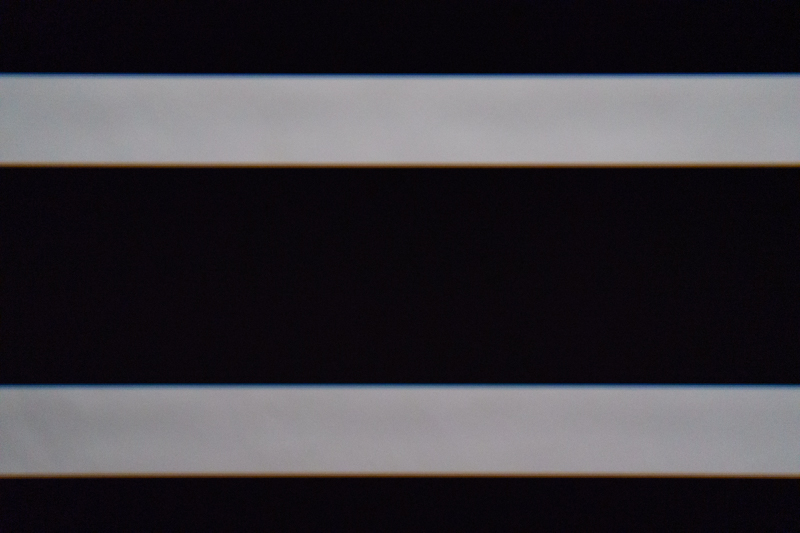
It's easier to measure your electronic shutter speed than I thought. It seems that the LED lights I have around the house switch at higher frequency and have sharper pulses than I expected, which makes accurate measurements easy. Just take your A9 or R5, or whatever you have, and photograph a white sheet of paper that is illuminated by an LED light. I found that the LED strip light that is mounted under the bookshelf above my desk has nice sharp bands in the image that are produced by 240 Hz pulses to the LED, double the frequency I was expecting. The light’s dimmer varies the width of the pulses, so I turn it down to a low illumination level to get a convenient band width. Photographs using the ES for the A9 and A7R4 are shown below.
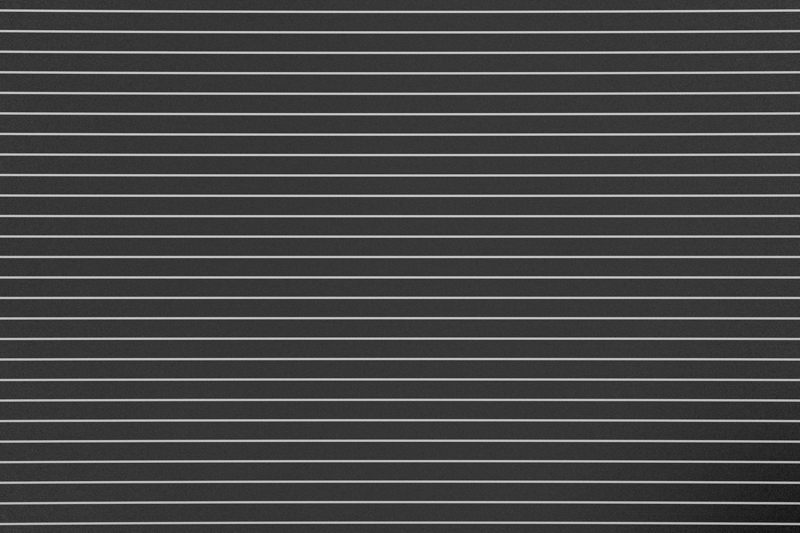
Just counting bands can be quite inaccurate, especially if the number of bands in the frame is small, as it is for fast shutters. For example, the A9 image below shows 2 bands. Using that and that the LEDs are pulsed at 240 Hz, I compute (2/240) = (1/120) sec for the shutter speed. It is much more accurate to take the image file into Photoshop and use the info panel to measure the vertical distance between the top (or bottom) edges of the furthest separated bands. In this case I measured the distance between the top of the bands to be 2332 pixels. That means there are (4000/2332) = 1.71 bands in the full image. Since the LEDs are pulsed at 240 Hz, that gives (1.71/240) = (1/140) sec for the shutter transit time. That is easy and quite accurate. The measurement is as accurate as you can measure the 2332 pixel band spacing, which I would estimate is better than 1%. In order to get the sharpest edge I used 1/10,000 sec shutter. Even if you have several bands in the frame it is more accurate to measure the band spacing to get the fractional band in the image. The A7R4 image shows 26 bright bands, 25 full dark bands and 2 partial dark bands. I measured the spacing and find there are 25.97 cycles. I measured a few others and find the average to be 25.95. The calculation (25.95/240) = 108 msec = 1/9.25 sec. That is for a single shot, uncompressed 14-bit RAW frame. Using continuous compressed 12-bit frames the result is 60.0 msec = 1/16.7 sec, which is 1.80 times faster (but still pretty slow!). These results are similar to those obtained by Jim Kasson, https://blog.kasson.com/a7riv/how-fast-is-the-sony-a7riv-silent-shutter/
I checked a few other LED lights around the house. I did not find any that pulse at 120 Hz. The bulbs in the ceiling lights were also 240 Hz. I was surprised to find some LED lights are pulsed at much higher frequencies. The reading lamp in my office shows over 14 bands with the A9, which means it pulses at nearly 2 kHz. Another reading lamp showed slightly over 41 bands with the A9, which means nearly 6 kHz! It seems that the lighting engineers are phase locking and pulse width modulating to get flicker free variable intensity lamps, although some of these frequencies seem ridiculously high. Some are such high frequency that the number of bands is too high to be practical for measuring slower electronic shutters.
Since some of the high frequencies are not simple multiples of the line frequency, an absolute measurement of the shutter speed is problematic. But it is easy to measure the ratio of shutter speeds quite accurately. For example, it is easy to measure the ratio of the electronic shutter and the mechanical shutter using a high frequency LED light. Or to measure the ratio of an A9 and R5 (if you have both). With a 240 Hz LED light, it can be done in just a few minutes. Note that it can’t be done with a 120 Hz LED since the A9 will show only one LED pulse.
It is also interesting to note that the 12 row bands are seen on the leading and trailing edges of the LED pulse. These bands are seen due to the rapidly changing light as the LED is pulsed on or off, not the interaction between motion blur and rolling shutter that was discussed at the beginning of this thread.
Hopefully someone with an R6 and R5 can use these methods to give us a measure of their electronic shutter speeds.
Edit: I forgot to mention that it is important to turn off any lens correction in the camera and in the RAW converter. Otherwise the bands may not be straight and the measurement of the distance between bands will depend on where along the band you measure the separation. That will obviously introduce a systematic error in the measurement of the shutter speed.
A9 photo of LED light pulses using the electronic shutter. The pulses are measured to be 2332 pixels apart and the pulse rate is 240 Hz. Consequently the frame contains 1.71 cycles and the shutter transit time is 1/140 sec.
A7R4 photo of LED light pulses using the electronic shutter in 14-bit uncompressed mode. There are 25.95 cyles in the image and the shutter transit time is 1/9.25 sec.
This shows and enlarged view of the leading edge of the A9 photo. It shows the 12 row bands due to the group readout discussed at the beginning of this thread. It also shows blue color (the trailing edge is red) due to turn on/off rates of the leds.
p.4 #5 · Electronic Shutter Artifacts in Sony A9 and Canon 1DX3 Images
@dclark, Nice write-up. An OLED-based smartphone is a good source for these tests since they have known refresh frequencies when their brightness is set to lower levels, such as 50% (due to PWM). This assumes you can accommodate fitting the entire smartphone screen in the FOV of the lens on the camera.
Another good source are LCD monitors since many use PWM for < 100% brightness levels. Since PWM is an eyestrain issue there are tests available online that measure the backlight refresh rate of many popular monitors at various brightness levels.