This topic is in the 2020 archive. You can read it and like its posts here. It is read only.
Archive 2020English manual R5 [AVAILABLE NOW!]
p.2 #1English manual R5 [AVAILABLE NOW!]
https://www.canon-europe.com/cameras/eos-r5/
Official disclaimer:
Electronic shutter up to approx. 20 fps with AF/AE tracking: Applies to some RF/EF lenses, when the aperture is fully open. See Canon’s official website for a list of compatible lenses. Burst shooting speed varies depending on the shutter speed, aperture setting, aperture condition during continuous shooting, subject conditions, brightness (especially in dim conditions), and type of lens. Mechanical shutter up to approx. 12 fps with AF/AE tracking: When using RF lenses and some EF lenses. See Canon’s official website for a list of compatible lenses. Burst shooting speed varies in up to 3 stages, depending on the battery type, remaining...Show more →
Jul 27, 2020 at 09:50 AM

p.2 #2English manual R5 [AVAILABLE NOW!]
highdesertmesa wrote:
https://www.canon-europe.com/cameras/eos-r5/
Official disclaimer:
So where is says "Burst shooting speed varies in up to 3 stages" I read that as we will have other burst speed selections (3) other than the full 20fps everyone keeps talking about. Is that what everyone else is reading there?
https://www.canon-europe.com/cameras/eos-r5/
Official disclaimer:
Earlier quote
Electronic shutter up to approx. 20 fps with AF/AE tracking: Applies to some RF/EF lenses, when the aperture is fully open. See Canon’s official website for a list of compatible lenses. Burst shooting speed varies depending on the shutter speed, aperture setting, aperture condition during continuous shooting, subject conditions, brightness (especially in dim conditions), and type of lens. Mechanical shutter up to approx. 12 fps with AF/AE tracking: When using RF lenses and some EF lenses. See Canon’s official website for a list of compatible lenses. Burst shooting speed varies in up to 3 stages, depending on the battery type, remaining battery charge, number of batteries, lens in use, temperature, setting of the built-in Wi-Fi (On/Off), and whether or not you are using a battery grip and WFT unit, DC coupler or USB power adapter. In addition to the above factors, the maximum burst shooting speed may decrease due to shutter speed, aperture, flash usage, flicker reduction processing, subject conditions, brightness (especially in a dark place).So where is says "Burst shooting speed varies in up to 3 stages" I read that as we will have other burst speed selections (3) other than the full 20fps everyone keeps talking about. Is that what everyone else is reading there?
Jul 27, 2020 at 10:17 AM
p.2 #3English manual R5 [AVAILABLE NOW!]
My FMer buddy Julius Kovatch just emailed me this link. Thanks Julius!
https://www.wimarys.com/canon-eos-r5-advanced-manual/
https://www.wimarys.com/canon-eos-r5-advanced-manual/
Jul 27, 2020 at 10:56 AM
p.2 #4English manual R5 [AVAILABLE NOW!]
That's an adapted version of the manual for EOS R. It's not the official canon user guide.
bobbytan wrote:
My FMer buddy Julius Kovatch just emailed me this link. Thanks Julius!
https://www.wimarys.com/canon-eos-r5-advanced-manual/
bobbytan wrote:
My FMer buddy Julius Kovatch just emailed me this link. Thanks Julius!
https://www.wimarys.com/canon-eos-r5-advanced-manual/
Jul 27, 2020 at 11:41 AM
p.2 #5English manual R5 [AVAILABLE NOW!]
lighthound wrote:
highdesertmesa wrote
https://www.canon-europe.com/cameras/eos-r5/Official disclaimer:
Earlier quote
Electronic shutter up to approx. 20 fps with AF/AE tracking: Applies to some RF/EF lenses, when the aperture is fully open. See Canon’s official website for a list of compatible lenses. Burst shooting speed varies depending on the shutter speed, aperture setting, aperture condition during continuous shooting, subject conditions, brightness (especially in dim conditions), and type of lens. Mechanical shutter up to approx. 12 fps with AF/AE tracking: When using RF lenses and some EF lenses. See Canon’s official website for a list of compatible lenses. Burst shooting speed varies in up to 3 stages, depending on the battery type, remaining battery charge, number of batteries, lens in use, temperature, setting of the built-in Wi-Fi (On/Off), and whether or not you are using a battery grip and WFT unit, DC coupler or USB power adapter. In addition to the above factors, the maximum burst shooting speed may decrease due to shutter speed, aperture, flash usage, flicker reduction processing, subject conditions, brightness (especially in a dark place).There are different levels for mechanical which are selectable by the user but also selectable by the camera if it doesn’t like something you are doing ( like adapting a 1920s lens, or using a battery with less than 60% charge etc).
In ES no matter what level you have selected it always shoots at 20FPS. Although maybe there are times the camera won’t meet that speed given conditions but I’m not sure about limitations in ES.
Jul 27, 2020 at 11:58 AM
p.2 #6English manual R5 [AVAILABLE NOW!]
arbitrage wrote:
Official disclaimer:
So where is says "Burst shooting speed varies in up to 3 stages" I read that as we will have other burst speed selections (3) other than the full 20fps everyone keeps talking about. Is that what everyone else is reading there?There are different levels for mechanical which are selectable by the user but also selectable by the camera if it doesn’t like something you are doing ( like adapting a 1920s lens, or using a battery with less than 60% charge etc).
In ES no matter what level you have selected it always shoots at 20FPS. Although maybe there are times the camera won’t meet that speed given conditions but I’m not sure about limitations in ES.
Ah, I see it now. Thanks. I thought the whole note was referring to ES. I didn't see where they switched over to talking about mechanical until I just re-read it.
lighthound wrote
highdesertmesa wrote
https://www.canon-europe.com/cameras/eos-r5/Official disclaimer:
Earlier quote
Electronic shutter up to approx. 20 fps with AF/AE tracking: Applies to some RF/EF lenses, when the aperture is fully open. See Canon’s official website for a list of compatible lenses. Burst shooting speed varies depending on the shutter speed, aperture setting, aperture condition during continuous shooting, subject conditions, brightness (especially in dim conditions), and type of lens. Mechanical shutter up to approx. 12 fps with AF/AE tracking: When using RF lenses and some EF lenses. See Canon’s official website for a list of compatible lenses. Burst shooting speed varies in up to 3 stages, depending on the battery type, remaining battery charge, number of batteries, lens in use, temperature, setting of the built-in Wi-Fi (On/Off), and whether or not you are using a battery grip and WFT unit, DC coupler or USB power adapter. In addition to the above factors, the maximum burst shooting speed may decrease due to shutter speed, aperture, flash usage, flicker reduction processing, subject conditions, brightness (especially in a dark place).In ES no matter what level you have selected it always shoots at 20FPS. Although maybe there are times the camera won’t meet that speed given conditions but I’m not sure about limitations in ES.
Ah, I see it now. Thanks. I thought the whole note was referring to ES. I didn't see where they switched over to talking about mechanical until I just re-read it.
Jul 27, 2020 at 12:36 PM
p.2 #7English manual R5 [AVAILABLE NOW!]
I thought it was odd that someone could have put this together so quickly! Oh well. It might not be too different though, and it could be useful to a DSLR shooter switching to EOS-R for the first time.
photoin.nyc wrote:
That's an adapted version of the manual for EOS R. It's not the official canon user guide.
https://www.wimarys.com/canon-eos-r5-advanced-manual/
photoin.nyc wrote:
That's an adapted version of the manual for EOS R. It's not the official canon user guide.
bobbytan wrote
My FMer buddy Julius Kovatch just emailed me this link. Thanks Julius!https://www.wimarys.com/canon-eos-r5-advanced-manual/
Jul 27, 2020 at 01:26 PM
p.2 #8English manual R5 [AVAILABLE NOW!]
it is here guys:
https://gdlp01.c-wss.com/gds/9/0300039689/01/EOS_R5_Advanced_User_Guide_v1_EN.pdf
And this time i downloaded it in case it is removed again.
You're welcome.
https://gdlp01.c-wss.com/gds/9/0300039689/01/EOS_R5_Advanced_User_Guide_v1_EN.pdf
And this time i downloaded it in case it is removed again.
You're welcome.
Jul 28, 2020 at 10:24 AM
p.2 #9English manual R5 [AVAILABLE NOW!]
Page 407
"With certain lenses, it may take more time to achieve focus with autofocus, or accurate focusing may not be achieved."
We have seen the list with supported lenses but does that mean we can expect all these listed lenses to achieve fast and accurate autofocus? I mean the statement above is pretty vague, and does not explain a lot.
Page 410
"Caution
Fewer shots are available when set to [Enable], because the lens is driven continuously and battery power is consumed."
Is that the FPS drop people mentioned earlier?
Page 452
"Caution
Approx. 12 shots/sec. continuous shooting speed with [] is available under the following conditions.
• Room temperature (23°C/73°F)"
So what happens to the shots/sec above room temperature?
Edited on Jul 28, 2020 at 10:56 AM · View previous versions
Jul 28, 2020 at 10:54 AM
p.2 #10English manual R5 [AVAILABLE NOW!]
Fantastic! Takeaways, people?
therealthings wrote:
it is here guys:
https://gdlp01.c-wss.com/gds/9/0300039689/01/EOS_R5_Advanced_User_Guide_v1_EN.pdf
And this time i downloaded it in case it is removed again.
You're welcome.
therealthings wrote:
it is here guys:
https://gdlp01.c-wss.com/gds/9/0300039689/01/EOS_R5_Advanced_User_Guide_v1_EN.pdf
And this time i downloaded it in case it is removed again.
You're welcome.
Jul 28, 2020 at 10:56 AM
p.2 #11English manual R5 [AVAILABLE NOW!]
The absence of the 400 DO II in the list of supported EF lenses for 12fps makes no sense to me.
Jul 28, 2020 at 11:04 AM
p.2 #12English manual R5 [AVAILABLE NOW!]
I see they removed AF Switching in the Servo parameters. Only TS and Accel/Decel. Removed Cases 5 and 6 and replaced them with Auto.
Jul 28, 2020 at 11:35 AM
p.2 #13English manual R5 [AVAILABLE NOW!]
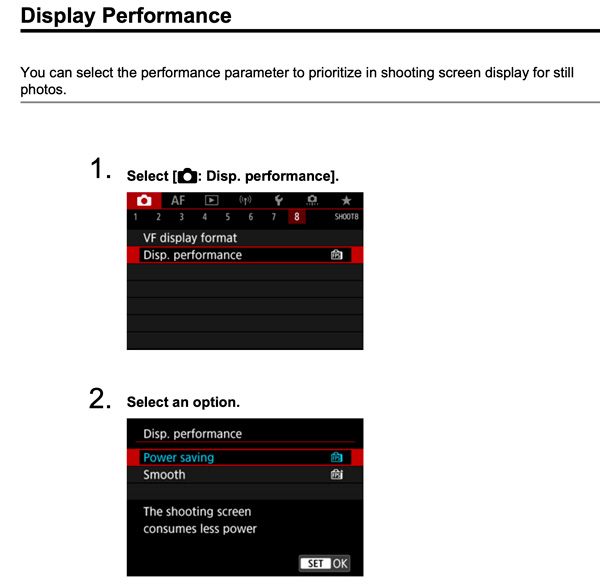
Looks like you can only use the VF 120 fps refresh rate for stills which is fine. Save the battery.
Jul 28, 2020 at 11:56 AM
p.2 #14English manual R5 [AVAILABLE NOW!]
It also has High Speed Display for RF lenses only. I wonder if it will do anything on the R5 & 6.
Jul 28, 2020 at 12:00 PM
p.2 #15English manual R5 [AVAILABLE NOW!]
Zenon Char wrote:
It also has High Speed Display for RF lenses only. I wonder if it will do anything on the R5 & 6.
What page is that referenced on?
Jul 28, 2020 at 04:35 PM
p.2 #16English manual R5 [AVAILABLE NOW!]
arbitrage wrote:
What page is that referenced on?
259. Sorry for late reply. Supper and the previous days late night show monologues to get through. Looks like frame insertion?
Zenon Char wrote
It also has High Speed Display for RF lenses only. I wonder if it will do anything on the R5 & 6.259. Sorry for late reply. Supper and the previous days late night show monologues to get through. Looks like frame insertion?
Jul 28, 2020 at 05:03 PM
p.2 #17English manual R5 [AVAILABLE NOW!]
Zenon Char wrote:
Looks like you can only use the VF 120 fps refresh rate for stills which is fine. Save the battery.
I'm assuming if you are set to Smooth (120 fps) it kicks into 60 when you shoot High Speed Continuos.
Looks like you can only use the VF 120 fps refresh rate for stills which is fine. Save the battery.
I'm assuming if you are set to Smooth (120 fps) it kicks into 60 when you shoot High Speed Continuos.
Jul 28, 2020 at 05:26 PM
p.2 #18English manual R5 [AVAILABLE NOW!]
I read about this before and I just found it. On 258 there is a Viewfinder Review option. Someone on another site said that if you Enable it there will be more lag. I wonder if it also kicks out during High Speed Continuous but it doesn't say. I don't know what the factory setting is but it appears to be in Disable based on how it is presented.
If it is the other way around maybe some testers are seeing more lag?
Edited on Jul 28, 2020 at 06:01 PM · View previous versions
If it is the other way around maybe some testers are seeing more lag?
Edited on Jul 28, 2020 at 06:01 PM · View previous versions
Jul 28, 2020 at 05:40 PM
p.2 #19English manual R5 [AVAILABLE NOW!]
Tony5787 wrote:
The absence of the 400 DO II in the list of supported EF lenses for 12fps makes no sense to me.
I mentioned this in another thread, but I read the limitation is related to the aperture blades and not the autofocus motors. The entire lens as a system has to keep up in mechanical shutter mode, and some can't.
Jul 28, 2020 at 05:41 PM
p.2 #20English manual R5 [AVAILABLE NOW!]
Oh yeah. This manual has no index. Hard to find stuff but it is better than no manual.
Jul 28, 2020 at 05:42 PM