What the heck is the deal with the squirrel shot @ 1:45 mark? They show a shot with the IS turned off and it looks like he was jumping up and down when the shot was taken. No wonder the image of this squirrel in the other thread looked like motion blur.
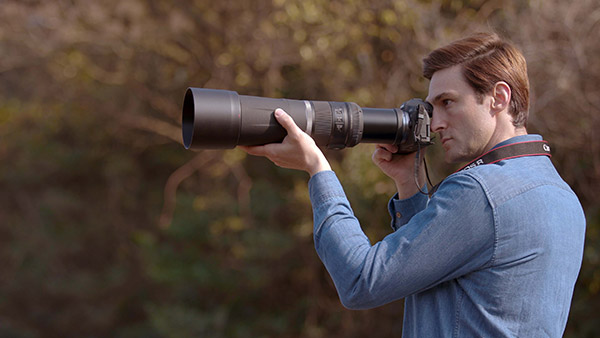
I think they need to fire this Jim Carrey lookalike guy as a photog.
ilkka_nissila wrote:
I think the idea is to show what kind of a result a user with the experience and skill level of the expected buyer of the lens can expect from it.
Well, I'm no Ansel Adams by any means but I'm very interested in this 800 for hiking and would have liked to see "real" photos taken with it so I know if it's worth it for a "pocket" lens. I'm sure decent (skilled) images will be showing up shortly, but I don't know what they were thinking with this one.
I'm a Nikon F mount photographer, and I'm incredibly jealous of the new Canon 800mm, looks like a really affordable and compact moon lens, particularly with a teleconverter. Its been a long time since any kit release has grabbed me as much as this lens does.
Also doesn't include a foot and not sure what type of attachment it has on that little square that sticks out to accept one
A lens hood that is close to 10% the cost of the lens? Classic Canon. I always fall for that though, and end up buying the OEM hood for my Canon lenses. One would be justified in blaming me for encouraging such behavior from Canon.
Liquidstone wrote:
Lol.... thanks for the enlightenment, Geoff. This shows my ignorance (due to lack of interest?) with the RF system.
Yes, all the MILC systems have fairly short flange distances so it is easy to make adapters to take DSLR glass onto mirrorless, pretty much impossible to go the other way. And then there is putting different mirrorless onto different mirrorless...that all depends on the details and some are like a mm apart so would need a wafer thin adapter. There is also issues with mount diameters as I understand it. There is an adapter to put Sony FE onto Nikon Z.
I am not sure that these lenses will move many serious wildlife photographers into the Canon system. The latter is not a critique of Canon's accomplishments, the uniqueness of the optics, or the attempt to produce an affordable option. Rather, it is a critique of the longterm usefulness of an f/11 lens. The novelty of shooting 800mm handheld will wear off after one spends more time looking at their final images.
While watching the video ( wt_ for false drama), I paused at every single still image. With the exception of the deer, each of those shots would have been in my delete bin for the distracting elements throughout. Foreground sticks were too prominent as were background sticks. The tight deer portrait was a keeper, and I had high hopes when I saw the Sarus (?) crane. Sadly, they failed to show what 800mm has the capacity to do.
Now, with all of that stated in a preamble, these lenses will be a huge hit in the market place. Canon will not be able to keep them in stock and they will be extremely popular with birders (not serious bird photographers) and wildlife travelers/enthusiasts. I can imagine a lot of people in the Tetons and Yellowstone wielding these lenses to photograph bears and wolves for their Facebook feeds. Furthermore, pair either with an EOS RP, and you have a kit capable of photographing distant wildlife for under $2000. However, once people become more critical about their images and wonder why they lack the "pop" others seem to get, they will become disenchanted... I have seen the latter occur w/ quite a few who have purchased Tamron/Sigma 150-600 lenses... love them to death until they are trying to emulate the best wildlife images.
As a Nikon Z/F shooter, my interest point to the 100-500 as they had with Sony's 200-600. I am super curious to see some real images from the new Canon Zoom and the R6. Does the 100-500 go a step beyond the amazing 100-400 mkII? Do the images have a higher degree of micro-contrast than what the 200-600 produces at maximum aperture? How well does the 100-500 perform w/the 1.4x... You Canon folks have some serious decisions ahead of you, as do those of us who are waiting for Nikon's entry into the telephoto world with their Z-system.
Here is 800mm with a 2X. The overall AF zone gets smaller towards the center, not 100 x 100% with the 100-500 and other RF lenses. Still impressive to AF at f22 though. You can almost one hand hold that 1600mm. Amateurs will love it I think.
arbitrage wrote:
Physics would say no....or mechanical engineering
RF is designed to be very close to the sensor...you would have to jam it into your mirror box to make it work....but a mallet may work?
The RF mount is close to the sensor, but where is the back element in collapsed position? you might be able to mount it in collapsed position on EF mount with a very simple mount adapter (no aperture to control, and for moon shots the IS isn't required either). The extension for sure is more than the difference in RF and EF flangeback.
I didn't check the optical configuration and have no idea if focusing would still be possible in this case, just guessing
JaimitoFrog wrote:
Here is 800mm with a 2X. The overall AF zone gets smaller towards the center, not 100 x 100% with the 100-500 and other RF lenses. Still impressive to AF at f22 though. You can almost one hand hold that 1600mm. Amateurs will love it I think.


 They show a shot with the IS turned off and it looks like he was jumping up and down when the shot was taken. No wonder the image of this squirrel in the other thread looked like motion blur.



 One would be justified in blaming me for encouraging such behavior from Canon.