alundeb wrote:
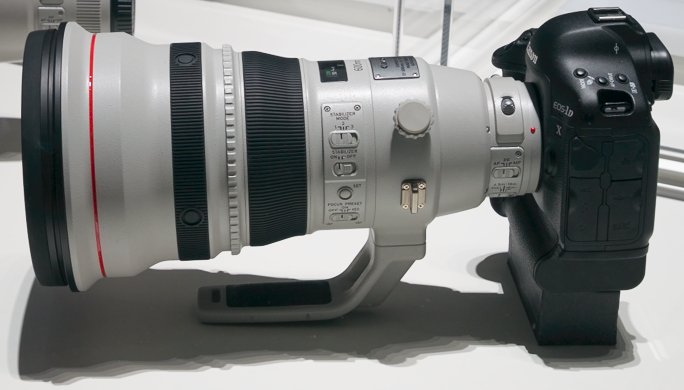
As far as I can tell, they traded on all the "right" things. Don't try to make it physically short. Keep the MFD long. This has been the recipe of the excellent old primes like the 400/5.6 and 300/4 non-IS. Further: Perfect use case for DO element. Make the build quality adequate but not L grade. In theory, they have done nothing that should compromise the image quality. I am a bit anxious about the DO element, but on the positive side it has always meant high resolving power wide open, even field and low CA. All good in my book....Show more →
One thing not mentioned yet, that I have seen...
If a DO lens can be made for this cheap, and the image quality is good, that means Canon found a way to make DO elements at a much lower cost than in previous generations. Maybe there is a hope for more DO lenses in the future that are affordable.
But, this could also be a result of making the lenses f11, which reduces the size of the DO elements and their production costs.
JohanEickmeyer wrote:
If a DO lens can be made for this cheap, and the image quality is good, that means Canon found a way to make DO elements at a much lower cost than in previous generations. Maybe there is a hope for more DO lenses in the future that are affordable.
Yeah, this is the key. Canon is going all in on 'mirrorless is smaller/lighter'. Maybe all future RF super teles will be DO
JohanEickmeyer wrote:
One thing not mentioned yet, that I have seen...
If a DO lens can be made for this cheap, and the image quality is good, that means Canon found a way to make DO elements at a much lower cost than in previous generations. Maybe there is a hope for more DO lenses in the future that are affordable.
But, this could also be a result of making the lenses f11, which reduces the size of the DO elements and their production costs.
My expectation is that ultimately DO elements will be significantly cheaper than comparable traditional optics elements with similar spec. Production technology for DO is still evolving, for small elements like for microscope lenses it is quite cheap already and in general production/QC problems exponentially increase with larger elements. Probably the f/11 spec helps to keep such production issues (and environmental issues during use) in check.
NonDecaf wrote:
Canon always seems to anchor themselves with some kind of bread-and-butter market segment. It was the new-kid/vacationing couple with their rebels, I guess now its.. birders/wild-life enthusiasts? I'm guessing we're going to see some crazy kit pricing with the RP and these lenses. I think Canon did the right thing with these lenses, it doesn't threaten the 1DX and 600 III buyers, and it gives Canon time to deliver a knockout R1 body that can hopefully drive the EF super tele glass like native RF.
A birders kit based on the RP and 600DO lens doesn't make sense because birding is almost always focal length limited (for people without car-sized budgets). You could get the same detail with e.g. SL2 + Tamron 100-400VC lens for similar weight and much lower price, with the additional benefit of a zoom and slightly better effective aperture (and maybe slightly worse corner performance which is not that important for most birders). For a 800DO kit it is a bit more difficult to find a cheaper APS-C alternative but still ... I think it would be a tough sell.
JohanEickmeyer wrote:
One thing not mentioned yet, that I have seen...
If a DO lens can be made for this cheap, and the image quality is good, that means Canon found a way to make DO elements at a much lower cost than in previous generations. Maybe there is a hope for more DO lenses in the future that are affordable.
But, this could also be a result of making the lenses f11, which reduces the size of the DO elements and their production costs.
Canon has had two levels of DO lenses for a long time. There's the 400mm DO L lens, with superior optics and a price to match, and the 70-300mm non-L DO lens with lesser optics and a much lower price. This is not a new thing for them.
technic wrote:
A birders kit based on the RP and 600DO lens doesn't make sense because birding is almost always focal length limited (for people without car-sized budgets). You could get the same detail with e.g. SL2 + Tamron 100-400VC lens for similar weight and much lower price, with the additional benefit of a zoom and slightly better effective aperture (and maybe slightly worse corner performance which is not that important for most birders). For a 800DO kit it is a bit more difficult to find a cheaper APS-C alternative but still ... I think it would be a tough sell.
That depends very much on the AF capabilities. There is a reason the Sony A9 is the preferred BIF body for those who can afford it in the Sony camp, and not the A7rIV or an APS-body, even when focal length limited.
johnvanr wrote:
Canon has had two levels of DO lenses for a long time. There's the 400mm DO L lens, with superior optics and a price to match, and the 70-300mm non-L DO lens with lesser optics and a much lower price. This is not a new thing for them.
Not quite a fair comparison. The 70-300 was around $1,400 MSRP new, and it's a very early DO version and an older lens (2004 iirc). The image quality from that thing was abysmal, but more likely due to being a zoom with DO element.
If the new f11 DO lenses offer image quality as good as the 400 DO at f11, then maybe Canon has lowered the cost of making DO elements that are worthy for replacing traditional elements.
ilkka_nissila wrote:
A DSLR cannot autofocus an f/11 lens in the normal way, through the viewfinder. Thus, such lenses are not realistically usable on DSLRs for the typical applications (wildlife).
That's true but all DSLRs have Liveview (with slow AF) and anyway, I'm doing all my action photography with manual focus now because AF on my 80D is way too slow. For EF-M mount it should be even less of an issue. Don't know if recent EOS-M bodies can autofocus an f/11 lens but technically it should be possible. If the price is low enough people will accept some compromises.
JohanEickmeyer wrote:
Not quite a fair comparison. The 70-300 was around $1,400 MSRP new, and it's a very early DO version and an older lens (2004 iirc). The image quality from that thing was abysmal, but more likely due to being a zoom with DO element.
If the new f11 DO lenses offer image quality as good as the 400 DO at f11, then maybe Canon has lowered the cost of making DO elements that are worthy for replacing traditional elements.
I guess whether the comparison is fair depends then on whether the image quality of these new lenses is any good, esp. compared to the 400DO. I have my doubts. But we’ll see.
johnvanr wrote:
I guess whether the comparison is fair depends then on whether the image quality of these new lenses is any good, esp. compared to the 400DO. I have my doubts. But we’ll see.
If they are anywhere close to the 400 DO I'll be jumping on the 800. I doubt they will, but who knows!
johnvanr wrote:
I guess whether the comparison is fair depends then on whether the image quality of these new lenses is any good, esp. compared to the 400DO. I have my doubts. But we’ll see.
I might have been a bit incorrect about the 70-300. When stopped down to f11, 300mm, it's actually not far off from the 400 DO at f11.
EDIT: Double derp on my part. Compared to v1 400DO. v2 absolutely destroys the 70-300.
arbitrage wrote:
Is there still hope for this one?
Not like that, no.
There will probably be a new RF 600mm f/4 DO lens at some point (and I wouldn't rule out an 800mm f/5.6 either, 300mm f/2.8 isn't that young either), but they will not rush it and pricing will be inevitably higher on that one.
Since Nikon did not upgrade their 400mm f/2.8 and 600mm f/4 lenses to the same level as Canon, I would expect them to come out with the mirrorless equivalents earlier than Canon.


 I'm guessing we're going to see some crazy kit pricing with the RP and these lenses. I think Canon did the right thing with these lenses, it doesn't threaten the 1DX and 600 III buyers, and it gives Canon time to deliver a knockout R1 body that can hopefully drive the EF super tele glass like native RF.