This topic is in the 2019 archive. You can read it and like its posts here. It is read only.
Archive 2019Pre-order: Voigtländer 50mm f/2 APO-LANTHAR
p.21 #1Pre-order: Voigtländer 50mm f/2 APO-LANTHAR
Also, on this article from Zeiss (lenspire.zeiss.com), it states the Loxia 25/2.4 features a floating element design:
"Constructed according to the Distagon design, the ZEISS Loxia 2.4/25 includes the ZEISS floating elements design, which compensates for aberrations at different distance settings."
https://lenspire.zeiss.com/photo/en/article/new-zeiss-loxia-2-4-25-compact-wide-angle-lens-for-photography-on-the-go
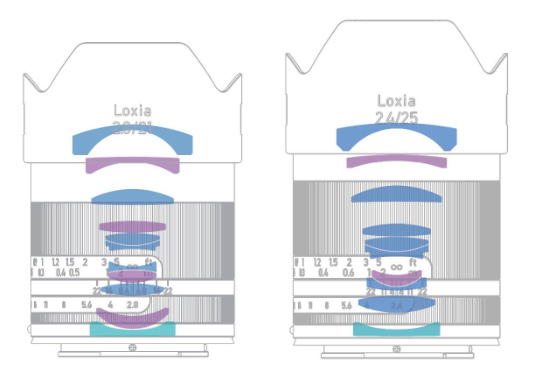
The Loxia 25 and 21mm have a very similar optical design.
Zeiss Loxia 21mm f/2.8 vs Loxia 25mm f/2.4 optical design
"Constructed according to the Distagon design, the ZEISS Loxia 2.4/25 includes the ZEISS floating elements design, which compensates for aberrations at different distance settings."
https://lenspire.zeiss.com/photo/en/article/new-zeiss-loxia-2-4-25-compact-wide-angle-lens-for-photography-on-the-go
The Loxia 25 and 21mm have a very similar optical design.
 |
||
 |
||
|
Zeiss Loxia 21mm f/2.8 vs Loxia 25mm f/2.4 optical design
Oct 20, 2019 at 11:15 AM

p.21 #2Pre-order: Voigtländer 50mm f/2 APO-LANTHAR
Fred Miranda wrote:
I've owned both the Loxia 21 and (currently) the CV 21/1.4. IMO, they are equal in IQ, both excellent. The biggest differentiators are size (win: Loxia) and speed (win: Voigtlander). Some prefer the Loxia sunstars. I kept the CV 21 for the abilty to do astro (which I never do  ). No wrong choice between the two.They also differ in field curvature shape. The Voigtlander's is wavy and the Loxia is inwards.Two other important differences for me after owning both:
1) I like the CV 21 f/1.4 better for up close performance. I think the floating element in the CV really helps provide very high level performance up close.
2) I much prefer the ergonomics of the CV especially the aperture ring at the front of the lens instead of back close to the mount on the Loxia. I also find the CV 21 f/1.4 a lot easier to get on and off the camera.Are you sure the Loxia 21/2.8 does not feature a floating system?
One Zeiss page, it shows the FLE icon:
Good question Fred. I have never seen that page before, so I thought that because Zeiss never said anything about a floating element design that the 21 didn't have a floating element. In shooting I always felt the one thing my Zeiss ZE 21 f/2.8 did better than the Loxia 21 f/2.8 was shooting up close and in my mind I attributed that to the ZE 21 having a floating element when the Loxia did not, but maybe I was wrong. That page with the icon at the bottom certainly suggests a floating element was used. Funny that Zeiss never said much about that. It is also strange that for all the Milvus and Otus lenses, which all have floating elements, and for the ZM lenses with floating elements (the 15 f/2.8 and the 35 f/1.4) Zeiss lists "floating elements design," in writing under the data tab on the lens description page where they describe special glass and other features of the lens, but they don't do so the Loxia 21 and 25. I can't find a legend for the icon at the at the bottom of the lens description page either.
Steve Spencer wrote
Fred Miranda wrote
smpetty wrote
chiron wrote
I can easily imagine the CV 50mm APO besting the Loxia 50mm, but the Loxia 21mm seems to many people to still have the better rendering compared to the CV 21/1.4. Works against making a consistent set of the same brand/ergonomics. Or is that just my OCD speaking?). No wrong choice between the two.1) I like the CV 21 f/1.4 better for up close performance. I think the floating element in the CV really helps provide very high level performance up close.
2) I much prefer the ergonomics of the CV especially the aperture ring at the front of the lens instead of back close to the mount on the Loxia. I also find the CV 21 f/1.4 a lot easier to get on and off the camera.
One Zeiss page, it shows the FLE icon:
Good question Fred. I have never seen that page before, so I thought that because Zeiss never said anything about a floating element design that the 21 didn't have a floating element. In shooting I always felt the one thing my Zeiss ZE 21 f/2.8 did better than the Loxia 21 f/2.8 was shooting up close and in my mind I attributed that to the ZE 21 having a floating element when the Loxia did not, but maybe I was wrong. That page with the icon at the bottom certainly suggests a floating element was used. Funny that Zeiss never said much about that. It is also strange that for all the Milvus and Otus lenses, which all have floating elements, and for the ZM lenses with floating elements (the 15 f/2.8 and the 35 f/1.4) Zeiss lists "floating elements design," in writing under the data tab on the lens description page where they describe special glass and other features of the lens, but they don't do so the Loxia 21 and 25. I can't find a legend for the icon at the at the bottom of the lens description page either.
Oct 20, 2019 at 11:52 AM
p.21 #3Pre-order: Voigtländer 50mm f/2 APO-LANTHAR
Sorry out of topic, but I wish Voigt made lenses for Nikon Z mount, although Nikon has made really good 1.8S lenses at competitive prices.
Oct 20, 2019 at 01:28 PM
p.21 #4Pre-order: Voigtländer 50mm f/2 APO-LANTHAR
Are there adaptors to use FE lenses on Nikon Z?
Oct 20, 2019 at 01:30 PM
p.21 #5Pre-order: Voigtländer 50mm f/2 APO-LANTHAR
umsl12 wrote:
Are there adaptors to use FE lenses on Nikon Z?
https://techartpro.com/product/techart-sony-e-nikon-z-autofocus-adapter-tze-01/
Are there adaptors to use FE lenses on Nikon Z?
https://techartpro.com/product/techart-sony-e-nikon-z-autofocus-adapter-tze-01/
Oct 20, 2019 at 01:31 PM
p.21 #6Pre-order: Voigtländer 50mm f/2 APO-LANTHAR
Nikon should make the Z mount specs available to others like Sony have.
Oct 20, 2019 at 01:31 PM
p.21 #7Pre-order: Voigtländer 50mm f/2 APO-LANTHAR
Fred Miranda wrote:
https://techartpro.com/product/techart-sony-e-nikon-z-autofocus-adapter-tze-01/
Thanks Fred. I miss Voightlander lenses when I moved to Nikon Z mount.
umsl12 wrote
Are there adaptors to use FE lenses on Nikon Z?Thanks Fred. I miss Voightlander lenses when I moved to Nikon Z mount.
Oct 20, 2019 at 01:39 PM
p.21 #8Pre-order: Voigtländer 50mm f/2 APO-LANTHAR
Excellent news. loxia can be used in nikon z!!!
Fred Miranda wrote:
https://techartpro.com/product/techart-sony-e-nikon-z-autofocus-adapter-tze-01/
Fred Miranda wrote:
umsl12 wrote
Are there adaptors to use FE lenses on Nikon Z?Oct 20, 2019 at 02:02 PM
p.21 #9Pre-order: Voigtländer 50mm f/2 APO-LANTHAR
realVivek wrote:
Nikon should make the Z mount specs available to others like Sony have.
Nah, let the infidels suffer
[/just kidding]
Nikon should make the Z mount specs available to others like Sony have.
Nah, let the infidels suffer
[/just kidding]
Oct 20, 2019 at 02:03 PM
p.21 #10Pre-order: Voigtländer 50mm f/2 APO-LANTHAR
Steve Spencer wrote:
I've owned both the Loxia 21 and (currently) the CV 21/1.4. IMO, they are equal in IQ, both excellent. The biggest differentiators are size (win: Loxia) and speed (win: Voigtlander). Some prefer the Loxia sunstars. I kept the CV 21 for the abilty to do astro (which I never do ). No wrong choice between the two.They also differ in field curvature shape. The Voigtlander's is wavy and the Loxia is inwards.Two other important differences for me after owning both:
1) I like the CV 21 f/1.4 better for up close performance. I think the floating element in the CV really helps provide very high level performance up close.
2) I much prefer the ergonomics of the CV especially the aperture ring at the front of the lens instead of back close to the mount on the Loxia. I also find the CV 21 f/1.4 a lot easier to get on and off the camera.Are you sure the Loxia 21/2.8 does not feature a floating system?
One Zeiss page, it shows the FLE icon:Good question Fred. I have never seen that page before, so I thought that because Zeiss never said anything about a floating element design that the 21 didn't have a floating element. In shooting I always felt the one thing my Zeiss ZE 21 f/2.8 did better than the Loxia 21 f/2.8 was shooting up close and in my mind I attributed that to the ZE 21 having a floating element when the Loxia did not, but maybe I was wrong. That page with the icon at the bottom certainly suggests a floating element was used. Funny that Zeiss...Show more →
I enquired with Zeiss about this a year or so ago, and they confirmed FLE in the 21 and 25.
Fred Miranda wrote
Steve Spencer wrote
Fred Miranda wrote
smpetty wrote
chiron wrote
I can easily imagine the CV 50mm APO besting the Loxia 50mm, but the Loxia 21mm seems to many people to still have the better rendering compared to the CV 21/1.4. Works against making a consistent set of the same brand/ergonomics. Or is that just my OCD speaking?). No wrong choice between the two.1) I like the CV 21 f/1.4 better for up close performance. I think the floating element in the CV really helps provide very high level performance up close.
2) I much prefer the ergonomics of the CV especially the aperture ring at the front of the lens instead of back close to the mount on the Loxia. I also find the CV 21 f/1.4 a lot easier to get on and off the camera.
One Zeiss page, it shows the FLE icon:
I enquired with Zeiss about this a year or so ago, and they confirmed FLE in the 21 and 25.
Oct 20, 2019 at 02:44 PM
p.21 #11Pre-order: Voigtländer 50mm f/2 APO-LANTHAR
hanay78 wrote:
Excellent news. loxia can be used in nikon z!!!
https://techartpro.com/product/techart-sony-e-nikon-z-autofocus-adapter-tze-01/
One important caveat about the TZE, however, is that IBIS has issues. So, far in my testing you seem to get 3-axis stabilization for the CV 50 f/1.2, but probably not 5 axis stabilization. IBIS is basically useless, however, for the CV 21 f/1.4. The TZE seems to not be conveying the proper focal length to the IBIS system for wide angle lens and I suspect it is conveying 50mm as the focal length for all lenses, but I will test that hypothesis more in the next few days.
There are also dumb adapters available on e-bay that allow you to shoot Loxia lenses and CV lenses for E mount on the Nikon Z, and the Nikon Z let's you store lens focal length and maximum aperture for easy designation of the lens. You get 3-axis IBIS with these adapters, but no EXIF information.
Edited on Oct 20, 2019 at 03:07 PM · View previous versions
Excellent news. loxia can be used in nikon z!!!
Fred Miranda wrote
umsl12 wrote
Are there adaptors to use FE lenses on Nikon Z?One important caveat about the TZE, however, is that IBIS has issues. So, far in my testing you seem to get 3-axis stabilization for the CV 50 f/1.2, but probably not 5 axis stabilization. IBIS is basically useless, however, for the CV 21 f/1.4. The TZE seems to not be conveying the proper focal length to the IBIS system for wide angle lens and I suspect it is conveying 50mm as the focal length for all lenses, but I will test that hypothesis more in the next few days.
There are also dumb adapters available on e-bay that allow you to shoot Loxia lenses and CV lenses for E mount on the Nikon Z, and the Nikon Z let's you store lens focal length and maximum aperture for easy designation of the lens. You get 3-axis IBIS with these adapters, but no EXIF information.
Edited on Oct 20, 2019 at 03:07 PM · View previous versions
Oct 20, 2019 at 02:47 PM
p.21 #12Pre-order: Voigtländer 50mm f/2 APO-LANTHAR
DavidBM wrote:
). No wrong choice between the two.They also differ in field curvature shape. The Voigtlander's is wavy and the Loxia is inwards.Two other important differences for me after owning both:
1) I like the CV 21 f/1.4 better for up close performance. I think the floating element in the CV really helps provide very high level performance up close.
2) I much prefer the ergonomics of the CV especially the aperture ring at the front of the lens instead of back close to the mount on the Loxia. I also find the CV 21 f/1.4 a lot easier to get on and off the camera.Are you sure the Loxia 21/2.8 does not feature a floating system?
One Zeiss page, it shows the FLE icon:Good question Fred. I have never seen that page before, so I thought that because Zeiss never said anything about a floating element design that the 21 didn't have a floating element. In shooting I always felt the one thing my Zeiss ZE 21 f/2.8 did better than the Loxia 21 f/2.8 was shooting up close and in my mind I attributed that to the ZE 21 having a floating element when the Loxia did not, but maybe I was wrong. That page with the icon at the bottom certainly suggests a floating element was used. Funny that Zeiss never said much about that. It is also strange that for all the Milvus and Otus lenses, which all have floating elements, and for the ZM lenses with floating elements (the 15 f/2.8 and the 35 f/1.4) Zeiss lists "floating elements design," in writing under the data tab on the lens description page where they describe special glass and other features of the lens, but they don't do so the Loxia 21 and 25. I can't find a legend for the icon at the at the bottom of the lens description page either.I enquired with Zeiss about this a year or so ago, and they confirmed FLE in the 21 and 25.
Interesting. I wonder why they don't make more of this design element for the Loxia lenses as they do with the Milvus, Otus, and ZM lenses.
Steve Spencer wrote
Fred Miranda wrote
Steve Spencer wrote
Fred Miranda wrote
smpetty wrote
I've owned both the Loxia 21 and (currently) the CV 21/1.4. IMO, they are equal in IQ, both excellent. The biggest differentiators are size (win: Loxia) and speed (win: Voigtlander). Some prefer the Loxia sunstars. I kept the CV 21 for the abilty to do astro (which I never do). No wrong choice between the two.1) I like the CV 21 f/1.4 better for up close performance. I think the floating element in the CV really helps provide very high level performance up close.
2) I much prefer the ergonomics of the CV especially the aperture ring at the front of the lens instead of back close to the mount on the Loxia. I also find the CV 21 f/1.4 a lot easier to get on and off the camera.
One Zeiss page, it shows the FLE icon:
Interesting. I wonder why they don't make more of this design element for the Loxia lenses as they do with the Milvus, Otus, and ZM lenses.
Oct 20, 2019 at 02:49 PM
p.21 #13Pre-order: Voigtländer 50mm f/2 APO-LANTHAR
Steve Spencer wrote:
Two other important differences for me after owning both:
1) I like the CV 21 f/1.4 better for up close performance. I think the floating element in the CV really helps provide very high level performance up close.
2) I much prefer the ergonomics of the CV especially the aperture ring at the front of the lens instead of back close to the mount on the Loxia. I also find the CV 21 f/1.4 a lot easier to get on and off the camera.Are you sure the Loxia 21/2.8 does not feature a floating system?
One Zeiss page, it shows the FLE icon:Good question Fred. I have never seen that page before, so I thought that because Zeiss never said anything about a floating element design that the 21 didn't have a floating element. In shooting I always felt the one thing my Zeiss ZE 21 f/2.8 did better than the Loxia 21 f/2.8 was shooting up close and in my mind I attributed that to the ZE 21 having a floating element when the Loxia did not, but maybe I was wrong. That page with the icon at the bottom certainly suggests a floating element was used. Funny that Zeiss never said much about that. It is also strange that for all the Milvus and Otus lenses, which all have floating elements, and for the ZM lenses with floating elements (the 15 f/2.8 and the 35 f/1.4) Zeiss lists "floating elements design," in writing under the data tab on the lens description page where they describe special glass and other features of the lens, but they don't do so the Loxia 21 and 25. I can't find a legend for the icon at the at the bottom of the lens description page either.I enquired with Zeiss about this a year or so ago, and they confirmed FLE in the 21 and 25.Interesting. I wonder why they don't make more of this design element for the Loxia lenses as they do with the Milvus, Otus, and ZM lenses.
A good question; it might be that they think it's a fairly straightforward thing in modern lenses, so all they need is an icon.
But with the older lenses, it was a big and unusual deal: so with Classic they made a big deal of it, and when they rehoused/redeigned Milvus (and made Otus) it was important to say the same thing to reassure people it hadn't gone away.
But Loxia is an entirely new market...
Pure speculation though.
BTW my understanding is that one of the motivations (besides ray angle) for using a distagon design in mirrorless wides is to create enough space for floating element systems...
DavidBM wrote
Steve Spencer wrote
Fred Miranda wrote
Steve Spencer wrote
Fred Miranda wrote
They also differ in field curvature shape. The Voigtlander's is wavy and the Loxia is inwards.1) I like the CV 21 f/1.4 better for up close performance. I think the floating element in the CV really helps provide very high level performance up close.
2) I much prefer the ergonomics of the CV especially the aperture ring at the front of the lens instead of back close to the mount on the Loxia. I also find the CV 21 f/1.4 a lot easier to get on and off the camera.
One Zeiss page, it shows the FLE icon:
A good question; it might be that they think it's a fairly straightforward thing in modern lenses, so all they need is an icon.
But with the older lenses, it was a big and unusual deal: so with Classic they made a big deal of it, and when they rehoused/redeigned Milvus (and made Otus) it was important to say the same thing to reassure people it hadn't gone away.
But Loxia is an entirely new market...
Pure speculation though.
BTW my understanding is that one of the motivations (besides ray angle) for using a distagon design in mirrorless wides is to create enough space for floating element systems...
Oct 20, 2019 at 03:48 PM
p.21 #14Pre-order: Voigtländer 50mm f/2 APO-LANTHAR
Floating element wide angles have been around for 35-40 years now. Nikon uses the term CRC = close range correction for it. Lenses such as Nikon 20/2.8, 24/2.8 that existed both as MF and AF lenses have this feature. The Ai-S 28/2 has CRC as well.
Zeiss is right in feeling that floating element designs are common place now.
Zeiss is right in feeling that floating element designs are common place now.
Oct 20, 2019 at 05:21 PM
p.21 #15Pre-order: Voigtländer 50mm f/2 APO-LANTHAR
Correct. It is a big deal for Leica (RF) due to space constraints and as noted earlier in this thread.
bjornthun wrote:
Floating element wide angles have been around for 35-40 years now. Nikon uses the term CRC = close range correction for it. Lenses such as Nikon 20/2.8, 24/2.8 that existed both as MF and AF lenses have this feature. The Ai-S 28/2 has CRC as well.
Zeiss is right in feeling that floating element designs are common place now.
Oct 20, 2019 at 05:34 PM
p.21 #16Pre-order: Voigtländer 50mm f/2 APO-LANTHAR
The Australian CV distributor has advised me that the RRP (Recommended Retail Price) for the Apo-Lanthar 50/2 is AUD1395 (approximately USD955/EUR856/GBP740/CAD1254).
Oct 20, 2019 at 05:41 PM
p.21 #17Pre-order: Voigtländer 50mm f/2 APO-LANTHAR
genji wrote:
The Australian CV distributor has advised me that the RRP (Recommended Retail Price) for the Apo-Lanthar 50/2 is AUD1395 (approximately USD955/EUR856/GBP740/CAD1254).
Wow, same price as a new Loxia 50/2 Planar:
https://www.bhphotovideo.com/c/product/1080387-REG/zeiss_2103_748_loxia_50mm_f_2_planar.html
Oct 20, 2019 at 06:05 PM
p.21 #18Pre-order: Voigtländer 50mm f/2 APO-LANTHAR
I just bought my second Loxia 50 to hold me until this comes out. Maybe , like to see a comparison
Oct 20, 2019 at 06:22 PM
p.21 #19Pre-order: Voigtländer 50mm f/2 APO-LANTHAR
GMPhotography wrote:
I just bought my second Loxia 50 to hold me until this comes out. Maybe , like to see a comparison
No maybes about it. Odds on the Apo-Lanthar 50 will smoke the Loxia.
I just bought my second Loxia 50 to hold me until this comes out. Maybe , like to see a comparison
No maybes about it. Odds on the Apo-Lanthar 50 will smoke the Loxia.
Oct 20, 2019 at 07:11 PM
p.21 #20Pre-order: Voigtländer 50mm f/2 APO-LANTHAR
Some early close-range correction involved a fixed rear group and the usual helical for the remaining glass. Simple and clever but not as sophisticated as two independently-moving groups.
Oct 20, 2019 at 07:15 PM