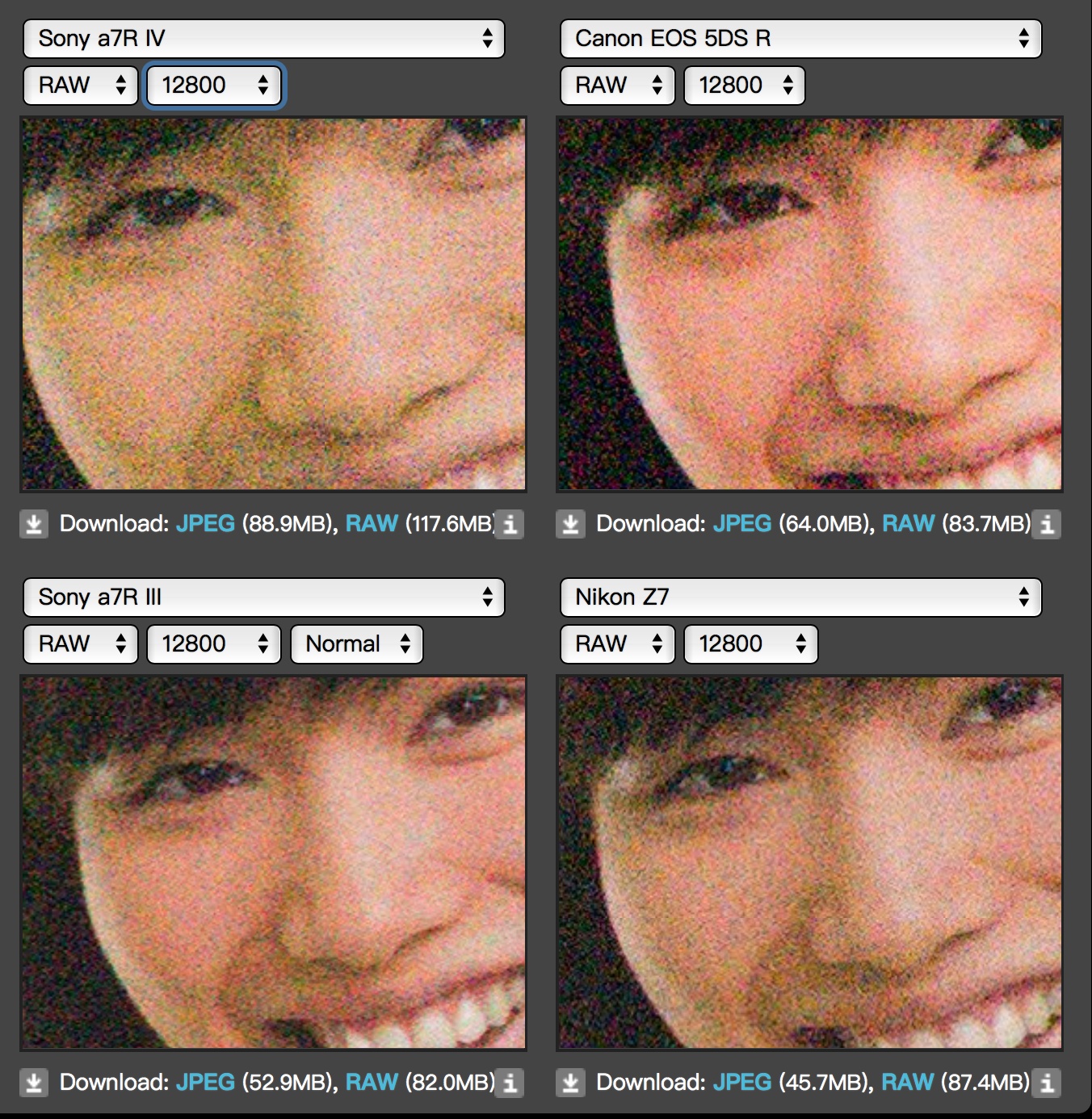
The problem with simple 100% comparisons is that it doesn't show what the files look like when normalized. That is, if you print the A7R IV files to the same size that you'd print any of these others, the noise will be notably smaller because it will use more pixels to make up that final image. When sized to the same output size, the noise on the A7R IV is very similar to the A7 III, which is one of the best performing cameras out for high ISO.
I downloaded the ISO 12,800 RAWs, processed them the same and then downsized the A7R IV file to the A7 III size, and below is the result.
The A7R4 is optimized for use up to ISO 500. If you are buying the A7R4 for use at ISO beyond that I believe you are making a mistake. It's optimized for high res applications.
dclark wrote:
The A7R4 is optimized for use up to ISO 500. If you are buying the A7R4 for use at ISO beyond that I believe you are making a mistake. It's optimized for high res applications.
Dave
You’re making a statement that could spark a flurry of bad reviews considering the body would unlikely be marketed for its high-resolution capabilities, yet give up on performance north of your stated 500 ISO. Have you spoken to anyone at Sony to discuss performance degradation at higher ISO? I don’t think the brand would want a wave of returns if this stands to be true. Mine could be one of them if I can substantiate your claim.
daniel.in.la wrote:
Another thing that gets old and is silly are these 12800 ISO comparisons. Lol who’s shooting at these silly ISOs anyway?
Seriously I’d fire myself if I was shooting that high. I never ever go over 2000 but more likely 1600. Seriously my Profotos would come out to play. Now I say that and I’ve shot everything under the sun for 43 years professionally.These people living in a hole or what.
AGeoJO wrote:
Are we trying to say that the OP is stirring the pot with that post ?
No it’s fun to see what things do for sure but you need to look at it as data points than relate it to your reality. What we have seen is the high ISo looks horrid so I’m not buying and those comments are really not fair because it’s not really the case. As a lot of us test around here we are always trying to eliminate the variables
Anyone who can’t think of an instance where ISO 12,800 would not be beneficial to any other photographer under any circumstances is out of touch with reality.
Imagemaster wrote:
Anyone who can’t think of an instance where ISO 12,800 would not be beneficial to any other photographer under any circumstances is out of touch with reality.
That’s not the case at all. I just won’t go there. But I can see where it has some merit especially with very long glass and speed issues.
My reality is different than yours . But I would not expect a 60 Mpx sensor to do it either. Its a pipe dream
Imagemaster wrote:
Anyone who can’t think of an instance where ISO 12,800 would not be beneficial to any other photographer under any circumstances is out of touch with reality.
Please elaborate. Do you mean you use these high ISOs in your shots? Or if possible, could you point me to some photography that lives at 12800 ISO? I want to make sure I’m not ‘out of touch’ with reality.
Shot some today at ISO 2000 that cleaned up pretty nice. But that is rare for me and the type shots I take. I have an A9 for higher ISO and sometimes it’s needed. However with the higher resolution of the R4 I plan to keep the ISO down. I did the same on my R3.
It’s not that you can’t shoot high quality images at higher ISOs with an A7R body. That’s just not where their strength lies. It’s sort of like driving a Ferrari on your commute through LA traffic.
Another way to state this might be: The 60 mP A7R IV is designed for the most resolution and dynamic range. To get that optimum DR and resolution you would use ISO 500 which implies control of lighting or substantial natural light.
For those who have subjects with very little light and still need to shoot, even with lowered DR and resolution as well as more noise, then ISO 12,800 could be a worthy expedient. In that case the larger pixels of an A9 or A7 III would likely be better than an A7 R IV since any extra resolution would be masked by noise.
Of course were the cameras “normalized” by “shrinking” 60mP to 24 mP then the noise and DR would be more nearly equal. Also a TIP: I find it more useful to shoot at ISO 6400 and pull up the exposure in PhotoShop-as necessary.


 Archive 2019 · Sony A7R4 incredible high ISO



 ?
?