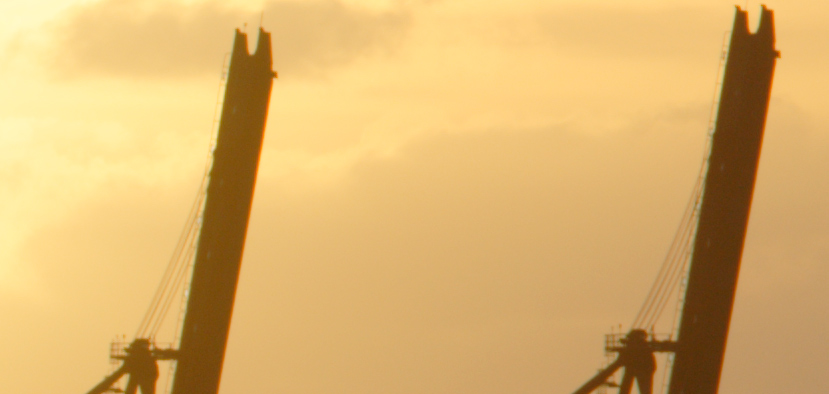
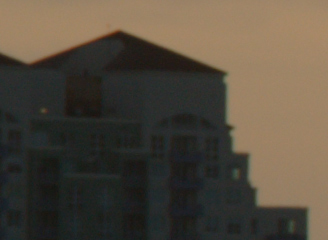
My current CV 110/2.5 shows some field curvature at infinity and I wanted to confirm if it's really a characteristic.
I'm getting a second copy tomorrow just to confirm this. It will also be helpful comparing its performance with another copy.
Whenever possible, I like comparing at least two well-centered copies side by side.
May I ask which direction the field curvature is in? My 85 FE is completely unusable at infinity with my thin-coverglass A7RII due to field curvature (as a result of the camera not lens). If this lens has some curvature away from the photographer in the corners it might be ok on my camera.
Fred Miranda wrote:
My current CV 110/2.5 shows some field curvature at infinity and I wanted to confirm if it's really a characteristic.
I'm getting a second copy tomorrow just to confirm this. It will also be helpful comparing its performance with another copy.
Whenever possible, I like comparing at least two well-centered copies side by side.
May I ask which direction the field curvature is in? My 85 FE is completely unusable at infinity with my thin-coverglass A7RII due to field curvature (as a result of the camera not lens). If this lens has some curvature away from the photographer in the corners it might be ok on my camera.
Same as Loxia. The edges/mid-field are on the plane of focus towards the lens' infinity mark. However, FC is minimal and most may never even notice it.
I just received a second copy of the lens and it's also perfectly centered. I expect very low variation with the CV 110/2.5!
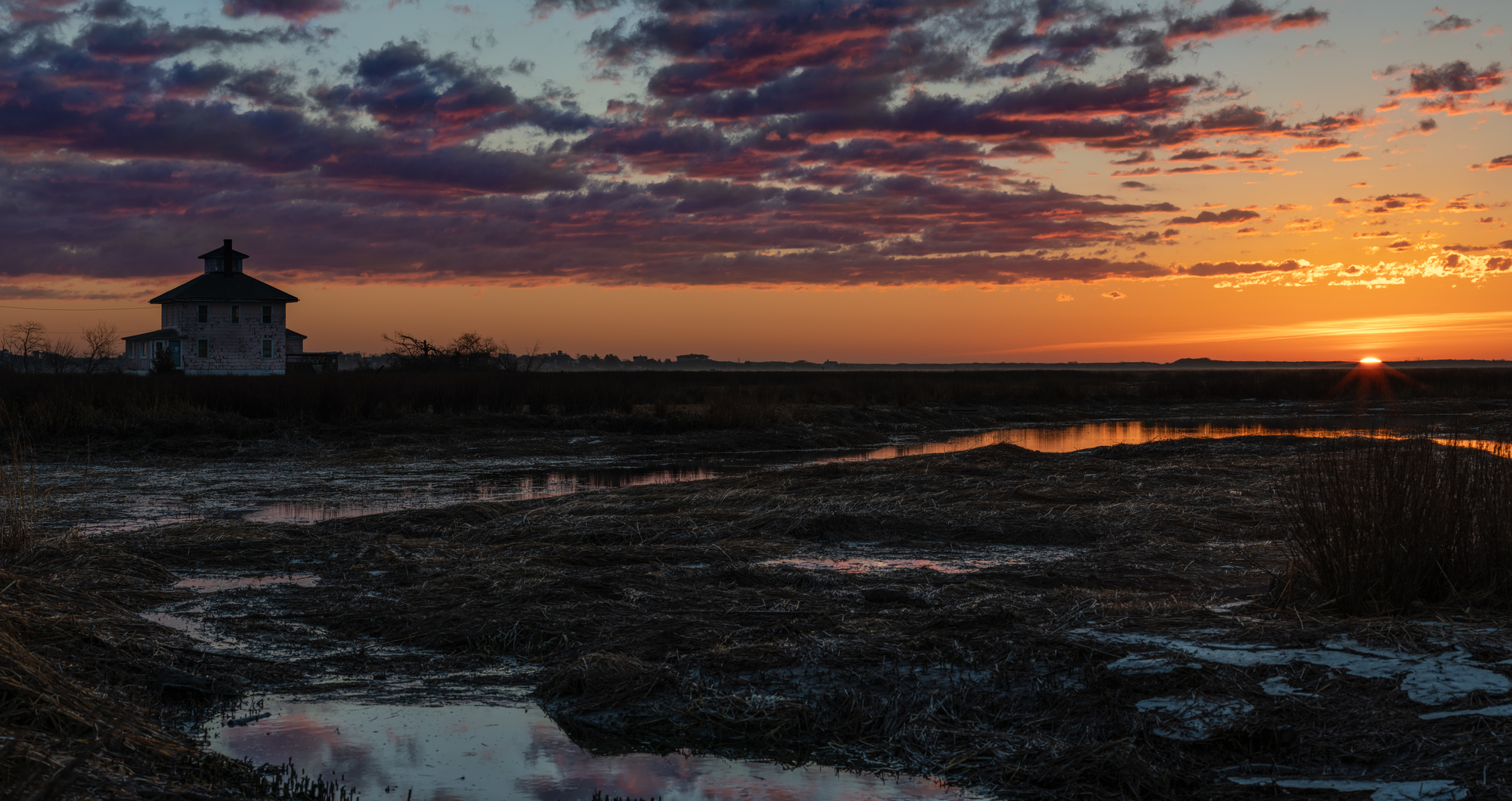
Still playing around with this lens. Ironically have not used it for macro yet. Hard to squeeze a 9 photo pano into 1.5MP but here you go. This morning sunrise, banding and all. (No banding with the full size file)
So I actually succeeded in generating CA with the lens!
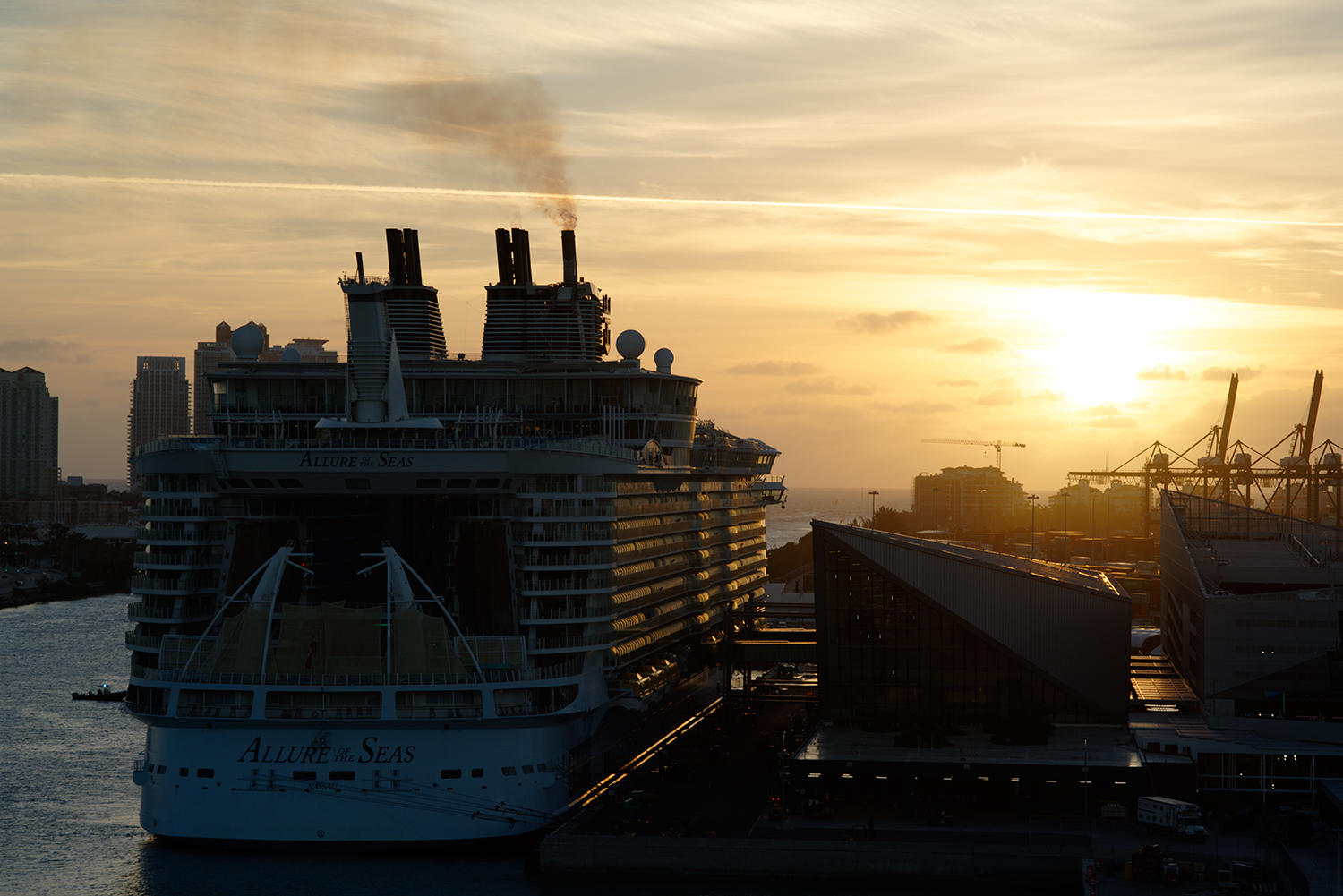
I was out on a holiday cruise and took the lens with me to play around with. While I'm still going through the photos, a few thoughts ...
1. Mechanically, the lens is a bit annoying. Dismounting the lens is pretty much guaranteed to change aperture. I started getting into habit checking / correcting aperture every time I mount it.
2. I used ship's side rails to steady the lens at times, and that allowed infinity focus to move from the starting point of the marker by a tiniest of amount - and caused entire image to blur. I have lost a number of photos not realizing this. I guess its the cost of having 'wiggle' room on the infinity focus instead of a hard stop. I have to train myself to double check infinity focus pretty much non-stop now.
As far as CA, when shooting directly into rising sun, the CA was separated into two fairly distinct colors - green on the side toward the sun, red on the side away from it. I turned off all photo processing in DxO Photolab, in case it was 'overcorrecting' something. It also wasn't able to remove that CA at all, and I wasn't able to make any adjustments to fix it. LR6 fared better and managed to get rid of if once I turned on CA removal. Examining a few other sunrise photos I do see faint red/green CA in certain areas of these specific photos. Examining regular daylight photos, haven't found any CA yet.
Is this something to be expected from these lenses? Not too big of a deal, just wondering as I've never owned APO lenses before... or - could it be sensor cover on the camera possibly doing this?
secondclaw wrote:
Is this something to be expected from these lenses? Not too big of a deal, just wondering as I've never owned APO lenses before... or - could it be sensor cover on the camera possibly doing this?
APO promises to cure axial CA (Longitudinal) and not lateral CA. That's what you are seeing in your image. This color aberration shows up off-axis and does not really go away even when stepping down the aperture. With the CV 110/2.5, it's very low and only present under extreme conditions.
Fred Miranda wrote:
APO promises to cure axial CA (Longitudinal) and not lateral CA. That's what you are seeing in your image. This color aberration shows up off-axis and does not really go away even when stepping down the aperture. With the CV 110/2.5, it's very low and only present under extreme conditions.
I think you may have it backwards.
Apochromats converge 3 primary colours at the plane of focus (no lateral CA) and have negligible spherical aberration. That is of course the typical expectation. I've owned plenty of 'APO' lenses with lots of axial CA (Leica 90 APO springs to mind) but I can't think of one that displayed lateral CA in the plane of focus.
Zeiss say both should be corrected before a lens is considered APO but the 135/2 APO-sonnar has loads of longitudinal CA.
I may be wrong but this is just my experience and the loose definition from different manufacturers doesn't help things.
Fred Miranda wrote:
APO promises to cure axial CA (Longitudinal) and not lateral CA. That's what you are seeing in your image. This color aberration shows up off-axis and does not really go away even when stepping down the aperture. With the CV 110/2.5, it's very low and only present under extreme conditions.
I think you may have it backwards.
Apochromats converge 3 primary colours at the plane of focus (no lateral CA) and have negligible spherical aberration. That is of course the typical expectation. I've owned plenty of 'APO' lenses with lots of axial CA (Leica 90 APO springs to mind) but I can't think of one that displayed lateral CA in the plane of focus.
Zeiss say both should be corrected before a lens is considered APO but the 135/2 APO-sonnar has loads of longitudinal CA.
If an APO lens is not very well corrected for axial CA, then it's not truly APO! ... the Leica 90/2 APO is indeed a good example of this.
I think defocused longitudinal CA is much harder to correct and it seems the Voigtlander doesn't exhibit this kind of abberation. I find it quite surprising that it displays lateral CA and no longitudinal CA.
Perhaps it was delayed due to being rebalanced for Nikon Z, EOS R and Sony FE, Then only calibrated for infinity. I guess we'll see if they release a Nikon Z and/or EOS R line.
thrice wrote:
I think defocused longitudinal CA is much harder to correct and it seems the Voigtlander doesn't exhibit this kind of abberation. I find it quite surprising that it displays lateral CA and no longitudinal CA.
It's pretty clean though and even lower than what we get with our best lenses.
While we can think of mathematically or geometrically perfect apo correction, a physically existing lens can never be perfect, just f***ing excellent! If Cosina has deliberately chosen to correct longitudinal CA at the expense of very slight lateral CA showing under extreme circumstances, then they've made the right choice, since lateral CA is the kind of CA more easily corrected digitally.
A fully flourite apo refractor telescope comes pretty close to perfect for all intents and purposes though.
bjornthun wrote:
While we can think of mathematically or geometrically perfect apo correction, a physically existing lens can never be perfect, just f***ing excellent! If Cosina has deliberately chosen to correct longitudinal CA at the expense of very slight lateral CA showing under extreme circumstances, then they've made the right choice, since lateral CA is the kind of CA more easily corrected digitally.
A very long thread so I'm sorry if this has been addressed and I missed it. Has anyone tried to mount the Sony 1.4x teleconverter on this lens and if so, does it mount? It would be great for those times when you need a bit more working distance or even greater magnification.
ejpeiker wrote:
A very long thread so I'm sorry if this has been addressed and I missed it. Has anyone tried to mount the Sony 1.4x teleconverter on this lens and if so, does it mount? It would be great for those times when you need a bit more working distance or even greater magnification.
With the exception of adapted lenses, I believe that the Sony 1.4X and 2X teleconverters only fit the Sony 70-200mm GM, Sony 100-400 GM, and Sony 400mm f2.8 GM lenses.