chiron wrote:
What is the practical significance of the LaCA, given how effectively it seems to be corrected by software?
Increasingly, software is so much a part of how a lens functions. I would imagine that is going to continue to increase, as with software implementation of bokeh characteristics. And I assume that lens designers might permit flaws that they know will be well-corrected by software in order to achieve useful design characteristics (like large apertures), or they might create designs that tolerate software-correctable flaws in order to reduce other flaws that are not so easily correctable by software.
Is it the case that the software-correction damages the image or the file in a significant way?...Show more →
The higher the lateral CA, the lower resolution will be towards the corners. In other words, less 'edge' definition. I think the discrepancy between the sag and meridional lines in the MTF graph is a combination of LaCA and astigmatism.
Yes, it can be masked in software but instead of having a visible color aberration, only traces are left behind. Vignetting can also be correctable in software but there is an increased in noise (most noticeable) and a dynamic range drop in the area affected.
No free lunch but almost!
Fred Miranda wrote:
The higher the lateral CA, the lower resolution will be towards the corners. In other words, less 'edge' definition. I think the discrepancy between the sag and meridional lines in the MTF graph is a combination of LaCA and astigmatism.
Yes, it can be masked in software but instead of having a visible color aberration, only traces are left behind. Vignetting can also be correctable in software but there is an increased in noise (most noticeable) and a dynamic range drop in the area affected.
No free lunch but almost!
So, the [EDIT] LaCA is related to the edges being less good than the center.
Would someone with very developed image-viewing skills, such as yourself, be able to actually see the grayish patch of the corrected [EDIT] LaCA or the reduced DR and increased noise in the corrected vignetting areas?
chiron wrote:
So, the LoCA is related to the edges being less good than the center.
Would someone with very developed image-viewing skills, such as yourself, be able to actually see the grayish patch of the corrected LoCA or the reduced DR and increased noise in the corrected vignetting areas?
He meant Lateral CA, not Longitudinal CA. This CA doesn't get reduced with stopping down and only appears toward the edges and corners. If you have done enough post CA correction, you will recognize that greyish/lifeless edge. LR correction also affect other similar colors in the entire scene as well, though not in a great extent since it's hard to find a scene with the same color, hue and saturation value of these CA. In term of vignetting correction, the surest sign is the increased noise. Reduced DR is harder to recognize since some details are crushed.
These behaviors exist on all fast 1.4 wides, with the possible exception of the Otus 28 (but vignetting is still there). Just look at everything as a whole to determine if you like what you see. There is no perfect optics so we can always find things to nitpick about.
I'd say lateral CA and vignetting are the most software friendly aberrations since they can be corrected automatically without too much damage. If you are using Lightroom, you won't be bothered by it at all.
Capture One can fix it just as good but without correction, it shows the lens true performance.
I left all of those corrections off in C1 on my tests. Posted those but did go back and turn CA back on and surprisingly it cleaned it up even at F1.4
Okay I’m a little pissed , sorry but these exaggeration comments on how good it is are without value or proof otherwise . Look I ran the tests took the time to post them and draw my conclusion from them. I have visual proof of what I’m seeing. Not only that I posted the raws to those tests and if you did not download them and check for yourself than you have absolutely no cause to say I’m exaggerating or anything else for that matter. I don’t care what you buy want to buy or want to sell. Don’t like it than don’t buy it or return it. But throwing bullets at it without some visual proof is simply not fair to those that went through the efforts here
.
I’m out of this conversation I did my due diligence and bought it, tested it and I’m satisfied and I still say warts and all it maybe the best GM yet. But that’s me
GMPhotography wrote:
I left all of those corrections off in C1 on my tests. Posted those but did go back and turn CA back on and surprisingly it cleaned it up even at F1.4
Okay I’m a little pissed , sorry but these exaggeration comments on how good it is are without value or proof otherwise . Look I ran the tests took the time to post them and draw my conclusion from them. I have visual proof of what I’m seeing. Not only that I posted the raws to those tests and if you did not download them and check for yourself than you have absolutely no cause to say I’m exaggerating or anything else for that matter. I don’t care what you buy want to buy or want to sell. Don’t like it than don’t buy it or return it. But throwing bullets at it without some visual proof is simply not fair to those that went through the efforts here
.
I’m out of this conversation I did my due diligence and bought it, tested it and I’m satisfied and I still say warts and all it maybe the best GM yet. But that’s me...Show more →
Cheers.... for the Raws, I used them in C1 and found them very useful. I've seen nothing to cause any concern, plenty of positives and I'm sure I can work around any flare problems that may arise.... seem fairly well controlled, not the best flare control but not that bad either. It's a tool that will do the job it's needed to do and from the IQ on those raws, I won't be wasting any time correcting shots..... which means I can get through more work..... bonus
Fred Miranda wrote:
The higher the lateral CA, the lower resolution will be towards the corners. In other words, less 'edge' definition. I think the discrepancy between the sag and meridional lines in the MTF graph is a combination of LaCA and astigmatism.
Yes, it can be masked in software but instead of having a visible color aberration, only traces are left behind. Vignetting can also be correctable in software but there is an increased in noise (most noticeable) and a dynamic range drop in the area affected.
No free lunch but almost!
With lateral CA sometimes the correction is truly lossless with no grey border and little resolution loss.
Why?
Lateral CA is caused by the magnification being different for different colour channels. Correction works by resizing one or more so that they perfectly align. When it works well there should be no gray border and only the tiny loss of resolution due to
The slight resizing. LoCA correction is different: just looks for edges and desaturates them.
This also means that sometimes, when the MTF shows what looks like astigmatism but is lateral CA, the resolution after good lateral CA correction can be, amazingly: *better* than the published MTF!
Edit: thanks to an alert forumer I corrected LaCA to LoCA in line 7!
GMPhotography wrote:
So for those like me that dislike the OEM hoods that come with these lenses and prefer metal screw in hoods. I ordered one off ebay and it works perfectly on the GM 24.
Um, to divert some emotion du jour...Guy - does that hood have inner threads so you can still use a filter? I also like using replacement hoods, but don't like giving up filter usage.
GMPhotography wrote:
I left all of those corrections off in C1 on my tests. Posted those but did go back and turn CA back on and surprisingly it cleaned it up even at F1.4
Okay I’m a little pissed , sorry but these exaggeration comments on how good it is are without value or proof otherwise . Look I ran the tests took the time to post them and draw my conclusion from them. I have visual proof of what I’m seeing. Not only that I posted the raws to those tests and if you did not download them and check for yourself than you have absolutely no cause to say I’m exaggerating or anything else for that matter. I don’t care what you buy want to buy or want to sell. Don’t like it than don’t buy it or return it. But throwing bullets at it without some visual proof is simply not fair to those that went through the efforts here
.
I’m out of this conversation I did my due diligence and bought it, tested it and I’m satisfied and I still say warts and all it maybe the best GM yet. But that’s me...Show more →
Thanks for all your testing Guy! And Fred!
My tests and those of Jannik and Bastian make me agree completely. This is above my expectation for a fast 24 and way above my expectation for a compact one, and it’s the best GM yet relative to FL (not counting the 400 about which I know nothing)
hiepphotog wrote:
He meant Lateral CA, not Longitudinal CA. This CA doesn't get reduced with stopping down and only appears toward the edges and corners. If you have done enough post CA correction, you will recognize that greyish/lifeless edge. LR correction also affect other similar colors in the entire scene as well, though not in a great extent since it's hard to find a scene with the same color, hue and saturation value of these CA. In term of vignetting correction, the surest sign is the increased noise. Reduced DR is harder to recognize since some details are crushed.
These behaviors exist on all fast 1.4 wides, with the possible exception of the Otus 28 (but vignetting is still there). Just look at everything as a whole to determine if you like what you see. There is no perfect optics so we can always find things to nitpick about....Show more →
Don't you spell "loteral" with an "O"?
I did mistype for LaCA.
Thanks for the interesting answer. I learned some things from it.
I have the lens and I am very happy with it. I love the rendering and the max ap and will gladly tolerate the flaws. The Canon 35 f/1.4L II is better corrected but a bit lifeless to me.
I was just trying to understand the process and issues of flaws, their practical effects, and what happens when you correct them. Thanks for your help.
jchapell wrote:
Um, to divert some emotion du jour...Guy - does that hood have inner threads so you can still use a filter? I also like using replacement hoods, but don't like giving up filter usage.
As I said earlier, it can often be fixed more or less losslessly by resizing the three colour channels so they are in perfect register. Then you get no grey border and higher resolution than the MTF would suggest. That's what the best CA correction boxes are doing usually.
But it does sometimes get harder to correct is when it's not a question of the three colour channels merely having different magnifications, but also different *distortions*. Then the way they overlap gets very complicated. It's still possible to correct the distortion for each colour channel and then match magnifications, but that's when the available algorithms start to struggle..
DavidBM wrote:
Just one more nerdy post on Lateral CA...
As I said earlier, it can often be fixed more or less losslessly by resizing the three colour channels so they are in perfect register. Then you get no grey border and higher resolution than the MTF would suggest. That's what the best CA correction boxes are doing usually.
But it does sometimes get harder to correct is when it's not a question of the three colour channels merely having different magnifications, but also different *distortions*. Then the way they overlap gets very complicated. It's still possible to correct the distortion for each colour channel and then match magnifications, but that's when the available algorithms start to struggle.. ...Show more →
You are such a nerd!
Yes, I stand correct that in theory LaCA can be indeed corrected without much loss. However, in reality it never goes away entirely. Instead of the grayish patch left over common with axial CA correction, I usually see some magenta/red traces and Lightroom is a bit bipolar when it comes to CA correction. It applies a built-in profile for most Sony lenses but lets us re-apply CA correction which usually makes things worse...
I wish Lightroom gave us the option to see the real aberration without any cover-up. We can handle it!
The weather was way better today without much haze and I decided updating the infinity crops. Still same commentary but more contrasty images. I also added f/11 crops.
For the nerds: ()
There is something interesting I learned today. The 24/1.4GM field curvature is wavy and minimal. It's also only noticeable at f/1.4 and f/1.8. At infinity, if you focus on the mid-field, the extreme edge and center get slightly worse (only visible at pixel level). And vice-versa. Nothing major like what I see with the Loxia wides.
Fred Miranda wrote:
The weather was way better today without much haze and I decided updating the infinity crops. Still same commentary but more contrasty images. I also added f/11 crops.
For the nerds: ()
There is something interesting I learned today. The 24/1.4GM field curvature is wavy and minimal. It's also only noticeable at f/1.4 and f/1.8. At infinity, if you focus on the mid-field, the extreme edge and center get slightly worse (only visible at pixel level). And vice-versa. Nothing major like what I see with the Loxia wides.
Some of the non-nerds are interested in the nerd stuff--as long as the nerd-posters explain enough for the non-initiated to have a clue to what is meant!
LCA = longitudinal chromatic aberration = axial color
TCA = transverse chromatic aberration = lateral color
"LoCA" is a local aberration of terminology here on FM.
I don't use LR but forced autocorrection of TCA would annoy me. The option to correct is great, of course, and the GM appears to clean up nicely. Without a profile, chromatic error of magnification (aka TCA) can be fixed manually by resizing the image in the affected channel. It gets, umm, harder if the error is nonlinear. I've done it for the Apo-Telyt-R 280.
Fred, thanks for the excellent shots. Are you inclined to keep the Loxia for landscape use, or is the GM going to suffice as your only lens in that focal length?
I've been very impressed with the FE 24/1.4 GM. By now we know it's sharp from center to extreme edges and that's from wide open!
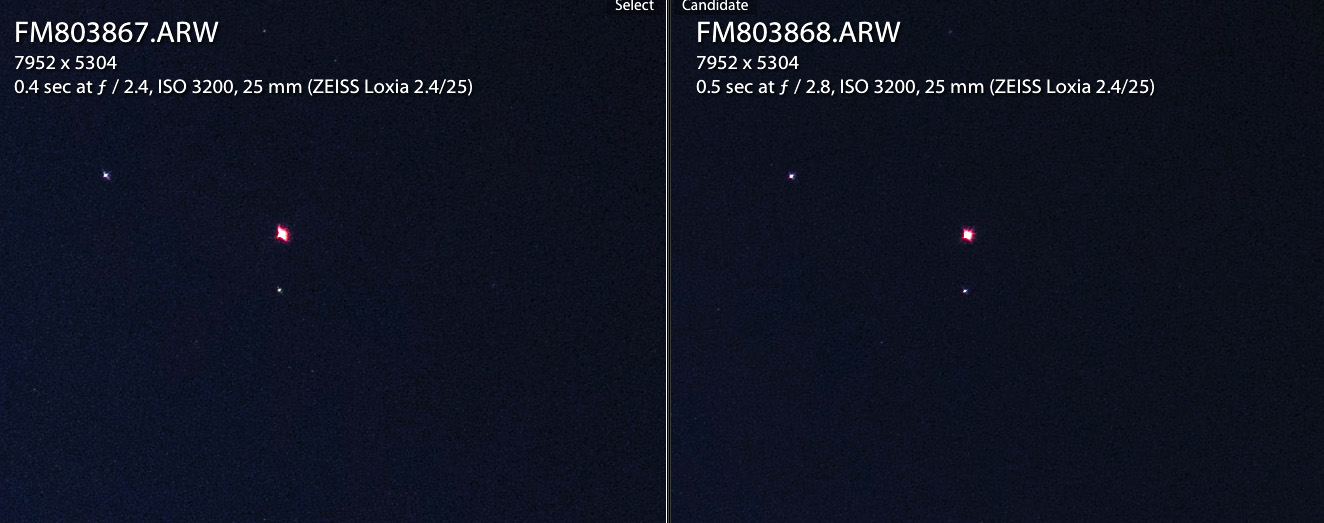
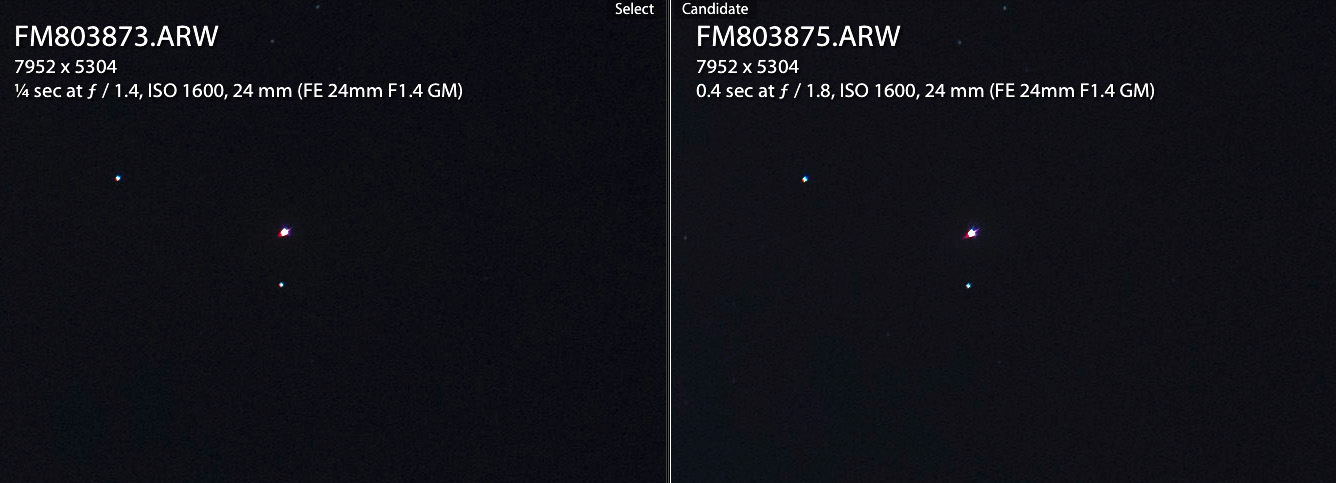
A high IQ fast wide can be used for many applications but nightscapes is at the top of the list. Think Aurora and Milky Away imagery.
I've tried wide angle lenses with satisfactory coma performance but they usually need a stop down for superb performance.
That's not the case with the FE 24/1.4 GM. It has the best coma performance I've seen in a 24mm f/1.4 lens. It's perfect from wide open (f/1.4). In fact it's better than another great nighscapes lens, the Loxia 25/2.4 @f/2.4!