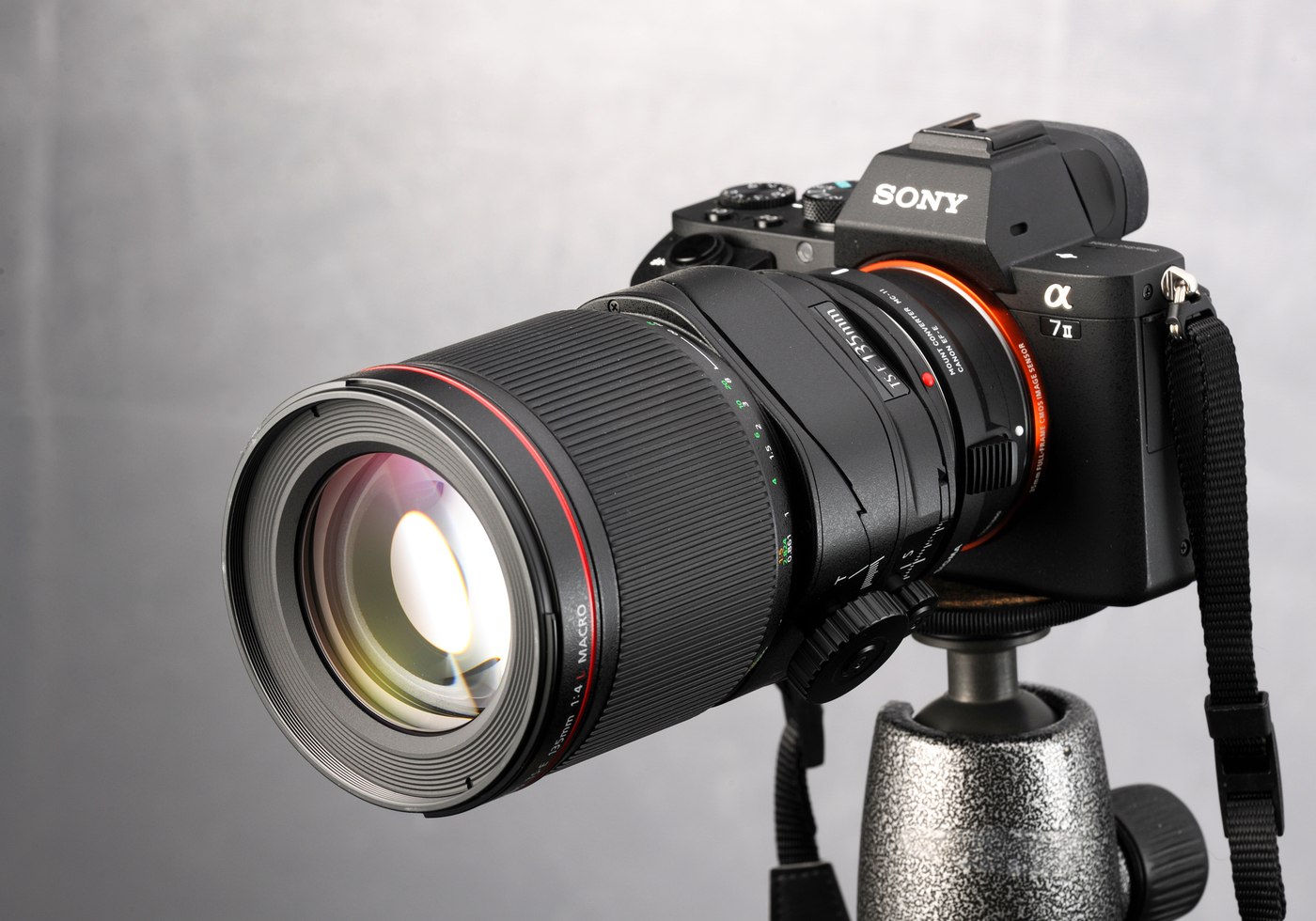
This is a rolling review of the newly released Canon 135/4L TS-E. Since it's currently mounted to my Sony A7ii, I consider it an alt lens so am posting in FM Alt. Makes further sense because it's manual focus, and is not classified by Canon as an EF lens.
Build is all metal including the entire barrel, filter ring, and dials. Focus is internal and the greased helical moves smoothly without backlash or play. As introduced by Canikon in their 24mm and wider tilt/shift lenses, the TS-E 135 has independent tilt and shift movements thanks to a rotation feature.
The diaphragm is electronic so the cheap, dumb adapters are out. I selected the Sigma MC-11 for its build quality and flocked interior: by their nature, tilt/shift lenses generate a lot of stray light.
Optical performance is top grade. Brief summary: the lens is flawless! Note that all my testing so far has been at 1-4m distances, not at 1:2 macro or infinity. Vignetting is absent wide open until extreme movements are dialed in. With maximum tilt and shifting the "wrong direction", the short edge will be shaded, while the long edge will be cut off. Suppression of stray light is effective, and making my Rokinon 135/2 redundant in the studio. There is no TCA over most of the image circle (and we're talking a big circle). There is no LCA. Sharpness is spectacular, with graceful softening off-axis wide open. Minimum aperture is f/45, and I see no debilitating softness at f/32. Aperture is circular at all settings. For those that like T/S panoramas, the long-edge shift results are excellent. I detect no linear distortion. Bokeh is smooth fore and aft, no onion rings, moderate cat eyes, clean defocus chromatics (perhaps the best ever). No field curvature detected.
A7ii IBIS is effective at 1/15sec, although the rig is heavy enough to affect handheld stability. Focus assist (shimmer) is especially valuable for quickly setting movements to a first approximation. I find further refinement with magnified view is desirable but, then, a tripod and more time is required. Electronic first curtain is really important if you are using slow shutter speeds because the front-heavy load is not super stable. I'm looking for a tripod support ring to fit the MC-11 (a certain Novoflex model might work).
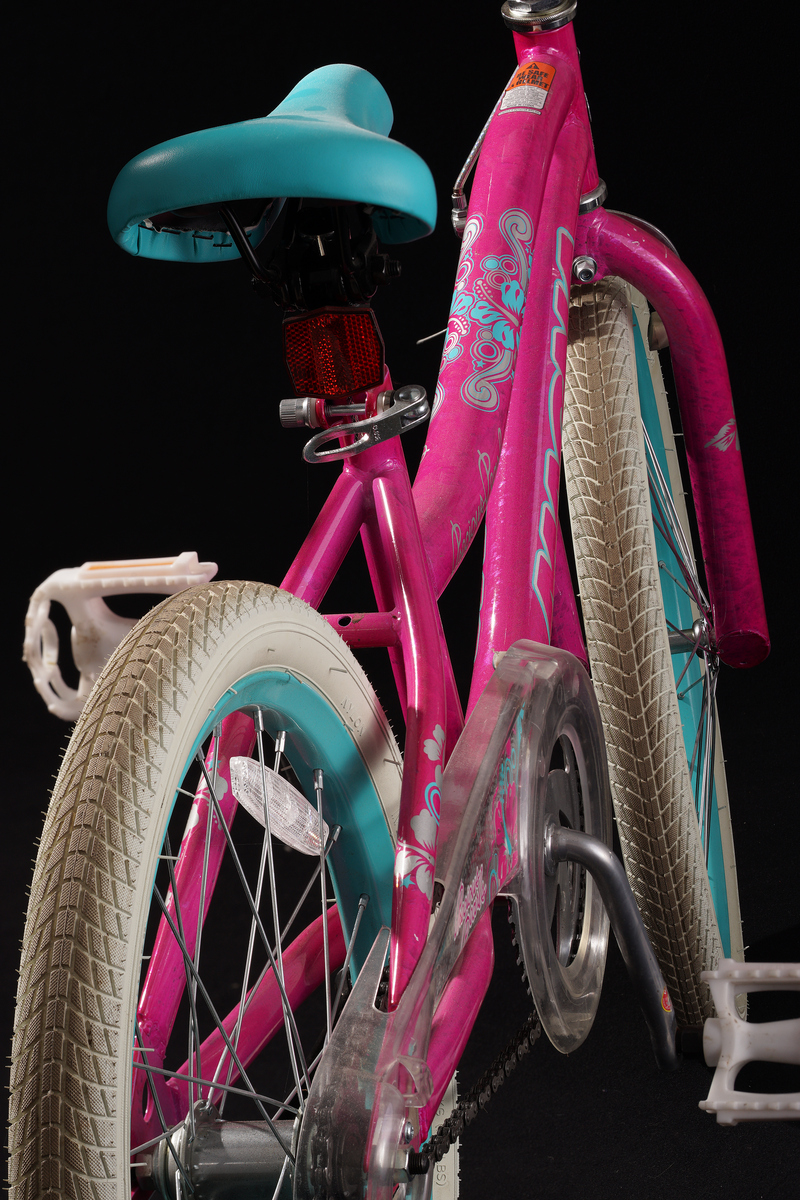
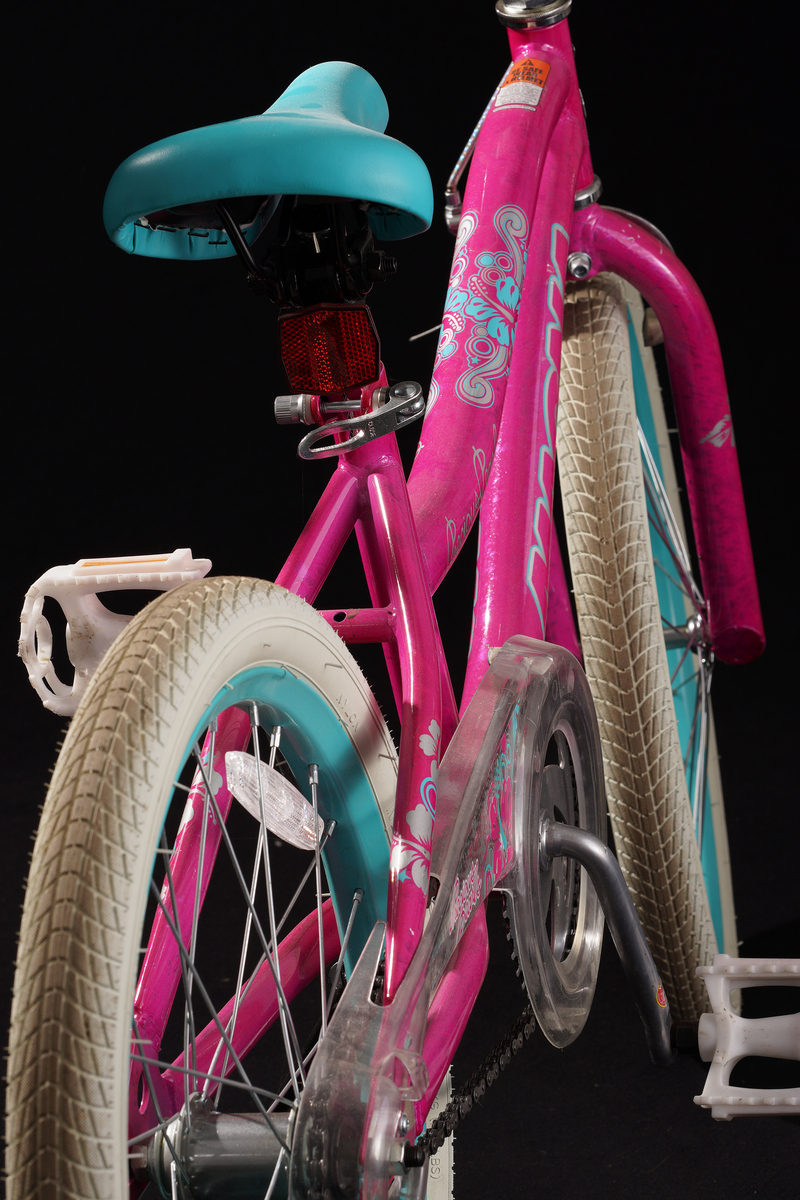
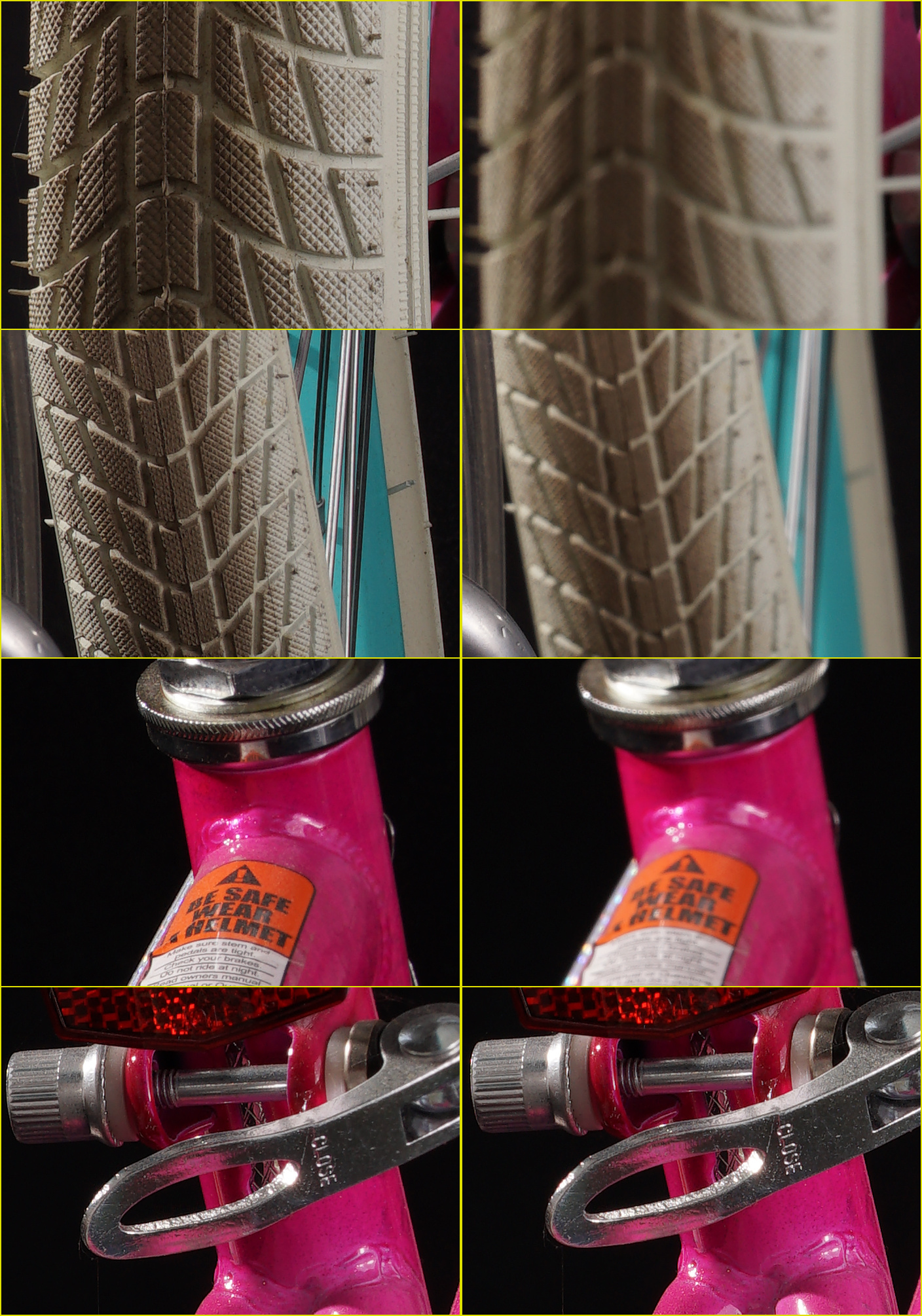
Test images of child's bike are SOOC JPEG with strobe lighting at f/16, The full images are uncropped and have been resized and lightly sharpened to web standard. The crops are not sharpened!
1st pic shows full tilt, no shift, and 20° rotation:
2nd pic shows no tilt, and slight shift to restore framing:
1x-scale crops:
Any softness is caused by DOF only, the lens isn't breaking a sweat for sharpness. Speculars are color perfect whether focussed or defocussed.
Here is Part 2 of my TS-E 135mm review, real-world image making:
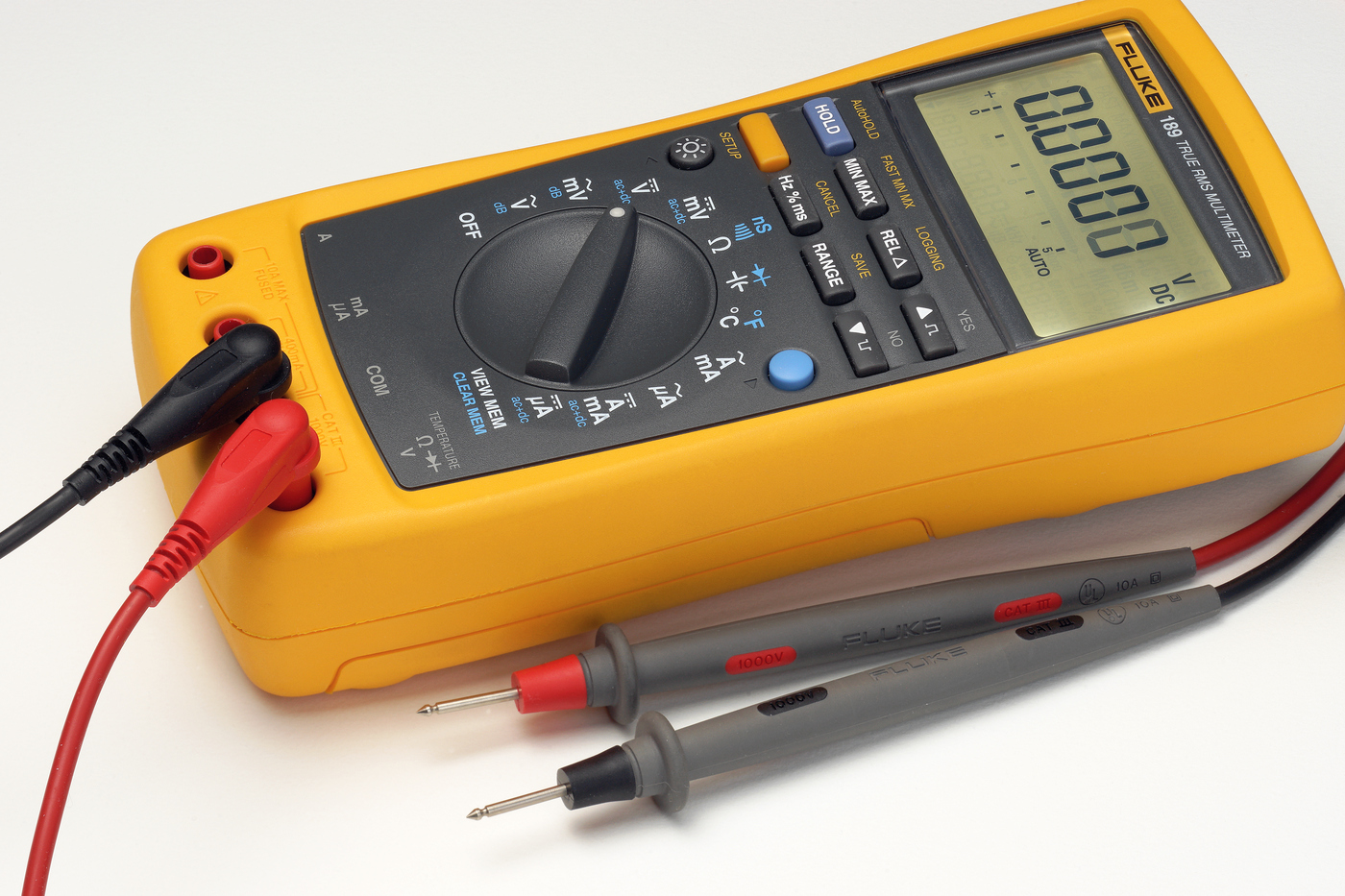
Shot with studio gear and oriented to top quality output, including critical color rendition and sharpness throughout the frame. Exposure was 8sec to capture LCD illumination. Aperture was f/22 to eliminate color moire, not for the DOF! The closeup ratio of 1:6 is common for me, especially with jewelry. Tilt, shift and rotation were dialed in. The greater working distance has less to do with creatures lunging at me, and more to do with reducing perspective distortion. The Fluke has organic lines and is larger at the top—characteristics hard to discern with a shorter FL.
Sony A7ii tripod socket and lens mount is now relieved from the stress of supporting the lens because I attached a Novoflex ASTAT-NEX tripod ring to the MC-11. The ring is also compatible with standard-sized Sony FE lenses, although I haven't checked yet.
Review continues with Part 3, an advanced tabletop example:
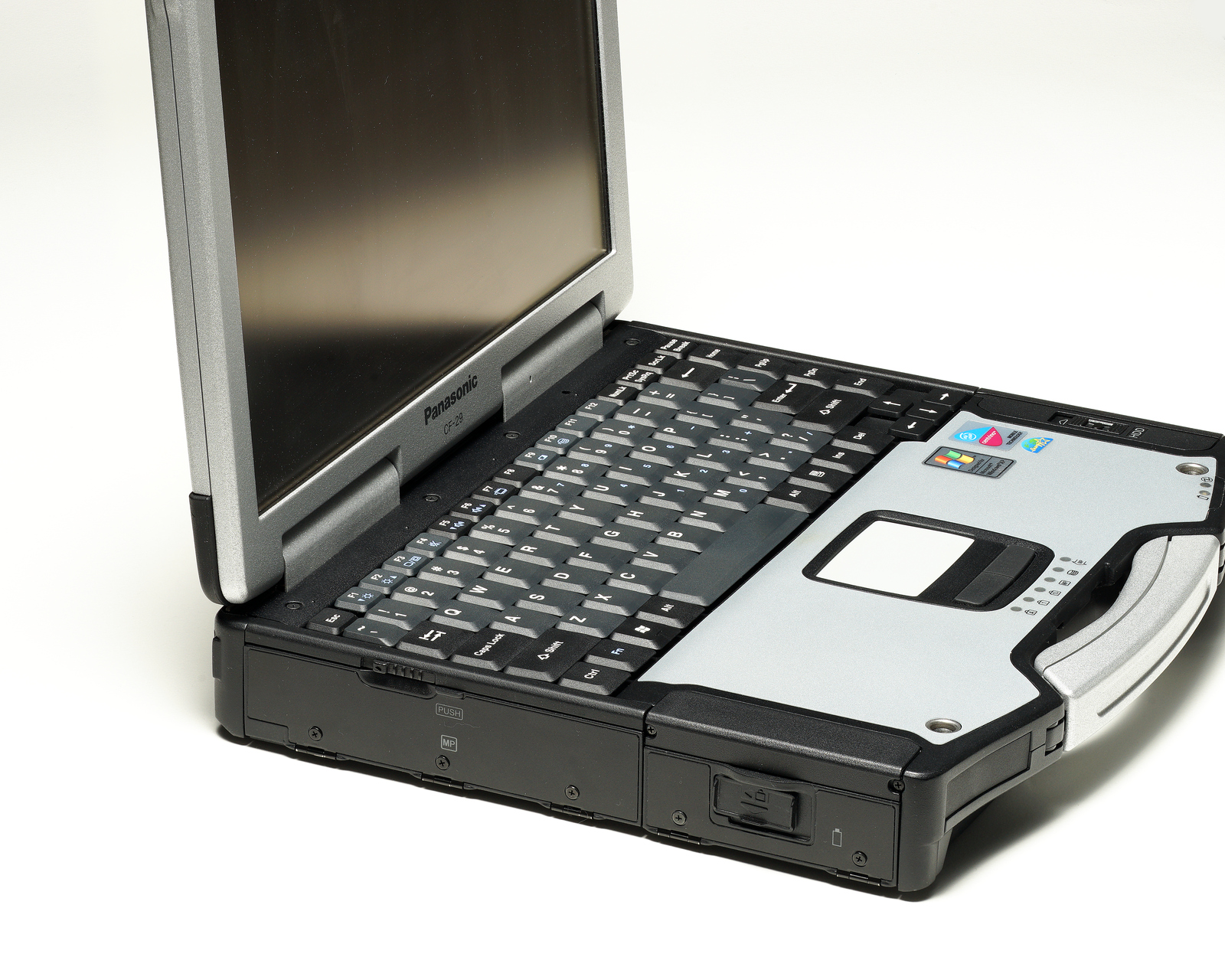
Sony A7ii, Canon TS-E 135/4L @ f/16, Sigma MC-11, Novoflex tripod ring, strobe @ 300J, diffuser panel. Tilt isn't supposed to handle this case, but I did it anyway. The trick (with considerable effort) was shooting two frames with an intervening rotation of 110°. Parallax was minimal especially with laptop hinge centered on the optical axis. The hinge is located on the focal plane of both frames, so I merged along that line. To make my task a little easier, the subject was positioned so the required degree of tilt is equal for the keyboard plane and the screen. Too late I noticed the subject was drifting out of the frame, but I wasn't about to start again!
A larger image (3.6MB) can be found here: <<clicky>>. Lightly sharpened, you can see dust particles quite clearly.
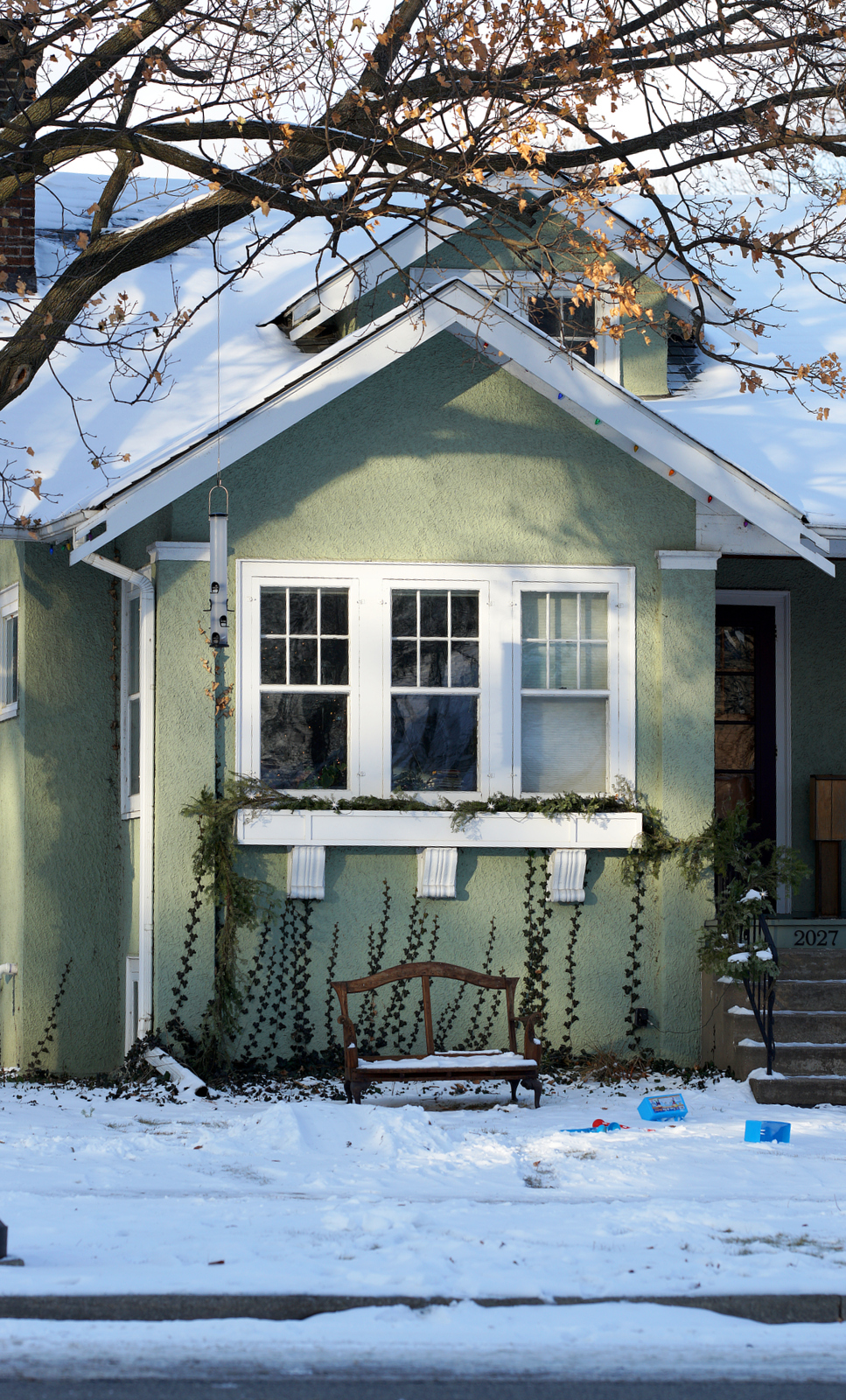
Mid-distance shot @ f/5.6 with a slight crop, and no movements, shows general sharpness, excellent linearity, and chromatically clean edges against snow. Bare branches (focussed or defocussed) are free of any fringing. Being mounted on the A7ii, there are no in-camera corrections and I applied none in post.
Temps were in the teens and dropping, so I couldn't apply any movements due to frostbite setting in. Damn those all-metal lenses.
wayne seltzer wrote:
Couldn't you get a similar macro shot of the multimeter with your your S100 planar with bellows but with zeiss colors and microcontrast? 😁
Oh, sure, the CZ SP100 with bellows has all the movements, and was my #1 for the last ten years. It does have numerous disadvantages: bellows are a pain to use, optical performance suffers outside the 1:4 design distance, no movements at infinity due to bellows mechanics, no auto-aperture. Being a 2017 formula, the Canon has unmatched features: performance at any distance with FLE, all movements all the time, huge and usable image circle, apo correction, great bokeh. Both are expensive, but the TS-E is better value.
I wonder if a Mirex tilt/shift adapter and a 120mm Mamiya (I already have, and it's sharp, APO, and cheap) or Zeiss medium format lens give me similar results.
One big problem with Mirex is that it seems a little difficult to order, but would be quite flexible since I can get more MF lens at a relatively low price.
Snopchenko wrote:
I have no idea about the TS lenses, nor any interest in them, but by God does it look sexy. (like most of the recent EF lenses, actually)
Ilya, time to return to the Black Sea for a little R&R.
ytwong wrote:
I wonder if a Mirex tilt/shift adapter and a 120mm Mamiya (I already have, and it's sharp, APO, and cheap) or Zeiss medium format lens give me similar results.
I use the Mirex with C 55/2.8N, C 80/2.8 N, and A 150/2.8. I also own the A 120/4 Macro, but I don't often use it on the Mirex, because (i) it gets very long as you get to higher magnifications ('long-lens support' can be helpful), and (ii) I use a M645 Auto Bellows N with macro/enlarger/MF/LF lenses for movements at high magnifications.
One disadvantage with the Mirex is that you can't independently change the tilt and shift axes; the Mirex is fixed, with both movements about the same axis (for tilt nose-down, it shifts left/right). I prefer to use the Mirex on a tripod with a geared head, and so it's easy to recompose after changing tilt (which you can do with shift, if the axes can be separated).
In general, the M645 A lenses and a few of the 'regular' C lenses (55/2.8 N and 80/2.8 N, in particular) match Zeiss for resolution. The M645 N lenses have slightly lower contrast and colour saturation than Zeiss, which I prefer for some subjects, and which can be completely tailored in PP, if I want more Zeissness. The M645 C...N lenses have slightly higher contrast than the earlier C versions.
The M645 C 35/3.5 N is nice, but not as quite as sharp as the TS-E 24/3.5 L II + 1.4x III, and not nearly as sharp as the Contax PC-Distagon 35/2.8 (shift-only).
Dragonfire wrote:
Ilya, time to return to the Black Sea for a little R&R.
Nope, after that figure skating championship I'm kinda appalled of taking up a camera... for a while. Besides, the weather's likely no good in Sochi or Crimea now, although Sochi might be interesting to visit and see what they've done with the city.
One disadvantage with the Mirex is that you can't independently change the tilt and shift axes; the Mirex is fixed, with both movements about the same axis (for tilt nose-down, it shifts left/right).
I didn't know Mirex can't independently change til and shift axis... there ain't a lot of words about Mirex adapter (niche product I suppose) on the net so I appreciate that info. I have a similar TS mount but it use FF lens on APSC E mount. My 17 TSE is the only TS lens I have used so I was expecting every TS thing T and S can work independently. But I so far use shift (perspective correction and stitching) way more than tilt (but usage a WA TS is very different to a longish, macro TS lens) so I need to think about whether that limitation on axis movements is acceptable or not.
Another advantage of using MF lens is possibility to work with Fuji GFX, which .... maybe I'll get one some day... uhm... sounds like I'm digging a hole for myself.
One disadvantage with the Mirex is that you can't independently change the tilt and shift axes; the Mirex is fixed, with both movements about the same axis (for tilt nose-down, it shifts left/right).
ytwong wrote:
I didn't know Mirex can't independently change til and shift axis... there ain't a lot of words about Mirex adapter (niche product I suppose) on the net so I appreciate that info. I have a similar TS mount but it use FF lens on APSC E mount. My 17 TSE is the only TS lens I have used so I was expecting every TS thing T and S can work independently. But I so far use shift (perspective correction and stitching) way more than tilt (but usage a WA TS is very different to a longish, macro TS lens) so I need to think about whether that limitation on axis movements is acceptable or not.
Another advantage of using MF lens is possibility to work with Fuji GFX, which .... maybe I'll get one some day... uhm... sounds like I'm digging a hole for myself. ...Show more →
Yeah, you're getting pretty deep.
The TS-E 17/4L and 24/3.5L II are the first Canon TS lenses to have user-control over independent tilt and shift axes. Earlier versions could be adjusted to change from the same axis to orthoginal axes, but that was usually a job for Canon service to perform, and was not easily user-controllable.
I use mostly shift on very-wide and wider lenses, and mostly tilt on telephoto lenses. In between, it's pretty much a free for all.
jcolwell wrote:
The TS-E 17/4L and 24/3.5L II are the first Canon TS lenses to have user-control over independent tilt and shift axes. Earlier versions could be adjusted to change from the same axis to orthoginal axes, but that was usually a job for Canon service to perform, and was not easily user-controllable.
It was extremely simple to do this on the old TSE versions! There are many tutorials online how to do it, but it is nearly self-explanatory. I changed the axis on my 90/2.8 TSE - releasing the 4 screws and rotating one part against the other 90 degrees, making sure that the connection band inside is not squeezed when reattaching the parts and then tightening the 4 screws again - done. No Canon service is needed here. The newer lenses can rotate freely - but most of the time a certain position is preferred by the user most of the time. I have used the free rotation option on my 24 TSE II only a few times in many years.
We all have different requirements. I work at a longer FL, always with tilt, and rarely at an orthogonal angle. Angle is dialed in to follow the subject's main contour. I mainly use shift to recenter the optical axis after tilting, but more stitching options are nice. Having two independent rotation points allow me to easily frame the tableau. With the Contax bellows, I have to tilt the entire rig to frame—a total pain. LF users are yawning, but the new TS-E lineup is what miniature format has needed for the last 100 years!


 Speculars are color perfect whether focussed or defocussed.
 (like most of the recent EF lenses, actually)