p.24 #2 · Official: Hasselblad X1D-50c Medium Format Mirrorless
Lee Saxon wrote:
That can be an idiomatic way of asking if I think there's reason to be optimistic, so I'm not sure if you're asking me that or if I'm literally seeing optimism here on the forum?
Either way, my answer is "sure, but my point is that Ming Thein is usually much more restrained than us."
Although I just re-read his post on the X1D-50c to second-guess myself and it's not as unrestrained as I thought the first time through. I think the bad taste in my mouth comes from his referring to the lenses - which have a lot of vignetting and distortion for their small max apertures - as "no compromise."
I've never been a fan of Ming's review process. I don't know him personally, so I cannot comment on his optimism. I think his quote "at least twice as interesting as they promise" is a bit optimistic. Unless he was thinking they just rebadged an A7 (something I joked about, but wouldn't put it past them). That and I like fast glass, so I couldn't be optimistic about the lens lineup. And I think the small max aperture is a compromise within itself. So until I see a lot of photos from people who shoot similar images to the way I shoot (or the way I strive to shoot), I'm going to hold off on purchasing it.
Again, I have no interest in the way Ming shoots/reviews to really use his site as a benchmark for my opinions about the camera. So I'm hoping a few people on here, who's opinions I trust get the camera quickly
p.24 #4 · Official: Hasselblad X1D-50c Medium Format Mirrorless
Fred Miranda wrote:
IMO, discussion has been well balanced here with fair criticism and praise. So far, we can only discuss technical aspects of the X1D system but whenever RAW samples emerge, we will be able to scrutinize IQ.
There is curiosity of how much better tonality and dynamic range the slightly bigger MF sensor provides when compared to the A7RII in the real world.
To me, the biggest difference won't be in resolution or overall dynamic range but color accuracy and tonal gradation especially towards the highlights.
For those curious how the number compare, DXO tested both sensors and here are the results:
It's weird that you say this.. But I asked my wife (who fancies herself a lay person when it comes to photography [although I don't agree with her assessment of herself]) and she said that she feels the S-006 is better then other cameras I have owned because of the way it transitions from light to blown out in the highlights. And because of the way she can get the colors to look like how she feels they should be (I take photos of her, and she edits them herself).
It didn't really strike me till she said that (the highlights part), but I feel that's what makes the S-006 special in general. How it handles transition to highlights. I wouldn't say it's film like, but I would say that thats also another reason why I like the way some of my film images look. Because of how film handles the highlights.
Oddly enough, that was one of the main reasons why I hated my A7 camera when it first came out (highlights looked awful to me).
Glad to hear the 50c sensor handles highlights well.
p.24 #5 · Official: Hasselblad X1D-50c Medium Format Mirrorless
MF is really about smoother color and tones in the transitions areas. If you had to pinpoint a area this would be it. Tend to think of it as a huge color gamut spread over the whole sensor just more data to fill the spaces between pixels. Another analogy a srgb monitor compared to a wide gamut as a wide gamut as shadow and higlight detail that gets blocked up in a srgb monitor for instance. I have a wide gamut monitor and you can visually see more shadow and highlight detail just comparing monitors. This is what MF is kind of about. The old adage of bigger is better kinds really holds true. Remember the film days between 35 and MF the bloody wars over it. Not much has changed but 35 aka our 42mpx has gotten very close today. Seriously don't buy a MF unless you mean it. Really have to have a serious desire to buy a 5 to 10 percent increase in image quality for a serious jump in price.
Good article which echoes some of what we have said in this thread. I'm a little more optimistic that Hasselblad may have a chance for a comeback - and a niche success with this camera.
We can all wish for a square sensor all day long but until/ unless Sony or another sensor manufacturer offers one, it's just not going to happen (and, at this point, I don't think it will).
p.24 #7 · Official: Hasselblad X1D-50c Medium Format Mirrorless
Tariq Gibran wrote:
Rich, by the numbers the resolution increase from our 36MP A7r is 19%.
From the 42MP A7rII, it would by 10%.
You gain a little in DR , around 1/2 stop compared to the A7r and about 3/4 stop compared to A7rII. Maybe 1/3 to 1/2 stop in noise performance. All going by the DxO posted numbers for Pentax 645z, A7r and A7rII.
None of these differences are dramatic in and of itself imo.
Tariq, I can state very confidently that the difference between the A7R2 and 645Z is obvious and noticeable, as I have both.
There's not that much difference in resolution at all. Because of the different ratios there's only 300 more pixels horizontally in the 645Z sensor. The resolution gain is all vertical so it doesn't *feel* like a lot more.
The 645Z files are staggering. They make the A7R2 files look flimsy. You can't overexpose the 645Z as it has a steep highlight shoulder but you can brutalise the file with little regard. It's actually difficult to introduce artefacts and noise. The files need no additional sharpening. You can push a few stops into the shadows at will It's simply ludicrous what you can do to them and still get something that prints well.
Personally I don't see me carrying my A7R2 again if it's possible to get the 645Z to the same location. my A7R2 has been relegated to a digital back for my TS lenses and most of my Sony lenses have been put up for sale.
This is a single exposure from the 645Z. 15-20 mins after sunset.
p.24 #8 · Official: Hasselblad X1D-50c Medium Format Mirrorless
People need to have a dmf and 35mm system even if the crop mf sensor isn't that much bigger there's still a noticeable difference. I don't shoot landscapes, but I can tell when shooting portraiture. Has its advantages the cost is arguable though.
p.24 #9 · Official: Hasselblad X1D-50c Medium Format Mirrorless
GMPhotography wrote:
MF is really about smoother color and tones in the transitions areas. If you had to pinpoint a area this would be it. Tend to think of it as a huge color gamut spread over the whole sensor just more data to fill the spaces between pixels. Another analogy a srgb monitor compared to a wide gamut as a wide gamut as shadow and higlight detail that gets blocked up in a srgb monitor for instance. I have a wide gamut monitor and you can visually see more shadow and highlight detail just comparing monitors. This is what MF is kind of about. The old adage of bigger is better kinds really holds true. Remember the film days between 35 and MF the bloody wars over it. Not much has changed but 35 aka our 42mpx has gotten very close today. Seriously don't buy a MF unless you mean it. Really have to have a serious desire to buy a 5 to 10 percent increase in image quality for a serious jump in price....Show more →
I guess the question is - is this "baby", smaller than any standard medium film format, sensor going to really give us that benefit. Close to FF 645 with a lowish MP sensor (as we had a few years back and which gave us noticeably larger pixel sizes vs FF 35), I have no doubt but I'm not sure about this size. I still think the real benefit of this particular sensor size is really all about preferred aspect ratio when compared to FF 35.
To further put this in perspective, keep in mind, the pixel size of this sensor is still just 5.3 microns so it's not like the pixels are that big. FF 35 at around 24MP's gives 5.96 microns, at 36MP's it's 4.87. There's really not much difference in pixel size and pixel size probably has a greater influence on the aspects I think you are touching on in the digital era. Beyond camera profiles and processing/software (and, traditionally, MF makers are very good with these which may be what really sets them apart), it will be interesting to see if there really is a demonstrable difference.
p.24 #10 · Official: Hasselblad X1D-50c Medium Format Mirrorless
flash wrote:
Tariq, I can state very confidently that the difference between the A7R2 and 645Z is obvious and noticeable, as I have both.
Gordon
I don't doubt that Gordon but I do wonder how much difference you might see comparing say the Pentax K-1 and the 645Z. My experience has been that Ricoh/ Pentax tend to really get the most out of a Sony sensor so I wonder how much of what you are seeing is down to this vs the actual sensor size. Perhaps this detail will not matter in the end as long as someone gets the result they desire.
p.24 #11 · Official: Hasselblad X1D-50c Medium Format Mirrorless
Tariq Gibran wrote:
I don't doubt that Gordon but I do wonder how much difference you might see comparing say the Pentax K-1 and the 645Z. My experience has been that Ricoh/ Pentax tend to really get the most out of a Sony sensor so I wonder how much of what you are seeing is down to this vs the actual sensor size. Perhaps this detail will not matter in the end as long as someone gets the result they desire.
Yes, especially with long exposures like the image he posted. The A7RII would not perform well in comparison.
Is there any side-by-side test between the A7RII vs 645Z comparing highlight transitions, shadow recovery and overall resolution? It would be great if someone has a Pentax 645 to E-mount adapter and even use the same lens for the comparison. That would gives us a baseline, extrapolating how the X1D compares since it uses the same 33x44 sensor. I may rent a 645Z and do the tests myself.
p.24 #12 · Official: Hasselblad X1D-50c Medium Format Mirrorless
Fred Miranda wrote:
Yes, especially with long exposures like the image he posted. The A7RII would not perform well in comparison.
Is there any side-by-side test between the A7RII vs 645Z comparing highlight transitions, shadow recovery and overall resolution? It would be great if someone has a Pentax 645 to E-mount adapter and even use the same lens for the comparison. That would gives us a baseline, extrapolating how the X1D compares since it uses the same 33x44 sensor. I may rent a 645Z and do the tests myself.
Hi Fred,
I will let Gordon clarify this, but if I am understanding what he posted, the image was taken 15 to 20 minutes after sunset and not the exposure time of 15-20 minutes.
p.24 #13 · Official: Hasselblad X1D-50c Medium Format Mirrorless
That shot is 30 seconds, f7.1, ISO 1600. No long exposure noise reduction. Single frame and processed only in Lightroom.
I have direct comparisons for lens tests and resolution. Not really any good as a DR test though. I have a big week ahead but if I get a chance I'll see if I can do a comparison shot. I don't have a K to E adaptor. But the FA75mm and FE55mm both at f8 would be enough.
p.24 #14 · Official: Hasselblad X1D-50c Medium Format Mirrorless
Fred Miranda wrote:
Yes, especially with very long exposures like the image he posted (15-20min). The A7RII would perform very poorly here.
Is there any side-by-side test between the A7RII vs 645Z comparing highlight transitions, shadow recovery and overall resolution? It would be great if someone has a Pentax 645 to E-mount adapter and even use the same lens for the comparison. That would gives us a baseline, extrapolating how the X1D compares since it uses the same 33x44 sensor. I may rent a 645Z and do the tests myself.
I also need to rent a 645Z myself to see how good this sensor is in the real world. I have some nice Pentax 67 lenses that I'm very curious to shoot on this body. Pre-645Z, I did rent the 645D and was not impressed with it's lack of DR compared to my A7r but have no doubt this sensor is certainly better than either the sensor in the A7r or A7rII...I just wonder by how much.
p.24 #15 · Official: Hasselblad X1D-50c Medium Format Mirrorless
Tariq Gibran wrote:
I don't doubt that Gordon but I do wonder how much difference you might see comparing say the Pentax K-1 and the 645Z. My experience has been that Ricoh/ Pentax tend to really get the most out of a Sony sensor so I wonder how much of what you are seeing is down to this vs the actual sensor size. Perhaps this detail will not matter in the end as long as someone gets the result they desire.
This is true. Everything I've seen from the K1 (I don't have one) seems to indicate that the K1 is better than the A7R2. I can only state what I see between the cameras i own. It also remains to be seen if Hasselblad can get the same performance Pentax do from this sensor.
I think it's fair to say that mostly I can't see the difference between APSC (XPro2) and 35mm. But sometimes I can. Mostly there's little difference between 35mm and mini MF. But sometimes there is. Sometimes you can blend exposures or use the Sony apps or Pentax sensor movements to build better files. Sometimes you can't. If *sometimes* matters then you'll go that way. If not then you won't. For me it was worth the hassle of packing, transporting and carrying the 645Z on my recent landscape trip. It sure would have been easier than stuffing lenses in my jacket pocket to get my gear on the plane.
All I can say is that, of the many cameras i own, this sensor in this body delivers the best files I have ever had. And the more I use it the more I like it. I'm certainly not trying to tell anyone else what is best for them.
p.24 #16 · Official: Hasselblad X1D-50c Medium Format Mirrorless
flash wrote:
This is true. Everything I've seen from the K1 (I don't have one) seems to indicate that the K1 is better than the A7R2. I can only state what I see between the cameras i own. It also remains to be seen if Hasselblad can get the same performance Pentax do from this sensor.
I think it's fair to say that mostly I can't see the difference between APSC (XPro2) and 35mm. But sometimes I can. Mostly there's little difference between 35mm and mini MF. But sometimes there is. Sometimes you can blend exposures or use the Sony apps or Pentax sensor movements to build better files. Sometimes you can't. If *sometimes* matters then you'll go that way. If not then you won't. For me it was worth the hassle of packing, transporting and carrying the 645Z on my recent landscape trip. It sure would have been easier than stuffing lenses in my jacket pocket to get my gear on the plane.
All I can say is that, of the many cameras i own, this sensor in this body delivers the best files I have ever had. And the more I use it the more I like it. I'm certainly not trying to tell anyone else what is best for them.
Great points...and I would love to see a match up between the Pentax 645z vs Hassy X1D. I believe it was Michael Reichmann who, after shooting the other MF options that use this same mini MF Sony sensor and testing the Pentax 645Z, stated that Ricoh/Pentax seemed to get the most out of it.
p.24 #17 · Official: Hasselblad X1D-50c Medium Format Mirrorless
Fred Miranda wrote:
Yes, especially with long exposures like the image he posted. The A7RII would perform very poorly here.
I think this is exactly the difference between 35mm and mini MF. When the smaller sensor gets pushed past it's envelope the larger sensor keeps going for a bit longer. Even a phone camera looks pretty good in ideal conditions. 90% of the time 35mm is more than enough. It's if you get into the other 10% that miniMF can be an advantage.
645Z. 8 minute exposure. ISO 100. No long exposure noise reduction. Pushed nearly two stops in post. Not entirely happy with the processing yet. But I'll get there because the file is so robust.
I'd like to see any 35mm sensor do this, this well.
p.24 #18 · Official: Hasselblad X1D-50c Medium Format Mirrorless
About the comparisons to full frame...
The larger sensor provides higher system resolution, which can affect things like corner resolution, etc. A lens with equal lp/mm performance will provide greater system resolution on the larger sensor system.
The Hasselblad system, as I understand it, produces 16-bit files. I don't know precisely how Hasselblad makes use of the additional bits, but they have the potential to allow greater dynamic range (perhaps possible with the larger photo sites, but probably not two bits worth) and/or a greater number of luminosity values. The latter can potentially provide smoother gradients and more color/tonal subtly, at least at the theoretical level.
Given the very high quality of current high MP full frame systems, while the improvements will be measurable, they will not be visible in any but some rather specialized situations, mostly about very large prints. (I sort of chuckle at the images of the 50MP mini MF system that try to make it look like a fine handheld camera. Well, yes, but you are going to be wasting the resolution potential.)
There are downsides. One particular issue relates to lenses, and to long lenses in particular. We hardly bat an eyelash at the idea of shooting at 400mm and above with full frame, and relatively inexpensive and high quality lenses are available to use for this purpose. That isn't going to be the case with any MF format, even the 33mmx 44mm mini MF system. The cameras a likely to be focal length limited, and lenses providing a given reach are likely to be huge and very expensive.
I'm personally very interested in the potentials of the mini MF systems for parts of my photography, but I think that the percentage of photographers who will benefit from such things is going to be quite small.
p.24 #19 · Official: Hasselblad X1D-50c Medium Format Mirrorless
flash wrote:
Tariq, I can state very confidently that the difference between the A7R2 and 645Z is obvious and noticeable, as I have both.
There's not that much difference in resolution at all. Because of the different ratios there's only 300 more pixels horizontally in the 645Z sensor. The resolution gain is all vertical so it doesn't *feel* like a lot more.
The 645Z files are staggering. They make the A7R2 files look flimsy. You can't overexpose the 645Z as it has a steep highlight shoulder but you can brutalise the file with little regard. It's actually difficult to introduce artefacts and noise. The files need no additional sharpening. You can push a few stops into the shadows at will It's simply ludicrous what you can do to them and still get something that prints well.
Personally I don't see me carrying my A7R2 again if it's possible to get the 645Z to the same location. my A7R2 has been relegated to a digital back for my TS lenses and most of my Sony lenses have been put up for sale.
This is a single exposure from the 645Z. 15-20 mins after sunset.
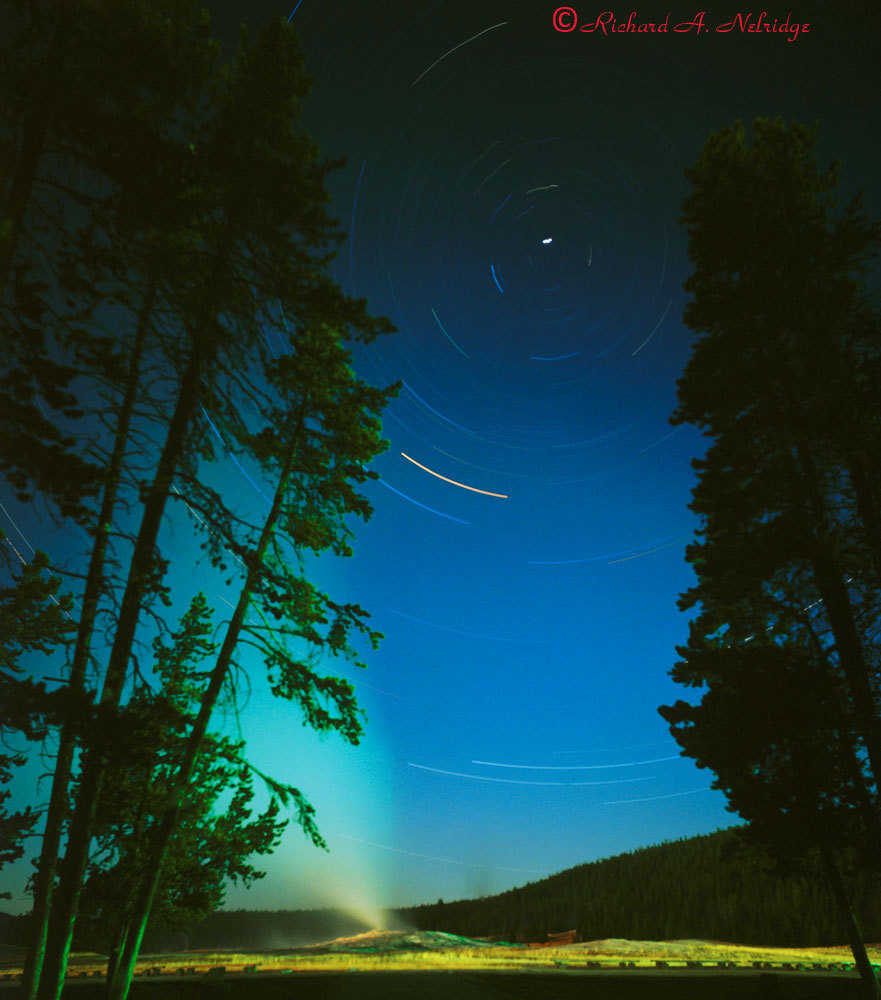
"Old Faithful and Star Trails" 2 hour exposure of Old Faithful Geyser and Star Trails. Taken Between 0100 and 0300. Old Faithful Geyser erupted 2 times. Film underexposed 2 stops. Push processed 1 stop. Image cropped slightly at the bottom to eliminate walkway lights and taken with my tripod mounted Linhof Super Technika IV 4" X 5" camera with my Rodenstock 90mm f6.8 Grandagon N MC lens on Kodak Ektachrome 100 Plus Professional film. Exposure: 2 Hours, f8.0; Photo taken September 29, 1993.
It will be interesting to see what all of the different digital sensors can do.
p.24 #20 · Official: Hasselblad X1D-50c Medium Format Mirrorless
so i have been using a Phase One P45+ on an Alpa 12 TC for a few months now and can say that resolution is not the be all end all of image sensors. The true 16bit workflow and color response is very noticeable even when comparing to a Modern DSLR like a 5dsr. the amount of tweaking you have to do before you even start to notice banding or artifacts is quite astounding. the P45+ has a bit of a bigger sensor than this blad, not full 645 but i think like a 1.1x crop factor from full 645. so its darn near full frame. if you are patient and methodical Medium Format can be very rewarding and produce stunning files. im sure this blad will be a very popular camera.
one question though....
why is 16bit Analog to Digital conversion limited to Medium Format? why has this not come to the 35mm world? is there something i am missing?