This topic is in the 2015 archive. You can read it and like its posts here. It is read only.
Archive 2015Canon 5Ds vs. Sony A7rII
p.59 #1Canon 5Ds vs. Sony A7rII
justruss wrote:
False. There are huge disadvantages to IBIS: you can't have a decent sized heat sink connected to the sensor. There are plenty of problems with the sensor heating up in long exposures and video use with the A7R2.I won't argue that there are potential disadvantages of that sort-- I was thinking in terms of stabilization and weight. So yes, I agree to an extent. And I'm very stills-centric, so I wasn't thinking about video. Your point carries water.
Huge disadvantages though? Not sure I'd characterize it that way, but then the magnitude of that disadvantage is a subjective thing. IBIS presents design challenges, certainly, but challenges (like the heat sink) that can be surmounted by other design choices. Just because it wasn't executed perfectly on the A7rII doesn't mean another camera won't get it more right.
I haven't...Show more →
You are not considering all the facts. Even if you don't use video actively, on the Sony camera there is no viewfinder image without video. And there is a marked increase in sensor temperature on long exposures....
charlyw wrote
justruss wrote
The short version is: There's virtually no disadvantage to offering IBIS beyond a slight weight penalty. There are lots of advantages.Huge disadvantages though? Not sure I'd characterize it that way, but then the magnitude of that disadvantage is a subjective thing. IBIS presents design challenges, certainly, but challenges (like the heat sink) that can be surmounted by other design choices. Just because it wasn't executed perfectly on the A7rII doesn't mean another camera won't get it more right.
I haven't...Show more →
You are not considering all the facts. Even if you don't use video actively, on the Sony camera there is no viewfinder image without video. And there is a marked increase in sensor temperature on long exposures....
Oct 10, 2015 at 01:50 PM
p.59 #2Canon 5Ds vs. Sony A7rII
charlyw wrote:
False. There are huge disadvantages to IBIS: you can't have a decent sized heat sink connected to the sensor. There are plenty of problems with the sensor heating up in long exposures and video use with the A7R2.I won't argue that there are potential disadvantages of that sort-- I was thinking in terms of stabilization and weight. So yes, I agree to an extent. And I'm very stills-centric, so I wasn't thinking about video. Your point carries water.
Huge disadvantages though? Not sure I'd characterize it that way, but then the magnitude of that disadvantage is a subjective thing. IBIS presents design challenges, certainly, but challenges (like the heat sink) that can be surmounted by other design choices. Just because it wasn't executed perfectly on the A7rII doesn't mean another camera won't get it more right.
I haven't shot a lot of 4K 100 mbps video (which is where I've heard about overheating... in direct sun, in hot temperatures, with the LCD closed, when shooting clips upwards 15+ minutes), but I haven't had any overheating issues myself yet.
Of course, back down on the ground (away from pure hypotheticals about design choices and implementations), bringing up video overheating, given current options, doesn't score many points for the non-IBIS systems we're discussing-- since I don't think the 5Ds can shoot 4K at all. I definitely don't have enough data points to say that IBIS presents a "huge" disadvantage when it comes to cooling as opposed to adds a challenge to designing a system that stays cool; I've definitely read about systems like the 1DC and RED overheating too in hot conditions when shooting 4K as well. Let's see how the A7sII does.You are not considering all the facts. Even if you don't use video actively, on the Sony camera there is no viewfinder image without video. And there is a marked increase in sensor temperature on long exposures....
Not considering all the facts? How do you know that?
In any case, if someone wants to primarily do long exposure night shots (over 30 seconds), or make such shots a significant part of their photography work (or video, as already mentioned), particularly in hot climates-- I would not recommend an A7rII as the best option. But my lack of recommending this particular camera on this front wouldn't necessarily apply to all cameras that have IBIS. That would be ridiculous.
If we're talking about video, I also wouldn't recommend a 5Ds, A7r, or 5D2 (which I also own).
On the A7rII I haven't seen any indication from anyone (nor in my own experience-- do you have any personal experience with the A7rII that says otherwise, I'd honestly be interested in hearing it?) that using the EVF or LCD is an issue when shooting stills besides this niche case of >30s night time exposures (which I already would suggest is not the A7rII's strength or a good primary purpose for buying this camera)... but I wouldn't preclude all current and future cameras with IBIS from being stellar at such types of work. Just that the A7rII isn't great at that.
It sound to me you're somehow stuck on the A7rII in an odd way: All features it has must be huge disadvantages when applied to all other cameras.
If it makes you feel better, I'll concede that there are challenges to having IBIS. I'll even call it a disadvantage (but I will not personally-- subjectivity alert-- agree it's a "huge advantage"), for your benefit.
But please, go back to my original post about IBIS: a personal experience using IBIS, and the impact it has on my shooting, compared to shooting the same or similar lenses on my 5D2 and X-E1. It's just a datapoint coming from a non-scientific, personal experience... which you're more than welcome to entirely discount since we disagree on the semantics (we agree on the use cases where the A7rII itself isn't the best tool!) surrounding the terror that is IBIS.
justruss wrote
charlyw wrote
justruss wrote
The short version is: There's virtually no disadvantage to offering IBIS beyond a slight weight penalty. There are lots of advantages.Huge disadvantages though? Not sure I'd characterize it that way, but then the magnitude of that disadvantage is a subjective thing. IBIS presents design challenges, certainly, but challenges (like the heat sink) that can be surmounted by other design choices. Just because it wasn't executed perfectly on the A7rII doesn't mean another camera won't get it more right.
I haven't shot a lot of 4K 100 mbps video (which is where I've heard about overheating... in direct sun, in hot temperatures, with the LCD closed, when shooting clips upwards 15+ minutes), but I haven't had any overheating issues myself yet.
Of course, back down on the ground (away from pure hypotheticals about design choices and implementations), bringing up video overheating, given current options, doesn't score many points for the non-IBIS systems we're discussing-- since I don't think the 5Ds can shoot 4K at all. I definitely don't have enough data points to say that IBIS presents a "huge" disadvantage when it comes to cooling as opposed to adds a challenge to designing a system that stays cool; I've definitely read about systems like the 1DC and RED overheating too in hot conditions when shooting 4K as well. Let's see how the A7sII does.
Not considering all the facts? How do you know that?
In any case, if someone wants to primarily do long exposure night shots (over 30 seconds), or make such shots a significant part of their photography work (or video, as already mentioned), particularly in hot climates-- I would not recommend an A7rII as the best option. But my lack of recommending this particular camera on this front wouldn't necessarily apply to all cameras that have IBIS. That would be ridiculous.
If we're talking about video, I also wouldn't recommend a 5Ds, A7r, or 5D2 (which I also own).
On the A7rII I haven't seen any indication from anyone (nor in my own experience-- do you have any personal experience with the A7rII that says otherwise, I'd honestly be interested in hearing it?) that using the EVF or LCD is an issue when shooting stills besides this niche case of >30s night time exposures (which I already would suggest is not the A7rII's strength or a good primary purpose for buying this camera)... but I wouldn't preclude all current and future cameras with IBIS from being stellar at such types of work. Just that the A7rII isn't great at that.
It sound to me you're somehow stuck on the A7rII in an odd way: All features it has must be huge disadvantages when applied to all other cameras.
If it makes you feel better, I'll concede that there are challenges to having IBIS. I'll even call it a disadvantage (but I will not personally-- subjectivity alert-- agree it's a "huge advantage"), for your benefit.
But please, go back to my original post about IBIS: a personal experience using IBIS, and the impact it has on my shooting, compared to shooting the same or similar lenses on my 5D2 and X-E1. It's just a datapoint coming from a non-scientific, personal experience... which you're more than welcome to entirely discount since we disagree on the semantics (we agree on the use cases where the A7rII itself isn't the best tool!) surrounding the terror that is IBIS.
Oct 10, 2015 at 02:22 PM
p.59 #3Canon 5Ds vs. Sony A7rII
Monito wrote:
A good photographer, or at least a good observer, would have noticed that in the Sony shot "atmospherics" was not the problem because the sharpness varied all over the place from one side to the other of the crop.
Note also that the foreground trees are quite soft, so unless this was shot at a very large aperture, the image does seem to be somewhat soft, leaving the camera, the lens, or the photographer as the most likely sources of the softness.
mogul wrote
Looks like you got stable atmospherics compared to the other shot...a good photographer will take that into consideration. Do you do a lot of focus and recompose with your 6D?Note also that the foreground trees are quite soft, so unless this was shot at a very large aperture, the image does seem to be somewhat soft, leaving the camera, the lens, or the photographer as the most likely sources of the softness.
Oct 10, 2015 at 03:31 PM

p.59 #4Canon 5Ds vs. Sony A7rII
chez wrote:
Wouldn't all love to have IS with their 135L...guess what with the A7R2...you got it.
But, isn't the 135L a pre-06 lens ... which means AF is still degraded on Sony for that lens?
Wouldn't all love to have IS with their 135L...guess what with the A7R2...you got it.
But, isn't the 135L a pre-06 lens ... which means AF is still degraded on Sony for that lens?
Oct 10, 2015 at 09:28 PM
p.59 #5Canon 5Ds vs. Sony A7rII
mogul wrote:
Even with a clean sensor, I would be embarrassed if this is as good as Canon can do.
If anything ... I'd be embarrassed to conduct a lens comparison on a 36MP sensor without an AA filter vs. a 22MP sensor with an AA filter and expect anyone to consider it credible with any remote degree of objective assessment about the lenses. While some reverse math can be applied to the results based on the MP delta, the AA filter impact is a bit less precise adjustment factor without knowing its attributes.
Bad enough to conduct a comparison with one variable of > 1.5X MP ... but to have an additional second variable of AA filter vs. non-AA filter is pretty pathetic comparison to suggest anything at all about the lenses sharpness.
If you really want to show some degree of parity in testing on native mounts, the Sony lens could have been mounted to the A7 or A900 (24MP + AA filter) to compare with the 5D MK III (22MP + AA filter), but DXO never tested the lens on the A7 (nor cross-platform tests, i.e. both lenses on the A7R). After all, if the Canon had been mounted on the 5DsR ... well, Sony fans (or anyone who is a fan of objectivity) would have likewise called foul for the extra MP of 50 vs. 36 ... although 50MP with offset AA vs. 36MP without AA is closer than 36MP without AA vs. 22MP with AA.
36 / 22 = 1.63
AA = 1.3
1.63 * 1.3 = 2.12
Even @ 1.15 for the AA filter
1.63 * 1.15 = 1.88
No matter how you slice it, you're still talking about roughly +2X factor for resolution based on the sensor differential. If you take out the 2X factor, then the Sony lens could actually be slightly less than the Canon (DXO score algorithm unknown) on the simplistic 32 / 2 = 16, while the Canon is at 18.
That's not to suggest the Sony isn't a fine piece of glass, but ...
mogul wrote:
...a good photographer will take that into consideration
before claiming that Canon should be embarrassed.
Edited on Oct 11, 2015 at 02:00 PM · View previous versions
Oct 10, 2015 at 09:47 PM
p.59 #6Canon 5Ds vs. Sony A7rII
molson wrote:
Here's an example of a Sony FE 24-70mm f4 - a lens that DxO Mark scores higher than the vastly superior Canon equivalent - they must have used the Canon blur filter by mistake on this one...
This is the sharpest of three shots, all tripod-mounted and shot at f/11... I went out and bought a Canon EF 24mm f4L IS the next day.
http://slrgear.com/reviews/zproducts/sony24-70f4zfe/ff/tloader.htm
Oct 10, 2015 at 10:52 PM
p.59 #7Canon 5Ds vs. Sony A7rII
Agreed, without any normalization between the test systems, I don't see how we can draw great conclusions on any particular lens. I have not read deeply into DXO measurements-- because they're not overly important to me-- but if you have Lens A tested on 10mp and Lens B tested on 40mp, forgetting all the additional factors like AA, etc, and don't even attempt to apply an estimated normalization... what kind of use, system-to-system, does that provide?
Given that we can mount certain lenses across multiple systems, it should be possible to do a couple tests and at least apply some estimate curves! Re-testing on higher resolution systems would be ideal, but take more time.
As for the pre-2006 thing: I think that's a very, very loose "rule" that isn't much of a rule at all. My UR date code 35L (2003 production date; lens introduced in 1998, with non-indicated minor revisions along the way, I guess) focuses quickly and accurately on the A7rII with a viltrox adapter in most situations. As in, in many situations it's faster than using the centerpoint on my 5D2 (not noted as a particularly fast), and significantly more accurate. I'm not in love with using the 35L on the Sony because the adapter just puts it past comfortable balance/size for me on such a small body.
Then there are lenses produced after 2006 that don't work that well at all.
Even if the adapters can work quite well, using Canon lenses on a Sony definitely (to me) seems like a stopgap or ersatz solution mainly used as a result of i) the shooter not wanting to go native ($$, multiple systems, etc), ii) Sony lens options being limited (even if growing) or not as good as the Canon version (see: 24-70 f/4).
Given what we've seen of the various 24-70 f/4 lenses, I have a hard time taking serious the argument that the Sony lens is up to part with the Canon. It's pretty clear... that's a weak spot in the Sony range.
Oct 11, 2015 at 02:27 AM
p.59 #8Canon 5Ds vs. Sony A7rII
RustyBug wrote:
No matter how you slice it, you're still talking about roughly +2X factor for resolution based on the sensor differential. If you take out the 2X factor, then the Sony lens could actually be slightly less than the Canon (DXO score algorithm unknown) on the simplistic 32 / 2 = 16, while the Canon is at 18.
Just look at all the measurements they produce - they are all a shambles scientifically because they fail to do any analysis/review if there are any outliers in their results, like the supposed colour differences on the 5Ds and 5DsR. With lenses it's not that differently. The results are inconsistent and will rate a lens worse if it can be stopped down beyond their measurement diffraction limit.
The only lens ratings worth a dime today are the measurements taken by LensRentals with their optical bank - because they produce true MTF charts independent on the recording media behind. This is important because we as photographers shouldn't buy a lens because one sample of it is good or the best on a certain body but because it is optically good period. With the body/lens combination tests that very test could well be the typical outlier that needs review (which simply doesn't happen at DxO)...
Oct 11, 2015 at 03:04 AM
p.59 #9Canon 5Ds vs. Sony A7rII
RustyBug wrote:
chez wrote
Wouldn't all love to have IS with their 135L...guess what with the A7R2...you got it.My understanding the latest firmware got the metabones adapter fixed the problems. I've read reviews where both the 135L and 85 1.8 AF work great now.
Oct 11, 2015 at 08:29 AM
p.59 #10Canon 5Ds vs. Sony A7rII
As always, I urge those trying to figure out how well which lenses do and do not work (and in which situations) on the Sony cameras to spend some quality time in the Sony Forum. You'll read some very interesting reports, some of which are pretty honest, that will help you separate the hype from the real and determine whether or not it is for you.
Here the goal is often (whether explicitly or implicitly) to come up with a result that shows that A is better than B or that B is better than A. Over there, quite often the goal is just to determine if a thing works, how well it works, and what the alternatives are.
Dan
Here the goal is often (whether explicitly or implicitly) to come up with a result that shows that A is better than B or that B is better than A. Over there, quite often the goal is just to determine if a thing works, how well it works, and what the alternatives are.
Dan
Oct 11, 2015 at 10:30 AM
p.59 #11Canon 5Ds vs. Sony A7rII
+1 @ Sony Forum can reveal a diff story than gets promulgated in this one.
Seems that Sony shooters helping Sony shooters asking for help from other Sony shooters yield a different degree of acknowledgement of the legitimacy of the issues presented.
Here, there seems to be a dedicated effort to refute the very same issue regarding Sony when it is raised by a Canon shooter, in the Canon Forum. Paying attention to the Sony Forum members helping other Sony Forum members, seems to be the most enlightening means for garnering a more accurate understanding of the issues associated to Sony.
It is a far different thing to actually acknowledge and offer assistance toward an issue vs. incessantly refuting its existence through deflection, etc.
Edited on Oct 11, 2015 at 10:55 AM · View previous versions
Oct 11, 2015 at 10:44 AM
p.59 #12Canon 5Ds vs. Sony A7rII
I always put much more value behind people that actually have used the gear in discussion over people that just like to talk about it.
Oct 11, 2015 at 10:49 AM
p.59 #13Canon 5Ds vs. Sony A7rII
RustyBug wrote:
+1 @ Sony Forum can reveal a diff story than gets promulgated in this one.
Seems that Sony shooters helping Sony shooters asking for help from other Sony shooters yield a different degree of acknowledgement of the legitimacy of the issues presented.
Here, there seems to be a dedicated effort to refute the very same issue regarding Sony when it is raised by a Canon shooter, in the Canon Forum. Paying attention to the Sony Forum members helping other Sony Forum members, seems to be the most enlightening means for garnering a more accurate understanding of the issues associated to Sony.
It...Show more →
You also have to be very careful not to say anything negative about Sony... so any real or percieved flaws or deficiencies quickly get swept under the rug on that forum.
Over here, I suspect you get a fairer balance of truth versus fanboyism (the occasional Canon fanboy post notwithstanding...)
I'm just very cynical but brand-agnositic - if any product from any company doesn't do what I think it should, I will take them to task on it, and when the fanboys who have never used the gear (and this is usually quite obvious) jump in to argue, I just ramp it up...
Edited on Oct 11, 2015 at 11:05 AM · View previous versions
Oct 11, 2015 at 11:01 AM
p.59 #14Canon 5Ds vs. Sony A7rII
molson wrote:
RustyBug wrote
+1 @ Sony Forum can reveal a diff story than gets promulgated in this one.Seems that Sony shooters helping Sony shooters asking for help from other Sony shooters yield a different degree of acknowledgement of the legitimacy of the issues presented.
Here, there seems to be a dedicated effort to refute the very same issue regarding Sony when it is raised by a Canon shooter, in the Canon Forum. Paying attention to the Sony Forum members helping other Sony Forum members, seems to be the most enlightening means for garnering a more accurate understanding of the issues associated to Sony.
It is a far different thing to actually acknowledge and offer assistance toward an issue vs. incessantly refuting its existence through deflection, etc.
Over here, I suspect you get a fairer balance of truth versus fanboyism (the occasional Canon fanboy post notwithstanding...)
Again, like I said on the previous post, unless you have direct experience with a product, all you are doing is parroting stuff you read about. A lot of parroting in his thread...especially from a few Canon boys.
Oct 11, 2015 at 11:04 AM
p.59 #15Canon 5Ds vs. Sony A7rII
chez wrote:
Seems that Sony shooters helping Sony shooters asking for help from other Sony shooters yield a different degree of acknowledgement of the legitimacy of the issues presented.
Here, there seems to be a dedicated effort to refute the very same issue regarding Sony when it is raised by a Canon shooter, in the Canon Forum. Paying attention to the Sony Forum members helping other Sony Forum members, seems to be the most enlightening means for garnering a more accurate understanding of the issues associated to Sony.
It is a far different thing to actually acknowledge and offer assistance toward an issue vs. incessantly refuting its existence through deflection, etc.You also have to be very careful not to say anything negative about Sony... so any real or percieved flaws or deficiencies quickly get swept under the rug on that forum.
Over here, I suspect you get a fairer balance of truth versus fanboyism (the occasional Canon fanboy post notwithstanding...)Again, like I said on the previous post, unless you have direct experience with a product, all you are doing is parroting stuff you read about. A lot of parroting in his thread...especially from a few Canon boys.
Credibility check...
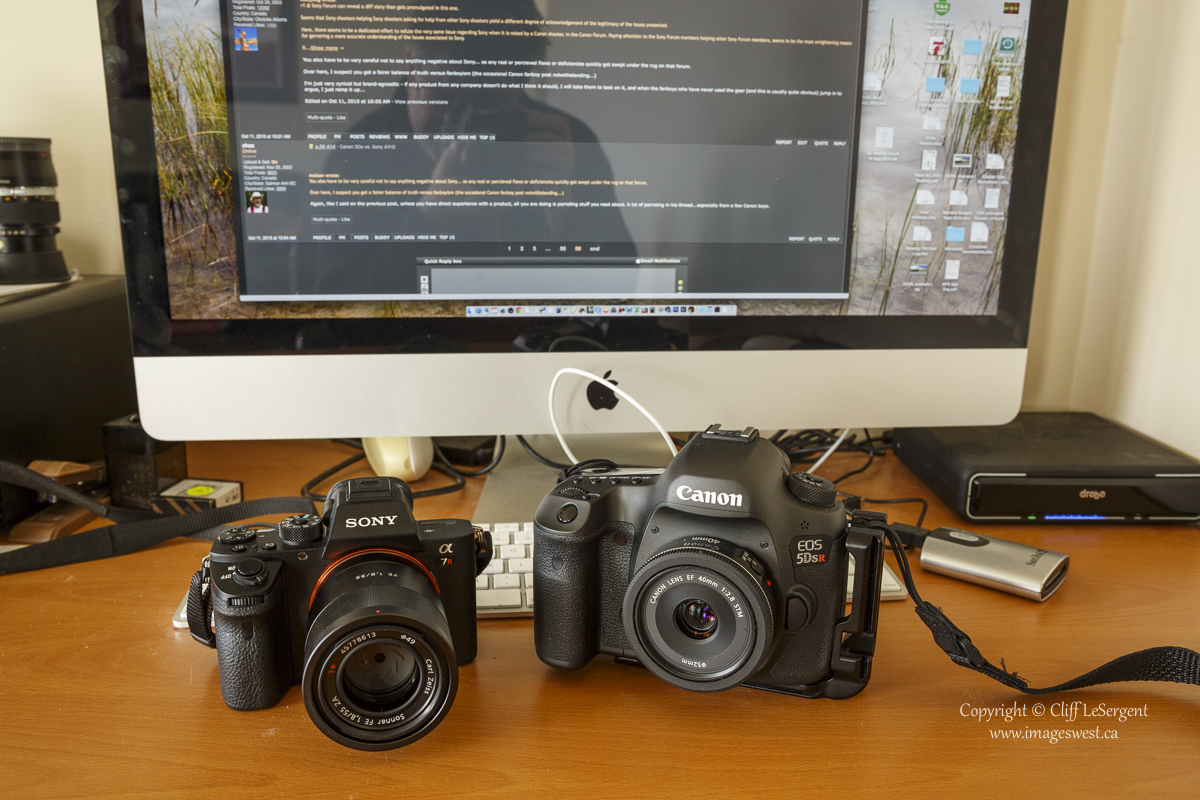
Yes, I Actually Use Both Cameras...
molson wrote
RustyBug wrote
+1 @ Sony Forum can reveal a diff story than gets promulgated in this one.Seems that Sony shooters helping Sony shooters asking for help from other Sony shooters yield a different degree of acknowledgement of the legitimacy of the issues presented.
Here, there seems to be a dedicated effort to refute the very same issue regarding Sony when it is raised by a Canon shooter, in the Canon Forum. Paying attention to the Sony Forum members helping other Sony Forum members, seems to be the most enlightening means for garnering a more accurate understanding of the issues associated to Sony.
It is a far different thing to actually acknowledge and offer assistance toward an issue vs. incessantly refuting its existence through deflection, etc.
Over here, I suspect you get a fairer balance of truth versus fanboyism (the occasional Canon fanboy post notwithstanding...)
Credibility check...
Yes, I Actually Use Both Cameras...
Oct 11, 2015 at 11:13 AM
p.59 #16Canon 5Ds vs. Sony A7rII
molson wrote:
I'm just very cynical but brand-agnositic - if any product from any company doesn't do what I think it should, I will take them to task on it
As it should be if objective / critical analysis info is the goal.
From there ... well, then it becomes a matter of subjectivity / preference @ whether or not the issue matters for a given individual or application. But, at least it should be openly acknowledged, rather than "fan-boy" dismissed.
Case in point ... Canon isn't the DR champ (i.e. openly acknowledged). What that may or may not mean for a given person / usage / application can range from "OMG" to "Who Cares".
Oct 11, 2015 at 11:16 AM
p.59 #17Canon 5Ds vs. Sony A7rII
molson wrote:
chez wrote
molson wrote
RustyBug wrote
+1 @ Sony Forum can reveal a diff story than gets promulgated in this one.Seems that Sony shooters helping Sony shooters asking for help from other Sony shooters yield a different degree of acknowledgement of the legitimacy of the issues presented.
Here, there seems to be a dedicated effort to refute the very same issue regarding Sony when it is raised by a Canon shooter, in the Canon Forum. Paying attention to the Sony Forum members helping other Sony Forum members, seems to be the most enlightening means for garnering a more accurate understanding of the issues associated to Sony.
It is a far different thing to actually acknowledge and offer assistance toward an issue vs. incessantly refuting its existence through deflection, etc.
Over here, I suspect you get a fairer balance of truth versus fanboyism (the occasional Canon fanboy post notwithstanding...)
Yeh I know you do. What I like on the Sony board is people with actual experience using the gear. Here we get a lot of posts from people who have not touched said equipment but somehow come across as experienced users of it...at least in their minds.
Oct 11, 2015 at 11:19 AM
p.59 #18Canon 5Ds vs. Sony A7rII
chez wrote:
Seems that Sony shooters helping Sony shooters asking for help from other Sony shooters yield a different degree of acknowledgement of the legitimacy of the issues presented.
Here, there seems to be a dedicated effort to refute the very same issue regarding Sony when it is raised by a Canon shooter, in the Canon Forum. Paying attention to the Sony Forum members helping other Sony Forum members, seems to be the most enlightening means for garnering a more accurate understanding of the issues associated to Sony.
It is a far different thing to actually acknowledge and offer assistance toward an issue vs. incessantly refuting its existence through deflection, etc.You also have to be very careful not to say anything negative about Sony... so any real or percieved flaws or deficiencies quickly get swept under the rug on that forum.
Over here, I suspect you get a fairer balance of truth versus fanboyism (the occasional Canon fanboy post notwithstanding...)Again, like I said on the previous post, unless you have direct experience with a product, all you are doing is parroting stuff you read about. A lot of parroting in his thread...especially from a few Canon boys.Credibility check... Yeh I know you do. What I like on the Sony board is people with actual experience using the gear. Here we get a lot of posts from people who have not touched said equipment but somehow come across as experienced users of it...at least in their minds.
I think there is just as much parroting on the Sony (and Nikon) forums as there is here... but I find I can usually tell fairly quickly if the poster has any experience using the gear or not - some of the comments are pretty far-fetched (and some are flat-out ridiculous...)
molson wrote
chez wrote
molson wrote
RustyBug wrote
+1 @ Sony Forum can reveal a diff story than gets promulgated in this one.Seems that Sony shooters helping Sony shooters asking for help from other Sony shooters yield a different degree of acknowledgement of the legitimacy of the issues presented.
Here, there seems to be a dedicated effort to refute the very same issue regarding Sony when it is raised by a Canon shooter, in the Canon Forum. Paying attention to the Sony Forum members helping other Sony Forum members, seems to be the most enlightening means for garnering a more accurate understanding of the issues associated to Sony.
It is a far different thing to actually acknowledge and offer assistance toward an issue vs. incessantly refuting its existence through deflection, etc.
Over here, I suspect you get a fairer balance of truth versus fanboyism (the occasional Canon fanboy post notwithstanding...)
I think there is just as much parroting on the Sony (and Nikon) forums as there is here... but I find I can usually tell fairly quickly if the poster has any experience using the gear or not - some of the comments are pretty far-fetched (and some are flat-out ridiculous...)
Oct 11, 2015 at 11:25 AM
p.59 #19Canon 5Ds vs. Sony A7rII
molson wrote:
Seems that Sony shooters helping Sony shooters asking for help from other Sony shooters yield a different degree of acknowledgement of the legitimacy of the issues presented.
Here, there seems to be a dedicated effort to refute the very same issue regarding Sony when it is raised by a Canon shooter, in the Canon Forum. Paying attention to the Sony Forum members helping other Sony Forum members, seems to be the most enlightening means for garnering a more accurate understanding of the issues associated to Sony.
It is a far different thing to actually acknowledge and offer assistance toward an issue vs. incessantly refuting its existence through deflection, etc.You also have to be very careful not to say anything negative about Sony... so any real or percieved flaws or deficiencies quickly get swept under the rug on that forum.
Over here, I suspect you get a fairer balance of truth versus fanboyism (the occasional Canon fanboy post notwithstanding...)Again, like I said on the previous post, unless you have direct experience with a product, all you are doing is parroting stuff you read about. A lot of parroting in his thread...especially from a few Canon boys.Credibility check... Yeh I know you do. What I like on the Sony board is people with actual experience using the gear. Here we get a lot of posts from people who have not touched said equipment but somehow come across as experienced users of it...at least in their minds.I think there is just as much parroting on the Sony (and Nikon) forums as there is here... but I find I can usually tell fairly quickly if the poster has any experience using the gear or not - some of the comments are pretty far-fetched (and some are flat-out ridiculous...)
Also interesting that a constant voice here hasn't used any of the gear being discussed, specifically an a7rII and 135L lens, yet continues to be an internet parrot :-)
chez wrote
molson wrote
chez wrote
molson wrote
RustyBug wrote
+1 @ Sony Forum can reveal a diff story than gets promulgated in this one.Seems that Sony shooters helping Sony shooters asking for help from other Sony shooters yield a different degree of acknowledgement of the legitimacy of the issues presented.
Here, there seems to be a dedicated effort to refute the very same issue regarding Sony when it is raised by a Canon shooter, in the Canon Forum. Paying attention to the Sony Forum members helping other Sony Forum members, seems to be the most enlightening means for garnering a more accurate understanding of the issues associated to Sony.
It is a far different thing to actually acknowledge and offer assistance toward an issue vs. incessantly refuting its existence through deflection, etc.
Over here, I suspect you get a fairer balance of truth versus fanboyism (the occasional Canon fanboy post notwithstanding...)
Also interesting that a constant voice here hasn't used any of the gear being discussed, specifically an a7rII and 135L lens, yet continues to be an internet parrot :-)
Oct 11, 2015 at 12:11 PM
p.59 #20Canon 5Ds vs. Sony A7rII
jctriguy wrote:
molson wrote
chez wrote
molson wrote
chez wrote
molson wrote
You also have to be very careful not to say anything negative about Sony... so any real or percieved flaws or deficiencies quickly get swept under the rug on that forum.Over here, I suspect you get a fairer balance of truth versus fanboyism (the occasional Canon fanboy post notwithstanding...)
Yes, this constant voice admittedly claims they have never used the mentioned combination and says explicitly that he's read about the performance of said combination on another thread...unlike others, not to name anyone herhee, who come across as though they are experts with the equipment and have many years behind them with said equipment. Much different scenarios.
Oct 11, 2015 at 12:15 PM