I really think the BSI is more about the stacked chip. Some of the video sites are quoting that the chip is capable of doing 300+fps at full resolution. Also there appears to be support for the belief that the camera is doing full resolution rescaling to 4k and not doing any line skipping or temporal exposure magic. They claim to have a BSI chip, because they do, but my feeling is that move was made to allow the mixed processing that they get with their stacked chip. If they are going to have to do TSVs, then BSI actually seems to solve a lot of problems along the way and may even simplify implantation.
The increase in low light capability that came with BSI on the compact sensors was mostly because the pixel pitches were sub 2µm (some of the newer announced sensors are sub 1µm), meaning that by the time you stuck 2-4 .18µm wires across the top of these pixels, there wasn't much of the sensor that wasn't metalization---thereby reducing the fill factor. Even on this "high density" sensor in the nx-1, we are still talking about pixel pitches in the range of 3.5-4µm where there is much less expected to be gained from bumping up the fill factor 10-20%. Fill factors even for high-density aps-c seem to be greater than 50% (at least if your not stuck on a really old process), therefore I think the expectation of miraculous low light performance are overrated.
I must admit though, iso 3200 on the nx-1 is way more dependable than even iso 1600 was on my old nex3.
Jman,
your night shots are convincing me to strap this camera to a tripod!!!
Jman13 wrote:
Indeed...which is why I said if I were starting new, this would be a very strong consideration. However, selling all my Fuji gear (well not all, since I review it and need a base system to continue that), and the price starts becoming prohibitive very quickly, especially once you start adding other lenses. However, if I were going with one system only and I didn't review them? I'd seriously consider the switch. The camera and (at least this) lens are very capable...more than capable actually. The only concern is: how serious is Samsung about the camera business. Sony has been in it long enough to think that there will still be e-mount cameras in 10 years. Samsung? Maybe. Maybe not. Heck, it wouldn't surprise me in 10 years if they were the dominant player, given their track record in other industries, but at this point it's a risky bet. The camera is great, though.
As to AF in 'demanding' situations. So far, it's only 'ok' there. If you have good light, it does a fantastic job. Probably the best in the mirrorless world, and the tracking is fantastic. In dimmer light, however, it's only average at best. Tracking isn't nearly as good indoors and in lower light scenarios, at least with this lens, it slows down a fair bit. I honestly think my X-T1 is the better focuser in dimmer light, including tracking, and neither are as good as the m4/3 cameras in dim light (for single shot). In good light, the Samsung is crazy fast, though.
Are you able to extract more highlight detail (and hint of subtle tone) from these shots, particularly the 5/3rd(?) bank sign on top of the building from the first shot and on the bottom shot, the lights flanking the entrance to the building? That look (completely blown out highlights) sort of screams small sensor to me.
Those two areas? Nope. Those are situations where, as I've referred to, there is extremely minimal highlight headroom in the RAW files. I'm guessing I could have underexposed the majority of the image and brought up the midtones and shadows in post, but it's hard to remember to do that when you're used to shooting a certain way for 10 years. I plan on doing that DR test this weekend, so we'll hopefully see, but that's what I'm referring to when I say that DR seems less than the competition. Otherwise, though, the sensor quality is excellent.
Jman13 wrote:
Those two areas? Nope. Those are situations where, as I've referred to, there is extremely minimal highlight headroom in the RAW files. I'm guessing I could have underexposed the majority of the image and brought up the midtones and shadows in post, but it's hard to remember to do that when you're used to shooting a certain way for 10 years. I plan on doing that DR test this weekend, so we'll hopefully see, but that's what I'm referring to when I say that DR seems less than the competition. Otherwise, though, the sensor quality is excellent.
Thanks. I suppose if the culprit is a "false" histogram (that might lead to overexposure since it's based on the jpeg anyway), that should show up in your DR test if it's bracketed.
Its more like that Jman13 is used to shoot ETTR style (like many of us) and this camera simply has only as much DR as you see on histogram. There some like that, mostly old and CCD based..
Usable DR is by my guesstimation somewhere around 12 eV. Maybe bit more, if one has tolerance to some noise or can do selective NR in shadows. I think its pretty normal camera when it comes to DR.
Frankly I dont mind, it seems to have enough DR for my use and it has ridiculous resolution plus pretty nice colors (not great, just nice). If someone wants to shoot for example landscapes on APS-C, this would be my first choice.. (actually due pixel density, it probably beats everything else too, including FFs).
Mescalamba wrote:
If someone wants to shoot for example landscapes on APS-C, this would be my first choice.. (actually due pixel density, it probably beats everything else too, including FFs).
Particularly for landscape, I take the opposite view and believe DR is one of the more important aspects where 2 stops of DR can make a very noticeable difference (even at smaller display sizes). I'm not in the market myself for this camera but if it turns out to have noticeably worse DR (the better APS sensors offer around 14 stops, some FF even more), it would be a deal breaker.
I played a bit with the NX1 and A6000 studio scene RAW files from dpreview and my first impression is that the DR on NX1 seems slightly better than A6000. Here are the output crops from both after pushing the shadows on the gray bars:
Both cameras were at ISO 100 and the exposure for both was 1/40s @ f5.6 so it is a fairly apples to apples comparison. Under default ACR conversion the samsung image was slightly darker (though not drastically so). Sharpness and noise reduction were set to 0 in ACR. I pushed the A6000 image by 3 stops and the NX1 images by around 3.3-3.4 stops to ensure that the grayscale patches have about the same intensity.To me that Samsung output seems to have less noise across all patches despite being slightly larger.
On a seperate I also played a little bit with using dcraw to generate linear raw output from both cameras without any tone curve applied, and interestingly in that the NX1 actually seems to produce a slightly brighter output.
Mescalamba wrote:
Its more like that Jman13 is used to shoot ETTR style (like many of us) and this camera simply has only as much DR as you see on histogram. There some like that, mostly old and CCD based..
Usable DR is by my guesstimation somewhere around 12 eV. Maybe bit more, if one has tolerance to some noise or can do selective NR in shadows. I think its pretty normal camera when it comes to DR.
Frankly I dont mind, it seems to have enough DR for my use and it has ridiculous resolution plus pretty nice colors (not great, just nice). If someone wants to shoot for example landscapes on APS-C, this would be my first choice.. (actually due pixel density, it probably beats everything else too, including FFs)....Show more →
I don't always shoot ETTR...I try and get the exposure close to where I want it for the final image. I am used to having the ability to pull back at least SOME highlight detail, though, and that's where things are tough, especially in a night scene. If I expose for the highlights and let everything else drop into the abyss, then while I may be able to recover most of that detail, it's going to have a heck of a lot more noise. Here's an example from that last shot.
First, here's the file with no adjustments. Note the histogram is pretty bottom heavy, with only a very little at the right. How am I to read that in the field? I'd read it as capturing the scene pretty fully and being careful of the highlights. (I shrunk my LR window so things look a bit easier on the forum)
And with highlights pulled -50. This is not a massive adjustment, but you can see here, I've essentially gained no additional information at all, and have simply managed to posterize the highlight area. (I will probably go back to that image and un-pull the highlights since them flat blown looks more natural).
If it's simply that all the DR is bottom loaded, I get it that the whole DR is there, but it makes judging exposure incredibly hard in situations like this, and makes pulling up exposure really hard when you need to underexpose by 1-2 stops and pull up 95% of the image just to keep that top end.
Luckily, I've found in most of my shooting, it's not a problem with this camera, but in a scene like this, it's noticeable. (I still like both those shots too).
curious80 wrote:
I played a bit with the NX1 and A6000 studio scene RAW files from dpreview and my first impression is that the DR on NX1 seems slightly better than A6000. Here are the output crops from both after pushing the shadows on the gray bars:
Both cameras were at ISO 100 and the exposure for both was 1/40s @ f5.6 so it is a fairly apples to apples comparison. Under default ACR conversion the samsung image was slightly darker (though not drastically so). Sharpness and noise reduction were set to 0 in ACR. I pushed the A6000 image by 3 stops and the NX1 images by around 3.3-3.4 stops to ensure that the grayscale patches have about the same intensity.To me that Samsung output seems to have less noise across all patches despite being slightly larger.
On a seperate I also played a little bit with using dcraw to generate linear raw output from both cameras without any tone curve applied, and interestingly in that the NX1 actually seems to produce a slightly brighter output. ...Show more →
This doesn't surprise me, actually. But it doesn't address the 'whole DR' issue here. I definitely think the shadow range is better on the NX1 than on the a6000 (and similar to my Fuji's, at least from rough feel from what I'm used to...it could be better). I've always found my a6000 to suffer when pushing shadows a lot (and especially when messing with local contrast in darker areas). However, the a6000 has at least a stop and up to two full stops of data in the highlights of the RAW file that isn't there at all in the NX1. It's something I'm going to test, mainly by bracketing each camera in 1/3 stop increments to set a 'highlight threshold.' That is, the brightest exposure where the highlights JUST clip. THEN look at how much detail remains in deep shadows. It may be you just need to meter a bit differently with the NX1. Olympus is actually the opposite of this...their RAW files are calibrated low, such that there is a LOT of highlight headroom, but not as much shadow room.
Jman13 wrote:
This doesn't surprise me, actually. But it doesn't address the 'whole DR' issue here. I definitely think the shadow range is better on the NX1 than on the a6000 (and similar to my Fuji's, at least from rough feel from what I'm used to...it could be better). I've always found my a6000 to suffer when pushing shadows a lot (and especially when messing with local contrast in darker areas). However, the a6000 has at least a stop and up to two full stops of data in the highlights of the RAW file that isn't there at all in the NX1. It's something I'm going to test, mainly by bracketing each camera in 1/3 stop increments to set a 'highlight threshold.' That is, the brightest exposure where the highlights JUST clip. THEN look at how much detail remains in deep shadows. It may be you just need to meter a bit differently with the NX1. Olympus is actually the opposite of this...their RAW files are calibrated low, such that there is a LOT of highlight headroom, but not as much shadow room. ...Show more →
Jordan, these RAW files are effectively giving you what you want to try. The exposure is just below the highlight clipping point on each camera and yet you get a bit more shadow room in NX files suggesting that the "whole DR" is slightly better on NX1 than A6000 (and about the same as D7100). But studio scenes are one thing, and real life is another thing and it would be very interesting to see the results you get.
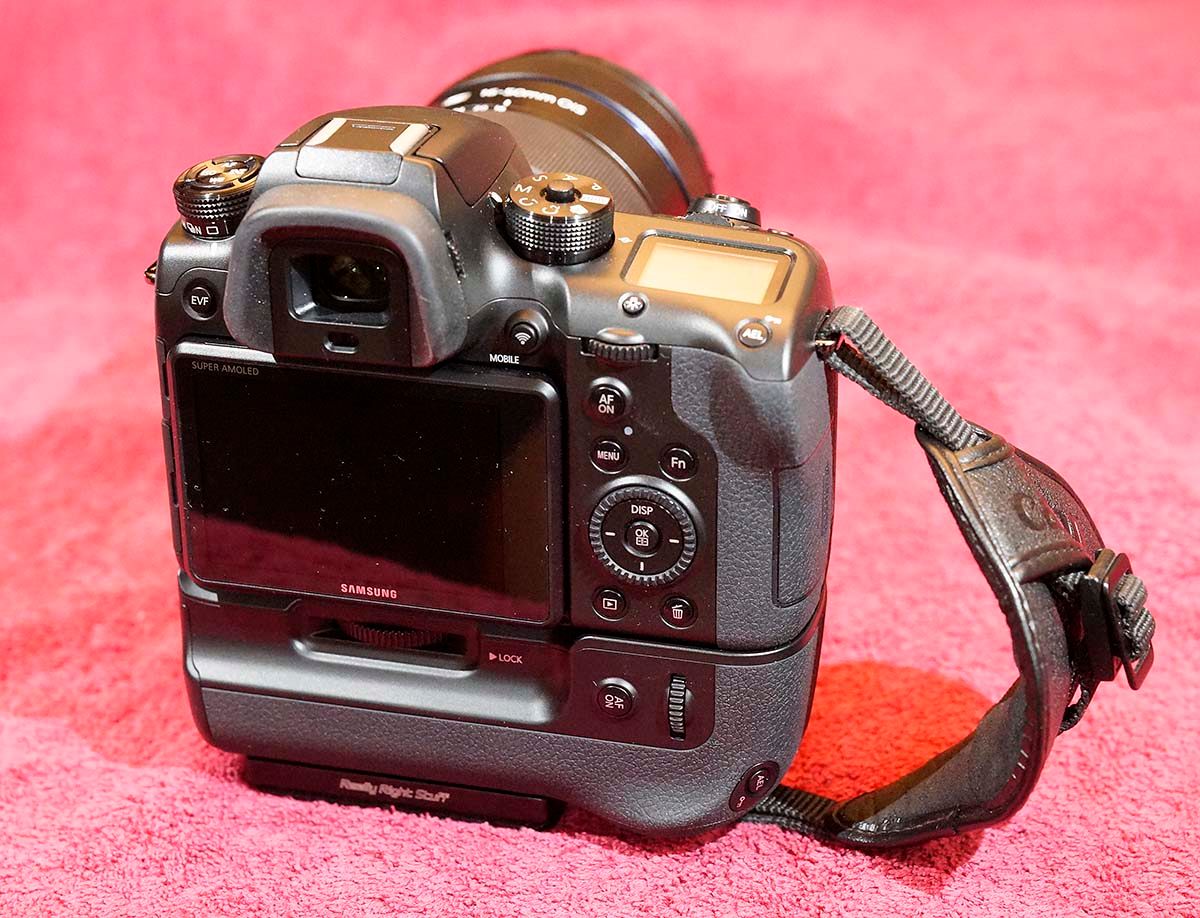
Wow; you people are LOTS more technical than I ever was or will be. I bought the NX1/16-50/2-2.8.BG/charger kit and received it in December. I do NOT have big hands, and I hoped the body would be big enough for my three grip fingers. That answer turned out to be 'barely', initially, and then 'no'. On went the BG...
...and I'm a happy guy. The body is still smaller and lighter than its predecessors--Sony a99, Canon 6D, more--and NOT horribly clunky feeling like the Sony a7r that I owned for a few months.
Not wanting to spend SO much money all at once, I bought the 50-200 (and it's good enough for now) and a Samyang 12mm/2 manual, and that's quite good after adjusting for barrel distortion.
I'm really glad I bought this NX1 system. FOR ME and my purposes, it's high in resolution, bulky and ergonomic enough to feel good and handle well*, and MUCH lighter than my former systems. It's definitely a keeper.
curious80 wrote:
Jordan, these RAW files are effectively giving you what you want to try. The exposure is just below the highlight clipping point on each camera and yet you get a bit more shadow room in NX files suggesting that the "whole DR" is slightly better on NX1 than A6000 (and about the same as D7100). But studio scenes are one thing, and real life is another thing and it would be very interesting to see the results you get.
You had to pull the a6000 files over a stop to get the highlights to show? That's what I'm talking about. They aren't right at the highlight clipping point if they both look near white with no adjustments...the a6000 has over a stop of highlight information still in the file, while the NX1 has maybe 1/3 stop at most. You'd need to effectively overexpose the a6000 file by 1-1.5 stops to equalize the DR. I'm still thinking of the best way to reliably test this, so we'll see how it turns out. In any case, you have to be a lot more careful with highlights on the NX1, and if anything err on the side of shooting dark.
Again, though, I still love the camera, and with the exception of the lack of highlight RAW headroom, I love the image qualtiy. Quite clean files with fantastic detail, good color and nice tonality, and the shadows can be pushed quite a bit.
Jman13 wrote:
You had to pull the a6000 files over a stop to get the highlights to show? That's what I'm talking about. They aren't right at the highlight clipping point if they both look near white with no adjustments...the a6000 has over a stop of highlight information still in the file, while the NX1 has maybe 1/3 stop at most. You'd need to effectively overexpose the a6000 file by 1-1.5 stops to equalize the DR. I'm still thinking of the best way to reliably test this, so we'll see how it turns out. In any case, you have to be a lot more careful with highlights on the NX1, and if anything err on the side of shooting dark.
Again, though, I still love the camera, and with the exception of the lack of highlight RAW headroom, I love the image qualtiy. Quite clean files with fantastic detail, good color and nice tonality, and the shadows can be pushed quite a bit. ...Show more →
Jordan, thanks for going to all this trouble - it's a lot of work!
Jman13 wrote:
....
You had to pull the a6000 files over a stop to get the highlights to show? .....
Hmm thats not true. A6000 output was actually closer to highlight clipping than NX1 output which was darker. Thats why I had to pull the shadows a bit more on NX1 (3,3 stops vs 3 stops). Below are the ACR outputs with histograms. What you will see is that under the same exposure A6000 is "blowing the highlights" a bit more ((look at the men's faces) which it would then allow you yo recover as highlight headroom . NX1 on the other hand is not blowing those highlights at all. In other words, NX1 will blow the highlights when you actually overexpose the image in which case you obviously can't recover it. Whereas the A6000 makes you think that the highlights are blown due to its brighter tone curve and then lets you recover that. In reality there is no extra information captured by A6000.
But I do agree that with a camera like NX1 you have to worry more about metering. At the same time I suspect selecting a different profile in the camera might help with that.
You may be right...there's always room for misleading data based on a) where the maker calibrates the RAW file, and b) Where the true ISO rating is (regardless of what number is chosen). I'm working up my little test now, and hope to have some hard data here in the next hour or so.
Jman13 wrote:
In any case, you have to be a lot more careful with highlights on the NX1, and if anything err on the side of shooting dark.
Hmm, sounds a lot like the M9/M-E.
A bit OT, perhaps, but after a few years with the M9, it was noticed by a number of users that the sensor seemed to be pretty much 'ISO-less' in that pushing 5 stops in post from base ISO was as good or better (due to better NR options in LR, etc.) than changing ISO in the camera. I wonder if the NX1 behaves similarly, whereby a 5-stop push from ISO 100 is as clean as RAW at ISO 3200? If shadow noise is well controlled then conceivably exposing to preserve highlights would be a reasonable technique.
Jordan, In your second image of the most recent two above, is there some vertical banding or lines of some sort in the top left corner of the sky (running the lengthwise direction of the image)? Or is it my eyes playing tricks on me?
A bit OT, perhaps, but after a few years with the M9, it was noticed by a number of users that the sensor seemed to be pretty much 'ISO-less' in that pushing 5 stops in post from base ISO was as good or better (due to better NR options in LR, etc.) than changing ISO in the camera. I wonder if the NX1 behaves similarly, whereby a 5-stop push from ISO 100 is as clean as RAW at ISO 3200? If shadow noise is well controlled then conceivably exposing to preserve highlights would be a reasonable technique.
Jordan, In your second image of the most recent two above, is there some vertical banding or lines of some sort in the top left corner of the sky (running the lengthwise direction of the image)? Or is it my eyes playing tricks on me?...Show more →
Huh..that's bizarre. I'll look into that. I don't think it's banding in the file, but may have been caused by something in the resizing. (I haven't seen banding in ANY situation with this sensor, even when pushing a file +5 stops, though I'm sure it could be done). It almost looks like an odd reflection, though I had no filters. I'll let you know once I've had a look.