film_4ever wrote:
Does anyone know a website that has several of these service manual images, like the ones posted here, posted for the D800/e ?
Yes, there is a website that sells all kinds of service manual. Just Google and search for D800/E Service and Maintenance Manual, and it will lead you there.
Oops! Sorry if you meant for free than you have to Google Image search and there are a few under all kinds of headings.
hans98ko wrote:
@sjms
I can. assure you that it is not all for the past 60 years.
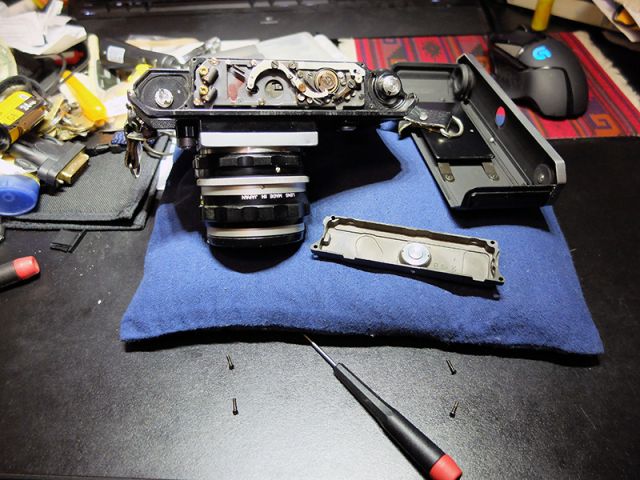
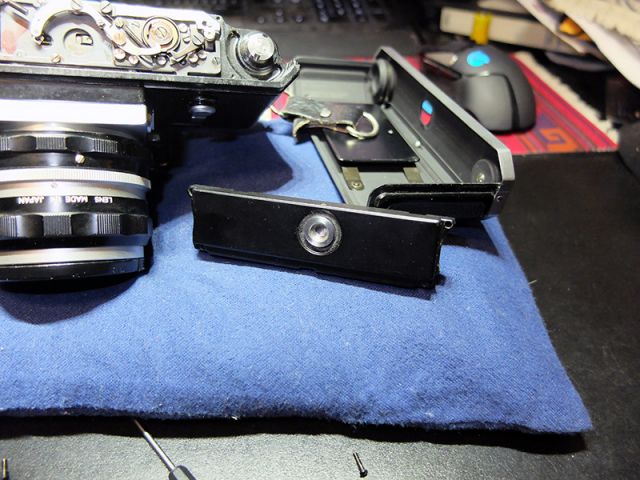
I have a few cameras that have the tripod mount molded or attached to the main chassis. A few that comes to mind is the Nikonmat EL, Nikon F3 and my Rollei SL35ME all mounted to a solid chassis. The base plate is just a plate with a simple hole for the tripod mount. Just did a simple check from one of my cabinet.
i did not say all, i said most.
the Nikon F (circa 1968ish) also does not mount to an inner frame so i would venture to say that the F3 follows form and does not either. due to its cover design it doe mount to a 4 (straight slot too not Philips type) screw base plate/cover under the film bay cover. looks can be deceiving.
A question for all the engineers, armchair and otherwise: would using the option battery grip help to prevent such torque fractures?
My thinking: since the tripod now mounts into the grip, and the grip has a fairly large surface area for contact with the camera base, any forces will be distributed across the entire bottom of the camera.
Might make investing in the optional grip a bit of an insurance policy.
Just to be clear: I'm not a grip manufacturer / reseller. I ain't trying to sell anything. Just tossing around ideas. And perhaps trying to justify the purchase of a grip with each new body?
that is dependent on how the grip is made. i'm not too much of a fan of grips overall. quality varies widely and construction is generally polymer and or polymer alloy. grips tend to introduce flex.
@RLDubbya
No it wouldn't make a difference, only worst because the load is still going to be spread amount the 4 tiny screws on Armando's photo which will still tear that piece off.
A grip might add some additional compliance that will help to absorb some of the energy upon impact, if the camera lands on the grip. But if you have a large lens mounted, having a grip probably won't significantly change the moment arm (lever length) that the c.g. of the lens has about the impact point, if the body falls directly to the ground, and is not mounted to a tripod.
It CAN change the moment arm if the point of impact is to the legs of a tripod though. It could actually increase the moment arm which could result in the bending stresses being worse.
So to answer your question, it depends upon the point of impact to the camera/lens & tripod system.
hans98ko wrote:
@RLDubbya
No it wouldn't make a difference, only worst because the load is still going to be spread amount the 4 tiny screws on Armando's photo which will still tear that piece off.
actually when you screw a tripod or a grip into the hole its load is spread over the flange on the inner part of the mount the load is not on the screws directly. the screws are there to position and secure the flanged plate in properly on the baseplate.
Actually I do agree with what you were saying about the spreading of the load across the plate surface, but the end result is still the 8 contact points where the screws comes in contact with the main chassis, and with majority of the load absorbed by the 4 screws closest to the tripod mount before ending up on the other 4 screws further away.
Must also add that the rim of the plate also helps to absorb some of the load depending on direction of forces.
i feel that the base plate of the camera will start to yield/deform outside of that initial 4 mount screw area first due to the surface area. it would be a relatively substantial loading at that point.
mounting the tripod screw base assy on a component of the camera that could directly compromise the optical alignment really would be in my opinion a slightly questionable design/engineering practice to begin with.
There is quite a difference in not just thickness, but where screws are attached in the D810? my goodness this isnt good for those of us that vigorously use our d800's for nature photography, backpacking etc.
armando: Of course I don't mind your "me too" comment; the reason I started this post to begin with was my concern with finding the ebay camera with the same crack. That concerned me and I wanted to know if there were others. I had a running list of people who either sent me a message or had mentioned in earlier posts to this thread that their D800s suffered "rear casting crack"/"impact damage", but none of them had pictures.
Ronno: Re the Tom Miles video you posted: Agreed. Particularly after reading what has been emphasized in this thread (or at least questioned as possible culprits - heavy lenses and/or pressure on the tripod mount), seeing those cameras swing from that tripod mount with heavy lenses attached made me twitch. And that was a Nikon sponsored video, so they couldn't even question those practices if they're in their video, wouldn't you think?
Hans: I am so grateful for your very knowledgeable input. RE: what you were discussing with armando about his focus issues: The reason I sent my camera to Nikon to begin with was an intermittent focus problem that was getting increasingly worse. It's not a left focus problem like many others have claimed; it's been back focusing. Can I assume it is a result of this crack? Because I'm assuming the instability of the frame would be the reason for it being intermittent (expansion/contraction with temperature changes?) - I'm no engineer, just speculating.
My eye for looking at the guts of a camera is untrained, but I am feeling a little more confident in Nikon after reading your opinions on what you saw in armando's 810 photos. I need my camera (or A camera) soon. My backup is a D7000, so it's an obvious void. I'm just grateful it's the slow season.
Hi Mary,
Based on the little information you have posted here, I would say the only fracture shown on your picture should not affect your focusing issue, unless there are other issues that were not shown in your picture as in the connection between the front and back chassis where the lens mount is attached by a couple of other screws. That is why I said Nikon should never have void your warranty. The reason they keep using the praise "impact damage" is to get owners to scrap their cameras so that they can get away with their responsibilities while they released a new model with this issue fixed. But this time they are not going to get away with it and is going to hurt them hard financially due to the D800/E was one of the best selling cameras within their arsenals. If only they have took care of all their customers having this issue quietly, this would never have blown into such a mess. Someone from Nikon USA is going to take the blunt for it because so far none of the other countries have reported impact damage for this issue.
Now, let me try to isolate your back focusing issue. Try to do what I proposed to Armando using the 3 different methods and see which method is having this issue.
If using live view mode is not having this issue then the fracture has no effect on your focusing.
If only using view finder mode has the problem even after cleaning the focusing sensor than there might be a chance that the reflex mirrors need some kind of adjustment. This can only be done by Nikon service.
If using live view mode with 100% zoom and manual focusing after cleaning the sensor still have this issue, then there is a high chance that there was a major issue caused by the misalignment of the sensor plane and the lens mount.
Hope this helps.
Forgive me if this has already been mentioned (just found this thread and didn't have time to read every post), but casting processes can introduce flaws into the output just like any other manufacturing process. Among these are porosity (metal has air pockets) and cracks. It's possible that Nikon received a bad batch of castings and used them anyway. It's also possible that MOST of the D800 castings have issues in the areas of documented weakness due to poor product design and/or shoddy casting process control.
..it seems that Nikon is perfectly aware of this issue and they fixed it in D810. They just wont admit it to those which frame cracked in D800/D800E. Also given what material it is and how crack looks, I think there might be some material quality issue too.. (as one above me say, bubbles in material)
nwadventurer7 wrote:
There is quite a difference in not just thickness, but where screws are attached in the D810? my goodness this isnt good for those of us that vigorously use our d800's for nature photography, backpacking etc.
Define: "vigorously".
i use 3 different camera bodies in my work currently. being that they are tools of image making and i shoot everywhere (and that's pretty far and wide) that i can i would like to get an idea of just what you personally mean with that term.