Which did you use for the MD 35-70? My only gripe with the MD, is that it only goes to 1:4 in macro, whereas the Contax someone told me, does 1:2.5.
I'm using some extremely cheap Fotodiox NEX Macro Tube Extension Kit for Extreme Macro Photography (the title on Amazon).
They're basically threaded rings in 7,14, and 28mm sizes, which then connect to a front and rear mount adapter ring. It's pretty strange and sort of a PITA to use if you swap the tube lengths out a lot, but for basic stuff it's not too bad (do note your lenses may end up mounted upside down because of how these work).
The MD35-70 doesn't take much at all, just the 28mm, and you're already very close to the subject. 28mm is actually probably too much for this lens, and I should back off to 14mm.
Cool thing about this is that since you physically move the elements back and forth in macro, you can gain a bit of working distance by backing off the macro setting.
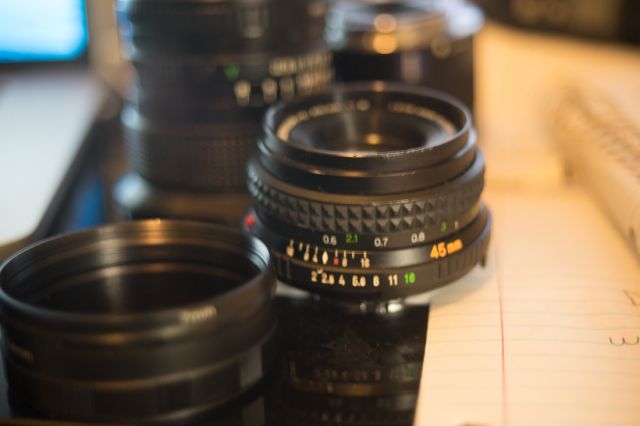
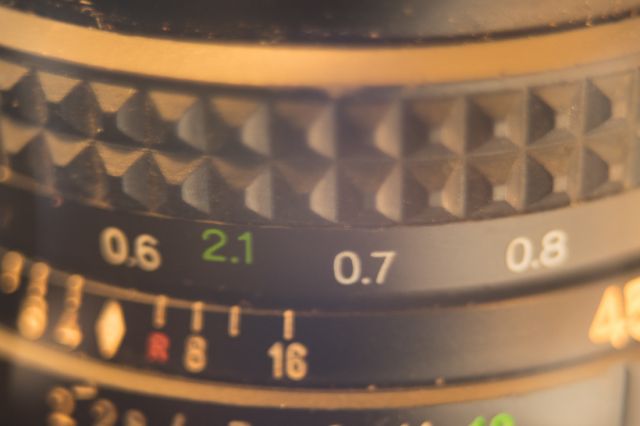
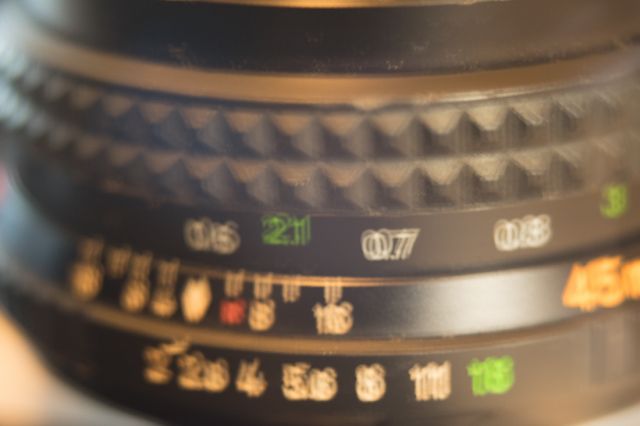
Here are three shots (sorry they're crappy but this was quick in a dark office)
MFD and 1:4 setting
MFD and 1:4 setting with 28mm
MFD and 1:7 setting with 28mm
Derek, sorry to hear about the injury. Give it all the time it needs to heal.
Here are a few shots taken in dark woods, thankfully while it was not raining as is so common here. These are among my last shots with the Canon 16-35 EF f/4 as I sold it yesterday to fund other gear.
ebookman wrote:
Derek, sorry to hear about the injury. Give it all the time it needs to heal.
Here are a few shots taken in dark woods, thankfully while it was not raining as is so common here. These are among my last shots with the Canon 16-35 EF f/4 as I sold it yesterday to fund other gear.
Nice Images. These are tough shooting conditions. Most of my previous Digital cameras could not handle this without blowing the highlights or creating an inky unrecoverable mess in the shadows. The a7(r) is a definite step above...
You had a lot of nice images out of this lens...may I ask why it didn't stay in your collection?
eheffa wrote:
Nice Images. These are tough shooting conditions. Most of my previous Digital cameras could not handle this without blowing the highlights or creating an inky unrecoverable mess in the shadows. The a7(r) is a definite step above...
You had a lot of nice images out of this lens...may I ask why it didn't stay in your collection?
-evan
Thanks for your kind words. Forests in the Northwest are a favorite challenge to me. They are so tall and shield the sun so effectively that the light that make it through the canopy offers a really bright contrast against the very dark forest floor. I find my self shooting at -3 all the time to keep from blowing out the highlights. Even that is not enough sometimes and I have to go full manual to the point of hardly being able to see the shot in the finder. You are right. The dynamic range of the A7r saves these shots that would have failed in earlier generation cameras.
The Canon 16-36 is an excellent lens and a pleasure to use with manual focusing because it has a huge focus ring with smooth precise motion. It is edge to edge sharp. I love what it can do. My only issue is size, It is like a 70-200 in bulk. It is a lot to carry around with a half dozen other lenses. Nevertheless, I would never have sold it if I had not run into somebody yesterday who had an immediate need for the lens and somebody else on the same day who offered me a great price on a like-new Leica Tri-Elmar (WATE) which is what I was looking for when I purchased the Canon in the first place. I can always go back to the Canon but I might never have another opportunity like this for the WATE.
Frogfish wrote:
Really like these shots. However they don't look as sharp as they might be and I'm wondering if you haven't hit the point of diffraction (or maybe just a software issue) ? On the D800E I use it's already noticeable at f11 and sometimes f8 with particular lenses. Anybody know if this is the same with the A7(r) ?
For sharpness, using a thirty five year old Sigma Mini-wide, that is about as good as it gets. I could force software to make it sharper, and in some of my photographs I have, but in my last photograph of Yellowstone, I prefer the more natural look.
No, I do not think it is refraction, just the limitations of an old lens. It is a Macro, with a shallow depth of focus. Some of what it renders is soft. It suffers from poor design. But what it offers is vibrancy, and a lively almost still-life presentation that newer lenses cannot equal. It is small and fits well with the camera, and is considerably sharper than my W.Rokkor-x 28mm.
I posted a photograph some days back, using a Canon 55mm, F1.2, off of a tripod. I never really liked that lens until I used it that day. It shot cleanly corner to corner. Now I am shopping for a clean condition Canon 20mm.
Taking a few hours off work I had planned for Wednesday since the temperatures looked like being a little lower with some cloud cover - didn't happen, it was still 37-38C and up to 41C at times, the cloud cover was pretty pathetic too
However not to be deterred I continued with my plans to visit the Shanghai Film Studios (outdoor sets). These studios are hardly used now as a massive new studio has been built in neighbouring Zhejiang province, however it's still an interesting place to go and there was a film being shot whilst I was there.
Of huge interest to me were the (obviously not original) 1920's-1930's posters to be found on the walls all over the studio. That and the film extras slowly melting in the heat !
So here is the first of what will be a few posts all taken at this location. All with A7 and Zeiss 100/2.
sebboh wrote:
not seed actually. i was trying to test the lens on humming birds and opened the window for clear shooting. my daughter had made a mess eating her granola though and a few juncos and chickadees wandered in to help clean up.
Birds in California seem to be much tamer than those in Northrine Wesphalia (yes, thats the name of my "state" ), even when I try to bribe them with food they fly away.








 ), even when I try to bribe them with food they fly away.