Samuli Vahonen
Offline
• • • •
Upload & Sell: Off
|
Jochenb wrote:
Everything that's in focus is painted over with red: example field curvature
Look how curved the plane of focus is. Almost the whole center is out of focus. When I focus more to the foreground the opposite happens: everything that's now painted in red (in focus) will be out of focus. So annoying.
When I examine my old 5DII photos with this lens things look completely different. A much milder forward field curvature. The lens was already useful at F5.6 for landscapes.
Question: have you knocked the lens hard or dropped it to hard surface between shooting with 5DII and A7?
Why I'm asking? I have seen this exact same behaviour earlier, but with 5DmkII. A fellow Finnish photographer had ZE 1.4/50, which worked exactly this way with his 5DmkII few years ago. To demonstrate he made similar picture, but he used ripe cornfield (quite homogenous) and sharpened the image 10+ times and it clearly visualized identical field curvature as your red overlay. He had a loooooooong fight with the Finnish importing company and Zeiss - that ended up sadly, when importing company finally agreed to send it to Zeiss, Zeiss just returned the lens and said it's according to the spec!!! That lens was clearly defective, some misalignment of lens elements or something else broken. At that time I counted this as a outlier as at that time Zeiss service still had great reputation.
My own ZE1.4/50 (with 5DmkII) was sharp over whole image area already at f/4.5 - There was really strong wind on mountain pass when I took this (sorry little small for our standards in 2016, but it's from 2011...) and whole frame is VERY sharp. The 1/1250s shutter speed was needed because I took the shot in conditions I needed to lean ~30 degrees to not fall in the wind and was barely able to walk few meters from car - tripod did not stand on ground without supporting it 100% of time - it was weird experience as I moved half kilometer for next shot, there suddenly was not much wind (photo has GPS coordinates in case somebody wants to study geography, it identifies pretty exact shooting location, of course there can be slight time sync issue with GPS and camera timestamps, but it can't be far off).
I installed ZE 1.4/50 to A7r, and take it with me when I go next time shooting - it will be hard time to find suitable test scenario at this time of year, but I'll see what I can do on weekend if there is any change to get outdoors while there is daylight.
navmannz wrote:
I find this topic fascinating and have been known to waste more than my share of time comparing lens, but coming from a background in science, I'd make one comment. That is, the images we end up with are influenced by a range of factors of which the lens is just one - the atmospheric conditions, lighting, aperture etc., can all influence outcomes.
This makes it quite risky to assess the comparative performance of two lenses by subjectively comparing one set of images shot with one lens, with a quite different set of images shot in different conditions with another - as you hint at above. In my view, a much more robust process is to shoot the same scene with a couple of lenses, preferably with a tripod, and perhaps over a range of apertures, and then process them identically. Otherwise, the risk is that we build an impression of how a particular lens performs and then 'see' the evidence that confirms that view, but miss the evidence that contradicts it - or confuse the influence of other factors with the performance characteristics of the lens....Show more →
This approach works for stuff what is easily explained and measurable (the stuff science likes ==> sharpness, aberrations, etc.) - I can't see this methodology to work to find out rendering style differences on real life conditions. In real life conditions the light is interesting when it's constantly changing, but it makes it A-B comparison next to impossible. There is no change to do it if ANY clouds in sky OR sun is low - generally leaves possibility to shoot only when sun is high in the sky, and that quite often doesn't look good (it can look good sometimes in some scenes, but it's rare). Even wind can change how things look in nature so that A-B can be no longer done if there is any wind, for example when leafs in three are pointhing to left compared to right the three in image looks different.
I have tried this scientifical approach and it's quaranteed to kill my interest to photography - and in record time. Reminds me of sitting on the boring glassed on technical university...yawn... When I have done this I find I always "prefer" the lens which is better at 100% pixel peeping, but which I may hate in real life shooting because it doesn't deliver what I actually want.
But I know people who can do this all day and get kicks from it. So as usual what makes world interesting is people and how different we are. From the tests people have done this way I have never found anything what really interests me - for sure it may reveal some things regarding sharpness (generally great interest withing photographers, not mine). For photographer like me whom doesn't care sharpness as long as there is enough of it, I pay attention >95% to other stuff. What I have seen by attempts of doing this scientifically 80% fail because they chosen scene which is controlled (=indoors) but extreme boring and not at all telling anything about real life outdoor rendering. The remain 20% fail because they have tried to do it outdoors and the minute differences in light cause the images to be not comparable even would have been shoot with same lens.
navmannz wrote:
Doing an exact comparison like this really starts to expose the significant differences between lenses, and sets you up to identify the subtle changes in use and processing required to achieve particular effects.
I see people all the time killing their lenses interesting rendering style features by their processing, but never seen for example anyone been able to change DOF to boke transition or something else really interesting via systematical/practical method (for one photo it can be done by gigantic work drawing masks for hours etc.).
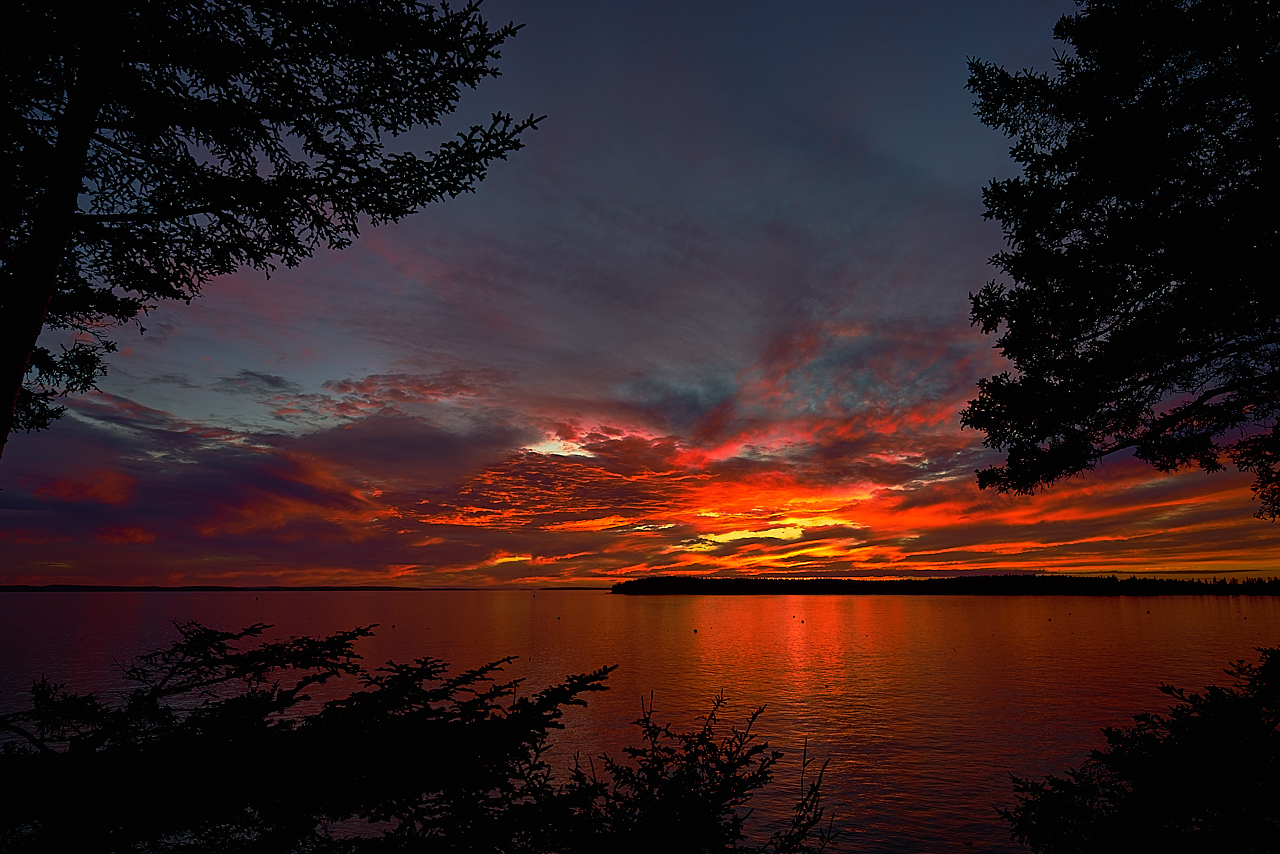
Carl Zeiss APO-Sonnar T* 2/135 ZE @ f/5.6, HDR (1/10s, 1/40s, 1/160s) ILCE-7 @ ISO 200
[no matter what I do, there is no way to get same intensity of blood red sky I did see in front of me shooting this]
Samuli
|