Can anyone suggest a portable (Not Studio) off camera Flash situation for shooting singles couples or small groups at places like clubs or art galleries. I am trying to come up with a different look for my shots that dosen't have that on Camera passport look! but all I can think of is an assistant holding a small unit off to the side. Has anyone ever tried anything like this on a location job?
You could hold your camera in your right hand and your flash in your left hand and high up. Just use a TTL cable and dial in whatever balance of flash-to-ambient you like. It's how I've shot nightlife events the few times that I have.
Two things one get a camera bracket that holds the flash further away for the lens or get a lite 6-8' light stand and carry it with you drop it snap the shot pick it up and move around.
Second setup strobes so that it lights the areas where you will be shooting by bouncing it or bouncing you on camera flash and using a second as a fill on a stick. I think it David Hobby that puts his flash on a monopod and points down so that it will hit the subject with his off hand and shoots with his main hand.
I use a flash bracket(current is a Stroboframe ProT that I got off eBay) I will use the monopod some next week I expect and maybe even the light stand also.
The things you need to consider when moving a single flash off camera are:
1) will there be light in both eyes even if the face is turned away from the light?
2) where will the nose shadow fall on the face?
3) how dark will the shadows be?
Dark eyes, and dark sideways nose shadows are not flattering. To move a flash off camera and it create flattering facial it first needs raised it enough so the nose shadow falls downward, not sideways in portrait mode, and winds up in a position where it either models the nose perfectly (i.e. shadow falls over 1/2 the nose) or hangs off somewhere it isn't noticed.
If you put a person in front of a window or any light source and turn their face to the light you'll find the most natural modeling of the face occurs when the light source is about 45 degrees from the nose. When the "key" light is 45 degrees from nose it will illuminate just the front planes of the face putting good light in both eyes and modeling the nose with a shadow that falls right along its base, where it hits the recess of the cheekbone, and down over the top of the nostril.
The problem with respect it a single flash is that its IMPOSSIBLE to place a single flash at a 45 degree angle to the nose and front of the face at normal shooting distances. So as a result when flash is just hung out to the side a foot or so the shadow from the nose hands out to the side. Raising the flash a foot or so and off to the side makes the nose shadow fall down to the side where it is less distracting position-wise, but it will still be very dark because there is no source of fill.
The more effective single flash strategy is to simply hide the nose shadow under the nose where it really isn't noticed and thus doesn't really matter much perceptually if it is dark and unfilled as it would when hanging across a brightly lit face. So by simply raise the flash straight-up above the lens by about 12-18" its possible to get very flattering lighting without any shadow from the nose distracting from the more important eyes and mouth...
If you want true short lighting on a face in a candid situation its necessary to use a second flash in order to position it 45 degrees from the nose. That's actually simpler than it might seem if you put the off camera flash on a wheeled stand. I use a converted IV stand. To take the shot below, I noticed the guest of honor at his going away party would be talking to the people for a few minutes so I wheeled the off camera flash around until I could see his face obliquely from behind the flash stand (literally seeing where the light would fall on his face) when he was facing the tall guy - 45 degrees from his nose -- then I walked back over to the other oblique side of his face and waited for him to look at the tall guy again. Totally candid and unposed, but dramatically lit in a way not possible with a single flash.
I place a high value on flattering facial lighting and if I can't orient the face to the key light in predictable / controlled way I switch strategies to rim-light + frontal fill. That's where the placement of the flash over the lens on a bracket is very valuable because it provided flattering downward modeling of the face without a distracting nose shadow. Placement of the off camera flash behind the subjects isn't critical so the technical aspects are really a no-brainer:
Raising the fill prevents the flat "flashed" look and the rim light creates the illusion of 3D via rim-light which defines the shape and provides separation. Often when a group is posing for someone else facing them, I'll slide over the side at a 45 degree angle and capture them in a more flattering oblique view with the same rim light strategy.
With one flash on a bracket and the other on a wheeled stand its very simple to switch back an forth from one or two flashes as the situation and needs dictate. I use ETTL mode for the flashes because its simpler. Once FEC is dialed in the flashes can be moved around without much thought given to how to set the exposure. The camera metering isn't always perfect, but via the simple expedient of monitoring the over-exposure warning and histogram when shooting its easy to keep the exposure in the optimal range and avoid blowing highlights.
Thanks Chuck, Those are some great shots! they are all far superior to the average on camera flash shot! I am going to look into your bracket Idea for my own use, as it still allows me to be somewhat more mobile than with stands, Thanks again for the PIC'S and thanks to shatterkiss and Michael White for your excellent ideas and help also.
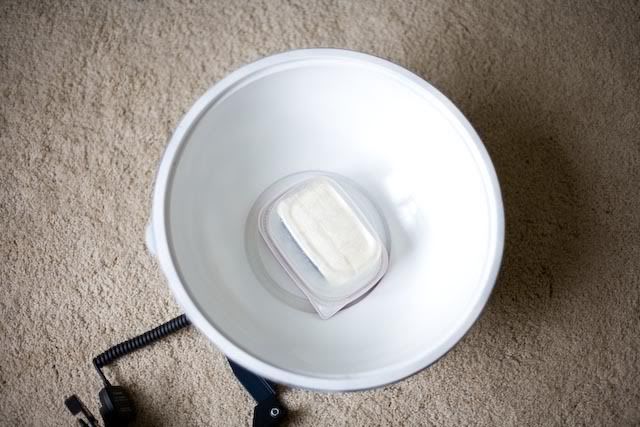
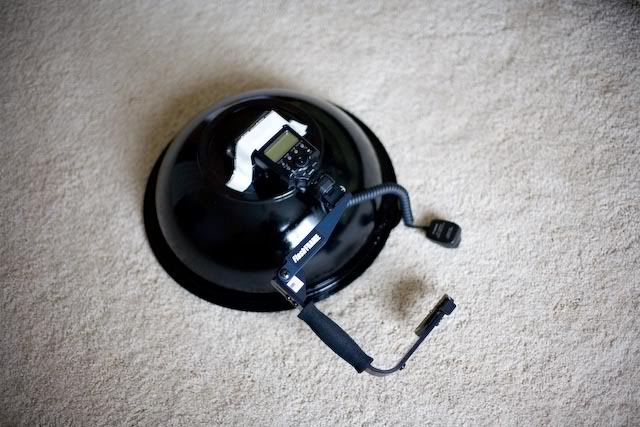
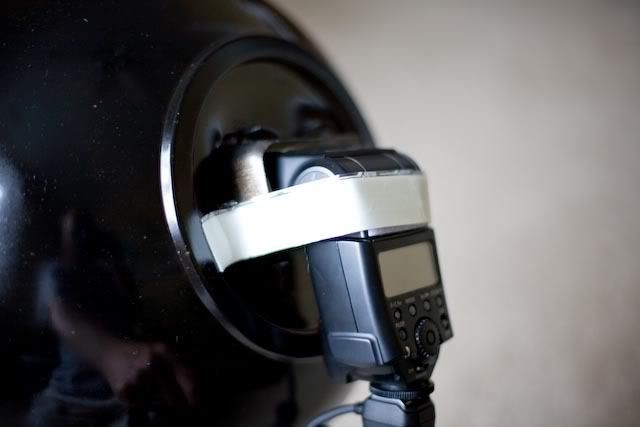
I use a speedlight and a homemade beauty dish on a light stand. It's very light, compact and easy to pick up and move around. The only issue would be using it in a crowded room. Here's what the result looks like.