Anyone up for a little pseudo-scientific comparison testing?
I took the Canon 1N with 24-70/2.8L, and the Contax N1 with 24-85/3.5-4.5 for a little spin in overcast conditions. Film was 35mm Ektar 100, processed as 18MB TIF by Simi Valley Photo Lab.
The images have been mildly PPed in LR4 to try to bring them a little closer on WB and exposure, but not drastically, as you will see obvious differences and tendencies.
Why? I'm trying to decide if I want to convert a couple Contax N lenses to Canon AF, or whether to keep the Contax N1 bodies I have on hand, or sell them all off and abandon the effort. Right now the Zeiss 24-85 and 70-200 are a bit redundant, but if they are stellar and provide an obvious advantage over Canon offerings, I'd keep them and proceed to the conversion(s).
Lenses were shot at the same focal length from 24-70, and matching apertures. Focus target is usually an identifiable object in center: tree, sculpture, patch of lawn, etc. Apertures were between f/4 and f/8, matching for each camera on each subject.
Initial observations:
The Canon is sharper at all focal lengths, especially the edges/corners.
The Zeiss is pretty bad on the edges for sharpness.
The Zeiss lens has more neutral balance and higher contrast, producing a "punchier" initial impression.
The Canon runs toward "ruddy" color balance and lower contrast in the shadows (almost a "fogging" effect). (But Canon images can be adjusted for contrast and color; the Zeiss can't be improved easily for missing sharp details.)
Contax center AF/metering sensor is quite a bit larger than the Canon, which meant less precision in AF and exposure in evaluative mode.
Contax tended to run "hotter" placing exposure time 1/3 to 2/3 stop faster than Canon.
Canon has much better close focus capabilities.
In general, Contax tends to slightly front focus, Canon tends to slightly back focus. The Contax is more out of spec for the target chosen.
The jury is still out. I want to run at least one more roll through each camera in sunny situation.
On with the show, Contax images first, followed by Canon:
(This first image had slightly more PP for the Contax, with dodging on the left side using the shade feature.)
Fuji Global wrote:
Fujifilm Professional is stopping production of its Fujichrome Velvia 100F in 35mm, 120 and 4x5 formats, and Velvia 50 in 4x5 and 8x10. However, Velvia 50 will continue to be distributed in 35mm and 120 formats.
I don't think anybody will miss Velvia 100F - Velvia 100 is an awesome film with better colors that scans really well.
I am a little surprised Fuji would bother keeping the 35mm Velvia 50 if they discontinue the larger format stock. I am glad it's around in 120 still, but any time I would turn to Velvia these days, I think I would go straight to 100.
corposant wrote:
I don't think anybody will miss Velvia 100F - Velvia 100 is an awesome film with better colors that scans really well.
I am a little surprised Fuji would bother keeping the 35mm Velvia 50 if they discontinue the larger format stock. I am glad it's around in 120 still, but any time I would turn to Velvia these days, I think I would go straight to 100.
Remember that they tried to kill 50 once already, but users rebelled as they didn't like either of the 100's.
I always wondered about Velvia 50 and who would buy it, when Velvia 100 has or is supposed to have the same color and contrast, same resolution, but with finer grain and much better reciprocity failure characteristics.
plus, supposed to and actually do are different. there's a reason I prefer J. Herbin's Poussiere de Lune over Caran D'Ache's Storm when most people would just pass them off as being the same color. Same with these two films.
edwardkaraa wrote:
I always wondered about Velvia 50 and who would buy it, when Velvia 100 has or is supposed to have the same color and contrast, same resolution, but with finer grain and much better reciprocity failure characteristics.
Check out the data sheets - they aren't really the same film, but they are close. Velvia 50 should be a little less grainy and a touch stronger greens - but in practical use... who cares. The one thing I have definitely noticed is how much better V100 scans.
corposant wrote:
Check out the data sheets - they aren't really the same film, but they are close. Velvia 50 should be a little less grainy and a touch stronger greens - but in practical use... who cares. The one thing I have definitely noticed is how much better V100 scans.
Good to know that. I have about 10 rolls of each that I'm going to shoot next week during my vacations.
However according to the data sheets, Velvia 50 has RMS 9 while Velvia 100 has RMS 8, with similar resolution numbers (160/80) so I would expect Velvia 50 to be grainier than the 100. Color wise, I have no experience with the 100 but the 50 was sometimes too greenish.
"I always wondered about Velvia 50 and who would buy it, when Velvia 100 has or is supposed to have the same color and contrast, same resolution, but with finer grain and much better reciprocity failure characteristics."
Never was a fan of Velvia 100. Tried it and it just never measured up to 50. Yeah, it had slightly finer grain, but 50 was actually sharper and there's just a look to 50 that is it's own. Personally, they all scan the same, meaning one flavor isn't more or less difficult than another.
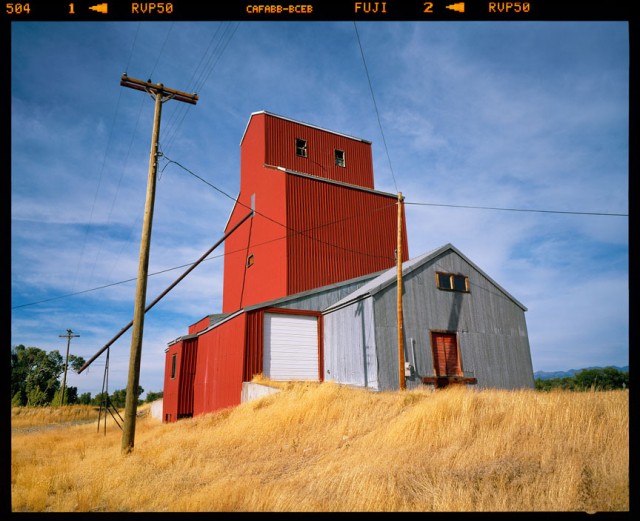
Here's a Mamiya 7 50mm shot from Clyde Park, Mt. from last fall. I shot this both on digital and on Velvia with the Mamiya, and I like the rendering on the film much better.
I scanned a Velvia for Corposant (Mike) last week that maybe he'll post. Now that one was a challenge as we were trying to pull as much shadow detail out as possible, and that's never an easy thing to do, but the difference between the film on a Just Normlicht box and the image on screen was dramatic. I'd say on that one we probably hit the limits of the pmt's in pulling out shadow detail.




 ordering some from Japan this next week