Whatever happen to the one light studio thread? If noone knows, can we start another? To see how creative everyone can get with one light is pretty awesome! So lets see em'
Try putting your key light behind your chess piece about 135 degrees off the camera angle.
Classic portrait lighting, with the key light in front at 45 degrees isn't the most effective still life lighting. One of the axioms of lighting is "shoot into the shadows to reveal the shape and texture". The exception to that conventional wisdom is a human face, mainly because of dilemma its shape creates. To both get light in the recessed eye sockets and model the shape of the nose with its shadow in a pleasing way the key light must be placed in front, either at about 45 degrees or high at 0 degrees directly in line with the nose in a full-face pose.
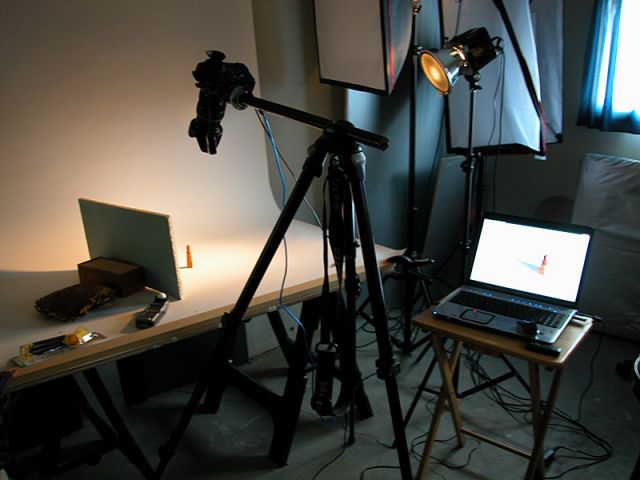
If the subject doesn't have a human face (e.g. pets, still life, etc.) the combination of back-side lighting and camera axis fill (for even illumination of the frontal detail in the shadows) is better for revealing shape and texture. This is a test shot I made with a pair of 580ex flashes when I first got them; one behind and to the left as key with fill on a camera bracket over the lens:
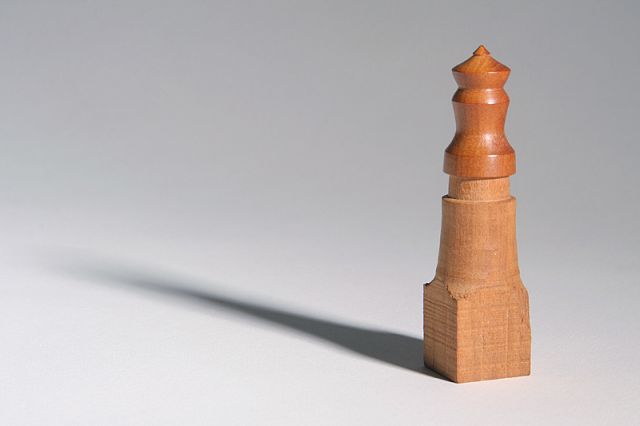
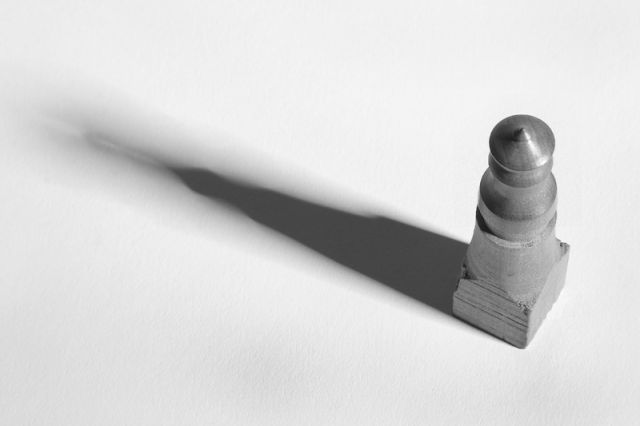
Thanks Chuck, I'll definitely give that a try. I was kind of getting into the gradiant in the background and the shadow cast by the single light source with that setup, although the result is hardly groundbreaking... I was pleased with the top-down B/W shot though.
I think visual examples in threads like this are much more useful than arguments over who's got the best, most, and most expensive set of stuff..
Informative as always but how does all this pertain to a One Light Set up?
How would a back lit chess piece with a reflector fill card be an improvement on his shot?
Albert,
Making the shadow a central element of the shot works for me.
BTW, you can control your shadow edge some by using grids and adjusting your light distance.
I like your angle and gradation in #1 and the use of B&W in #2 which simplifies the elements and creates a strong interplay of shadows.
Loved the One Light Set Up thread. Hope this one does as well.
Carmen Miranda wrote:
Informative as always but how does all this pertain to a One Light Set up?
How would a back lit chess piece with a reflector fill card be an improvement on his shot?
Well he also mentioned interest in two light set-ups. The jist of my message was to point out the difference between frontal and back lighting. People accustomed to shooting portraits often keep the lights in front out of habit and never to consider backlight as an option.
As for your second question, again the point was simply to suggest a different set-up with backlighting so Albert could see the difference it makes himself. It would certainly make the chess piece look different, don't you think?
My photos were just to illustrate how backlighting reveals shape and texture - technical cause and effect - Whether a chess piece looks "better" or not is a subjective judgement each person would need to make. I rarely shoot with one light and didn't have any one light still life examples on line. The studio shot was just one I also had on line I included for comparison. Here's one (sun) light shot with subject / shadow interplay for you to keep me on topic, and you in your self-appointed role of forum administrator happy
BTW - It illustrates that if you are going to use a shadow as a secondary center of interest that works better when the shadow is distinct and depicts a mirror-like image, which creates the symmetry and compositional balance. A shadow of a chess piece that doesn't look like a chess piece doesn't create that illusion or balance.
cgardner wrote:
Here's one (sun) light shot with subject / shadow interplay for you to keep me on topic, and you in your self-appointed role of forum administrator happy
Chuck
Just trying to pump up the thread, Chuck. I'd rather see your stuff than mine anyway.
Nice shot.
Thanks guys, while I liked the refraction effect in the shadow caused by the grid on the B/W shot (or whatever the optical explanation is for it) and would have otherwise been just another shadow shot, the diffused shadow on the color one was kinda wimpy and figured a snoot rather than the grid might be the better way to go for a more well defined shadow..
heres a one light setup just before sun set.
[.img]http://michaelallen.phanfare.com/show_image.aspx?album_id=446189§ion_id=620534&hmi_id=34881556&image_version=6&rend=WEB[./img]
i used to meter for the ambient light, but now I have all my exposures in my head now depending on time of day, I just set my camera to the settings in my head, and adjust my mono light accordingly to provide the right amount of fill flash.
artillusions wrote:
Anyone using 1 light(maybe a reflector) to do portraiture work?? Please show
Totally - I'm all over that. Like Carmen, I tend to work simply (I'd even say quick-and-dirty) rather than getting too complicated. The images below were all done with a single strobe. In fact, none of them used an added reflector or anything else, except for the ambient sunlight in the first.
Great work again, Simon! On the ones that appear to be studio shots. Your 1 light, straight on slightly elevated? I tend to shoot w/ 1 light and use a reflector to the other side to get some fill. Problem I find is that I get a high ratio. Because I get 8.0 or so on main but the reflector only gives 2.8, and I have the reflector as close as possible. Anyone work with this or work around it??
Yup, in the second and third images the light is above and just slightly to camera right. In the third image the lens is literally resting against the underside of the softbox with both about 2' away from the model's face - I shoot that way a lot. In the second image it's a 5' octabox tabled over the model's head and angled back a bit, which is why it wraps her face so evenly - the diffuser is really close to her and just plain huge by comparison. I was trying to get a soft window-light effect with it.
I've definitely found that a reflector has to be more or less on top of someone to have a measurable effect, especially if it's a smaller collapsible model. I think a lot of people make the mistake of going too small with reflectors. In a portrait shoot, if I'm shooting head and shoulders and trying to bounce light back into a subject's face, I'll put the reflector as close as possible while still being out of frame.
Not really one-light shots (sorry for going off-topic!), but here are two behind-the-scenes shots showing where the reflector lived in each. First one was just an assistant holding a piece of foamcore to knock down a shadow in a test shoot:
And this one was a single key light with a reflector filling in under the chin and in the eye sockets. The two reflectors hanging to the sides of the model are actually both black, so they're there to suck up light and enhance the contrast on the sides of the model's face - not reflecting at all.