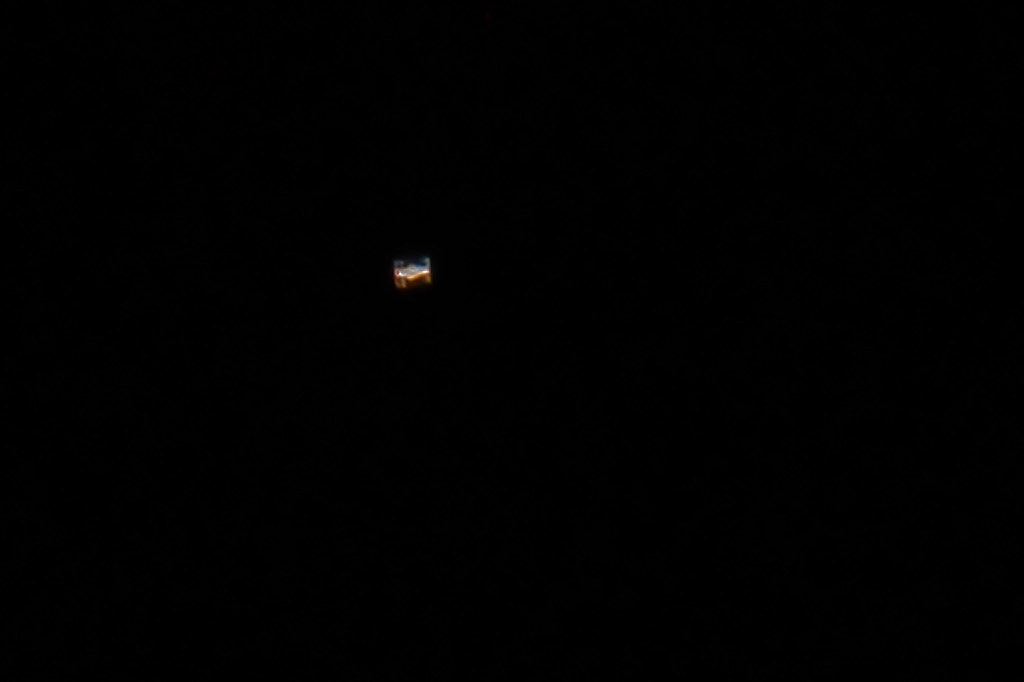
p.1 #1 · A hand held attempt at the ISS with the 400 DO II :)
I was planning to stack three 2x TCs on my 400 DO II (to make 3200 mm, f/32) for this bright pass of the ISS over our islands a couple of days ago. But silly me, I forgot my bag containing two of the doublers in another place. So I had to make do with a single doubler.
ISS OVER NORTHERN PHILIPPINES , November 29, 2015, Bacnotan, La Union, Philippines (05:20:25 local time, maximum magnitude = -3.40).
Shooting info - EOS 7D MII + EF 400 f/4 DO IS II + EF 2x TC III, 800 mm, f/8, ISO 640, 1/800 sec, manual exposure, prefocused on the moon using CD AF then switched to MF, hand held, IS Mode 1 engaged.
Interestingly, the solar panel at the upper left has a different color compared to the rest of the panels. I shot 104 frames and such color is present in all the captures. Anybody has an idea why?
p.1 #7 · A hand held attempt at the ISS with the 400 DO II :)
Awesome. Always check sky view to make sure the ISS and Hubble don't get into a fender bender because they get pretty close to each other from time to time . We'd like to try that up here but we would have to shoot through the planet.
p.1 #8 · A hand held attempt at the ISS with the 400 DO II :)
Very nice, Romy!
As for the solar panel color, I'm just going to speculate that it is at a different angle than the others (for reasons that would be beyond any meaningful speculation on my part).
p.1 #13 · A hand held attempt at the ISS with the 400 DO II :)
ClausC wrote:
Looks good, you will get lot of diffraction at f/32.....
Yup, for sure. But I'd still stack the 3 doublers on the next bright pass. I've already noted the exposure settings - f/32, 1/400 sec, ISO 5000, prefocus on a planet or the moon atop a tripod using MF, then dismount the rig for hand holding, IS on, shoot long bursts to get at least one without camera/motion blur.
p.1 #14 · A hand held attempt at the ISS with the 400 DO II :)
paulfeng wrote:
Very nice, Romy!
As for the solar panel color, I'm just going to speculate that it is at a different angle than the others (for reasons that would be beyond any meaningful speculation on my part).
What puzzles me is that the color is there in all my 104 frames, starting when the ISS was lower in the horizon until it was almost overhead. Surely, the angle of reflection of sunlight must have changed through the 45 degrees ++ flight arc?
My domestic boss says the color is orangy (I'm color-blind of course), so I joked with her that perhaps the panel is starting to have rust even in a low-oxygen environment.
p.1 #18 · A hand held attempt at the ISS with the 400 DO II :)
I was thinking maybe it had a gold plated backing on one side and that panel had the gold side toward you. I wonder if you would have better results attaching a body to a telescope vs a 400mm with 3-2x converters?
p.1 #19 · A hand held attempt at the ISS with the 400 DO II :)
OK, I just have to try this.
If I were to shoot this with a 1.6 cropper body and a 100-400 II lens on a tripod what settings would give me the best chance of getting something worth while? Or would I not have enough reach @ 640mm?
p.1 #20 · A hand held attempt at the ISS with the 400 DO II :)
JohnBrose wrote:
I was thinking maybe it had a gold plated backing on one side and that panel had the gold side toward you.
That seems plausible.
JohnBrose wrote:
I wonder if you would have better results attaching a body to a telescope vs a 400mm with 3-2x converters?
Sans exotic mounting and tracking equipment, using only a gimbal or heavy duty fluid head, I think my (dream) lens of choice would be an SLR lens with the biggest diameter glass. That would be the 1200 5.6L (214 mm diameter), or as a second choice the Siggy 200-500 2.8 (179 mm dia.). I'd stack TCs on either till f/16 or so, with a 7DII. IMHO, the limiting factor in such an ISS shot is the atmospheric seeing conditions, which affects system resolution much more than diffraction.