Skarkowtsky 
Offline
• • •
Upload & Sell: Off
|
I'm posting this quote objectively. I find it appropriate for this thread, and downright interesting about the history of photography--which we all love.
Cited from a book entitled Hometown U.S.A: A study of what life was like 75 years ago. Copyright, 1975.
"The number of men and women in that profession was surprisingly large; of a nationwide total of 31,775 photographers listed in the 1910 census, more than half, 16,700, were based in small towns. Their beat was succinctly described in an advertisement placed by L.E. Lindsay and J.L.B. Smith, partners who worked out of Nashau, New Hampshire. The Lindsay & Smith studio assured the public that it was prepared to produce "Views of Homesteads, Interiors, Public Buildings, Family Gatherings, School Classes and Groups, taken to order in short notice." Most such photographers found it necessary to roam beyond their home base to generate enough business to support themselves. Theodore Teeple, for example, maintained galleries in Ashland, Wooster, and Massillon, Ohio, requiring him to journey some 50 miles to cover all three. The Howes brothers of Ashfield, Massachusetts, were even more itinerant, spending their entire summers criss-crossing the Connecticut Valley by horse and buggy from Hartford nearly to the Vermont border to pick up commissions."
"A substantial number of pictures made by talented amateurs will also be found on these pages. For some, photography was a hobby that led them to experiment with a variety of cameras and materials; for others, the fun was less in the technique than in the subject matter. Mrs. Jeanette Bernard seems to have been in the latter category...Nearly all of her pictures were taken in or around her home--in the kitchen, on the back porch, in the yard by the grape arbor, in a nearby wooded area..."
"Commercial photographers rarely had cause to take pictures of such "ordinary" scenes, and so our visual record is dependent on the amateurs like Mrs. Bernard who had the wit--and the talent--to make the everyday interesting."
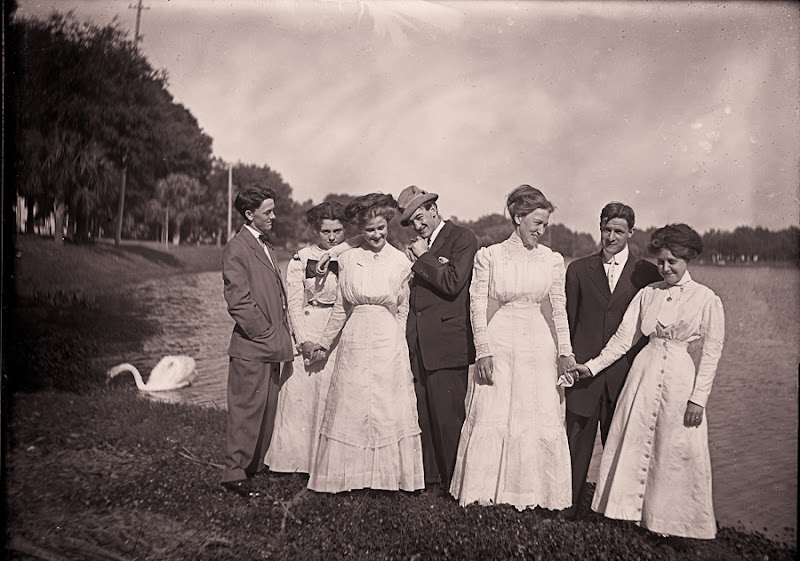
Seems like photography was all over, and it would be difficult for us to qualify Doug's glass plate as professional or amateur, as everyone working with the medium in an era when an understanding of mathematics and chemistry was required could produce such a photograph.
Let's just leave it alone as a great photo?
No, I did not go to the library just for this, haha. I just happened to receive this book by mail this afternoon, as I've taken an interest in Edwardian American society.
Ok, no more geeking out, I promise!
|