p.1 #1 · first post, wife and I are trying to learn...CandC?
Well, we went down to the park, had a couple shots I wanted to try...but I forgot to charge the battery last night, so, didnt quite make it to those I had been imagining.
Also...i am still trying to figure out the picture stuff...but unless I am wrong it looks like I can not actually post photos...and so probably wont be welcome here unless I pay t join? I will keep reading.
We are not very good at composing shots, and I am even worse at editing them...lol. Anyway, here are three we felt were moderate, though none are winners, for sure, and I was wondering how you might improve composition, just give up on them as they are, or edit for better quality? I have tinkered around with the tone curves and done a little cropping in some, boosted saturation in pretty much everything....anyway, let me know what we are doing wrong, hoping to improve!
p.1 #2 · first post, wife and I are trying to learn...CandC?
You can absolutely link photos here without joining, but you'll need to do it just a little bit differently. There should be a little icon that looks like a mountain ... if you click on that and insert the URL to your photo in there (one at a time) it should pop up.
Like so: (I just clicked on "grab the link" from your flickr page, and I had to look at the BB HTML code to extract the actual picture URL rather than a link to that page. ALso, try to post larger, like 800 pixels on the long side)
I think your "walking through the woods" images would be better if you could see some faces, personally. The water picture is interesting but because you put the waterline smack in the middle of the frame, it's hard to tell what you're supposed to be looking at. The eye wanders, like an Italian politician, so to say.
p.1 #3 · first post, wife and I are trying to learn...CandC?
TrojanHorse wrote:
The eye wanders, like an Italian politician
I like the use of the tree branch for framing the subjects. Would have liked to seen a bit more negative space below the people compositionally, and probably a slightly tighter crop, as they are a bit small in the scene. PP-wise, they are slight touch oversaturated to me, but you're off to a good start ... I can at least get a sense of your vision, even though the execution is a work in progress (as it is for everyone starting out).
p.1 #4 · first post, wife and I are trying to learn...CandC?
I have a web site full of tutorials, including one on composition, you may find helpful: http://photo.nova.org/
A analytical photojournalist rather than artist by temperament I approach photographic composition as I do writing a story or telling a joke. It is said a photo is worth 1,000 words, but most effective stories told in photos are more akin to a well constructed sentence or one-line joke than a short story and the problem is the photographer needs to arrange the content in the photo so the word picture formed in the brain of the viewer is what they intend. Which composition decisions wind up telling the story as intended starts with knowing yourself what the storyline and punchline are before taking the photo.
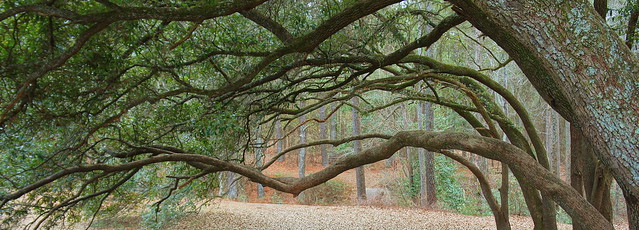
When composing a photo or critiquing one I ask myself what is most important to the message and how much background context is needed to convey the intended message. After identifying the center of interest where I want the viewer to wind up dwelling on and returning to I zoom in tight on it, literally with the lens or figuratively with imaginary cropping guides, then slowly expand the frame from the focal point outward, adding more and more context to the story. At some point in any photo when there is as many pixels devoted to the background as there are to the focal point the storyline shifts from being focal point centric to context centric. Your first and third shots are good examples of that. It is more about the environment than the people.
Comparing those two shots in the similar setting which do you think tells the story more effectively? The one with the figures centered in the frame or the third where they are off to the side? I find the first more effective because what is more interesting to me than the people is the pattern of the overhanging branches forming a tunnel they are walking down. That tunnel imagery is lost in the third shot due the way it is cropped. The image of a tunnel in the first shot would have been even stronger had you cropped a bit wider and included all of the arch of the first tree in the foreground.
In the third shot the tighter crop shifts more of the focus to the people which are slightly larger. What makes it interesting to me, despite the backs being turned, is how the tilt of Mom's body is matching the bend of the tree they are looking at in the background. That relationship is easier to see if all the other distractions are removed from it...
How did I find that relationship? By first cropping in tight on the figures then slowing expanding the frame and exploring different crops to find some storyline more interesting than the backs of two strangers.
That also raises an issue to consider when shooting photos you plan to share with strangers like me, the role personal experience plays in how one reacts to a photo. Your reaction those two photos will differ greatly from mine because you know and love the people whose backs are turned to the camera and I don't. So for starters we are judging it with a different set of subjective emotional filters. After looking at the first wide establishing shot and my "medium" crop of your third shot I still have not related to the people because I haven't seen their faces. So what you need in that sequence is a third shot, with Mom and kid, faces together, sitting in a big pile of leaves on the ground, looking up in the camera. That's the missing piece, the "punchline", needed here to complete the story of the the kid's first walk in the woods for me. Then if forced to pick one one of those three shots to convey the story the choice would be pretty obvious — the one with the smiling faces.
The problem I have with your second shot is that it lacks any compelling focal point or difference between what is seen in the reflection and the actual trees in the background. I find scenic reflection shots are more interesting when they contain some interesting content in the foreground for the viewer to find as they explore into the shadows....
In a photo like that one, composed similarly to your first, differs in that there are multiple focal points. It's a more complex story and the challenge compositionally is trying to predict and control which order the viewer will see them when composing the shot. For example did you notice the Lincoln Monument in the background or the ducks in the foreground first? Your reaction would differ whether or not you've ever been to Washington, D.C. (or seen Forest Gump) and recognize that it is the Lincoln Memorial seen on the back of the $5 in your wallet. My intention in composing and editing the shot is that the viewer find the monument first and then follow its refection down in to the shadows to find the ducks. I tried to influence that by using the relative contrast of the white building vs. the dark ducks and water. The ducks were also kind enough to pose for me like the politicians further up Capitol Hill from that location
That's an example of what I suggested as the "missing" part of the story in your woods shot. Without first seeing the establishing shot of the ducks in the reflecting pool of the Lincoln Memorial for context the joke about the politicians wouldn't have worked.
The point to take away here is sometimes you can tell a complete story in one shot by including a compelling focal point (i.e. smiling faces) and background context, and sometimes you can tell the same complete story in a sequence of photos. When shooting I find it helps to think in terms of whether or not the POV in the shot works as an establishing shot, medium shot showing relationship of subject and location like my crop of your second shot, or a close-up where there isn't any obvious context an the focus is on the subject's or their actions. When you start thinking and shooting with type of storytelling in mind you wind find your photos start telling the complete story of your family outings better...
p.1 #5 · first post, wife and I are trying to learn...CandC?
cgardner wrote:
I ask myself what is most important to the message
+1 @ "What's the point" that you are trying to convey to your viewer.
Then use the tools at your disposal (capture / PP) to help you achieve and present your point to your viewer. The myriad of elements of composition, scale, color, focus, contrast, etc. are all such tools to help you, along with a gazilliion 'tips & tricks" to make "cool" pics ... but, knowing / understanding what your message is intended to be for your viewing audience is where it all starts, imo.
Imagery is a form of communication ... formulate the message in your mind first, then proceed to create & deliver it.
p.1 #8 · first post, wife and I are trying to learn...CandC?
Thanks for your feedback everyone! I just got home and wanted to give the thanks, some really amazing posts and feedback, though for some reason gardners pictures didnt show up, I will figure that out later tonight.
ou
Of note, I actually cropped some of the foreground out thinking that my wife and daughter (the subjects) were too small and wanted to keep the trees intact, but I will revisit my crop with my wife tonight and see what we can do to better emphasize the main focus. What I had in mind, though I had not completely developed the idea at the time, I will have to focus on that, was the age, in particular the aging process implied therein of the trees, in juxtaposition to the youth of my daughter to the *youth of my wife as they progress through time moving forward through the trees......or something silly like that I am still not 100% sure. Either way, I had no idea how to make it show up in a picture!
Also, thanks for the advice on saturation...I agree, though I had a hard time playing around with it. It was actually an HDR, but it needed more contrast, and I went crazy from there. Will work on it tonight and drop on into the competition for fun, though we dont stand a chance with the incredible quality out there!
p.1 #9 · first post, wife and I are trying to learn...CandC?
ahhh, sorry, felt this needed a separate post. I see the pictures now, and excellent job cropping everyone. We will revisit as well together and see what we can do, perhaps with a different but similar shot just so we arent copying anyone for the actually WA, though I am sure you guys have done better than we will
Thanks for the long post gardner, we will read through it all more throughly and check out the site later tonight!




 I am still not 100% sure. Either way, I had no idea how to make it show up in a picture!