Hello All,
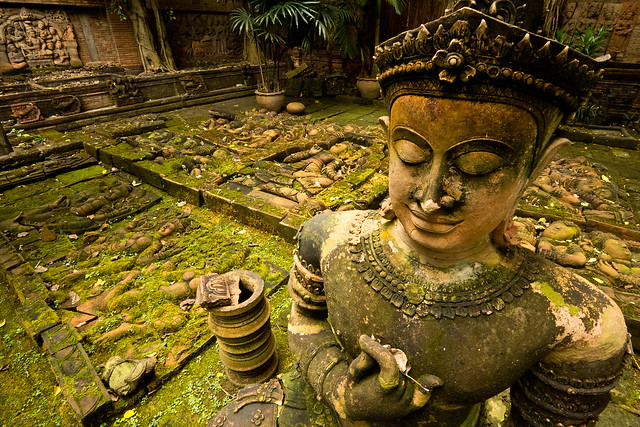
This is time I have posted a photograph on FR. I am still quite green when it comes to photography. I was hoping to get some more constructive criticism than the occasional flickr "favorite" or my fiance's "Oh, I like it!" Anything from basic composition to post-processing would be appreciated.
I was playing around with hyper-focal lengths and made this photograph in a hurry. It was shot handheld and therefor I shouldn't have shot it so stopped down. But like I said I was in a hurry so I just made 4 shots hoping the odds would work in my favor and I would end up with a sharp photo.
From the look this has, I'm guessing this was a wide angle shot? Maybe 10mm or so on a crop? I like how close the statue comes to being out of frame, but doesn't draw tension. You nailed that one. As for the back, theree isn't much that I'd like so sharp. I think f/6.3-7.1 would have been great.
Well Robby, this is a nice start.
You have an interesting subject who really knows how to hold a pose and is relaxed in front of the camera!
OK, OK. I dont mind the DOF here. While the statue is clearly the subject and captured with fine detail, there is much of secondary interest along the "ground", enabling my eye to take a bit of a tour while still returning to the subject.
This may be the best angle to shoot from with the lens you had, but I would have moved up and down, stepped back a bit to possible end up with a less "downward" capture of the statue and perhaps less lens distortion. I am curious about the EXIF.
Overall, I think this image works well to document the statue and the setting.
It's difficult to properly critique an image when it's posted this small. We usually suggest 800 pixels for the longest dimension. That said It may be a bit over-processed - hard to be sure on a small image. Also, seems to have a yellow cast to my eyes.
Jesse - You are exactly right ef-s 10-22 @10mm on a 60D. I took one other of the same scene at f/4.5 but even less of the statue was out of frame and I didnt like how the angle worked out.
Scott - When I walked into this place I was blown away by how it seemed to go on forever and I was trying to use the exaggerated perspective of the wide angle accentuate that. I see what you are saying though and I probably chose an angle that took it too far. I am almost embarrassed to post the EXIF because my settings we far from optimal for the conditions. We weren't really sure if we were supposed to be here or not so I took the photos far to hastily.
ef-s 10-22mm @10mm
iso 1600, f/22, 1/6 sec
manually focused at about 1ft and handheld
AuntiPode - It is a pretty "punchy." I also had a lot of trouble with the white balance on this one. Flickr only does 640 or 1024 and I was worried about post as big as 1024. Here it is at 800 along with the original soc.
Good to see you try hyperfocal distance shooting. It's one of the many techniques commonplace in the past that automation has caused to fall out of use. In the shot you posted my C&C would be that while the higher POV and off center composition of the foreground center of interest works here, a wider crop with more consideration of how the foreground and background elements hit the edges of the frame would have improved it. Here the foreground figure seems arbitrarily chopped off on by the bottom and the background by the top.
The carving on the wall on the far left is an interesting element, but so interesting it creates a ping-pong competition between it and the star of the show on the right. Here's an alternative to consider...
It includes the context but not in a way that pulls the eye off the main focal point as much. To put more emphasis on the focal point I lighten the tone of the background and also blurred it slightly. I also lightened the forehead of the figure a bit.
For those not familiar with the term shooting using the hyperfocal distance it requires knowing the DOF of the lens for a given f/stop then setting the focus distance so everything from a foreground distance to infinity will be in focus. The shorter the focal length of the lens the more DOF you can get at any aperture. With an WA lens the DOF at hyperfocal distance will render just about everything in focus so its a technic that can be used to quite literally "shoot from the hip" for street photography and situations where photography isn't allowed.
It was easier and more intuitive back when lenses had aperture rings and DOF lines corresponding the each f/stop etched and color coded to the f/stops as shown below on my old Nikon F and 85mm lens.
With a modern camera without the markings you need a calculator to know what distance to set focus manually or use the DOF preview button, another frequently overlooked technique nowadays.
Cgardner - You make a really good point about different aspects fighting for attention. Your crop still pulls you into the background but in a much smoother fashion it seems. Thank you.
rbn920 wrote:
Cgardner - You make a really good point about different aspects fighting for attention. Your crop still pulls you into the background but in a much smoother fashion it seems. Thank you.
That's due to the physiology of human vision. Our eyes move around a scene or photo in a series of saccades (quick jumps) and fixations between things that attract attention. In person we react to sound, movement and other stimuli a photo doesn't have. In a photo our eyes react to contrasts in tone, color, texture, etc.
In your original crop the carving on the wall on the right seen out of the corner of your eye when looking at the statue on the right is screaming to your brain "HEY COME LOOK AT ME" because it has contrasting texture that piques curiosity. So the brain tells the eyes to dart across the frame to look at it. That eye movement in the photo has a effect similar to how you'd react if you hear a noise coming from that direction and were startled. The stronger the contrast of the object moving the eye across the frame, the fast the eye darts across to find it and the greater the sense of tension there is in the photo.
One of the things that makes your photo work, and the detail on the right so distracting, is its narrow color palette and range of tone. When all the colors and tones in a photo are similar it will make other types of contrast, such as detail and relative sharpness of objects more of a factor in how the eye moves around a photo. In your original the statue attracts attention because it is a human face, large and sharply focused. The carving on the wall attracts attention because of everything else on the frame it has the most detail.
The other significant element that catches the eye is the column/post on the ground immediately behind the statue. It isn't as distracting as the carving on the right because your eyes can see it more or less at the same time as the statue without any rapid eye movement across the frame.
By removing the contrasting detail on the right with my crop I removed the reason for the eye to dart over in that direction so when it does wander off the statue to explore the background context it does so at a more relaxed pace creating a more harmonious sensation.
Once you become consciously aware of how this "ping-ping" dynamic in composition triggers a sensation of tension or harmony you can start to use it effectively to intentionally creating the impression of harmony or conflict between photo elements. For example if you want to depict a married couple fighting you'd want to compose the shots with one on either edge of the frame with an huge empty space in the middle. If you want to depict them as being very much in love you'd want to pose them together, heads touching with no gap seen between them. Compositionally the first would be competing centers of interest and the second unified centers of interest. The first forces the eye to jump across the frame to see both the second allows both to be seen at the same time.
It's not just physical separation which creates that type of reaction but also the degree your centers of interest contrast with the background. That's why in my edit I also lightened the background to make the darker statue contrast. Blurring the background has the same effect. The degree to were to blur it in that shot will control whether or not the viewer will be tempted to explore the background context.
I blurred it a bit in my edit to make the background a bit less compelling than in your shot, but not so much blur the sense of context was lost. That type of judgement on foreground / background balance via DOF control is often quite difficult to make when shooting. Cameras focus wide open with minimal DOF and when shooting other than wide open the resulting photo will have more DOF than seen when framing the shot unless the DOF preview button is used. Using the DOF preview button used to be more or less an automatic reflex for me back in the days of manual focused lenses like the ones on my Nikon F, but nowadays I just gauge the DOF at the shooting aperture it via the playback.