Nifty Fifty wrote:
What do you call that rhetorical trick when you put words into someone else's mouth that they never said and then contradict them?
"Straw man": https://en.wikipedia.org/wiki/Straw_man
RustyRus wrote:
Here is two recents- Both have pop to my eyes.
One is shot at f/8 and one is 1.4. The f/8 shot is much more pronounced IMO.
What says all of you? None? Some? Awful?
For me, the second shot (at f1.4) has more depth and therefore pop because of the composition. I count as many as 8 planes in the second shot, but only two planes in the first shot. The first shot also has pop, which I think comes primarily from the looming, enlarged quality of the dog and the dog's separation and angular variance from the person. But even if you see the pop running in the opposite direction, the differences in composition make it hard to attribute the pop differences to the aperture differences, as I think you mean to suggest.
RustyRus wrote:
Here is two recents- Both have pop to my eyes.
One is shot at f/8 and one is 1.4. The f/8 shot is much more pronounced IMO.
What says all of you? None? Some? Awful?
Since you asked... and with due respect to the photographer (no offence is meant):
The first picture could benefit from sky replacement, or if the sky had been enhanced. In the present form, it looks somewhat like (I can imagine) a picture one could take with a high-end smartphone camera, with little-to-no prost-processing.
The second picture I like more, but the fringing along the edges in the out-of-focus background is distracting. It is not clear if this is was produced by the lens, or is a LR-processing artifact. In any case, it doesn't look good in a professional photo.
ruthenium wrote:
Since you asked... and with due respect to the photographer (no offence is meant):
The first picture could benefit from sky replacement, or if the sky had been enhanced. In the present form, it looks somewhat like (I can imagine) a picture one could take with a high-end smartphone camera, with little-to-no prost-processing.
The second picture I like more, but the fringing along the edges in the out-of-focus background is distracting. It is not clear if this is was produced by the lens, or is a LR-processing artifact. In any case, it doesn't look good in a professional photo.
Umm...We where talking about 3Dpop in images.
Also you want me to replace an Oregon rainy day sky with what? Sunshine? Why even take the picture at all. No thanks. Thanks for the feedback even if we are just talking about 3d pop in an image (I think)
RustyRus wrote:
Umm...We where talking about 3Dpop in images.
Also you want me to replace an Oregon rainy day sky with what? Sunshine? Why even take the picture at all. No thanks. Thanks for the feedback even if we are just talking about 3d pop in an image (I think)
No, the "pop" I didn't see. The subject is well-isolated in both photos, this is true, as could be expected in these compositions. However, as far as this thread ("which lens has the most 3D POP?) is concerned, I don't discern an important contribution of the lens, only the use of composition to isolate the subject.
Regarding the sky replacement - I failed to make this clear that was a tongue-in-cheek proposal. I still believe that the sky could be dramatically enhanced in post and this could enhance the effect of the subject isolation. Right now, the subject is against a gray void and this doesn't enhance the sense of dimension or distance.
RustyRus wrote:
Umm...We where talking about 3Dpop in images.
Also you want me to replace an Oregon rainy day sky with what? Sunshine? Why even take the picture at all. No thanks. Thanks for the feedback even if we are just talking about 3d pop in an image (I think)
I agree. Replacing skies is no better than just using AI to generate the entire image. I can understand why people that will resort to replacing skies cannot see differences in 3d rendering between lenses.
Every week or so I keep checking on this thread to see whether someone finally posted two images of an identical subject taken by two lenses with the same focal length and aperture.
1. LEFT: 3D pop
2. RIGHT: no 3D pop
80+ pages and still.... zero. Just a bunch of shallow DOF snaps. Dear 3Dpoppers, even UFO fans are capable of presenting more evidence for their beliefs. On the other hand, your stubborness is strangely admirable.
old-gregg wrote:
Every week or so I keep checking on this thread to see whether someone finally posted two images of an identical subject taken by two lenses with the same focal length and aperture.
1. LEFT: 3D pop
2. RIGHT: no 3D pop
80+ pages and still.... zero. Just a bunch of shallow DOF snaps. Dear 3Dpoppers, even UFO fans are capable of presenting more evidence for their beliefs. On the other hand, your stubborness is strangely admirable.
Keep 3Dpopping! I'll check up on you next week.
Firstly…why should anyone prove anything to you. You obviously have made up your narrow view.
Secondly…most people do not have 2 lenses of the same focal length with the same aperture.
old-gregg wrote:
Every week or so I keep checking on this thread to see whether someone finally posted two images of an identical subject taken by two lenses with the same focal length and aperture.
1. LEFT: 3D pop
2. RIGHT: no 3D pop
80+ pages and still.... zero. Just a bunch of shallow DOF snaps. Dear 3Dpoppers, even UFO fans are capable of presenting more evidence for their beliefs. On the other hand, your stubborness is strangely admirable.
Keep 3Dpopping! I'll check up on you next week.
Understood ... I have no duplicates in my kit. I was thinking about the VM 75/1.5 that I used to own (swapped) in relationship to my M 75/2.4 as a potential comp, too.
Certainly a variety of scenarios that might showcase the differences well, but folks have to have those lenses. And, generally speaking folks who have the ilk for one kind, don't often buy duplicates of the other kind.
I did do a shootout with my 28's (Nikon AIS, OM, C/Y) back in the 2009 era thread, back when I had some dup's. The C/Y won the day on that one.
LBJ2 wrote:
F8 is one of my own 3D Pop stress-tests for a particular lens and this lens/this image has it at F8 ✅
Agreed.
Stopped down performance that renders well is a different matter from skinny aperture / mfd / bokeh monsters.
As to the images, these two have plenty ... and have a bit of the "cutout" look to them. This occurs mostly when the glass is very capable, coupled with a large expanse of spatial distance between subject and (nearest) neighboring elements.
While I'm not a big fan of the "cutout" look, it is an indicator of strong acutance in the optic, likely well corrected. Meanwhile lenses with more SA in them will render a bit different. In addition to the aforementioned perspective of element size relationships, there is the matter of Spherical vs. Aspherical elements being used in the design. My observation is that ASPH elements tend to have less SA, and thus better acutance (generally). Balancing that relationship is a design choice(s). Other glass types as well, are in play.
While there are a vast combination of variables in play for optical design. How much / which element(s) kind a designer puts in play is a craft unto itself (craft beer / craft lenses), as well. As a means of correction, there is more than one way to skin that cat ... but the acutance and the transition rates play in harmony with each other.
Also, each lens will have its sweet spots / optimized / etc. so learning where that lands (infinity / portrait) and harnessing it can be learned with time spent with a given lens. This is also why I'm not a fan of the MFD bokeh monster as a measure of comps ... I mean, which lenses are truly optimized by the designers for MFD performance? Yeah, think about that ... showing different lenses at their weakest point in the design, doesn't really trip my trigger as telling the story I want to know about a lens. Which kinda takes us back to your point about stopped down performance test (at an appropriate distance).
BTW, I find it interesting that the OTUS shot at MFD for the fence didn't do much for me. Yet, the OTUS shot at distance presented "cutout" ish. Back to the point that MFD isn't a good indicator ... and go figure the odds that the same lens would be presented bang-bang by two different members at such different use case.
Here's a nothing pic ... just out learning the new lens. Stopped down a bit to f/6.8
For my temperament, it's not quite as rapid transition as some others, but my eye perceives it well. While not a "Most Pop" aggressive, candidate, but it renders a "natural" transition presence (mild "pop", if you will) I like. Pretty flat lighting, also.
Kinda like how some craft beers are VERY Hoppy, and some folks like just a little "less" hop. Everyone's palette (visual included) is different, both in what they like and in their ability to differentiate and discern (gross vs. subtle, etc.) their sensory experience(s).
You might wonder: why the talk about bokeh in a 3D thread? Because technically, the image is arguably all bokeh, once the viewing eye leaves the focal plane. The literature refers to a simple dichotomy in the images: in-focus and out-of-focus content.
The problem with this schema is that it is not technically correct (at all) nor can it even be universally agreed upon. Bokeh is a gradient of focus fade, the degree of blur increases steadily (more or less) from near to the best the lens can deliver – adjacent to the focal plane – to eventually reach its zenith, given the configuration that led to the image composition.
Photographers freely use the term ‘bokeh’ as if all there is perfect understanding of what is meant by it. While highly imperfect for the job, the slanting fence images above show the journey image content makes on its way out of focus, as it gradually escapes the orbit of visible content. The effect is minimized when using small aperture settings like f8, or f11, with few of us using f16 these days.
The important point to realise here is that most images consist largely of bokeh, in a technical sense at least. But we can be more descriptive and more aware by breaking down the ex-plane content: there is a transition zone that starts immediately upon departure from the focal plane.
The end of the transition zone is reached when each viewer decides the fade effect has reached the state of what is currently called ‘bokeh’ – this is the beginning of the ‘bokeh field’. We might even divide the bokeh field into two sections: entry or light bokeh, and deep bokeh. So that would give us a conceptually useful schema of three separate sections of ‘bokeh’.
The little mentioned transition zone has serious implications for image appearance. Because the range from the focal plane to the deepest bokeh is a *fixed quantum* in any given composition and hardware, if you shorten one section, you extend the adjacent section – like robbing Peter to pay Paul.
Despite what you read in some places, lenses vary considerably in their rate of fade, and this is consequential for the presentation of DOF – which brings bokeh into the discussion of 3D dimensionality as a major determinant of image depth. If you like, the transition zone trains the viewing eye to adjust from seeing sharp content to a kind of grey zone before all content becomes indisputably blurry.
In other words, the transition zone sets the stage for bokeh to fill the rest of image in longitudinal space. It also starts the process of shape recognition and the style of ‘drawing’ of content.
Each lens has its own ‘signature’ as to how and what it delivers from the image to the sensor. All lens makers are trying to develop and popularize their lenses ‘look’ as something different from the others.
At the heart of the topic is the fact that ‘bokeh’ is a construct that is alien to natural human vision. We cannot see out-of-focus content in our visual field, except as a part of the field that is ‘not being looked at’ - it now resides inside the shadowy world of peripheral vision, which is sensed as much as it is ‘seen’.
A lot of brain processing takes place in producing our vision, and this happens before we consciously know we have seen something – it is subliminal. Instantly, the brain strives to ‘make sense’ of the visual field. This is an adaptive state in which we unconsciously accept what we ‘see’ and we seem to do this uncritically. Our tolerance is very high for departures from expectations.
The issues surrounding 3D are made more urgent thanks to the very large number of fast lenses on the market, now well within reach of most consumers. We have f2 and even f1.8 zooms, and lens producers rush their superfast lenses to market ahead of their more regular lenses. Many users use their f1.2/f1.4 lenses wide open all, or most, of the time, so 3D is now far from what it was 20 years ago when most of us wanted the effect in deep images shot at mid-to-small apertures.
chez wrote:
Firstly…why should anyone prove anything to you. You obviously have made up your narrow view.
You know the answer. Because you want to prove it to me. You're desperate. The educated skeptics don't bring any energy into the temple of 3D pop or Jehovah's witnesses or whatever. We come here to feed off yours. As I said above, blind faith is strangely entertaining. See? We're on the 80th page already.
chez wrote:
Secondly…most people do not have 2 lenses of the same focal length with the same aperture.
This sounds like a totally plausible explanation for why 3D pop never made an appearance on the Internet.
Despite the obvious differences in Marc’s rail focus-fade tests above, it ought to be clear that lenses vary ‘a lot’ in
(i) the on-axis length of their transition zones;
(ii) the rapidity of the introduction of their bokeh fields; and
(iii) the retention of structures in the bokeh field proper, their forms, the level of bleed around each motif’s shape, the contrast and color of it all.
It’s a little more involved than peering at the surface finish of highlight balls for aspherical grinding marks! Or marking down lenses for the inevitable appearance of ‘cats eye’ balls in the outer frames. But no one does it, and there is no literature on anything but the magic spell word 'bokeh'.
As an advocate of 3D, I’m not a fan of rapid focus fade, rapid onset bokeh lenses that (by design) ‘obliterate’ backgrounds as though the content is just a distraction from the main subject sitting on/near the focal plane; while fully respecting those that feel differently about it. Even if content is heavily abstracted, it can be very useful for context. And our eyes always try to interpret the shapes of objects, even blurry shapes.
The rapid fade lenses also put a larger premium on transition zone shaping of key features like ears and hair, even nose tips these days. You run the risk of important elements disappearing into the blur factory as they extend longitudinally into the image. With deep image lenses (and that is exactly what they are), there is the prospect of not just seeing more content, but often of also knowing there is even more content to see behind the subject. Such has been the market success of the big bokeh lenses.
The irony is that fast lenses that disdain bokeh content and reduce it accordingly, give you so much more bokeh. But, not everyone legitimately needs or even wants image depth, and many believe they can just stop down when they do want depth, more DOF.
And that is precisely where they may run into another largely unnoticed (or ignored as ‘that is just how it is’) – polygonal or ‘saw tooth’ aperture ghost shapes which can appear willy-nilly in images.
And then, why give up 2-3 stops just to see a little more of what lies beyond the ‘permitted visible zone’ that the maker has dictated you use at f1.4? You might not have the light, you might need the ISO to stay low, focus is harder with a broader in-focus region. And why have f1.4 if you need to leave it for something an f2.8 lens would do with less weight, cost, size, intimidating presence etc.?
Watching Ted Forbes' latest videos on the new Otuses, I was struck by the lack of outdoor images. That's a good move, because the 50mm lens moves very quickly into full bokeh, and some viewers would find that not to their liking.
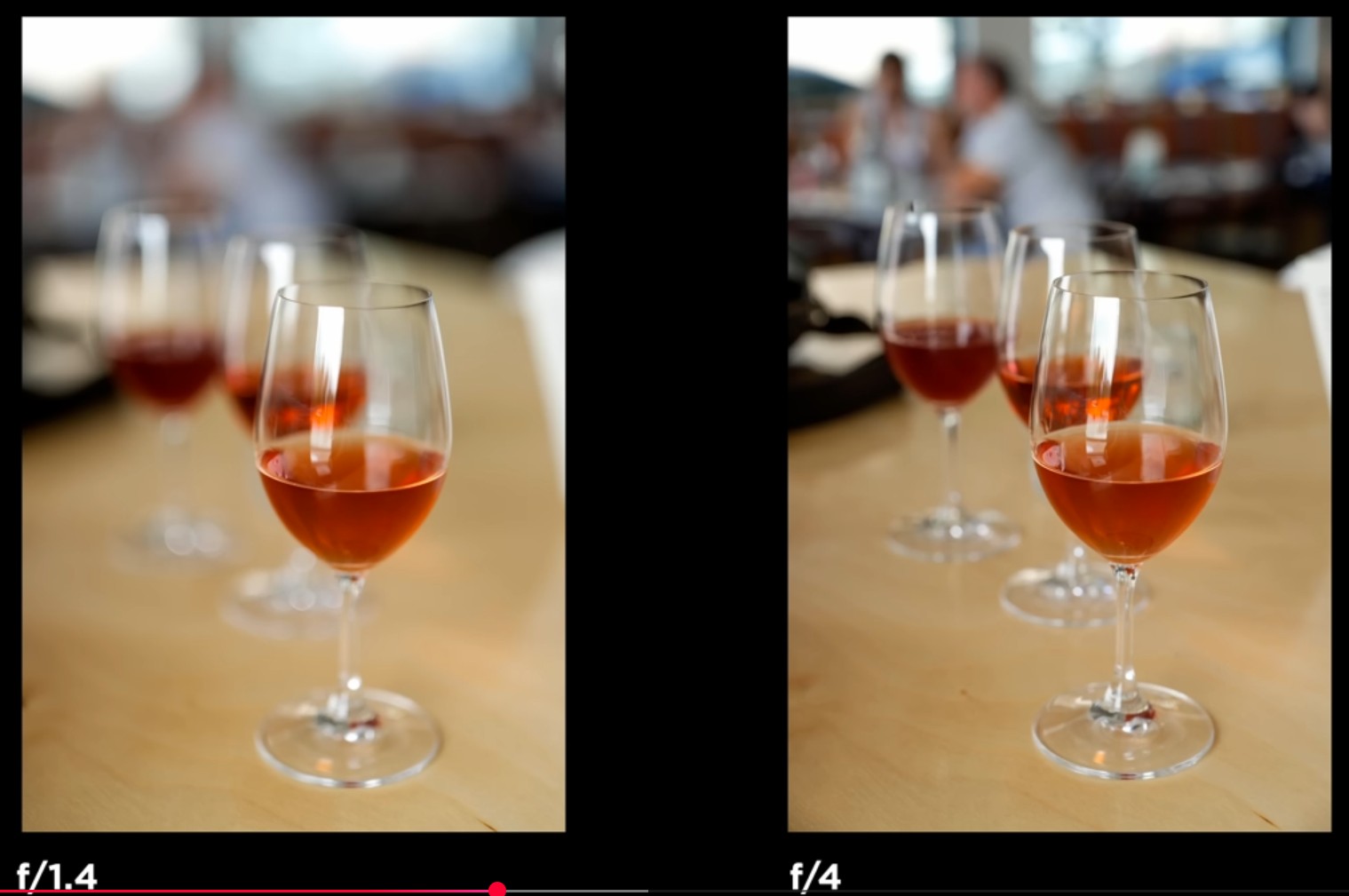
three stops to go from unidentifiable blobs to blurry humanoid blobs at ~5m; note the color of the liquid improving on stop down.
old-gregg wrote:
You know the answer. Because you want to prove it to me. You're desperate. The educated skeptics don't bring any energy into the temple of 3D pop or Jehovah's witnesses or whatever. We come here to feed off yours. As I said above, blind faith is strangely entertaining. See? We're on the 80th page already.
This sounds like a totally plausible explanation for why 3D pop never made an appearance on the Internet.
Some people come here to learn, others come with a closed mind to be entertained. Which are you?
chez wrote:
Some people come here to learn...
... and then, unfortunately, encounter charlatanism and the Witnesses of Thypoch. That's the problem.
It's the same as if someone who wants to learn about medicine were to seek advice from a snake oil peddler.
Here are a few that satisfy all eight of my criteria for image depth. 28s are already well on the way towards 3Dness because some attributes flow from the focal length itself. Like a longer transition zone, field curvature (which Thypoch use in their marketing!) - how cheeky is that? Anyway, here are three from their 28/1.4 - two street portraits, one shop lady.
I particularly want to point to probably one of the bitter pills for opponents in this debate - that of design-induced 'structure retention' inside the mature bokeh field, and how it can be used artistically in 'image design' by the photographer - the setting up of the composition at shot-time. See what and how many image motifs are easily identifiable and how smoothly drawn they and the bokeh are in these images.
It's all part of the formula, one of many. These deep lenses are always on your side if 3D is your thing, trying to get the best out of the light with verve, character and vividness. It'll never be for everyone, or even many, but it's part of the fabric of the tapestry, for sure.
chez wrote:
Secondly…most people do not have 2 lenses of the same focal length with the same aperture.
At least those who pose as pseudo-experts in lens design and dedicate entire novels to their followers about the advantages of their favorite brand over the shoddy rest should have at least once made actual, meaningful, one-to-one comparisons, right? But of course, it's more comfortable to stubbornly ignore such hints and simply continue to ramble on.