gdanmitchell wrote:
Useful to ask, "What makes a painting 'pop'?"
At the end of the day ... it is the mastery of understanding regarding human physiological cues. Then, using the various tools of your discipline to develop those cues.
This holds true in all 2D disciplines trying to develop depth cues ... painting, drawing, photographic, cinematic, etc.
Which, then begs the question of "What are the human physiological cues for perceiving depth?" ... the foundation of the subject, as we aspire for human (i.e. the viewer) perception of depth in our work. Largely, the answer is rooted in rates of transition variance in multiple attributes ... tonal, scale, saturation, hue, contrast, detail, focus, etc.
Where care is taken to align the differing attributes, the effect is enhanced. Where a mismatch of attributes are incongruous with each other, the effect is diminished. Having a complete understanding of these attributes affords the creator to present the effect in varying degrees ... ultimately being a matter of Trompe' Loeil, via the understanding of those human physiological response cues for rendering "3D" (depth cues) in a 2D medium.
@mudlake Thanks for sharing your thoughts and video—I have see it before. I think I’m quite familiar with most of the concepts people here are talking about here. I have thoughts of my own and am particularly sensitive to lens’ color, contrast and dimensionality (which is where most of a lenses magic reside IMO).
At this point in time, I am more interested in intelligent comps than theory though
"The use of modern photography lenses for beautiful cinematography is rare, mostly because many modern photo lenses lack a distinct and artistic character, instead prioritizing sharp images that can feel devoid of life."
"Images captured with the Thalia 65 lenses can appear to have an added depth and dimensionality, especially on large sensors, due to a gradual focus fall off curve. Rather than even, flat layers of focus across the frame..."
That is some background to the strong emphasis Sonderoptic placed on Aesthetic Image Design, with the pursuit of beauty leading them to adopt: 'gradual focus fall-off', 'image depth' and 'out-of-focus elements maintaining their structure' as the driving forces of their lens design.
Image rendering is targeted as being: deep, smooth and informative, therefore.
Some may wonder: why do we need a large number of aperture blades? (The Thalias have 15 blade irises). It seems to be because they play a part in the ultra smoothing of still vibrantly visible image motifs that 'maintain their structure' in what is euphemistically called 'bokeh':
"And the newly designed circular iris keeps the bokeh smooth and beautiful through all stops while maintaining structure in the out-of-focus details. The innovative iris design of the Thalia lenses maintains a circular iris through all aperture stops, creating a cinematic bokeh that comes alive with character. Out of focus elements maintain their structure, which further adds to the sense of dimensionality of the image."
through all aperture stops..
creating cinematic bokeh..
adds to dimensionality..
These are the effects of circular irises, according to not just CW Sonderoptic, but many industry insiders as well. It's not a new idea, either, there were many high blade count lenses made deep back into last century. Maybe the industry decided to cheap out, around the time cameras were changing from beloved scientific instruments into consumer goods. Still, better late than never.
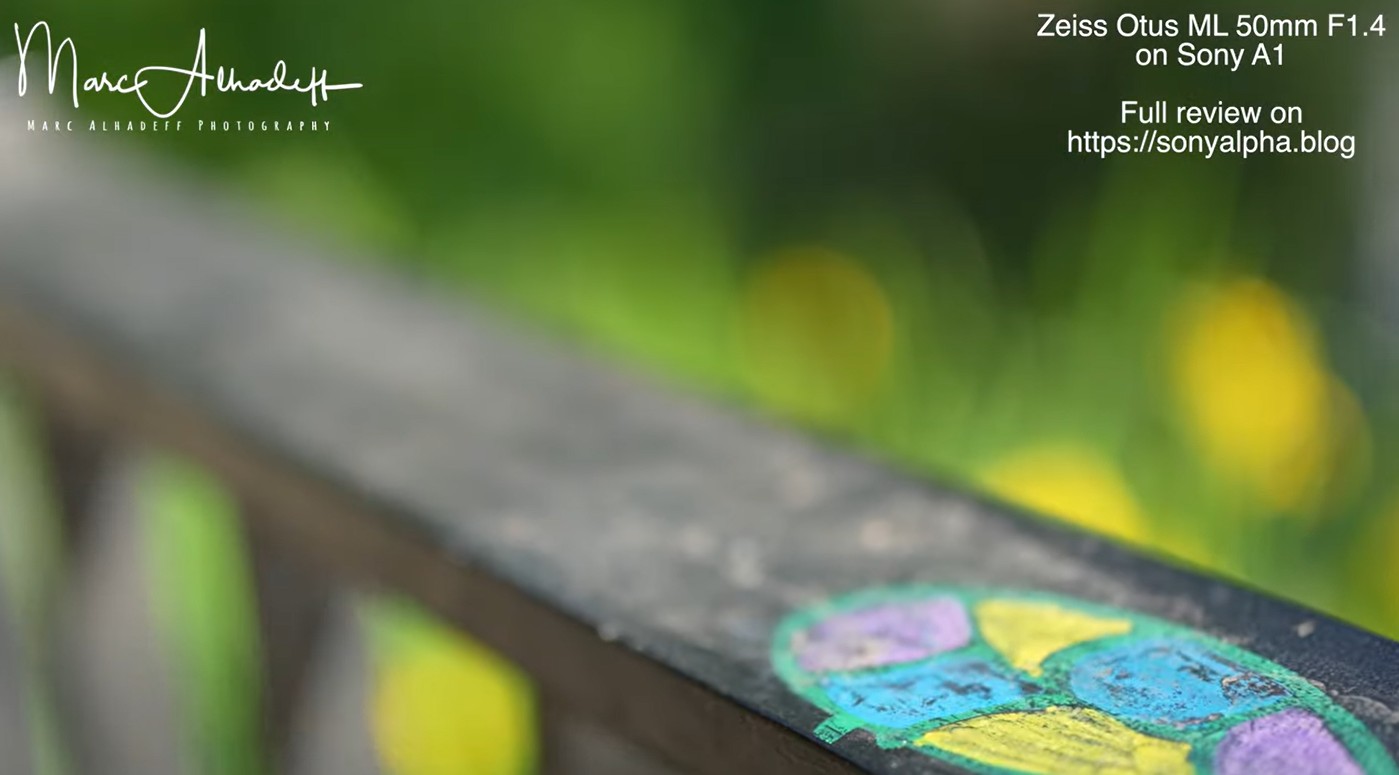
Marc Alhadeff does these short but informative videos, no talk, just images left up for seconds, lots of people, tests for flares, aperture function etc. These image snips are from four 50mm f1.4/f1.2 lenses. Ignore or look past the differences in scale, color, tone, exact angle. Things to look for:
the rate of onset of what you would call 'bokeh' from the focal plane to that threshold;
how soon after the focal plane is left is bokeh beginning to appear?
how easy on the eye is looking on the most abstracted bokeh in each image;
how about the retention of image structures (objects, motifs) into the bokeh field and how well they are maintained;
what information can you glean from the bokeh field? Is it intended as 'art' in itself, or is there more to the approach?
how straight is the rail in its journey from focus to edge-of-frame, how realistic does it look?
philip_pj wrote:
Marc Alhadeff does these short but informative videos, no talk, just images left up for seconds, lots of people, tests for flares, aperture function etc. These image snips are from four 50mm f1.4/f1.2 lenses. Ignore or look past the differences in scale, color, tone, exact angle. [...]
Can we put a stop to these comparisons which either are setup to favor for a certain brand or are posted despite not containing any useful material?!
philip_pj wrote:
Ignore or look past the differences in scale, color, tone, exact angle.
This is precisely the cardinal error. Compare different scales, colors, tones, angles, and apertures and then draw conclusions from them.
Nifty Fifty wrote:
This is precisely the cardinal error. Compare different scales, colors, tones, angles, and apertures and then draw conclusions from them.
Why those comps weren't shot from a tripod ...
Personally, I don't find the min focus distance, WO a good indicator of depth cues modeling that the optic brings to the table, per se. There are some things that can be gleaned from it (although, these fence comps are widely varied, so it limits that as well) ... mostly about bokeh structure, etc. but, that's not the "only" thing that imparts the cues. Lots of folks dig on that (I did too, at one time),
Imo, the rendering that I prefer is where the acutance is significantly crisp, prior to the transition into the bokeh. The difference in acutance (impacted by SA, etc.), etc. An optic that is in focus, but lacks excellent acutance can have all the bokeh it wants, but it doesn't call to me in quite the same way.
None of those images did anything to convey dimensionality cues for me. They largely present DOF at min focus distance for a micro-skinny focal plane. A study of the bokeh extremes that those optics offer ... I reckon, but none of them caught my attention as presented.
philip_pj wrote:
"The use of modern photography lenses for beautiful cinematography is rare, mostly because many modern photo lenses lack a distinct and artistic character, instead prioritizing sharp images that can feel devoid of life."
"The use of modern pianos for beautiful music is rare, mostly because many modern pianos lack a distinct and artistic character, instead prioritizing accurate tuning that can feel devoid of life."
"The use of modern knives for beautiful cooking is rare, mostly because many modern knives lack a distinct and artistic character, instead prioritizing sharpness that can feel devoid of life."
"The use of modern automobiles for auto racing is rare, mostly because many modern automobiles lack a distinct and artistic character, instead prioritizing comfort and performance that can feel devoid of life."
There are two (more, actually, but not relevant here) forms of gear fixation. One is the presumption that only the newest thing is good enough and the other is the presumption that the newest thing is never as good.
gdanmitchell wrote:
"The use of modern pianos for beautiful music is rare, mostly because many modern pianos lack a distinct and artistic character, instead prioritizing accurate tuning that can feel devoid of life."
"The use of modern knives for beautiful cooking is rare, mostly because many modern knives lack a distinct and artistic character, instead prioritizing sharpness that can feel devoid of life."
"The use of modern automobiles for auto racing is rare, mostly because many modern automobiles lack a distinct and artistic character, instead prioritizing comfort and performance that can feel devoid of life."
There are two (more, actually, but not relevant here) forms of gear fixation. One is the presumption that only the newest thing is good enough and the other is the presumption that the newest thing is never as good.
Fred Miranda's testing and perhaps even his very successful career on this site is built around the proposition that there are meaningful differences among lenses and sensors. Some people can see the differences and others can't. Some people care about the differences and others don't. But there are differences and some of them run along the dimension of when the lenses were designed and built. I would think this would be obvious and non-controversial.
Jonas B wrote:
Can we put a stop to these comparisons which either are setup to favor for a certain brand or are posted despite not containing any useful material?!
The Zeiss wins- The colors are the best
Yea I am not seeing anything but images that hurt my eyes
chiron wrote:
Fred Miranda's testing and perhaps even his very successful career on this site is built around the proposition that there are meaningful differences among lenses and sensors. Some people can see the differences and others can't. Some people care about the differences and others don't. But there are differences and some of them run along the dimension of when the lenses were designed and built. I would think this would be obvious and non-controversial.
"there are meaningful differences among lenses and sensors" - agreed!
However, I don't believe that these differences meaningfully impact one's photography in the sense that buying a new lens is a way to improved one's photography and get "better" pictures. One exception is action (including BIF) photography when faster lenses and sensors do make a difference.
My feeling is that the whole obsession with lenses may actually do some harm as it drives the idea that one need some exotic lenses to do better photography.
Investing time in learning and mastering the composition and post-processing skills is way more productive and useful for photography than buying a collection of lenses because of their alleged rendering.
chiron wrote:
Fred Miranda's testing and perhaps even his very successful career on this site is built around the proposition that there are meaningful differences among lenses and sensors. .
Is this supposed to be a joke? I've already linked to Fred's comparison of the 50mm Summilux and the 50mm Simera twice, which, according to philip_pj, reflect completely opposite approaches to lens design, and neither you nor your friend philip_pj have responded. He just keeps selling the same fantasies and marketing statements as scientifically based facts. If it weren't so annoying, you could laugh about it.
Here for the third time. From page 7 #7. https://www.fredmiranda.com/forum/topic/1878983/6#rend
chiron wrote:
Some people can see the differences and others can't. Some people care about the differences and others don't. But there are differences and some of them run along the dimension of when the lenses were designed and built. I would think this would be obvious and non-controversial.
What do you call that rhetorical trick when you put words into someone else's mouth that they never said and then contradict them? Who says there are no differences? Nobody. It's about the absurd exaggeration of differences and the bizarre praise of one's favorite brand with the help of marketing statements repeated hundreds of times that are already pouring out of one's ears.