fredmiranda.com
Login

Moderated by: Fred Miranda
  New fredmiranda.com Mobile Site
  New Feature: SMS Notification alert
  New Feature: Buy & Sell Watchlist
  

FM Forums | Leica & Alternative Gear | Join Upload & Sell

1       2       3              66              68              138       139       end
  

which lens has the most 3D POP?


Robin Smith
Offline
• • • •
Upload & Sell: Off
p.67 #1 · which lens has the most 3D POP?


All with different lenses too…


Jun 06, 2025 at 11:43 PM
Nifty Fifty
Offline
• • •
Upload & Sell: Off
p.67 #2 · which lens has the most 3D POP?


dclark wrote:
I see this thread is up to 1318 posts and 269,746 views (1319 and 269,747 with my post).

What a senseless waste of valuable time!


Jun 07, 2025 at 12:39 AM
Coltrane
Offline
• • •
Upload & Sell: On
p.67 #3 · which lens has the most 3D POP?


Of all the lenses I've used over the years, the two that gave me the nicest pop were the Zeiss ZE 28mm f2 and the Contax/Zeiss 85mm 2.8 MMJ. However I do think that almost any lens can give a nice 3D effect on a given shot if conditions are favorable.


Jun 16, 2025 at 09:37 PM
fritzx6
Offline
• •
Upload & Sell: On
p.67 #4 · which lens has the most 3D POP?


I find that in my personal experience the lenses that produce the strongest 3d signature are 50mm or wider. I notice it most intensely with 21-35mm lenses. Super creamy backgrounds typically do not elicit the response from me, to the contrary, I feel like the bokeh having some structure actually enhances it sometimes. I notice the effect most noticeably on my zeiss lenses. The 28G for Contax was the first lens I noticed it with, and this preceded any reading or bias from forum posts, but I was excited when I saw others mention the same lens, or other lenses I have seen it from. I think it's something you notice or don't, and for most folks it doesn't matter either way, it's just an added delight for those of us who are sensitive to it.


Jun 16, 2025 at 10:08 PM
philip_pj
Offline
• • • • • •
Upload & Sell: On
p.67 #5 · which lens has the most 3D POP?


Probably best to differentiate between what we might call 'classic Zeiss' and 'modern Zeiss', at least in frames of reference. In particular, the early (pre-2010) CZ 28mm lenses had fabulous 3D, yet now we see the company extolling the virtues of massive levels of separation so as to exhibit (and let me quote them) 'an extraordinary shallow depth of field that directs the viewer's gaze precisely to what matters.'

https://www.zeiss.com/consumer-products/int/photography/otus-ml/otus-ml-1450.html

In fewer words, they want to maximize ('extraordinary') the separation of focus from background (and presumably foreground). Structure in bokeh is a key (but not the only) characteristic of 3D. I'll go so far to say you cannot have decent 3D without progressive axial separation inside the bokeh field, which of course includes (i) partial bokeh (near the camera/lens) as well as (ii) medium distance bokeh, and (iii) distant bokeh. We see the unfortunate consequences of this unrequested design protocol in foreground bokeh as well, where image space objects blur far too readily.

Leica do something similar. They make out that you can emulate a f1.4 lens in an f2 lens by designing in a massive amount of lens contrast at the focal plane bordered in both directions by ultra-rapid fall-off of focus.

'"Peter Karbe explained to me, the lack of aberrations results in much more contrast at the point of focus than in an ordinary lens, and that this contrast falls off very quickly in front and behind the point of focus. This means that an f2 lens can appear to have the same depth of field as an f1.4 lens (or even less in the case of the 75 f1.4 compared to the 75 f2 M lens)."'

Many don't want other content messing up their focal plane separation - they only want that thin sliver of super-sharp to be seen:

"I think that this rapid fall-off of contrast confers a special look on the Leica APO lenses, which are very detailed when in focus, but with a quick roll-off into gentle bokeh: Indeed, I think the whole look is 'gentle..'"

https://www.slack.co.uk/leica-apo-m-lenses.html


Jun 17, 2025 at 12:26 AM
philip_pj
Offline
• • • • • •
Upload & Sell: On
p.67 #6 · which lens has the most 3D POP?


Don't you find it interesting that commentators refer only to 'bokeh' as it only the full state of out-of-focus exists, minus these intermediate states? Why is that? Surely the see it. And you will struggle to see any Magnum photographers using the technique, and they had access to fast lenses back then.

Linearity from near to far objects in image space - the steady progression from visible structure to fully abstracted content - is fundamental to both natural eye vision and as a consequence, the ideal state of our images, IF you want true-to-life images. And who would not want that? All else is a photographic artifact introduced by the lens design team..Many do not like their visual field being disrupted.

It matters, all right. It matters massively, in fact. One is accurate portrayal (3D) and the other is conjured artifact - a created version of depicted reality, akin to fake news asking you to deny your lying eyes..

I do believe the industry will eventually decide they have embarked on an 'oops' too far' direction and we will see a return to organic well-integrated axial data. 3D is a learned experience, and it is also empowering to go your own way, rather than being a passive recipient of lens designers' predilections. Just as the battle with big sugar was won, I think we can win this one too.

Soon, if we follow their moves to their logical conclusion, we will see many more images with only eyes in focus, everything else swamped by encroaching bokeh blur. It's made even more bizarre because in modern Zeiss's own terms, non focal plane data is precisely what does NOT matter.

It's a fast lens issue most pressingly, because many such lenses are only used at or very near wide open. The other startling thing about it is that this is something lens makers have wilfully thrown away; many older lenses were true to life and I don't recall anyone asking for the deletion of non focal plane content in favor of ever greater levels of 'designer blur'.


Jun 17, 2025 at 12:28 AM
philip_pj
Offline
• • • • • •
Upload & Sell: On
p.67 #7 · which lens has the most 3D POP?


Simply by their compressed nature, short telephoto lenses produce considerable bokeh wide open, or near to that setting. The better ones will still show harmonious bokeh content with enough detail to work with the subject, not against it. The subjects do not need 'maximum isolation', in fact the exact opposite applies.

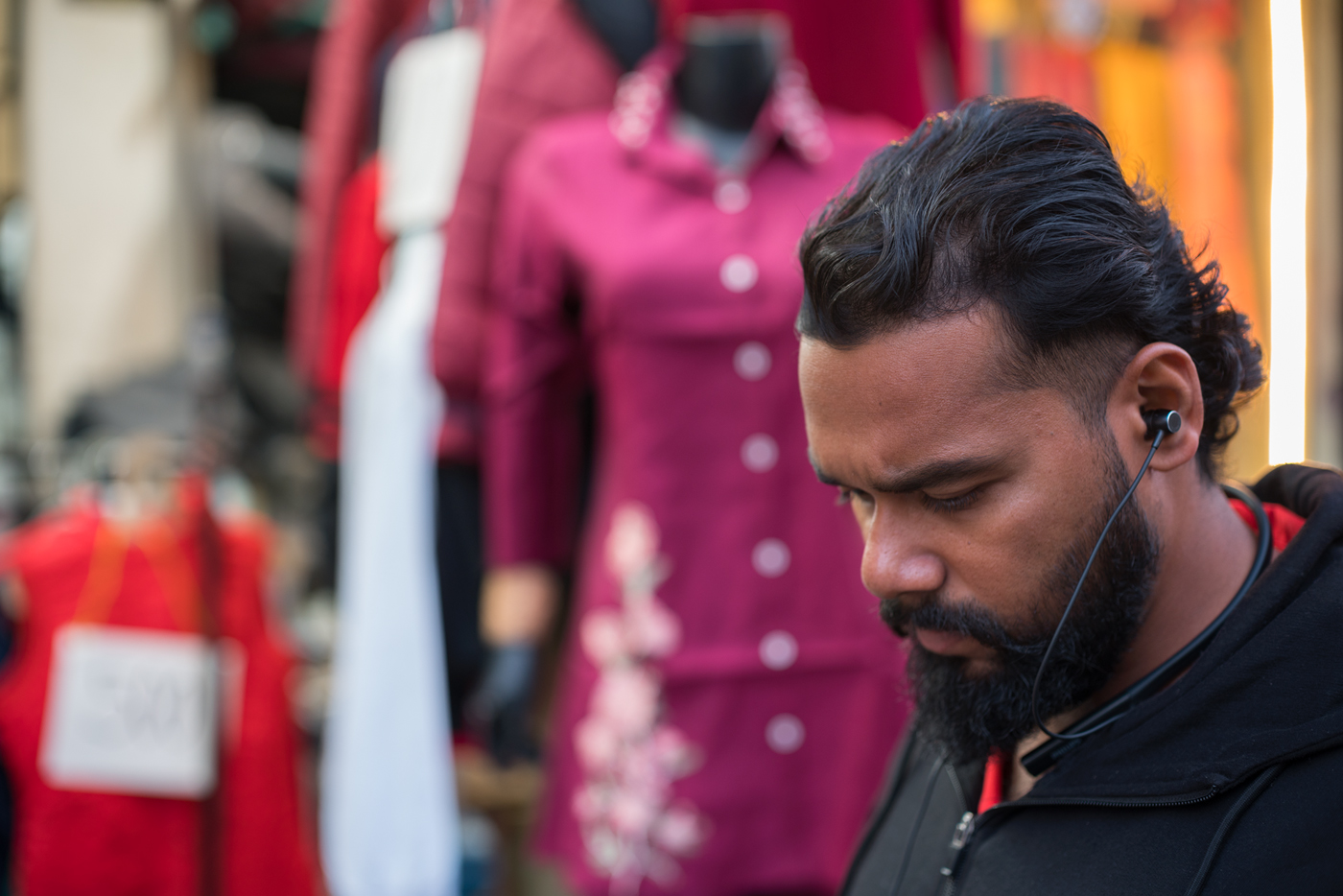
Let me post a few longer FL images shot wide open (or a half stop down) to illustrate how in-bokeh content can enhance imagery, by providing valuable context. You get a more meaningful image in many situations, because the extra content works synergistically with the main subject to show: where the photo took place; who was around them; and to use color to expand the image's feel and look.

In the first three, nothing is over sharp, but you feel you can reach out and touch the person. They are fully 'intact', because the lens design team cared to make it easy to have the lens do this. I am guessing not many have fully internalized this, but the lenses you use determine the kind of photos you can take. Your compositions have to work inside the lens's functional envelope!

Many who do see in three dimensional space find it very difficult to consider lenses that do not deliver it, let alone those lenses that actively work against it.


color matching and oblique focus fade - shop


shopkeeper, note good definition of dresses and very solid imaging of his face and head


I like to show parents with the kids I photograph, for obvious reasons, clothes on sale clearly visible


I doubt the new Otus 50mm lens could take this photo, which depends on near camera bokeh quality


Jun 17, 2025 at 12:51 AM
Garmadon
Offline
• •
Upload & Sell: Off
p.67 #8 · which lens has the most 3D POP?


Those are impressive.
What are your suggestions for lenses like these in the system ? hopefully with AF ..
philip_pj wrote:
Simply by their compressed nature, short telephoto lenses produce considerable bokeh wide open, or near to that setting. The better ones will still show harmonious bokeh content with enough detail to work with the subject, not against it. The subjects do not need 'maximum isolation', in fact the exact opposite applies.

Let me post a few longer FL images shot wide open (or a half stop down) to illustrate how in-bokeh content can enhance imagery, by providing valuable context. You get a more meaningful image in many situations, because the extra content works synergistically with the main subject to show: where
...Show more


Jun 17, 2025 at 03:53 AM
RustyBug
Offline
• • • • • • •
Upload & Sell: On
p.67 #9 · which lens has the most 3D POP?


philip_pj wrote:
Probably best to differentiate between what we might call 'classic Zeiss' and 'modern Zeiss', at least in frames of reference. In particular, the early (pre-2010) CZ 28mm lenses had fabulous 3D, yet now we see the company extolling the virtues of massive levels of separation so as to exhibit (and let me quote them) 'an extraordinary shallow depth of field that directs the viewer's gaze precisely to what matters.'

https://www.zeiss.com/consumer-products/int/photography/otus-ml/otus-ml-1450.html

In fewer words, they want to maximize ('extraordinary') the separation of focus from background (and presumably foreground). Structure in bokeh is a key (but not the only) characteristic of 3D. I'll go
...Show more

Personally, I prefer to shoot my "3D-ish" a bit stopped down. I find that the "massive blur" thing is not the path to rendering the visual cues the way I like. Your points are well noted, that there is a difference between those cues that provide the viewer with the perceptions of natural transition vs. hyper transition.

For some folks, they interpret the massive bokeh separation to the focal plane, as a "3D-ish" thing. That's not my objective, rather I prefer to have multiple layers of depth cues as the transitions progress. (Imo) "Too fast" or "too much" and it takes on that "cut-out" look. Some folks dig on faster / more is better as a party trick (been there, done that).

I try to learn the sweet spot of a given lens, but have found in my research years back that while some faster lenses provide for more separation wide open, the visual cues "effect" shot stopped down provide for a more natural rendering that embarks the brain to that perception.

My visual cues do not totally obliterate the BG, the way a creamy bokeh BG does. Heck, even with my glasses off (20/800) I may see a fuzzfest, but the form is still present. The salient point is to agree with your other points regarding the way the brain processes dimensionality isn't predicated solely on maximum creamy, obliterated BG. Folks dig on that (which is fine), but that doesn't present (imo) the most "3D-ish" rendering for giving visual cues. Having this uber sharp, micro small focal plane coupled to an uber fuzz BG, isn't my objective. I tend to prefer that the focal plane transition at a rate that the brain can "follow" the visual cues into / out of / around the focal plane. What can also help is when a lens designer provides for different rates of transition in different zones. Which takes us back to your referenced mention of different optics.

To your point ... the pendulum (lens designs) swings.


Jun 17, 2025 at 07:22 AM
gdanmitchell
Offline
• • • • • • •
Upload & Sell: Off
p.67 #10 · which lens has the most 3D POP?


After nearly 70 pages (!), this thread has predictably failed to demonstrate that any particular lens has “the most 3D POP” compared to any other lenses. If you are looking to buy some lens that will magically give you “the most 3D POP,” save your money.

However, the multitude of photographs posted in the thread can illustrate visual techniques that you can apply to enhance a sense of depth and layering in photographs. As with some many things in photography, the brand/model of gear has far, far less significance than how you see and how you implement your vision photographically.

Things that create this unfortunately-named effect include:

1.selective focus

2. lighting (super important!) and relationships between lighting of primary and secondary subjects

3. Color relationships

4. Relationships between areas of detail and softer areas

5. Composition

6. Awareness of leading lines

7. Contrasts between light and dark areas of the frame, vignetting, saturation levels, and more.

8. Control of complexity and areas of detail in areas of the frame.

9. In the case of human subjects, their position, wher their gaze goes, and more.

If you want to successfully produce whatever this effect is, don’t waste your time trying to buy the lens with the “most 3D POP.” Devote yourself to understanding how visual imagery works and to seeing and applying these visual elements in the photographs you make. That takes time, skill, practice, awareness, thoughtfulness, practice, and refinement over time… not another order from B&H.

Edited on Jun 17, 2025 at 10:40 AM · View previous versions


Jun 17, 2025 at 09:44 AM


Search in Used Dept. 

Nifty Fifty
Offline
• • •
Upload & Sell: Off
p.67 #11 · which lens has the most 3D POP?


RustyBug wrote:
Personally, I prefer to shoot my "3D-ish" a bit stopped down. I find that the "massive blur" thing is not the path to rendering the visual cues the way I like.

I find such a blanket statement quite nonsense, as it completely ignores the extreme impact of the distance conditions.


Jun 17, 2025 at 09:52 AM
StoneCrop
Offline
• •
Upload & Sell: Off
p.67 #12 · which lens has the most 3D POP?


Yeah, I think the super blur cut out look is something that’s become popular because of graphic designers moving towards having text over the blurred out area. In that case, you don’t want definable forms competing with the text, you just want a nice palette that’s continuous with the main image. At least, that’s how I’ve used it before, and it has significant value in that usage. The percentage of people that consume photos purely as art is quite small in comparison to the number of people who consume them as advertising, so the lens design follows the money and usage trends…

It would be interesting to me to see a discussion of those qualities which give a 3d impression in photos and also in paintings. People have been chasing that objective in painting for a lot longer than in photography, and they have also been using optics since the baroque era to help in that quest.

I’m personally of the opinion that most images made with a single exposure and single lens don’t actually reproduce the way I see the world, though some images do convey a certain feeling of depth in the picture plane. Compare to painters like Vermeer or Lucian Freud’s later work. A larger format of sensor (or the use of panorama technique) can help to create an image with a wide enough field of view without introducing the distance distortion that makes things feel unnatural. Vermeer’s style encapsulates the very large format type of look, Lucian Freud’s has more of a panorama (/curved sensor) type quality.


Jun 17, 2025 at 12:45 PM
Nifty Fifty
Offline
• • •
Upload & Sell: Off
p.67 #13 · which lens has the most 3D POP?


I think this thread is getting more and more amusing. There are pages and pages of philosophizing about lens design and great art, and at the same time example images are posted that just make me shake my head. You see a high-contrast and very colorful bokeh that literally makes the main subject fade with its radiance. This is primarily the fault of the image composition and image processing and only secondarily the optics, but that doesn't make it any better. I have the feeling that image composition often falls by the wayside because of the sheer focus on rendering, depth of field, and plasticity. Of course, I'm fully aware of the intention behind image 4 in the post Page 67 #7, but in my opinion it just doesn't work.


Jun 17, 2025 at 01:10 PM
Garmadon
Offline
• •
Upload & Sell: Off
p.67 #14 · which lens has the most 3D POP?


Here is a good example from Vermeer :
https://images.app.goo.gl/kmdvN

There is a huge sense of depth here , but why?
It is definitely not sharp , and it is mostly in focus (except the wall ). I will guess 28mm and f/6 ?

There is a lot of information in the textures, and a great variance between lighten and dark parts... micro contrast?

What else do you see?
StoneCrop wrote:
Yeah, I think the super blur cut out look is something that’s become popular because of graphic designers moving towards having text over the blurred out area. In that case, you don’t want definable forms competing with the text, you just want a nice palette that’s continuous with the main image. At least, that’s how I’ve used it before, and it has significant value in that usage. The percentage of people that consume photos purely as art is quite small in comparison to the number of people who consume them as advertising, so the lens design follows the money and
...Show more


Jun 17, 2025 at 01:16 PM
Nifty Fifty
Offline
• • •
Upload & Sell: Off
p.67 #15 · which lens has the most 3D POP?


Please take a look at this thread.
https://www.fredmiranda.com/forum/topic/1905989/

No 3D pop, no fake cinema effect, not even a nice bokeh. But a good eye and a sense of the moment. Anyone who has these skills can create good images with any device, even an iPhone.


Jun 17, 2025 at 01:21 PM
philip_pj
Offline
• • • • • •
Upload & Sell: On
p.67 #16 · which lens has the most 3D POP?


We still have shibboleths to address and defeat on the road to a consensus about 3D. Two for the chopping block are DOF tables and Hyperfocal as a method of focusing. Both these pseudo-scientific concepts are, of course, backed by copious amounts of 'scientific literature' to fool those who fall under their spells. Both assume you don't use your eyes, just use the formulas.

The notion that all lenses of the same focal length share identical 'acceptable image depth' is preposterous. It does not account for lens design! Our lenses vary widely in characteristics that are strong determinants of image depth. They include: contrast, micro-contrast, color, tonal scaling, glass formulations and usage, rates of focus fade at various distances from the lens, field curvature, vignette, and more (like the light conditions etc).

Hyperfocal and DOF tables assume these attributes are equally distributed across all our lenses at common FLs! But you don't perceive anything in images using formulas, because we have human vision, with millions of years of development behind it, primarily to perceive visual cues.

Zeiss apparently still believe in these fake science abominations, despite telling users they are doing their level best to isolate 'what really matters' on the focal plane from the design-induced blur field surrounding it. It's extraordinary they don't see the contradictions here.

Leica is another separation zealot on this subject. A quote from Peter Karbe:

"Higher Contrast for greater perceived depth

With an initial aperture of f/2, the SL-Summicron lenses are significantly more compact than faster lenses (pp: f1.4 lenses), but *still allow photographers to work with similar depth of field*. The reason for this is contrast: the zone of highest contrast is perceived by viewers as being sharp, while zones with lower contrast are regarded as being unsharp.

In the case of SL-Summicron lenses, this difference in contrast is considerably higher than that of conventional lenses: sharply focused objects show much higher contrast than objects that are out of focus. This means that objects “snap” more distinctly out of the foreground or background and more effectively isolate the subject. This creates a three-dimensional visual effect with *very impressive apparent depth*. (asters are mine)

He compares the spanking (2018) 75/2 APO in SL-mount to one of Leica's greatest portrait lenses from the last century, the Summilux 75/1.4 (1980-2007). Hardly a fair comparison in my view.

In fact, the web page has a graphic that shows the differences in sharpness forming around the plane of focus. Further down the page, we see the effects of APO on human skin - a blond model appears to have a monobrow shrouded by a layer of makeup!

https://leica-camera.com/en-GB/photography/lenses/sl/apo-summicron-sl-75mm-f2-asph-black

He has made my case for me. He doesn't use DOF tables to make his case here, he uses 'apparent depth' and expresses that high contrast renders an f2 lens as having a 'similar depth of field' to an f1.4 75mm lens, despite it being a full stop faster with very narrow DOF.

Image depth is perception based. We all know it, even if some industry leaders want you thinking otherwise. And, if you want to photograph people of any age, stay well clear of APO lenses. They are poison to human skin.

So we have these optical technocrats deciding how your images are going to look. I don't recall them asking their user bases what they want. And they are now trying to recreate portraiture as a fashion statement.

But luckily, the Chinese lens makers arrived just in time, and they will sow enough doubt in all but the true believers that the industry is doing us a disservice. Fate works in strange ways.


Jun 17, 2025 at 06:38 PM
RustyBug
Offline
• • • • • • •
Upload & Sell: On
p.67 #17 · which lens has the most 3D POP?


Nifty Fifty wrote:
I find such a blanket statement quite nonsense, as it completely ignores the extreme impact of the distance conditions.


It's not a "blanket statement", per se. If you've been following along my journey on this subject of study starting back over ten years ago ... and place it in context of my other comments, well you get the gist.

If you take it in isolation, then it might lack sense (i.e. nonsense as you've stated), to some.

Pg. 66 #2 is essentially what I'm referring to. The BG is not obliterated into mushy / massive blur from being shot wide open with long glass, from close distance, etc.

Imo, the matter of subject isolation (i.e. skinny dof) is different from the matter of 3D-ish rendering. Granted, the two "may" be combined, at times ... but, they are different concepts. Some folks interchange them, equally. Me, not so much.

Dissenters will dissent, but I'll add that when folks go to the optometrist and take their eye exam ... some folks look at the concentric circles and they very readily differentiate the ones that "pop" out into space from the others. Some folks struggle with picking up on the visual cues associated with that.

Alternatively, there are those mechanisms where folks try to test their depth perception by lining up two objects. Some folks do it with ease. Other folks miss by a country mile.

My point is that in addition to lens design (et al the other stuff), there is the aspect of the individual to correlate the nuance of the visual cues, such that it does convey. There are some folks that will NEVER be able to perceive the differences. They will of course be staunch dissenters ... because simply put, they CAN'T see it. Therefore, for them ... it stands to reason that they suggest otherwise to those who do pick up on the differentiation of visual cues well.

Kinda reminds me of the image that can be seen as an old, ugly woman or a young, pretty lady. Some folks could see both. Others ... could only see the one, and no matter how hard they might try, they never could process otherwise. The point being that the physiological response is in play, along with lens design ... and the other factors aforementioned.

As always, YMMV ... to which I'm not trying to sway the dissenters. That's not going to happen. But, for those other folks who have genuine, legitimate interest, I am always hopeful to chime in a nugget that might help them ... well, you get the gist.


Jun 17, 2025 at 06:47 PM
buggz
Offline
• • •
Upload & Sell: Off
p.67 #18 · which lens has the most 3D POP?


To me, it is the polarization of light that makes it special, not necessarily the thin DOF.
It really isn't one single factor, but many factors together.
Complicated...


Jun 17, 2025 at 08:52 PM
gdanmitchell
Offline
• • • • • • •
Upload & Sell: Off
p.67 #19 · which lens has the most 3D POP?


I’m glad you mentioned Vermeer, though you could mention a ton of other painters and their work.

If LENSES were the primary cause of dimensionality in visual images… how is dimensionality produced in a, uh, rather widespread medium in which lenses play no role at all (aside from camera obscura, but I digress) in the creation of the images?*

The answer is painfully obvious and has been well understood for centuries. It is about how the artist uses perspective, foreground/background relationships, color, direction and quality of light, composition, haze, color intensity and tone, subject posture and position, even photograph-like “focus” effects, and more.

I’m am completely serious when I say that looking at and understanding what goes on in paintings will get you 1000x closer to understanding how to produce “depth” and “dimensionality” in photographs than buying some lens.

I know that buying the magical lens is quicker and appeals to the gear-centric nature of photography, but it is a classic example of barking up the wrong tree. I’m not claiming that lens quality is irrelevant or that it doesn’t matter what lenses you use — but I am saying, loudly, that the answer to the questions that this thread asks is not the name of a brand or model of lens.

Go look at some paintings. As yourself HOW they work? What is going on in them? What can you adopt from this in your photoraphy?

Answers are there if you just look in the right place.

* Also, if lenses produced “dimensionality,” how is it that all photographs made with those magical lenses do not have it?

Garmadon wrote:
Here is a good example from Vermeer :
https://images.app.goo.gl/kmdvN

There is a huge sense of depth here , but why?
It is definitely not sharp , and it is mostly in focus (except the wall ). I will guess 28mm and f/6 ?

There is a lot of information in the textures, and a great variance between lighten and dark parts... micro contrast?

What else do you see?


Jun 18, 2025 at 09:54 AM
Garmadon
Offline
• •
Upload & Sell: Off
p.67 #20 · which lens has the most 3D POP?


The fact that you can draw a "dimensional" scene doesn't mean that lenses do not help .

Look at the Vermeer photo I linked , what do you see ?
I see contrast and many 'shades' or tones in her derss or his shirt .
Yes , if you can draw it you can also get it by put some time in post. but does it mean that all lenses will resolve this scene the same ?


gdanmitchell wrote:
I’m glad you mentioned Vermeer, though you could mention a ton of other painters and their work.

If LENSES were the primary cause of dimensionality in visual images… how is dimensionality produced in a, uh, rather widespread medium in which lenses play no role at all (aside from camera obscura, but I digress) in the creation of the images?*

The answer is painfully obvious and has been well understood for centuries. It is about how the artist uses perspective, foreground/background relationships, color, direction and quality of light, composition, haze, color intensity and tone, subject posture and position, even photograph-like “focus” effects, and
...Show more


Jun 18, 2025 at 11:36 AM
1       2       3              66              68              138       139       end


FM Forums | Leica & Alternative Gear | Join Upload & Sell

1       2       3              66              68              138       139       end


Welcome back
Log in to your account