We have plenty of proof (centuries of it, actually) that dimensionality results from a range of well-known and well-understood techniques and characteristics in visual images. This is no mystery at all at this point. (OK, one remaining mystery is how our minds process visual data and respond to such effects perhaps.)
In the context of painting and related visual arts, lenses play literally zero role in creating these impressions, yet these works are full of examples of extremely effective creation on dimensionality. We can learn from them.
It is impossible to prove that “lenses do not help,” but there is absolutely no real evidence that supposed “best 3D POP” lenses make any significant difference by comparison to the other obvious factors that do make a difference.
If the contribution of a lens alone to the creation of a dimensional quality of photographs were substantial and meaningful, then any photograph made with whatever lens that is would automatically possess the quality. It is plainly obvious that this is not the case, and flat banal images come regularly from such lenses, even the best ones.
(There are other reasons to use good lenses, but “3D” is not one of them. Further, there is no one “best” lens at any of these things — instead there are many excellent lenses that will do the job well.)
In addition, it would be the obvious case that no images made with lenses falling short of this imaginary standard would ever achieve the dimensionality claimed to be the province of these magical lenses. That is also plainly nonsense, given the existence of photographs with the quality that were made with just about every lens imaginable across the almost-200-year history of photography.
It. Is. Not. The. Lens.
It is the application of techniques based on the understanding of how visual perception works.
Anyone who is really interested in creating these effects should direct their attention on understanding visual imagery, not wasting time trying to deduce which specific lens will magically produce it. It does not work that way.
Garmadon wrote:
The fact that you can draw a "dimensional" scene doesn't mean that lenses do not help .
Look at the Vermeer photo I linked , what do you see ?
I see contrast and many 'shades' or tones in her derss or his shirt .
Yes , if you can draw it you can also get it by put some time in post. but does it mean that all lenses will resolve this scene the same ?
To provide evidence that dimensionality is indeed very real (because many do not believe it is real), I want to list a set of comments from the lens producers themselves.
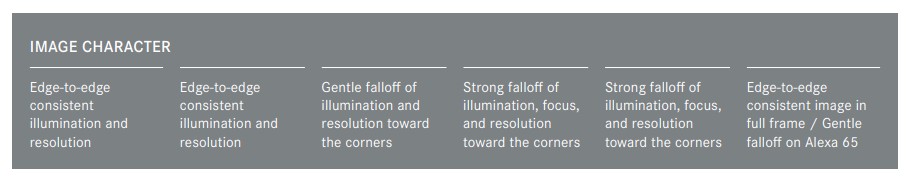
But first, you might like to see just how far the cine lens industry has departed from the regular stills lens review protocols in search of great image depth in their output. Below is from the Leitz Thalia descriptive material - it pertains to Leitz's very (very) expensive cine lens ranges. Note the common themes across their portfolio. They have 15 'performance' lenses, and 45 'character' or 'legacy' lenses.
@philip_pj that's just a text version of an MTF chart, where we're dealing with mundane soup of transfer values for various frequencies. Slightly less boring than lp/mm numbers but far from a mystical "3D pop".
old-gregg wrote:
@philip_pj@@ that's just a text version of an MTF chart, where we're dealing with mundane soup of transfer values for various frequencies. Slightly less boring than lp/mm numbers but far from a mystical "3D pop".
Since I stopped taking the posts in this thread seriously and just read them for amusement, my blood pressure has stabilized and I can even enjoy this real-life satire.
For those interested in Vermeer, I highly recommend watching the film Tim’s Vermeer, in which a curious DIYer with no training in painting sets about painting a Vermeer by first building the optics that Vermeer used. It included hand grinding a large lens, because modern lenses were too perfect and he couldn’t get one that would be like what would have been available to Vermeer. But also consider that the size of his ‘sensor’ was larger than a large format camera.
The notion of human perceived depth vs pure optical qualities reminds me of how the Santa Cruz guitar company voices their guitars - they try to make a balanced perceived tone from low to high, taking into account how humans hearing is in fact not balanced but withered more heavily towards certain frequencies. So they have to make it literally, objectively unequal and unbalanced in order to appear balanced to humans. And their guitars sound GREAT!
Jonas B wrote:
I have found that the only lens worthy of the title "3D-popper king" is the cheapo Sirui 85/1.4: https://photos.imageevent.com/jonas_b/fmforumssirui8514/h883_varvet_01_Vilma.jpg
It's all very satisfying as it means more traveling and less Otus thinking.
For me, this image is a prime example of how sharpness versus blur alone doesn't create a sense of depth. The image seems rather flat to me.
You can create spatiality without any Chinese wonder lenses or other pop kings, even with the much-maligned FE 1.8 50 and its complete absence of microcontrast. ;-)
Nifty Fifty wrote:
For me, this image is a prime example of how sharpness versus blur alone doesn't create a sense of depth. The image seems rather flat to me.
Fair enough.
Let me be clear about some basics: I don't believe in wonder lenses. I think that is clear to anyone having followed my posts (which I don't know why anyone would do but that's another topic). Calling the Sirui a 3D popper king was a joke. But, to me there is depth in the image and I posted it supporting my belief that you can follow the guidelines posted earlier in this thread and make an image with some depth in it.
Now you say the image is, in short, a typical example of no sense of depth. That's OK. I say I get a sense of depth when looking at it. Perhaps that is OK to you?
The conclusion is that we speak differently about the same sight. Maybe we are looking for different things? Maybe your world of images are verbally "flatter" than mine?
Yes, there is some sense of depth if looking at it big enough (that's a factor as well?). You don't have to look for the "depth" in the image, it strikes you at once. I like that.
In this case we have a green portal or entrance in focus, a layer that is out of focus but not totally blurred and then a third background layer where everything is blurred. The front greenary are on the border to look as it is pasted onto the background. Saved by context. All in all the image is taken following the mentioned guidelines.
We also have some disturbing greenary to the right and details making the focus distribution a little unnatural. Most people are probably not disturbed by that.
All this is a waste of time and interesting at the same time. We can however agree that it basically is not about the lens, right?
old-gregg wrote:
@philip_pj@ that's just a text version of an MTF chart, where we're dealing with mundane soup of transfer values for various frequencies. Slightly less boring than lp/mm numbers but far from a mystical "3D pop".
I think his point is that lens designers do design for different rates of transition by intent.
While Dan (et al) is totally dismissive of lens contribution, the lens designers haven't consulted him, yet.
Jonas B wrote:
But, to me there is depth in the image and I posted it supporting my belief that you can follow the guidelines posted earlier in this thread and make an image with some depth in it. Now you say the image is, in short, a typical example of no sense of depth. That's OK. I say I get a sense of depth when looking at it. Perhaps that is OK to you?
Of course that's OK with me, very OK in fact, because it illustrates how little prospect of consensus a discussion like the one we're having here has.
Jonas B wrote:
We can however agree that it basically is not about the lens, right?
Yes and no. Of course I believe that there are various ways of creating a sense of depth using image composition. The type of fall-off in sharpness is one of them for suitable subjects, and in my opinion this also depends on the lens used, which is why the lens does have an influence (otherwise I certainly wouldn't be lugging around a stovepipe like the 1.2 GM). However, this can also be overestimated, which is often done here. And as I said, there is simply a personal point of view, which is not up for debate. What is 3D pop for one person and therefore appears three-dimensional to them, for example, seems to me like it has been cut out and pasted on and devoid of any spatiality (there have been various such examples here; I will cite post #5 on page 64 as an example). What is the point of arguing about it? One person perceives this, another that.
What do you think about this one? :
I have a strong "feeling" that the boy is in front of the girl ,like I understand the placement of each subject in the space. DSC03193 by amit Garmadon, on Flickr
philip_pj wrote:
To provide evidence that dimensionality is indeed very real (because many do not believe it is real)…
No one said that”dimensionality is not “real.”
What we are saying is that it is not obtained by choosing special lenses. It comes from the application of a bunch of well-understood visual elements that are not even unique to photography.
- - -
Some auto-correct errors are so hilarious that I almost don’t want to fix them. I fixed this one above: “ What we are saying ishtar it is not obtained…”
I don't think so. Take away the contrast , play a bit with the colors and it will have a flat look .
I can 'see' the depth in this photo . Maybe because of the side light source , the contrast ,the colors ,the angle , the lack of distracting objects in the background. I also believe the lens can help ,and of course PP .