The only AF-S lens I kept was the 24-120/4, which is a lens I've always found useful. Although Nikon's new lens offerings momentarily piqued my interest, I kept my MFNG's all along. It's nice to know they're waiting for me once I regained sanity
When I vacationed in Hawaii 3 months ago, I took a few MFNG's but mostly AF-S glasses. My backpack weighed about 30 lbs! At that point I started missing my lightweight and fun to use MFNG kit. I found out that it's really not hard to let go of the big and pricey AF-S lenses, especially if they'll net you back a good sum!
So I'm back playing with my favorite fun to use MFNG's....Show more →
Chris,
The SD card mates with spring loaded raised metal bars inside the carrier. If you look at your SD card you can see where those V-shaped bent metal tracks will have rubbed against the copper areas on the card. Unevenness on those markings might give a clue. It is possible that one of those raised tracks inside the DF's card slot now doesn't make contact with the SD card - or has somehow been jammed under the surrounding plastic guides. Another problem might be a dry joint from the DF's card reader pins to the little PCB that is sits on. Worst case is that there is a problem with the SD data being sent from the Expeed processor.
I have had problems with cheap external SD card readers where wear and tear have compromised the pressure of the contact point.
Here are some pictures from an exploded view of an SD reader an the spring loaded contacts. Note that this a fix for a Raspberry Pi housing issue - however the the pictures were quite clear hence my reference.
If you look into your SD slot on your DF can you see the 9 raised pins?
Silly question but presumably you have tried another card to make sure that there isn't anything wrong with the 'lock' function since there is a 10th pin orthogonal to the others.
With the speed at which we are moving I'm not sure whether or not I already posted this photo here. I wanted to write a little about the "making of" of this photo
Spiders are very shy creatures, and not seldomly nocturnal by nature. This is very much true for our latest new family member. A Poecilotheria spec Lowlands female
In order to take this photo I had to make a few preperations.
1) set up flash and remotes during daylight
2) test the settings and place the readied camera on a surface that does not touch the enclosure of the spider in any way
3) wait for the spider to show up, and get the shot
At the moment the spider got out I would not be able to change any settings on the flashes. the merest movement nearby the enclosure would result in the spider moving back in that nice tube behind it
A day before I already made the mistake to place the camera on the same cupboard the spider enclosure is on. Spiders are sensitive to vibrations. Picking up the camera startled the spider and I missed the shot that day. (Spiders do not bother about flashes that much. They remain pretty much unphased, but retreat in their shelter as soon as everything calmed down)
I thought about Stanley Kubrik and his luxury of being able to use candlelight. All I had was a small night light in the room adjescent to th eliving room, and the door to that room opened some 2". All the light that leaked in was what I had to find my focus, which at f8 still wasn't much more then 1/4th or 1/8th of an Inch. So at a working aperture of f3,5 (instead of f0,7 as Kubrick had) and virtually no light, finding focus on a handheld camera close to 1/2 magnification did involve a bit of luck. I was glad that I could use a digital camera. On film, I would have to shoot a 36 exposure roll to make sure I got a keeper.
I got the shot at the 3rd attempt though. In the first two focus was a bit too much towards the front.
Now this got me thinking about the differences between OVF and EVF. Will an EVF camera like the Fuji be able to operate under such conditions at al? More things to consider ...
Hell's Angels on water spotted during a lunchtime walk in glorious sunshine.
Harley Davidson parked up on the deck of a long boat moored on the Kennet & Avon canal, Newbury.
the solitaire wrote:
With the speed at which we are moving I'm not sure whether or not I already posted this photo here. I wanted to write a little about the "making of" of this photo
Spiders are very shy creatures, and not seldomly nocturnal by nature. This is very much true for our latest new family member. A Poecilotheria spec Lowlands female
In order to take this photo I had to make a few preperations.
1) set up flash and remotes during daylight
2) test the settings and place the readied camera on a surface that does not touch the enclosure of the spider in any way
3) wait for the spider to show up, and get the shot
At the moment the spider got out I would not be able to change any settings on the flashes. the merest movement nearby the enclosure would result in the spider moving back in that nice tube behind it
A day before I already made the mistake to place the camera on the same cupboard the spider enclosure is on. Spiders are sensitive to vibrations. Picking up the camera startled the spider and I missed the shot that day. (Spiders do not bother about flashes that much. They remain pretty much unphased, but retreat in their shelter as soon as everything calmed down)
I thought about Stanley Kubrik and his luxury of being able to use candlelight. All I had was a small night light in the room adjescent to th eliving room, and the door to that room opened some 2". All the light that leaked in was what I had to find my focus, which at f8 still wasn't much more then 1/4th or 1/8th of an Inch. So at a working aperture of f3,5 (instead of f0,7 as Kubrick had) and virtually no light, finding focus on a handheld camera close to 1/2 magnification did involve a bit of luck. I was glad that I could use a digital camera. On film, I would have to shoot a 36 exposure roll to make sure I got a keeper.
I got the shot at the 3rd attempt though. In the first two focus was a bit too much towards the front.
Now this got me thinking about the differences between OVF and EVF. Will an EVF camera like the Fuji be able to operate under such conditions at al? More things to consider ......Show more →
Buddy,
Don't spiders 'see' more at the shorter end of the visible spectrum? UV to green according to some websites.
Therefore wouldn't ambient infrared light, coupled with an infrared camera & IR fill flash allow you to watch, compose, focus and frame more easily. IR might also bring out some patterns that are not normally visible. Just a thought.
An evf would do it, but it's refresh rate would be slow, so a tripod would help.
the solitaire wrote:
With the speed at which we are moving I'm not sure whether or not I already posted this photo here. I wanted to write a little about the "making of" of this photo
Spiders are very shy creatures, and not seldomly nocturnal by nature. This is very much true for our latest new family member. A Poecilotheria spec Lowlands female
In order to take this photo I had to make a few preperations.
1) set up flash and remotes during daylight
2) test the settings and place the readied camera on a surface that does not touch the enclosure of the spider in any way
3) wait for the spider to show up, and get the shot
At the moment the spider got out I would not be able to change any settings on the flashes. the merest movement nearby the enclosure would result in the spider moving back in that nice tube behind it
A day before I already made the mistake to place the camera on the same cupboard the spider enclosure is on. Spiders are sensitive to vibrations. Picking up the camera startled the spider and I missed the shot that day. (Spiders do not bother about flashes that much. They remain pretty much unphased, but retreat in their shelter as soon as everything calmed down)
I thought about Stanley Kubrik and his luxury of being able to use candlelight. All I had was a small night light in the room adjescent to th eliving room, and the door to that room opened some 2". All the light that leaked in was what I had to find my focus, which at f8 still wasn't much more then 1/4th or 1/8th of an Inch. So at a working aperture of f3,5 (instead of f0,7 as Kubrick had) and virtually no light, finding focus on a handheld camera close to 1/2 magnification did involve a bit of luck. I was glad that I could use a digital camera. On film, I would have to shoot a 36 exposure roll to make sure I got a keeper.
I got the shot at the 3rd attempt though. In the first two focus was a bit too much towards the front.
Now this got me thinking about the differences between OVF and EVF. Will an EVF camera like the Fuji be able to operate under such conditions at al? More things to consider ......Show more →
Ballard wrote:
Glen, I especially like the last window in monochrome.
Colin, you're getting me interested in IR digital photography. How much does the IR conversion cost?
Ken,
I think IR would merge very nicely with your style.
It can cost as little as buying a screw in 720nm filter.
However this requires composing the shot, attaching the filter and relying on a tripod / long exposures.
Alternatively one can have the 'hot mirror' removed from the camera's sensor and an IR filter installed.
This can be done professionally or, in my case I do it myself. There are some great tutorials online for various camera marques. Dust is your main enemy for DIY.
You are fortunate to live in the USA where several companies offer IR conversions. The two main companies that standout are Lifepixel and Kolari Vision. Check our their websites. There is a ton of useful information therein. I purchased my filters from Kolari.
A DX camera conversion costs about $275 whereas a DIY internal filter for DX costs about $90 from a reputable source.
Given that IR 'shines' in very bright harsh sunlight the need for FX is, in my opinion, diminished - although I have been toying with the idea of picking up a D600 to convert.
IR focus shift is something to consider. A conversion service will tweak the camera's auto focus for you. Sounds difficult but is very easy to do by accessing a hex bolt near the mirror box. You still need to compensate for this yourself when using the red-dot marks on our much loved manual focus lenses. .
A converted mirrorless camera has a great advantage in that an EVF will show you exactly what the sensor is imaging and will therefore give you perfect IR focus.
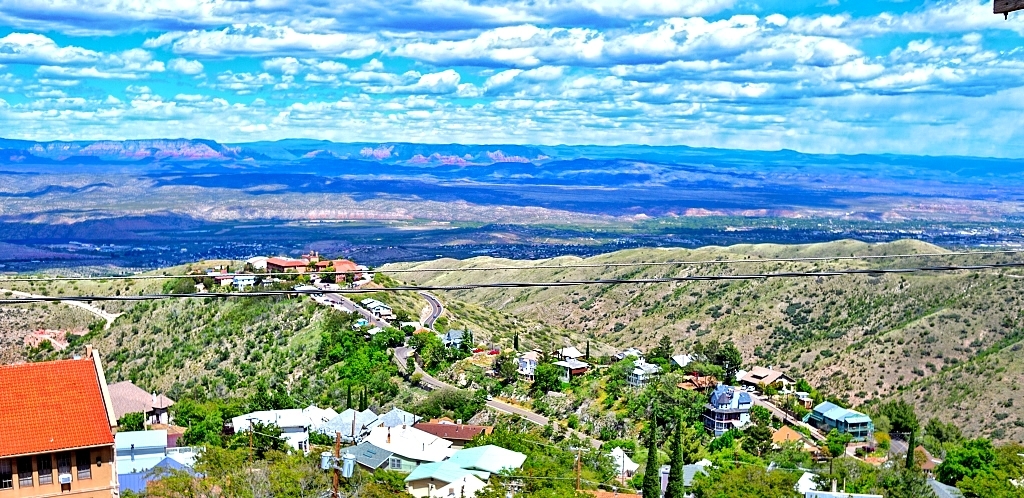
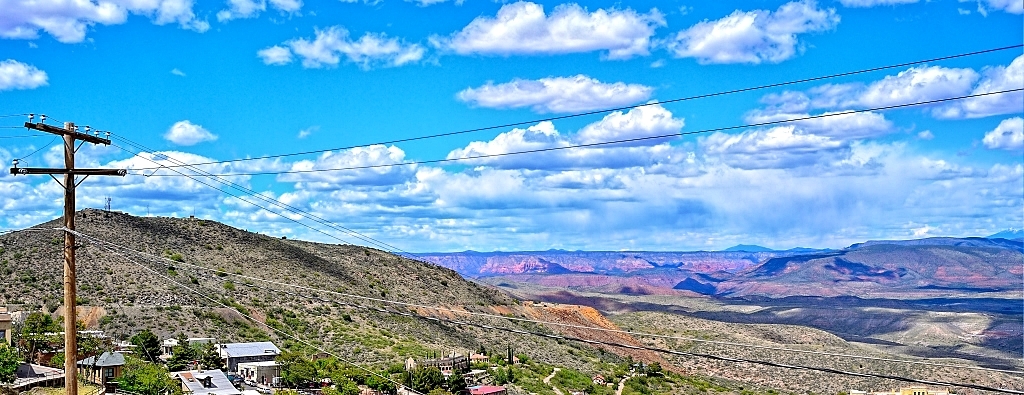
Todays offering is for the first day of the road trip that we weren't visiting with friends and family. On the way to Sedona we stopped in Jerome, Az. .... where there is a "haunted Hotel."
Well can't say if there were any ghosts, at least none that I saw!
DeltaSigma wrote:
Chris,
The SD card mates with spring loaded raised metal bars inside the carrier. If you look at your SD card you can see where those V-shaped bent metal tracks will have rubbed against the copper areas on the card. Unevenness on those markings might give a clue. It is possible that one of those raised tracks inside the DF's card slot now doesn't make contact with the SD card - or has somehow been jammed under the surrounding plastic guides. Another problem might be a dry joint from the DF's card reader pins to the little PCB that is sits on. Worst case is that there is a problem with the SD data being sent from the Expeed processor.
I have had problems with cheap external SD card readers where wear and tear have compromised the pressure of the contact point.
Here are some pictures from an exploded view of an SD reader an the spring loaded contacts. Note that this a fix for a Raspberry Pi housing issue - however the the pictures were quite clear hence my reference.
If you look into your SD slot on your DF can you see the 9 raised pins?
Silly question but presumably you have tried another card to make sure that there isn't anything wrong with the 'lock' function since there is a 10th pin orthogonal to the others.
I've only 2 SD-cards with me (Sandisk Pro) and both the cards look clean to me (no real scratches).
9 out of 10 I use the card reader of my iMac and/or MacBook, so that shouldn't be a problem either. A have a Sandisk card reader. The cards are working in the computer, so my guess is the Df.
I can't see anything in the Df
Colin, thanks for the IR info. Another camera body dedicated to IR is not in my immediate future, but it will certainly be on my wish list.
Curtis, I'm glad to see you enjoying the 135/3.5 more. You're last monochrome image with it is outstanding. Fast glass may be sexy, but I use the f/3.5 lens much more than the f/2.0. I just don't enjoy lugging the faster lens around.