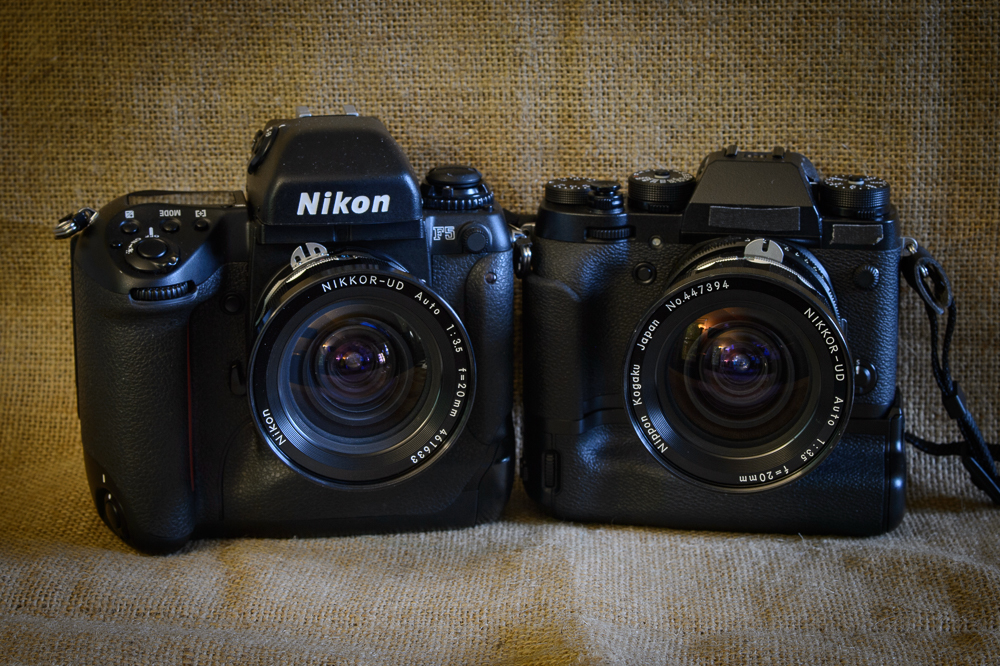
Side by side, both with NIKKOR-UD 20mm f/3.5 mounted. Right side body with grip and adapted with Metabones Speedbooster to show as a size example and to keep close to the full frame focal length.
To keep it safe for work, I taped over the offending markings on the one on the right
leighton w wrote:
You're probably not going to like how it feels at first. The thing I like the best is how it reminds me of my old F3. The viewfinder is huge as well.
Leighton, that's not really helping in my resisting the urge to buy one
(Taken with the 55mm f3,5 Ai micro Nikkor, but I did not/do not have the space in my non-CPU lens registry to permanently have the micro Nikkor in there)
George, in itself I think I can live without 11 FPS at 24 Mp each. Not sure on the battery life, but I rarely shoot more then 150 photos a day on those days where I shoot a lot. In itself the small form factor might be more appealing to me then being able to shoot 1000 photos in between recharges.
(I must admit though that taking 2 batteries to last me 2 weeks is a kind of luxury I can enjoy. My D3 does that trick)
Metabones speedbooster is something I'm still considering. Not sure how the extra glass effects the characteristics of the Nikkors. I could live with the crop factor, but would have to buy a fast 35mm lens at some stage. That or the Metabones adapter
Ken Hill wrote:
Thanks for the likes and the comments I appreciate it!
Not ever thought there were so many Scotsmen here, Colin, Leighton kind of stood out in my mind so lets form a "Brigade." I also agree with Leighton that the lenses are the bread and butter of any decent kit.
The trip to Arizona was a lot of visiting family and friends. One side trip took us to Scottsdale where we saw and took a few shot from the famed "Camelback" Mountains. Guess there is a camel in there. So from afar and from near the top!
A question for F3-shooters: anyone with experience with the H-type screens?
A screen completely with microprisms (available in 3 versions for different fast lenses).
I don't own a F3, but for very fast Nikkor's the H-screen would be highly attractive for me.
Georg, the Nikon F4 screens will fit in an F3 when you have an extra F3 screen to adapt the frame from. The glass is exchangeable, but the F4 glass is slightly better (brighter) then the F3 glass.
As far as experience with the H screens goes, I had a chance to use an F3 with a H screen once, and one clear advantage is that the view through the finder becomes less cluttered, and you can confirm focus everywhere on the focus screen. The tradeoff is that under some conditions the screen appears to black out completely, which I did not like all that much. If I remember correctly, using the DoF button caused the screen to become very dark. Focusing wide open, with a lens correlating to the screen (H1 for most f/2.8 lenses <=200mm, H2 for most f/5.6 or faster lenses <=200mm, H3 for most f/4 or faster lenses >200mm, H4 for most f/5.6 or faster lenses >200mm) seemed to work excellent, so I would say these screens should work best with the standard photojournalist lenses of the time such as the 25-50 f4, the 35-70 f3,5 and the 80-200 f4
This is a very informative discussion about the comparative qualities of Nikon DSLR's and Fuji mirrorless ILC's. In relation to my D800E, the only significant benefit I see for me in something like the X-T2 would be the combination of focus peaking and the one-button magnification in the viewfinder. My experience with my little X-E2 tells me that this would be a very significant benefit, but not necessarily yet one that would justify the expense ($2100 CDN retail, plus tax). For those who regularly use the X-T2, are there other benefits to it that you see?
While I await the flood of replies to that question, here is my next installment of cross-Canada photos from various, anonymous MFNG on the X-E2, and processed through the LR phone app. These show three different views of Kakabeka Falls near Thunder Bay.
the solitaire wrote:
Georg, the Nikon F4 screens will fit in an F3 when you have an extra F3 screen to adapt the frame from. The glass is exchangeable, but the F4 glass is slightly better (brighter) then the F3 glass.
As far as experience with the H screens goes, I had a chance to use an F3 with a H screen once, and one clear advantage is that the view through the finder becomes less cluttered, and you can confirm focus everywhere on the focus screen. The tradeoff is that under some conditions the screen appears to black out completely, which I did not like all that much. If I remember correctly, using the DoF button caused the screen to become very dark. Focusing wide open, with a lens correlating to the screen (H1 for most f/2.8 lenses <=200mm, H2 for most f/5.6 or faster lenses <=200mm, H3 for most f/4 or faster lenses >200mm, H4 for most f/5.6 or faster lenses >200mm) seemed to work excellent, so I would say these screens should work best with the standard photojournalist lenses of the time such as the 25-50 f4, the 35-70 f3,5 and the 80-200 f4...Show more →
Thank you!
I don't own a F3, but my shooting buddy should have one, 2 or more ;-) Maybe I try to get a H-screen and just try it in one of his cameras. If it works as well as expected I'll get myself a F3.
The H1 or H2 are according to an old compatibility chart the ones to try first.
I'm interested in a a screen for very fast focusing with 55/1.2, 35/1.4 and so on.
In my opinion the standard screen in my FM2 is already a great improvement over the DSLR-screen.
Buddy,
Thanks for the F3 HP photo. I ran two of the these from 1989 to 2008. One always loaded with Fuji 100 transparency film, and the other with Tri-x. Neither camera ever failed. I once estimated over well 800,000 frames on the the tri-x camera, and about 500,000 on the slide film camera. I can still feel them in my hands - in my minds eye.
As for focusing screens I replaced both camera screens with a Nikon central split screen that I got in 1989. I don't remember the part number, but they both were spot on, and made focusing easy for me. Outside of the central split prism area was a courser ground circle that shimmered when you hit focus....I only looked at those two areas, and not the finely ground rectangular glass area.
the solitaire wrote:
Leighton, that's not really helping in my resisting the urge to buy one
(Taken with the 55mm f3,5 Ai micro Nikkor, but I did not/do not have the space in my non-CPU lens registry to permanently have the micro Nikkor in there)
George, in itself I think I can live without 11 FPS at 24 Mp each. Not sure on the battery life, but I rarely shoot more then 150 photos a day on those days where I shoot a lot. In itself the small form factor might be more appealing to me then being able to shoot 1000 photos in between recharges.
(I must admit though that taking 2 batteries to last me 2 weeks is a kind of luxury I can enjoy. My D3 does that trick)
Had a rare combination tonight of:
(1) Fantastic post-dinner weather
(2) Just one girl that had nothing to do after dinner
(3) Wife taking the other girl to her gymnastics gig
(4) Not too much work to do myself
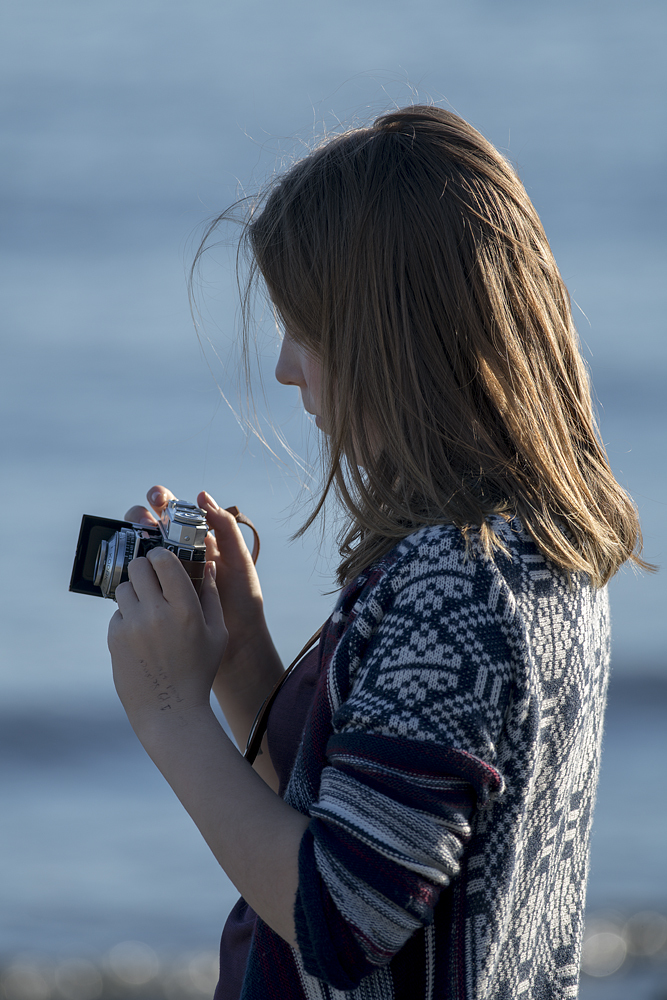
(5) And more importantly, a willing daughter who wanted to take the Kodak Retina IIa out to finish up a roll of T-Max that's in it.
Ended up with an hour walk around Alki point. Had a bag full of lenses, but kept the 300/4.5 ED-AI on the whole time. Sometimes you just don't want to change lenses.
the solitaire wrote:
Leighton, that's not really helping in my resisting the urge to buy one
One other thing I thought I would mention that I DON'T like about using Nikkors on the Fuji.
It doesn't have a non-cpu register like the Nikons. Which means it won't show what aperture you used at the time you took the image. Not a deal breaker, just a bummer.
John, the "What's SUP"-shot is great. Fantastic light. Stand-up-paddling is increasingly popular here too. Good to see your daughter working with a "piece of photographic history" (sorry for my English). But in 50 years or so maybe the "iPhone" is called a "milestone in the history of photographic devices"...
Ram, I like the B&W-take on the train the most.
Huss, your portraits are always very unique. Love your style.
James Markus wrote:
Buddy,
Thanks for the F3 HP photo. I ran two of the these from 1989 to 2008. One always loaded with Fuji 100 transparency film, and the other with Tri-x. Neither camera ever failed. I once estimated over well 800,000 frames on the the tri-x camera, and about 500,000 on the slide film camera. I can still feel them in my hands - in my minds eye.
As for focusing screens I replaced both camera screens with a Nikon central split screen that I got in 1989. I don't remember the part number, but they both were spot on, and made focusing easy for me. Outside of the central split prism area was a courser ground circle that shimmered when you hit focus....I only looked at those two areas, and not the finely ground rectangular glass area.
James, thanks for sharing your knowledge about the F3 and screens. The H-type-screens (completely filled with the shimmering microprisms you've mentioned) are occupying my mind every couple of months.
The limitations of the H-screens are clear, but since I have a F5 and a FM2 I could use one camera with a gridded screen and one with a standard screen and maybe a F3 for shooting fast lenses wide open.
Thanks again, Georg.