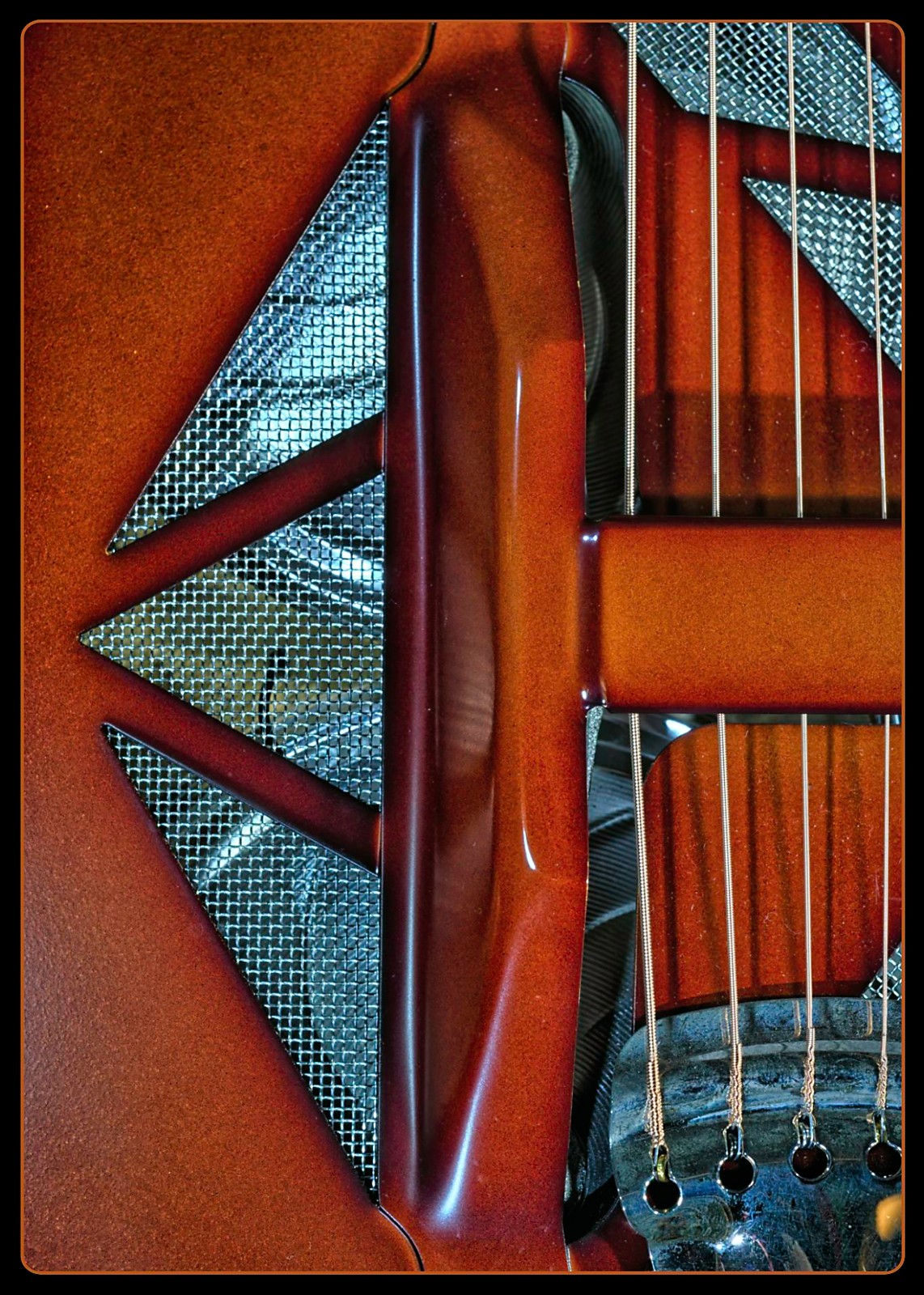
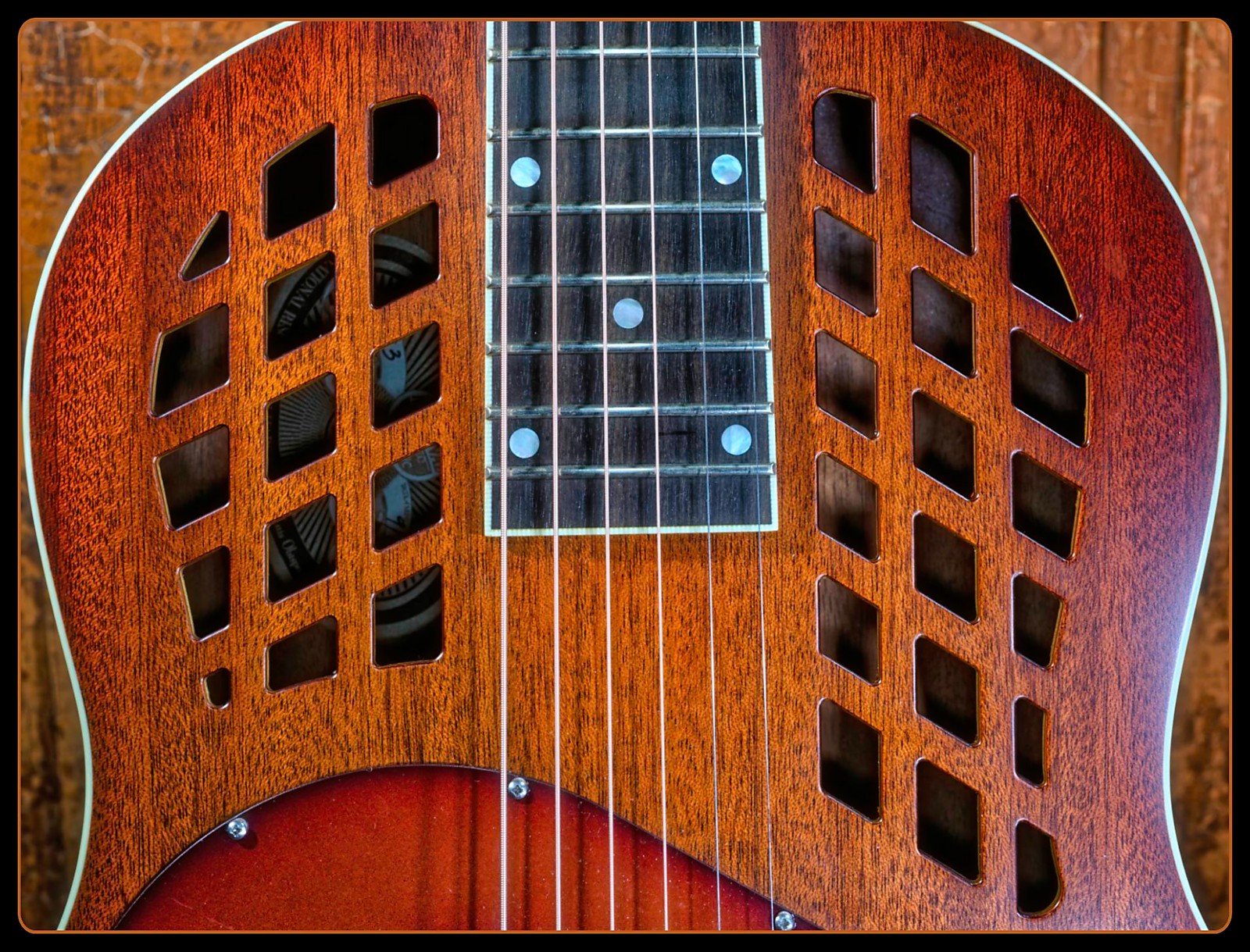
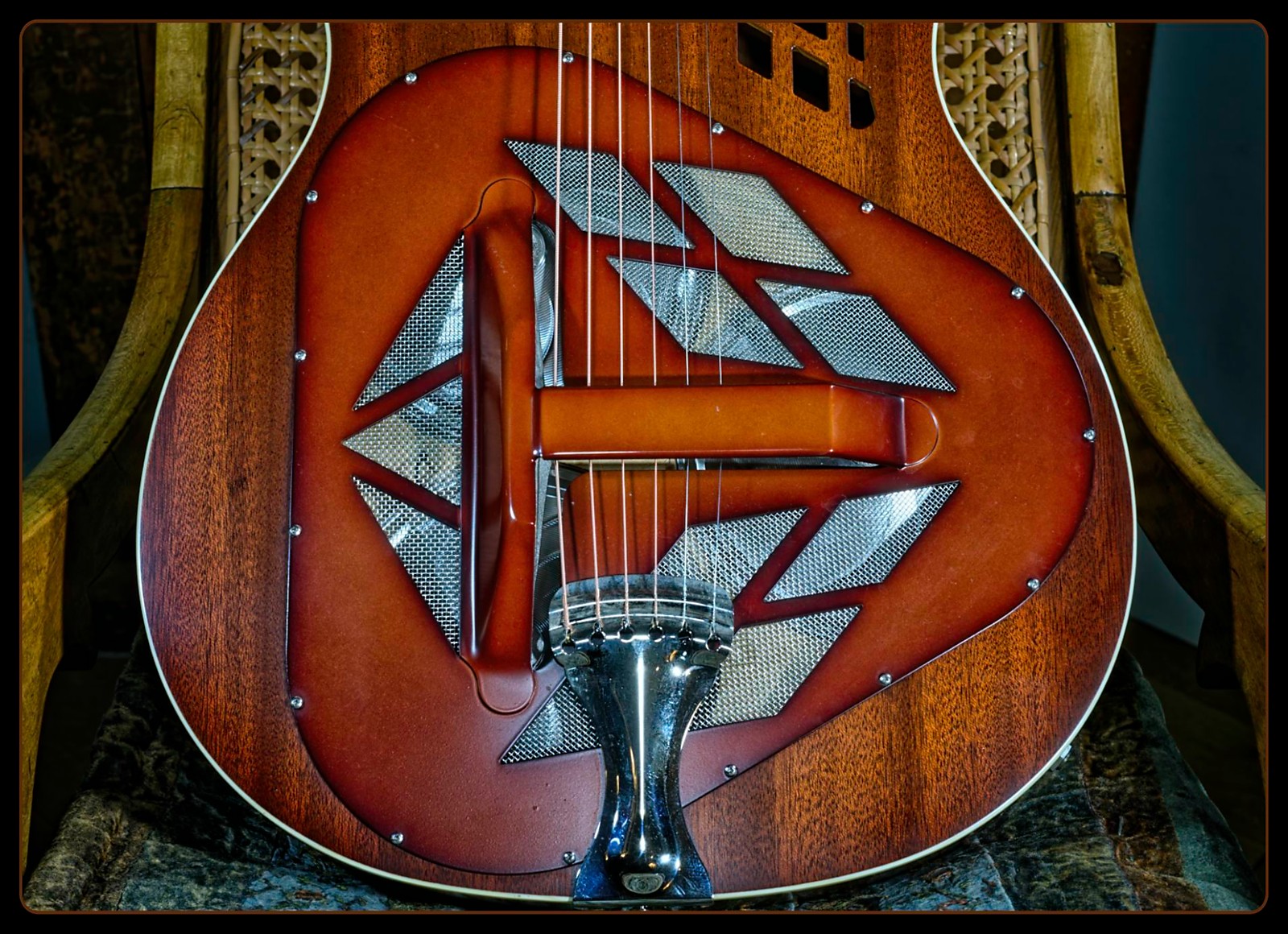
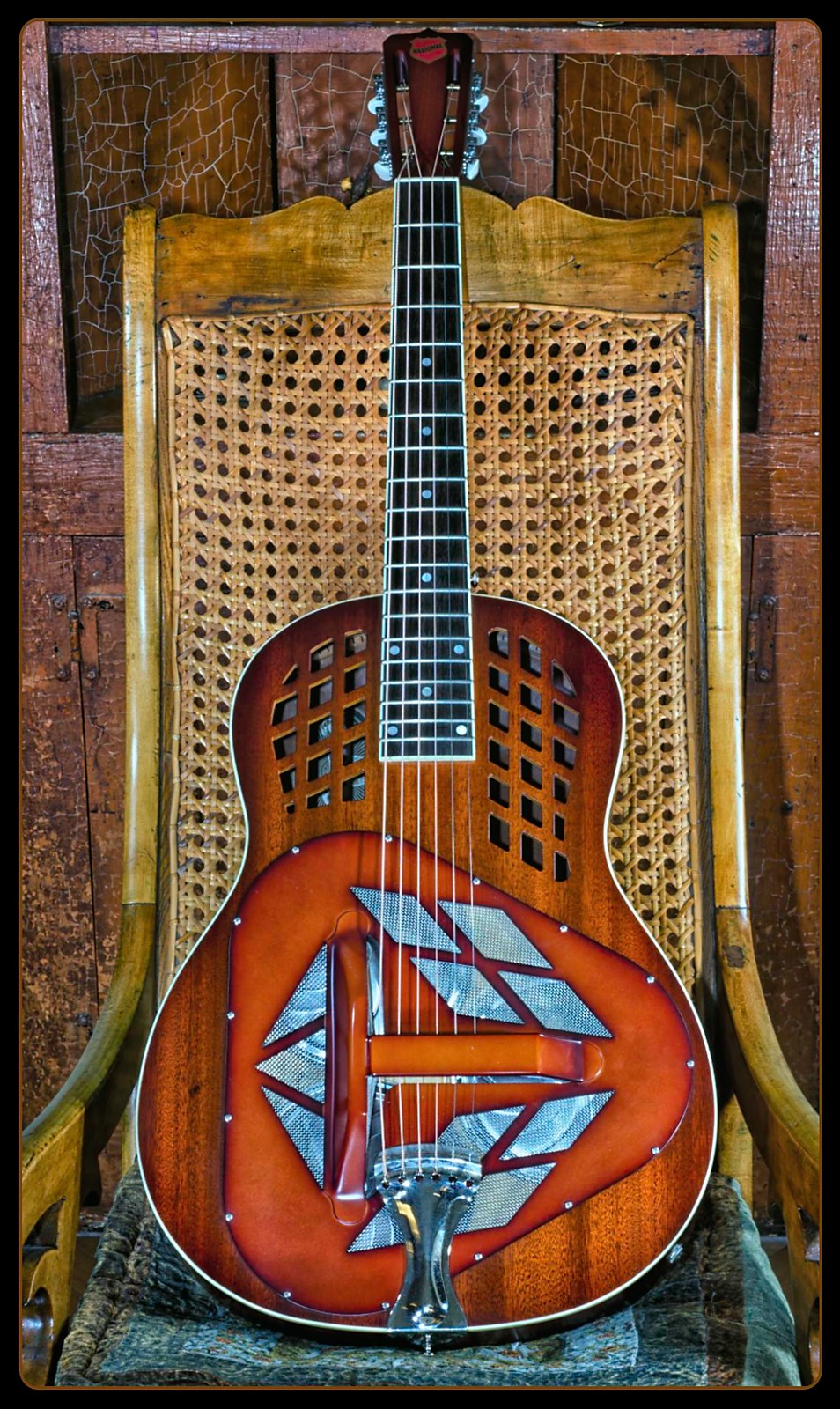
So, for anyone who may be curious about the new guitar, it is a tricone resonator, which is the first kind of resonator that John Dopyera invented. You can see the three aluminum cones behind the screen if you look closely at the third and fourth images below (two of them are visible in the first shot). The cones are shaped like speaker cones and open out towards the back of the guitar. Again, all photos were taken with the 55 f/2.8 Ai-s micro. This guitar is an absolute joy to play, either with a slide or without one.
GroWeb wrote:
So, for anyone who may be curious about the new guitar, it is a tricone resonator, which is the first kind of resonator that John Dopyera invented. You can see the three aluminum cones behind the screen if you look closely at the third and fourth images below (two of them are visible in the first shot). The cones are shaped like speaker cones and open out towards the back of the guitar. Again, all photos were taken with the 55 f/2.8 Ai-s micro. This guitar is an absolute joy to play, either with a slide or without one.
Glen,
I had to go and read about guitars and tricones.
Ended up watching/listening to some Youtube videos of the differences between the mono and tricone.
Very interesting.
DeltaSigma wrote:
I had to go and read about guitars and tricones.
Ended up watching/listening to some Youtube videos of the differences between the mono and tricone.
Very interesting.
Colin
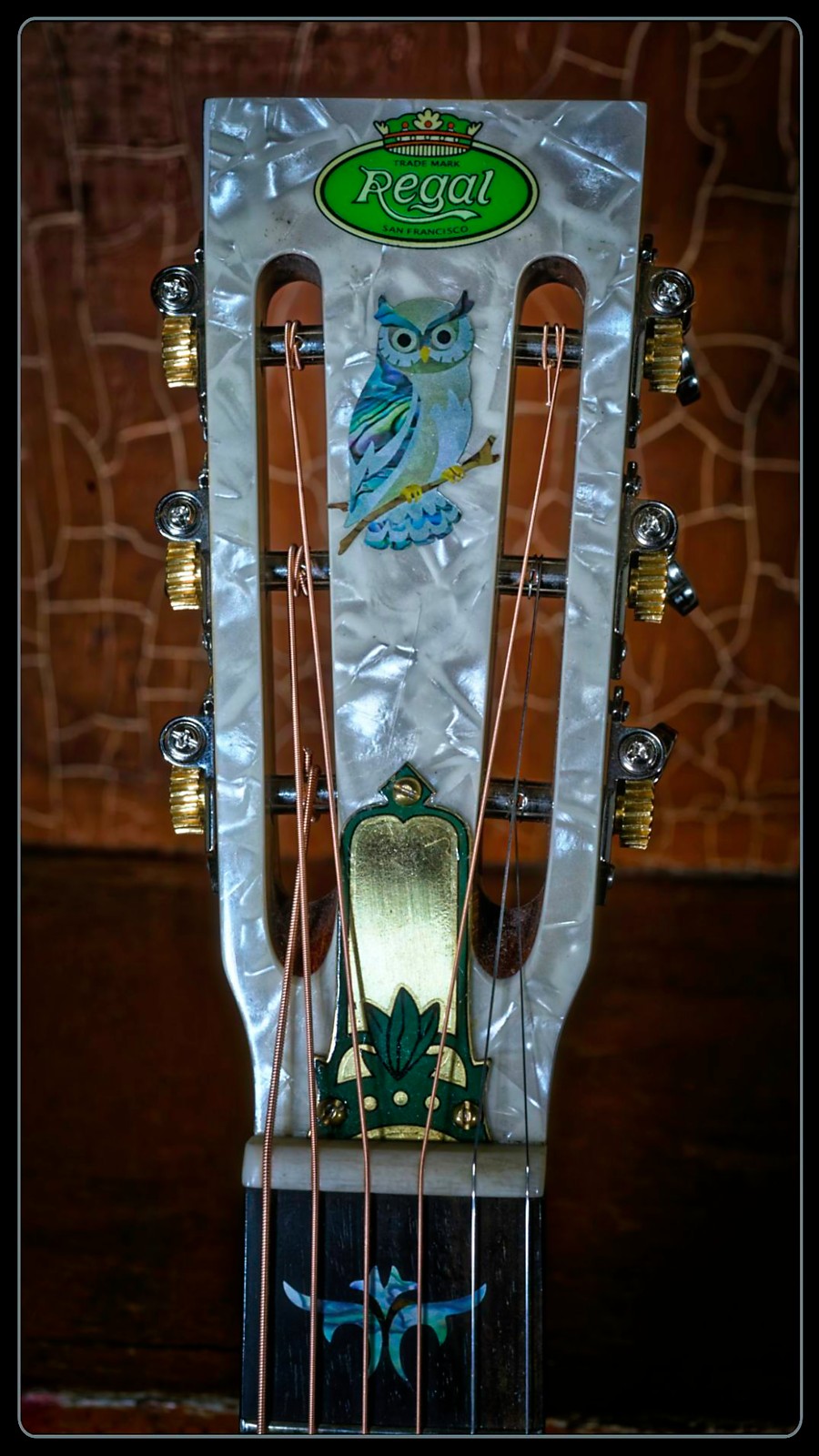
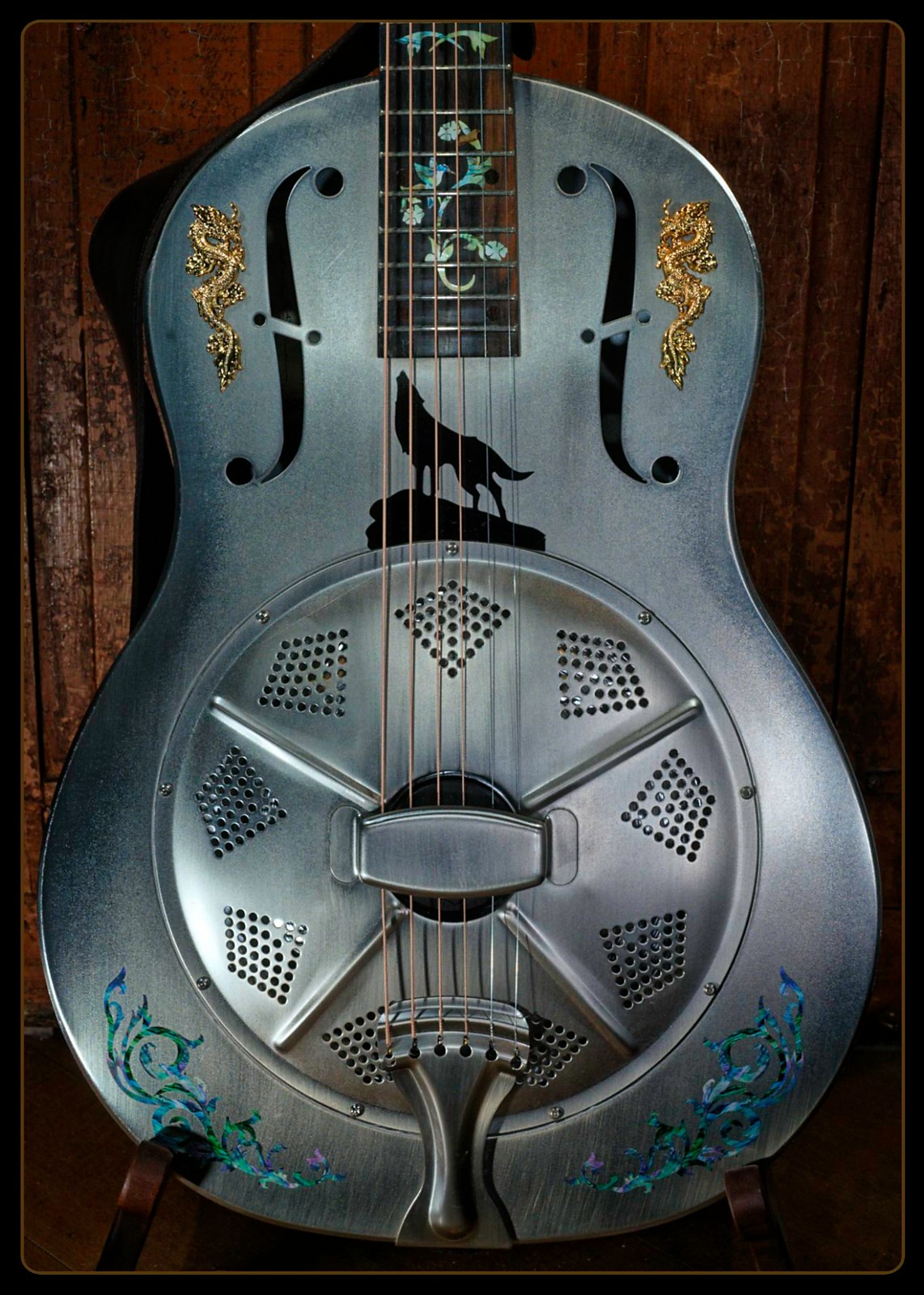
The history of these instruments is, indeed, interesting, Colin. After inventing the tricone, Dopyera then came up with the biscuit bridge resonator, which replaces the three 6" cones of the tricone with a single 9.5" cone (which has a disk-shaped bridge on its peak, called a biscuit). The first two images below show a Regal brand, steel-bodied biscuit bridge resonator (with a whole lot of bling added by me, along with a National brand cone and Grover tuning machines).
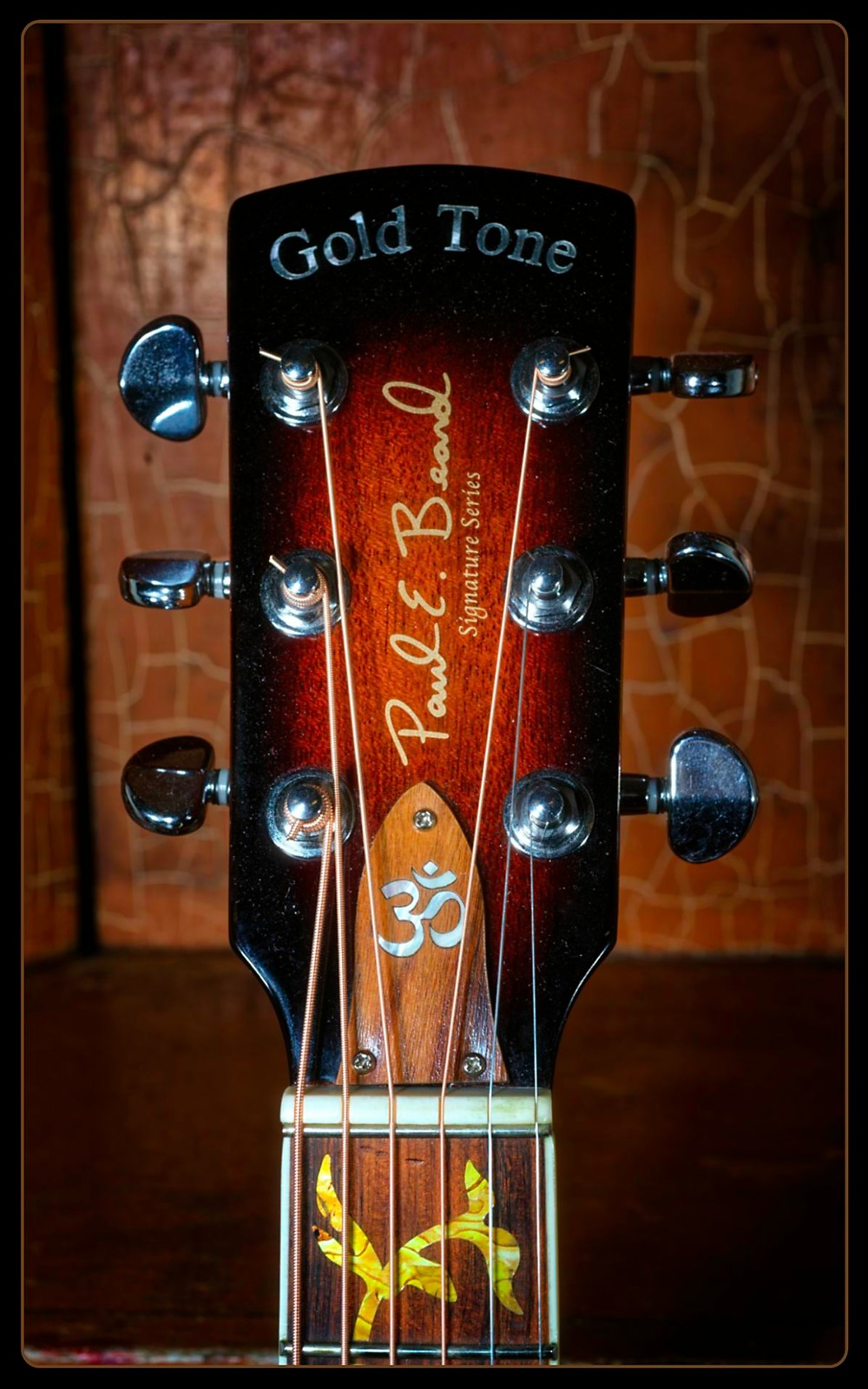
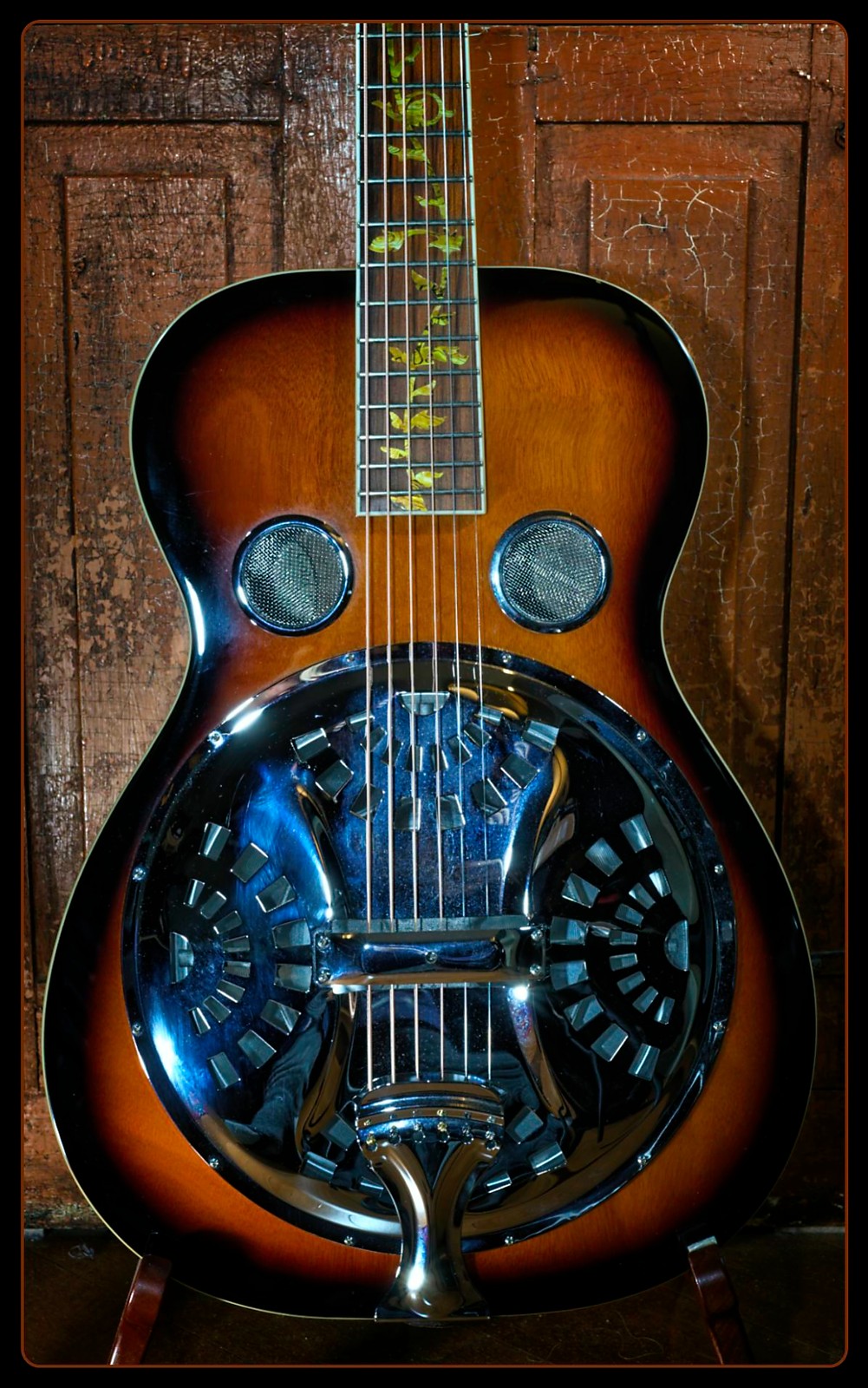
The most recently invented resonator is the so-called "dobro" or spider bridge resonator, in which the 9.5" cone is turned 180° so that it opens out towards the "top" (i.e. front) of the guitar, and the cast aluminum bridge straddles it like a spider. The third and fourth images below show a Gold Tone brand spider bridge resonator that sports Paul Beard's signature, because its cone and bridge were provided by the Beard factory. This is the style of resonator that Jerry Douglas plays so masterfully.
Each of the three different styles of resonator has a distinctive sound. Each of them has a pretty wide range of additional variation depending on whether the body is steel, wood (typically, laminated mahogany), or nickel plated bell brass.
GroWeb wrote:
The history of these instruments is, indeed, interesting, Colin. After inventing the tricone, Dopyera then came up with the biscuit bridge resonator, which replaces the three 6" cones of the tricone with a single 9.5" cone (which has a disk-shaped bridge on its peak, called a biscuit). The first two images below show a Regal brand, steel-bodied biscuit bridge resonator (with a whole lot of bling added by me, along with a National brand cone and Grover tuning machines).
The most recently invented resonator is the so-called "dobro" or spider bridge resonator, in which the 9.5" cone is turned 180° so that it opens out towards the "top" (i.e. front) of the guitar, and the cast aluminum bridge straddles it like a spider. The third and fourth images below show a Gold Tone brand spider bridge resonator that sports Paul Beard's signature, because its cone and bridge were provided by the Beard factory. This is the style of resonator that Jerry Douglas plays so masterfully.
Each of the three different styles of resonator has a distinctive sound. Each of them has a pretty wide range of additional variation depending on whether the body is steel, wood (typically, laminated mahogany), or nickel plated bell brass....Show more →
This has been fascinating for me - As far as I knew there were acoustic and electric guitars - another rabbit hole for my insatable curiosity.
FWIW I've always loved "Concerto de Aranjuez" by Rodrigo ( )
All images shot on Fuji Provia picture control setting which I find pleasing.
It's interesting that the only image with chroma is the Dietes. One of the reasons I've struggled with this lens. However the focus peaking is really helpful to these tired old eyes
GroWeb wrote:
The history of these instruments is, indeed, interesting, Colin. After inventing the tricone, Dopyera then came up with the biscuit bridge resonator, which replaces the three 6" cones of the tricone with a single 9.5" cone (which has a disk-shaped bridge on its peak, called a biscuit). The first two images below show a Regal brand, steel-bodied biscuit bridge resonator (with a whole lot of bling added by me, along with a National brand cone and Grover tuning machines).
The most recently invented resonator is the so-called "dobro" or spider bridge resonator, in which the 9.5" cone is turned 180° so that it opens out towards the "top" (i.e. front) of the guitar, and the cast aluminum bridge straddles it like a spider. The third and fourth images below show a Gold Tone brand spider bridge resonator that sports Paul Beard's signature, because its cone and bridge were provided by the Beard factory. This is the style of resonator that Jerry Douglas plays so masterfully.
Each of the three different styles of resonator has a distinctive sound. Each of them has a pretty wide range of additional variation depending on whether the body is steel, wood (typically, laminated mahogany), or nickel plated bell brass....Show more →
Glen. Congrats on your new to you guitar. I went and looked up a comparison between an acoustic guitar and a resonator. The first thing I notice is the difference in the attack of the sound, and in the duration of each note. Probably not a musical term, but the notes are more crisp on the resonator. Here is the video I watched.
I shot Nikon for a good while, and still use some of the Nikon glass.
These were shot with the 50mm 1.4 (non AI) on an A7RV. According to the serial it was made in 1971. I think it has a very cool character look and BOKEH.
Good morning from a sunny Knysna
As well as using these lenses for December, I'll try to include more images of the beautiful part of the world where I'm lucky enough to live.
All with the 28 2.8 ais (which I probably couldn't give away - definitely about 4/10 looks wise)
One pano from the road leading to Brenton on Sea looking West - Brenton and Buffalo Bay on the right
After all the action there's a pub at Belvidere Manor (dates to the 1830's) - a great place to have a cold one after all the activity. The Bell - formerly a stable.
I shot Nikon for a good while, and still use some of the Nikon glass.
These were shot with the 50mm 1.4 (non AI) on an A7RV. According to the serial it was made in 1971. I think it has a very cool character look and BOKEH.
Oosty wrote:
Good morning from a sunny Knysna
As well as using these lenses for December, I'll try to include more images of the beautiful part of the world where I'm lucky enough to live.
All with the 28 2.8 ais (which I probably couldn't give away - definitely about 4/10 looks wise)
One pano from the road leading to Brenton on Sea looking West - Brenton and Buffalo Bay on the right
After all the action there's a pub at Belvidere Manor (dates to the 1830's) - a great place to have a cold one after all the activity. The Bell - formerly a stable.
...Show more →
My favorite of the 28’s is the 28/3.5. Mine has balsam separation a little bit and it looks like it has gone through war (it is an EP marked lens, so maybe). But I love it and it’s sun stars are beautiful.
kwoodard wrote:
My favorite of the 28’s is the 28/3.5. Mine has balsam separation a little bit and it looks like it has gone through war (it is an EP marked lens, so maybe). But I love it and it’s sun stars are beautiful.
Hi Kevin I don't have that one but do have the 28 .35 PC which I'll put though it's paces on the Z5 Apart from the perspective correction in the PC I've never been able to differentiate between the 28's in similar shots - they all seem pretty sharp.
Having decided to use the MF glass seems to have taken me out of my slump.
While I've benefited immensely from my club membership both in experience and technique, one does tend to get obsessed with competition scores, salon acceptances and so on. One forgets that photography is supposed to be fun, light hearted and that one's images are really for oneself.
A few more with the 300 4.5 EDIF but on the D500 today
I went to one of my birding spots and shot the Pied Kingfisher at 1/3200, f8 and auto ISO ( as recommended by Steve Perry) - minimal processing except for removal of a slight color cast in ColorEfex Pro and a crop. I was quite surprised at the quality of the image as many of my previous efforts with the D200 and D7100 were very blurry - probably luck not good judgement as no focus peaking, just the dot.
These two catamarans seemed to be contemplating crossing the bar at the Knysna Heads into the Indian Ocean. Many craft have come to grief there and discretion seemed to be the better part of valour 1/1600 ISO 250 f8
You nailed focus on the kingfisher.
Great separation from the backgournd as well. Bravo!
Colin
Oosty wrote:
Having decided to use the MF glass seems to have taken me out of my slump.
While I've benefited immensely from my club membership both in experience and technique, one does tend to get obsessed with competition scores, salon acceptances and so on. One forgets that photography is supposed to be fun, light hearted and that one's images are really for oneself.
A few more with the 300 4.5 EDIF but on the D500 today
I went to one of my birding spots and shot the Pied Kingfisher at 1/3200, f8 and auto ISO ( as recommended by Steve Perry) - minimal processing except for removal of a slight color cast in ColorEfex Pro and a crop. I was quite surprised at the quality of the image as many of my previous efforts with the D200 and D7100 were very blurry - probably luck not good judgement as no focus peaking, just the dot.
These two catamarans seemed to be contemplating crossing the bar at the Knysna Heads into the Indian Ocean. Many craft have come to grief there and discretion seemed to be the better part of valour 1/1600 ISO 250 f8