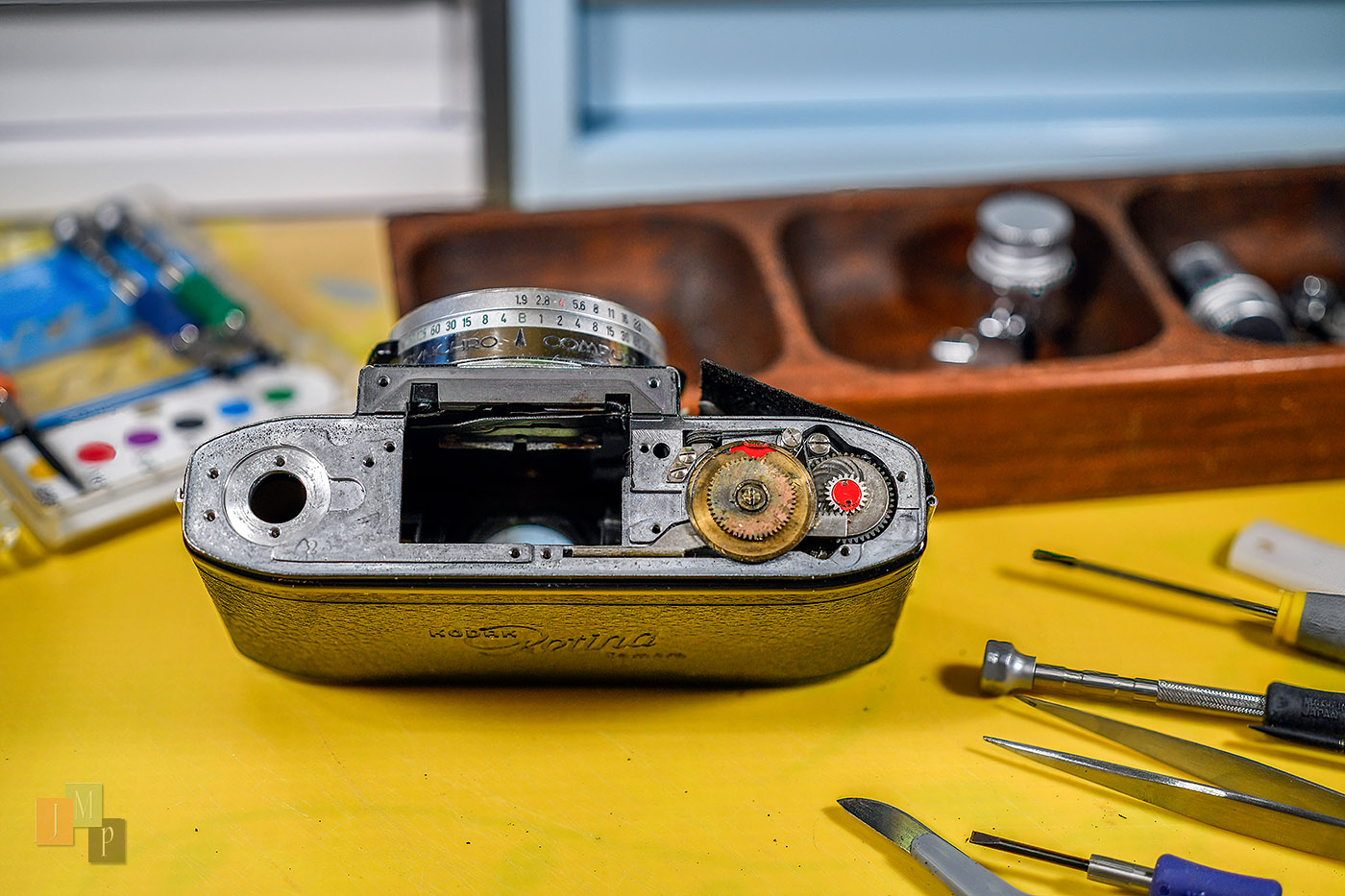
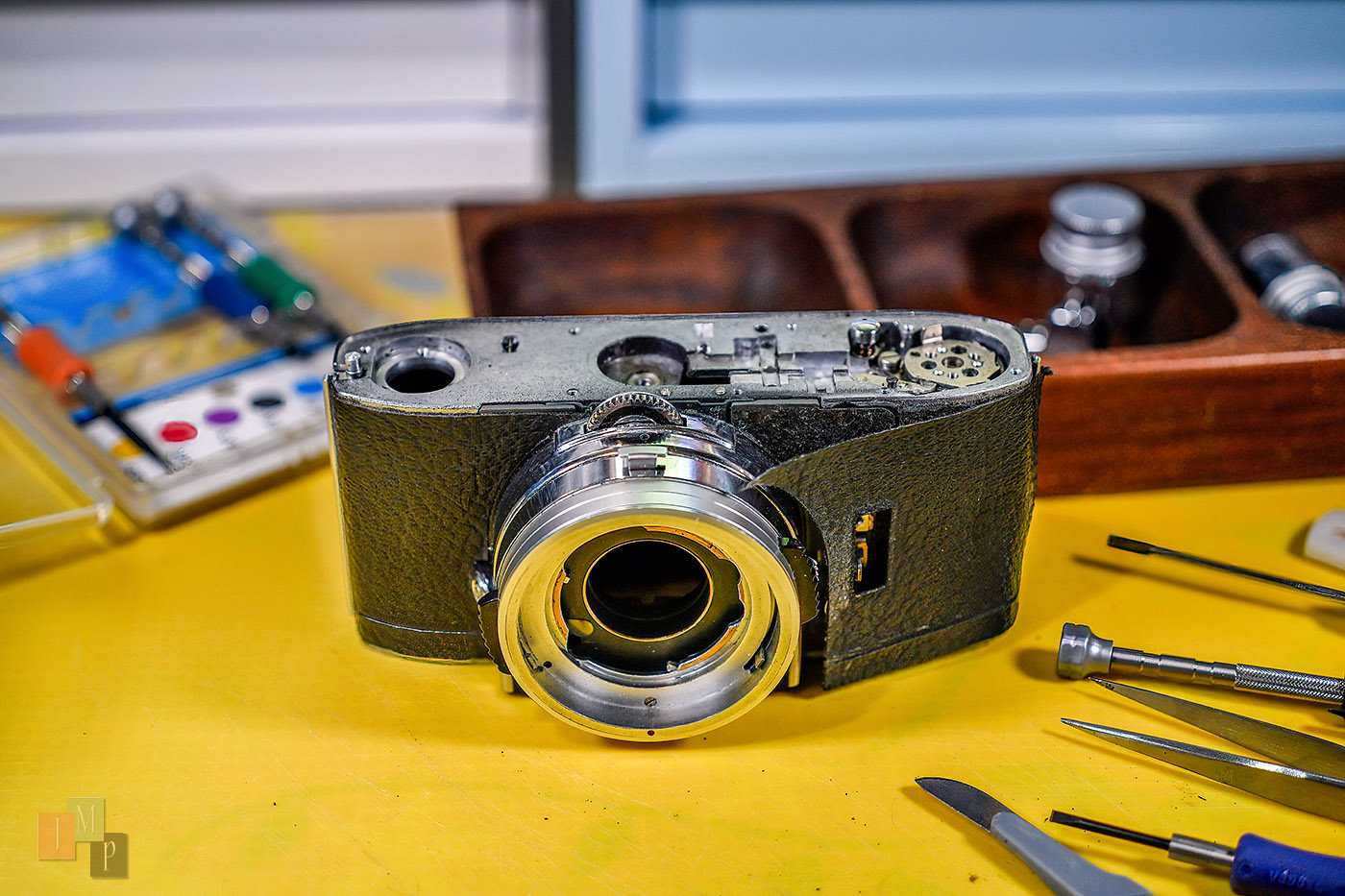
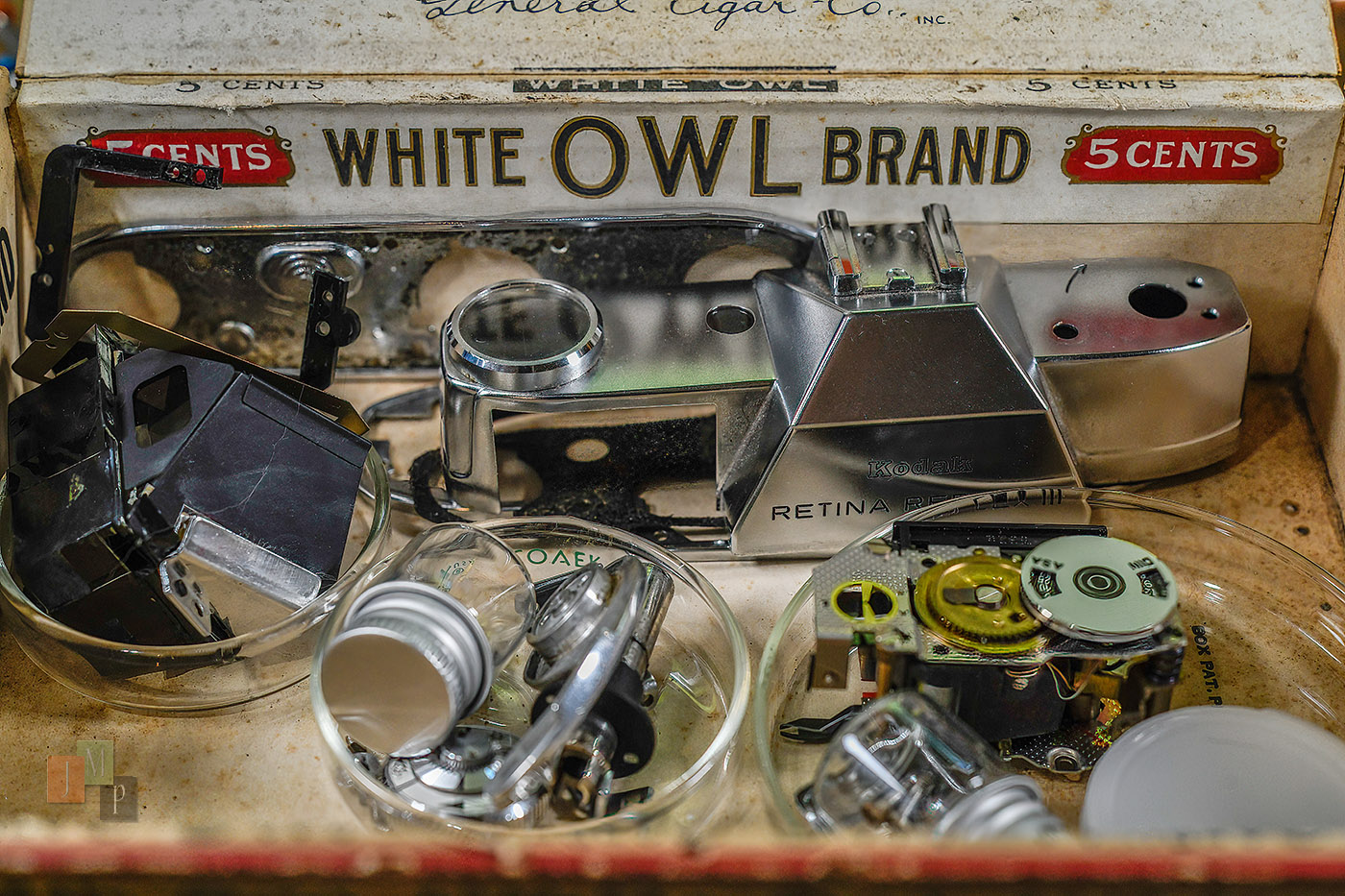
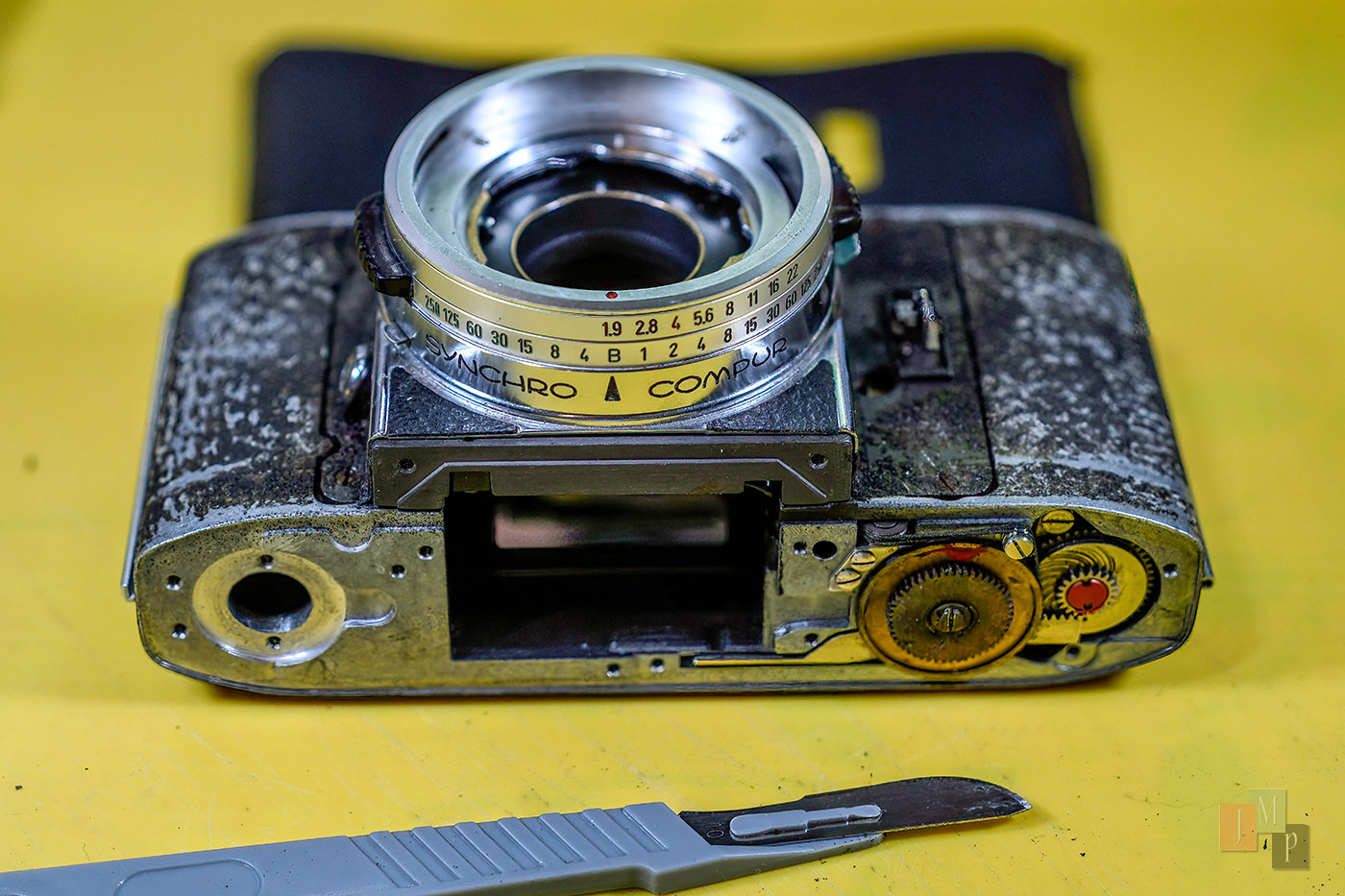
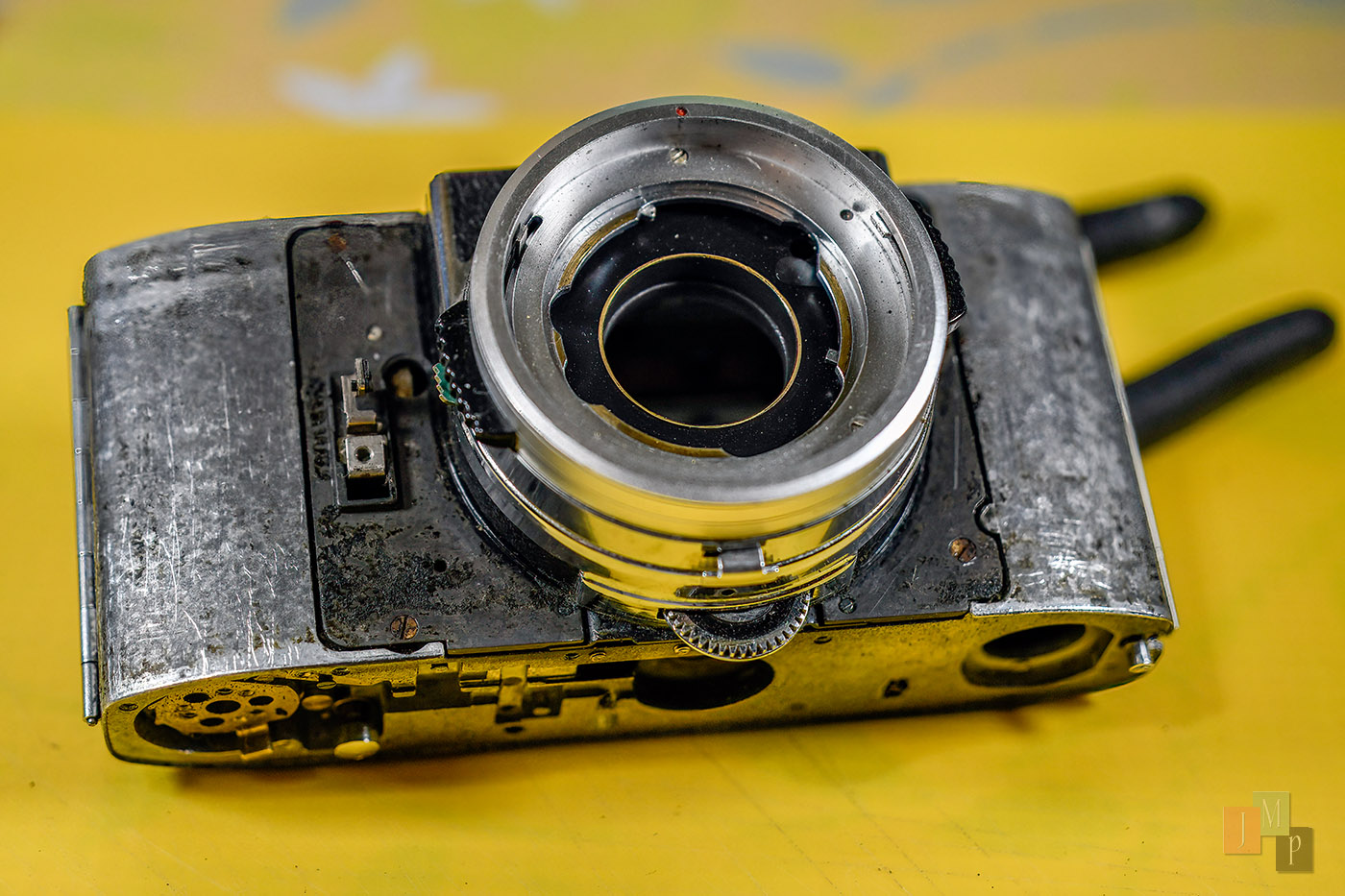
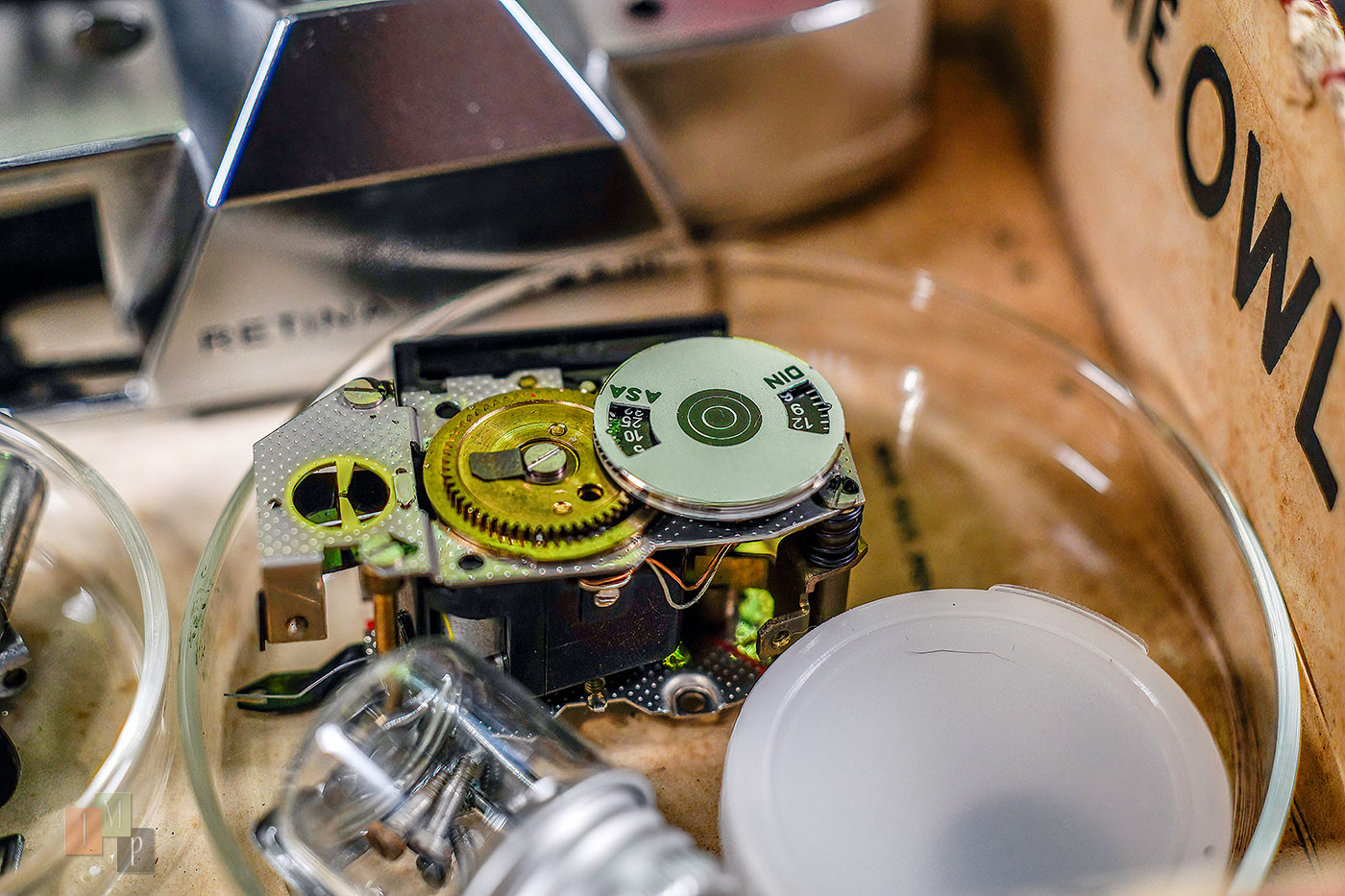
Second deep dive on a Retina Reflex III. First was to repair another person's messed up repair of the front rings of the shutter. It went so well that I began an entire tear-down of the same body. I need the plastic take up spool to make another Retina Reflex III body whole. You would think it should be an easy repair, but you have to remove the top, prism, light meter assembly, leatherette skins, bottom plate and a bunch of other springs and screws. Then there are two clutch assemblies on the take up spool. Thing is I have to do it again on the good working body to install the retrieved plastic spool. This morning I pulled the non working shutter assembly just for my own edification. All that is left is the take up spool and mirror box. All 55mm f3.5 ai shots
Top of the camera already stripped - just starting on the leatherette's
Bottom of the camera already stripped - just starting on the leatherette's
All the pieces at that point in petri dishes, little bottles and containers
Leatherette's removed
Casting cleaned prior to shutter assembly removal
Grandson showed up - so no removed shutter shot - here is the light meter assembly
Just had one minor mishap. I very slightly messed up one end of a flat screw blade slot due to dried glue. I an so glad I bought proper tools for this project. I didn't get a Starret brand set of jewelers screw drivers (I own two very old ones), but instead got Vessel brand. Excellent quality. If anyone knows of a brand of good pig nose, or snake eye drivers - my homemade ones worked, but would rather have a proper set of driver tips. The ones I bought were good, but had to be modified by hand.
James Markus wrote:
Second deep dive on a Retina Reflex III. First was to repair another person's messed up repair of the front rings of the shutter. It went so well that I began an entire tear-down of the same body. I need the plastic take up spool to make another Retina Reflex III body whole. You would think it should be an easy repair, but you have to remove the top, prism, light meter assembly, leatherette skins, bottom plate and a bunch of other springs and screws. Then there are two clutch assemblies on the take up spool. Thing is I have to do it again on the good working body to install the retrieved plastic spool. This morning I pulled the non working shutter assembly just for my own edification. All that is left is the take up spool and mirror box. All 55mm f3.5 ai shots
Just had one minor mishap. I very slightly messed up one end of a flat screw blade slot due to dried glue. I an so glad I bought proper tools for this project. I didn't get a Starret brand set of jewelers screw drivers (I own two very old ones), but instead got Vessel brand. Excellent quality. If anyone knows of a brand of good pig nose, or snake eye drivers - my homemade ones worked, but would rather have a proper set of driver tips. The ones I bought were good, but had to be modified by hand....Show more →
Chris Sherlock would work on them but after he retired and Paul Barden stepped in as the Retina repair specialist, he states on his website he doesn't do repair work on the reflex models. It's quite impressive you're willing to take on such an involved repair.
madNbad, I've been studying Chris's Retina Rescue web site, and Youtube channel for a few weeks - bought service manuals, and a bunch of broken Retina Reflex cameras - S, III, & IV's (at least two of each. I'm hoping to make one working model of each Kodak SLR (not counting the Reflex, and Instamatic models) These three seem to be Kodak's last serious attempt at a SLR, and they all came out of their Stuttgart Germany plant (including the lenses). I watched my engineer father rebuild a Retina III C, but I don't think I can now focus a rangefinder with my eyes. The split level focusing screen in these works great. The part I am nervous about is rebuilding a shutter. - the rest has been rather straight forward. My motive is to learn, appreciate the level of craftsmanship, engineering, design, and have fun doing it. The lenses are already impressive on my Nikon bodies - and soon the Canon EF adapter will arrive. With my over confidence, Sherlock's treasure of experience and knowledge, and a sense of adventure - who knows - maybe I will get lucky.
madNbad wrote:
Chris Sherlock would work on them but after he retired and Paul Barden stepped in as the Retina repair specialist, he states on his website he doesn't do repair work on the reflex models. It's quite impressive you're willing to take on such an involved repair.
James Markus wrote:
madNbad, I've been studying Chris's Retina Rescue web site, and Youtube channel for a few weeks - bought service manuals, and a bunch of broken Retina Reflex cameras - S, III, & IV's (at least two of each. I'm hoping to make one working model of each Kodak SLR (not counting the Reflex, and Instamatic models) These three seem to be Kodak's last serious attempt at a SLR, and they all came out of their Stuttgart Germany plant (including the lenses). I watched my engineer father rebuild a Retina III C, but I don't think I can now focus a rangefinder with my eyes. The split level focusing screen in these works great. The part I am nervous about is rebuilding a shutter. - the rest has been rather straight forward. My motive is to learn, appreciate the level of craftsmanship, engineering, design, and have fun doing it. The lenses are already impressive on my Nikon bodies - and soon the Canon EF adapter will arrive. With my over confidence, Sherlock's treasure of experience and knowledge, and a sense of adventure - who knows - maybe I will get lucky.
Chris Sherlocks videos are quite informative and entertaining too! Currently, I have a 1a (Type 015) that was serviced by Paul Barden. I also had a late model Retina 1 (Type 013) but it had the older Compur Rapid shutter and the speeds like to drift. I gave that to my neighbors son who was learning film photography. I've owned a IIIc, a couple of IIc's, one with the Schneider and another with the Rodenstock and I just checked at the shop that is working on a IIa. Paul had serviced one for me but due to some family medical problems, isn't taking any new work till later in the year.
I use a rangefinder because of my exceedingly poor eyesight. I can't see past the end of my elbow, I have macular degeneration in both eyes, my right eye has a patch from a posterior vitreous detachment in 2014. I don't like autofocus because I find the cameras to be too heavy, so I have a couple of Leica's and a the of Kodak Retinas. I do have a sports finder frame that is occasionally used with either the Ia or IIa.
Looking at your photos, it's understandable why a lot of camera repair shops don't want to work on the reflex Retinas. There are no spare parts, not many were made and they are somewhat over engineered. In this disposable age, it's encouraging tthat someone is willing to take on such a task. Keep posting, it'll be a good one to follow.
We are suffering super typhoon Yagi, gradually weakening now. Photo taken from balcony with Nikkor 45mm F/2.8 GN Auto on D3x. _D3X1065in by blurrist lump, on Flickr
rafaelcasd wrote:
Most of them were super performance replicas Serge, the winner was an original, but with the heat and the current times we only had 6 or 8 cobra cars show up.
Back 10 years ago we would see like 30 and most were originals. Here are some old photos.
Just fixed one of these broken cameras while reading hate posts about how Kodak was crazy to let engineers control the whole line of SLR's. Apparently, the Kodak Retina Reflex line of cameras were "overly engineered" (a nonsense statement), because in normal use by a normal person - they are prone to failure. I think I found an early example of not RTFM. A purpose built feature of the camera was to lock the shutter when the counter reached 36 so people wouldn't tear out the film sprocket holes by continuing to try and advance the film. One of the "S" bodies was in this state. Push a button, and slide another and the locked state was over. That has got to be the easiest "repair" ever. Didn't even need my fancy jewelers screwdrivers.
James Markus wrote:
Just fixed one of these broken cameras while reading hate posts about how Kodak was crazy to let engineers control the whole line of SLR's. Apparently, the Kodak Retina Reflex line of cameras were "overly engineered" (a nonsense statement), because in normal use by a normal person - they are prone to failure. I think I found an early example of not RTFM. A purpose built feature of the camera was to lock the shutter when the counter reached 36 so people wouldn't tear out the film sprocket holes by continuing to try and advance the film. One of the "S" bodies was in this state. Push a button, and slide another and the locked state was over. That has got to be the easiest "repair" ever. Didn't even need my fancy jewelers screwdrivers. ...Show more →
Locking the advance when the counter reached "1" with the count down counter, was a long running part of the Retina design. Starting with the lever wind 1a and IIa, Kodak incorporated a release button on the top plate. I have handled more than a few Retinas that were "locked" until the release button was pushed. It's always nice to to have such an easy repair.
I've been watching Chris Sherlock's video on the SIII. I can also see how the early SLR's were developed from established rangefinder designs.
Teardown on the 2nd Retina Reflex III took just over an hour this time. I have the needed spool, and traded out some parts that were in better condition from the first camera. Both of these bodies had been worked on before, but I am at the cleaning stage. Got an eye appointment this am - so I will likely be out of action for 1-3 days before reassemble. I am so impressed by the engineering in these cameras - they tried to anticipate so much - even servicing. With my magnifying visor I can see the beautifully machined screws, & tiny castings. Each camera looks like a handmade one off creation, but they are almost identical.
madNbad wrote:
Locking the advance when the counter reached "1" with the count down counter, was a long running part of the Retina design. Starting with the lever wind 1a and IIa, Kodak incorporated a release button on the top plate. I have handled more than a few Retinas that were "locked" until the release button was pushed. It's always nice to to have such an easy repair.
I've been watching Chris Sherlock's video on the SIII. I can also see how the early SLR's were developed from established rangefinder designs.