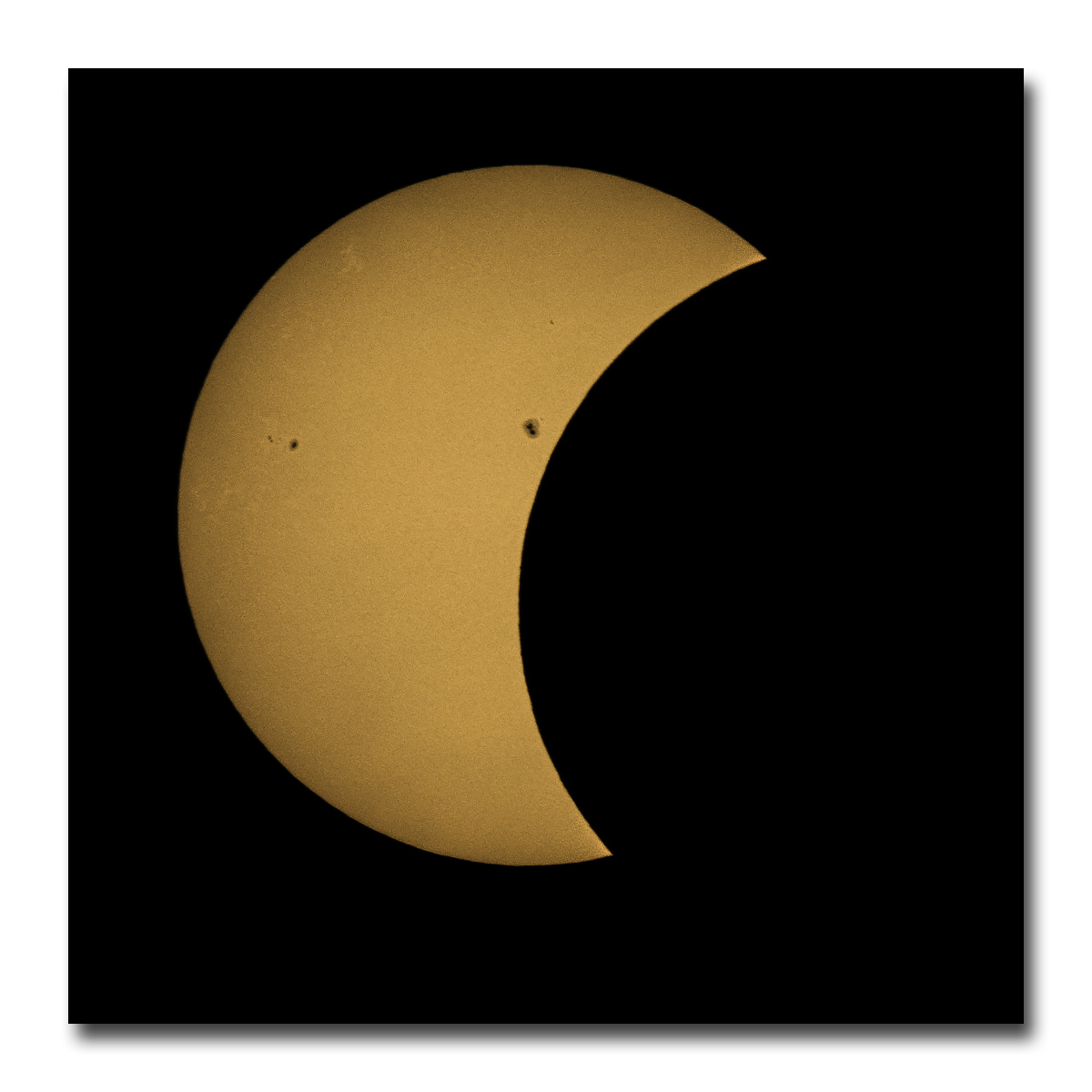
This is 80% of Peak with lots of processing to bring detail without adding noise, but the sun does not have much. My preious one seemed to have sharer focusing, This is B&W. As the atmosphere got hotter resolution dropped.
OK, this will be the last of it, unless someone opens my eyes to some other way of processing, these are color - doubled in size using adobe, but at this size that makes no difference, the warmer air killed some of my sharpness.
Great sunspots Rafael. Like Ray, I didn't decide to even photograph the eclipse until 12.15pm. I spent the morning at the dentist getting a crown, and didn't think I would be up to it. Didn't even think about tethering, or remote releases (Wish I had - have both) My first thought was to dig out two almost 6 inch Kodak film safelight (Wratten Series OA) filters I have. Not only are they dark, but both the greenish, and dark beige one are frosted. Then onto plan B
rafaelcasd wrote:
This was my setup. 800mm + TC14, Nikon camera control on laptop. Could view and control exposure from the laptop, did not have to touch the camera except for focusing.
Used the 24MP camera (Z6) as the sun has little detail to record. (Also, just in case I burned the sensor, this is my cheapest camera - but it survived, the filter inside the lens got hot)
(With iPhone, but there is a Nikkor in there)
Here is one sample at about 50% of peak cover, the grain in the surface of the sun is not noise, it is the sun, this was low ISO.
Will come back with more as I process better with Adobe.
Great job George, Rafael, Samy, Ray, and Jim! I think it's really cool that all of you shot the same subjects, but came away with completely different photos. And, all of them are excellent! Thanks for sharing the behind the scenes setup and for describing your approach and technique.
George, Rafael,, Ray, James and Samy, terrific photography of the eclipse. Many thanks for sharing your work.
Headed to the Central Park Reservoir and spent most of the time gazing at the stages of eclipse. The cloud cover was considerable but the eclipse was visible with the glasses. Took a few photos just to document the event.
rafaelcasd wrote:
That totality is just beautiful Ray!
The sun is white, how come it comes through as yellow?
Good question Rafael, and thanks! I had to keep the exposure lowish to prevent too much bleed into the dark areas around the sun. Even then I had to apply a pretty extreme curve tone to darken out the "glow" around the sun. From daylight to shade WB, it was always yellowish, just different hues and saturation of the color yellow. In the end I just chose the WB that resembled what I recall from looking through the inexpensive eclipse glasses we used for direct viewing. In fact, each frame of the sequence had a slightly different WB applied in Lightroom to make the yellow seem consistent, yet keeping the dark portions similar in tone.
I'll have a couple more to post, just having a harder time processing those due to flare / blooming(?) etc.
Ronny, Both the 180 and 105 photos of the gorgeous little purple flowers are beautiful. Did you use any tubes? Was it near MFD, and wide open? Super work.
Jim
James Markus wrote:
Ronny, Both the 180 and 105 photos of the gorgeous little purple flowers are beautiful. Did you use any tubes? Was it near MFD, and wide open? Super work.
Jim
Thanks Jim
Yes MFD and wide open
No tubes on theses shot .. but I did some with 180mm and 36mm tube
Post one later
rafaelcasd wrote:
This is 80% of Peak with lots of processing to bring detail without adding noise, but the sun does not have much. My preious one seemed to have sharer focusing, This is B&W. As the atmosphere got hotter resolution dropped.
Like the rainy deck composition Siphiwe, try it in BW!
Loved the flower-y headdress Serge.
Beautiful sticks and sunsets Matt
They do not make fuel pumps like they used to, Andy.
Ronny, that is one fantastic wispy flower, is the background all the lens? or is there some processing help?
Great eclipse photos everyone!!! The ingenuity price goes to James Markus!
Learned too late that there is a filter called H-Alpha that removes the white brightness from the sun and leaves the "Chromosphere" below, which is that reddish, grainy and flaming surface.
In my quest to play with lenses I bought an inexpensive EL-Nikkor 63mm 3.5, this lens was designed to print the negatives created with the Micro-Nikkor 70mm 1:5, which I own.
The Micro Nikkor 70mm 1:5 was designed to microfilm documents onto 70mm film, and is a successor to the R-Nikkor 5cm 3.5, meant to do the same on 35mm film.
I found the EL Nikkor 63mm to have the same behavior I had seen on the EL Nikkor 50mm 2.8, close-up they are excellent lenses, flat field, no focus shift with aperture, no chromatic aberration, very little distortion. These 63mm 3.5 were sselling for $800 due to having a fame of being great for UV, likely it si the same as other EL Nikkors for UV, I got mine rather cheap.
At a distance the 63mm has ugly sides, like the EL 50mm, but if you close it down to 1:8 or 1:11, it will look fantastic all across the frame. To open it wider you have to be closer to your subject.
These samples will show the lens at its best and will not really show the behavior I an describing.
M. Tanyflex in Flckr posts this interesting Nikon Branded serial 200003 lens with a Magnification factor of 30, my lens is branded Nippon Kogaku with serial 207XXX and no magnification factor print, else they look the same. That 200003 lens could be very unique, but still it looks pretty much the same, nice little M39 lens head.
Magnification factor of 30 with a 36mm frame means the lens is optimized for a ~1 Meter long front subject.
Addendum: looked into the regular 63mm 3.5 and it is designed for a 2x-20x range, that M-30 lens is really unique, got to get one!